Stacking finished boxes tested an autonomous packing robot more than folding them
Moving from lab demonstrations to long factory runs reveals how small physical misalignments compound over time, according to field observations from a confectionery packaging line.

In automated manufacturing, folding flat cardboard into a rigid container has long been considered a severe test of robotic dexterity. A machine must bend stiff panels along scored lines, crease corner tabs, and fit interlocking edges together without tearing the material. It seems natural to assume that once a machine masters those delicate motions, the remaining chores on an assembly floor would prove straightforward.
Yet when an autonomous machine took over packaging tasks at a commercial confectionery workshop, that expectation proved backwards. The robot folded retail containers with reliable precision, but struggled with the seemingly mundane step of stacking the assembled boxes into a neat vertical column.1
On September 15, 2026, Chelsea Finn, a computer scientist and co-founder of the robotics company Physical Intelligence, reported observations from a trial deployment of the group's Pi robot at Dandelion Chocolate, an artisan chocolate maker based in San Francisco.1 The system operated autonomously for several hours without human intervention, folding and storing confectionery packaging.1 Finn noted that while she anticipated the dexterous folding motion to be the primary obstacle, stacking the boxes reliably turned out to be the hardest part of the operation.1
The contrast exposes a persistent gap in automation between isolated laboratory demonstrations and sustained industrial utility.1 A robot in an experimental setting often needs to assemble only a single container to confirm that its neural network can coordinate fine motor control. In an active production room, however, a machine must produce dozens of units across an unbroken shift, during which every physical action alters the state of the workspace.
A packaging line follows a strict mechanical chain. First, a flat cardboard blank must be pulled into position and folded into a rigid structure. Next, the robot must lift that newly created container away from the assembly jig and carry it toward an aggregation zone. Then, it must lower the box onto an existing stack with millimeter accuracy. Each layer of the stack serves as the physical foundation for the box that follows. If an early container sits even slightly askew, that tilt is transferred to the next unit, shifting the center of mass until the entire column tumbles.

Why is stacking boxes harder than folding them?
Stacking assembled containers demands continuous spatial adaptation to changing target coordinates, whereas folding an individual box repeats an identical motor sequence in a stationary frame.
When folding a box, the boundaries of the cardboard blank and the worktable surface remain predictable across cycles. The robot interacts with the same physical geometry every time it bends a tab. Stacking, by contrast, requires the machine to generalize its movements across three dimensions because each completed box occupies a new elevation and an altered surface profile.1 Finn reported that an imprecisely placed box can cause the entire structure to collapse many cycles later, turning an imperceptible initial error into a compounding failure.1
Visual obstruction compounded the mechanical challenge. Finn noted that the group's original table-mounted robotic arm suffered from poor visibility of the growing stack without auxiliary cameras positioned elsewhere in the room.1 Anchored to a single point, the arm could not adjust its onboard perspective to peer over the rising column, leaving the perception system blind to the contours of the landing surface.
How does a mobile base change the packaging workflow?
Mounting a robotic arm onto a mobile base allows the system to alter its vantage point and approach angle as the pile of stacked boxes grows.
Physical Intelligence replaced the stationary table setup at Dandelion Chocolate with a mobile robot.1 Moving around the packaging station eliminated the visual blind spots that hindered the fixed arm, allowing the machine to inspect the stack directly without external camera rigs. Finn stated that the mobile configuration operated with complete self-sufficiency over multiple hours, managing the continuous cycle of building and arranging boxes.1
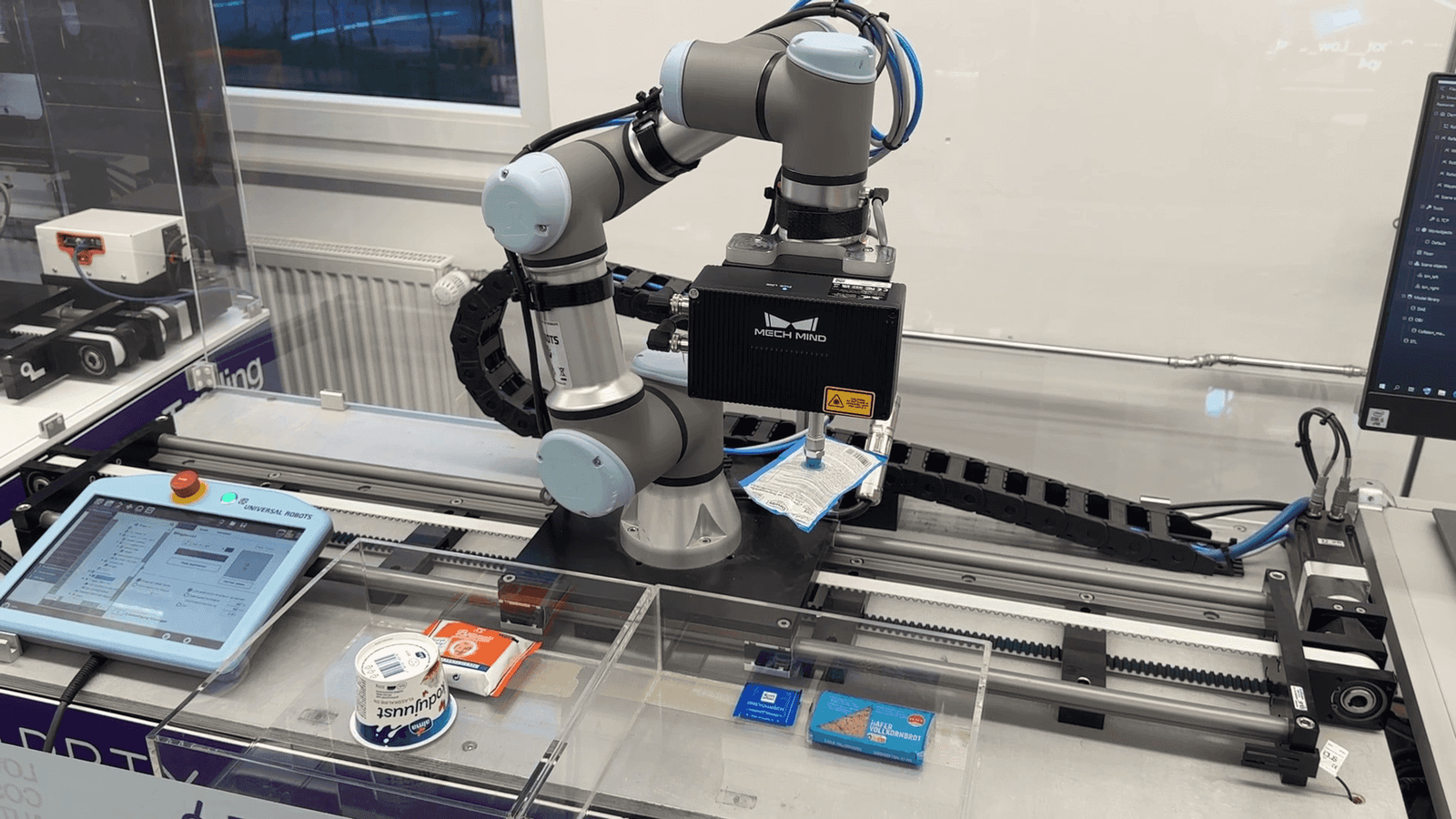
The resulting production runs generate operational feedback that laboratory environments cannot easily duplicate. Finn observed that data collected from sustained industrial tasks is valuable for training the company's Pi pre-trained foundation model as the organization scales its technology.1 The software learns how minor physical misalignments develop over hundreds of consecutive real-world movements.
What remains unproven about autonomous factory packaging?
Informal deployment observations from a single packaging station cannot establish how reliably an autonomous system functions across diverse industrial environments or different container materials.
The operational details shared by Finn represent informal findings from a single commercial deployment rather than a peer-reviewed experimental study.1 The announcement did not include quantitative metrics, such as exact cycle times, long-term failure rates, or systematic comparisons against human packaging workers.1 Operating conditions inside an artisan chocolate facility also differ from high-speed manufacturing plants, where throughput demands are higher and packaging dimensions change frequently. While multiple hours of autonomous activity prove that a mobile robot can manage a specific packaging sequence, they do not show whether the system can adapt when cardboard blanks arrive warped or out of alignment.
For developers of physical artificial intelligence, the deployment at Dandelion Chocolate indicates that mastering isolated dexterity is only a preliminary stage in practical automation. The greater obstacle lies in managing physical compounding errors, the gradual buildup of positional drift that occurs when machines interact with unstructured workspaces over long periods. As Physical Intelligence expands the dataset behind its pre-trained Pi model, subsequent tests will need to show whether generalist models can self-correct when materials drift unexpectedly, without relying on specialized external sensing hardware.
This piece was prepared from public records; the authors have not been interviewed.
What this rests on
13 sentences trace to 1 source.
-
1
H
https://x.com/chelseabfinn Document · x.com · 15 Sep 2026 Pi Robot Operates Autonomously at Dandelion Chocolate Deployment See the source