AI manages nuclear fusion instabilities in milliseconds
A modular software framework developed at Princeton allows machine learning models to coordinate magnetic fusion controls faster than human reaction speeds.
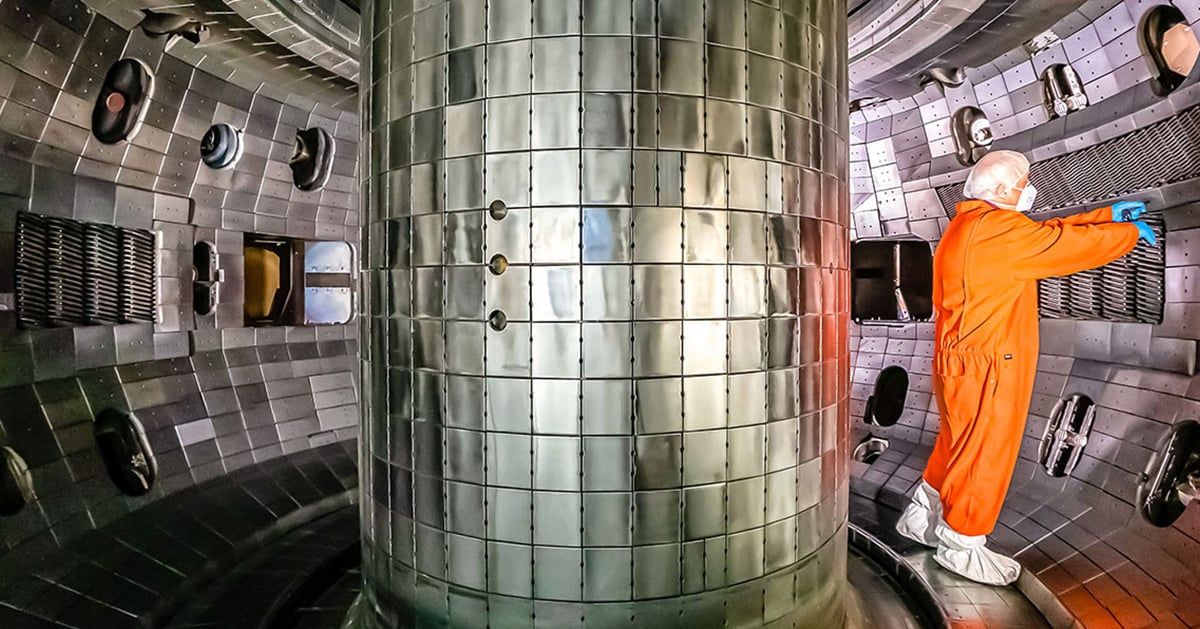
Harnessing nuclear fusion on Earth requires trapping matter under conditions more severe than the interior of a star. In a magnetic confinement device known as a tokamak, an electrically charged gas called plasma reaches temperatures hotter than the core of the sun.1 At these extreme thermal thresholds, the superheated gas becomes prone to sudden physical disturbances that develop in a few thousandths of a second.1 If left unchecked, these fast-growing instabilities can disrupt the confinement field, extinguish the fusion reaction, and damage the interior walls of the reactor vessel.
Fusion power holds long-term interest because it offers the prospect of a virtually limitless source of clean electricity.1 To keep a tokamak operating, experimental teams must continuously balance three linked physical properties: temperature, density, and stability.1 Sustaining that balance demands unrelenting, coordinated adjustments across multiple mechanical systems, including high-power heating beams, magnetic containment coils, and targeted gas injectors.1 The operational challenge lies in the rapid timeline of plasma physics. While human operators can monitor long-term trends across seconds or minutes, microscopic disturbances can amplify across milliseconds, far outstripping the reaction speed of human reflexes.1
Why do plasma disturbances outpace conventional fusion controls?
Plasma disturbances outstrip conventional fusion controls because the physical chain reaction causing heat loss unfolds across tiny fractions of a second. The sequence begins when turbulent eddies or magnetic perturbations form within the charged gas. As these microscopic fluctuations align, they distort the surrounding magnetic field lines that keep the superheated fuel confined away from the vessel walls. This magnetic distortion alters local electrical currents, which in turn causes the initial disturbance to swell into a macro-scale instability. If magnetic containment weakens even slightly, heat bleeds rapidly out of the plasma core into cooler surrounding zones.
To intervene before confinement collapses, a control system must detect subtle sensor signals, calculate corrective actuator movements, and fire targeted countermeasures before the disturbance expands. Traditional numerical simulations used by plasma physicists model these nonlinear behaviors with great mathematical precision. However, running those detailed physical programs often requires days or months of supercomputing time.1 That timeline is useful when scientists plan future machine campaigns a year in advance, but it cannot deliver real-time decisions during an active plasma shot that lasts only several seconds or minutes.1
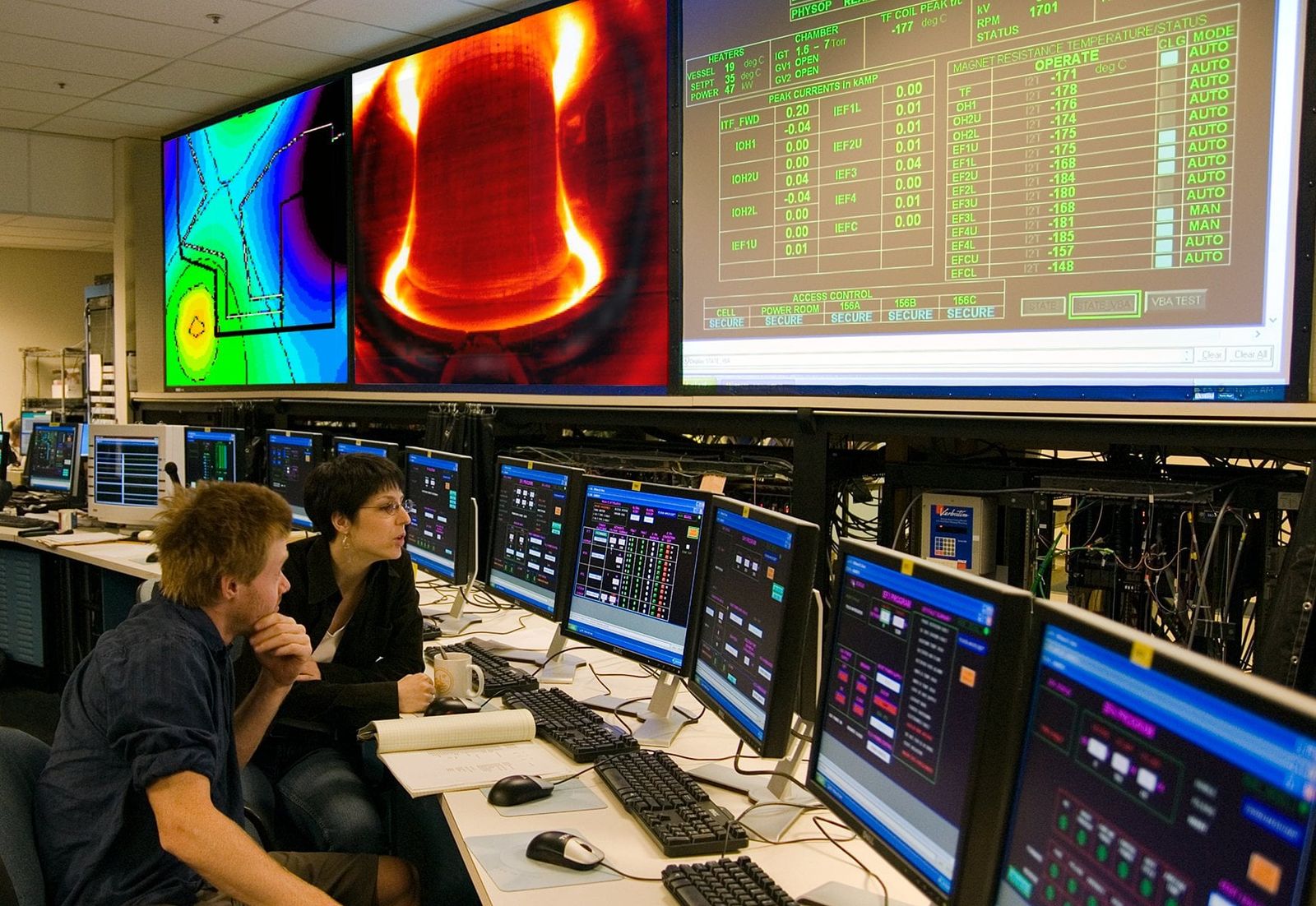
Simple classical controllers can run quickly, but they typically identify problems only after an instability has already taken physical shape. In the case of a tearing mode, an instability that tears and reconnects magnetic field lines, conventional systems detect the disturbance only after it starts. Co-lead author Hiro Farre Kaga, a graduate student in the Princeton Program in Plasma Physics, noted that reacting after onset forces operators to suppress an active tear, which brings significant performance degradation to the discharge.1 Stopping the instability before it begins requires an automated system capable of forecasting plasma dynamics hundreds of milliseconds ahead of time.1
How does PACMAN orchestrate split-second fusion decisions?
The PACMAN framework orchestrates split-second fusion decisions by operating a continuous four-stage pipeline that gathers data, validates measurements, evaluates predictive machine learning models, and issues hardware commands.1 Developed by researchers at the U.S. Department of Energy Princeton Plasma Physics Laboratory and Princeton University, the software package takes its name from Prediction And Control using MAchiNe learning.1 The design treats fusion control like a high-speed assembly line that completes an entire analysis loop roughly every 20 milliseconds, repeating the cycle continuously throughout an experimental run.1
At the first station of the pipeline, the framework gathers live diagnostic measurements across the tokamak, reading sensor streams for plasma temperatures, fuel densities, and magnetic field fluctuations.1 The second station cleans this data flow, checking the incoming telemetry for measurement errors and packaging the clean figures into a unified computational bundle.1 The third station distributes this standardized bundle to specialized artificial intelligence models.1 Each predictive model ingests the specific physical measurements it requires to calculate what the plasma is doing in that moment and forecast what it will do next.1
In the fourth stage, software controllers translate those predictive forecasts into concrete hardware instructions, such as ramping up an auxiliary heating source or redirecting magnetic coils.1 An output coordination system reviews the resulting commands to eliminate conflicts between competing controllers and enforce strict hardware safety limits before sending the signals to the tokamak.1 Co-lead author Andy Rothstein, a graduate student in Princeton University Department of Mechanical and Aerospace Engineering, reported that while a highly focused human operator reacts on the order of seconds, the automated framework executes in approximately 20 milliseconds, making rapid adjustments to minute plasma shifts that human operators could never execute.1
What did experimental testing reveal on an active tokamak?
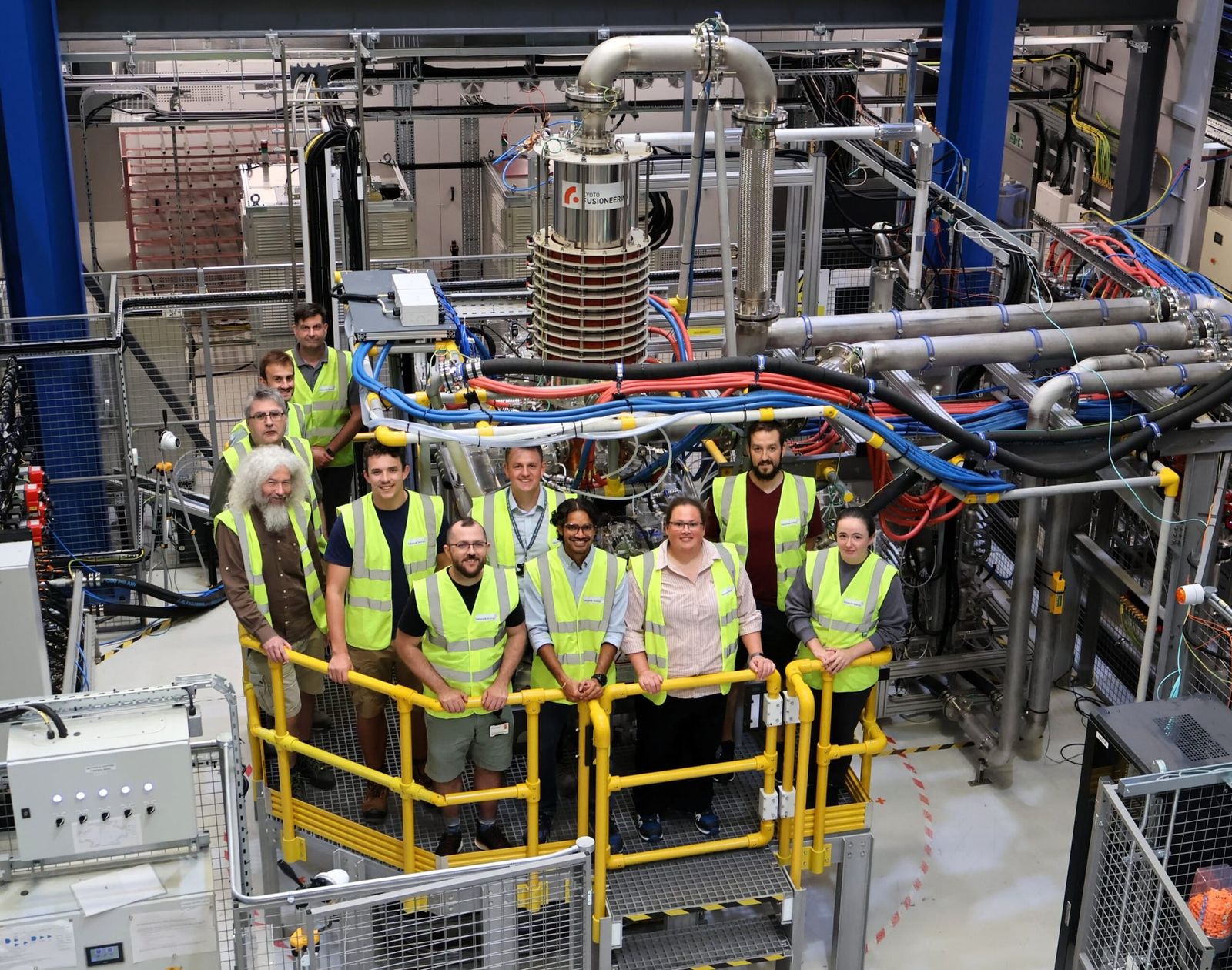
Experimental testing on the DIII-D National Fusion Facility tokamak in San Diego proved that the automated framework can successfully execute multiple complex control tasks during live plasma operations.1 Documented in the journal Nuclear Fusion, the research team evaluated PACMAN across five distinct experimental scenarios.1 In one trial, the framework handed control of the tokamak heating systems to a machine learning model trained through reinforcement learning, an algorithmic method where an artificial intelligence discovers effective control strategies through simulated trial and error.1
The system demonstrated proactive mitigation by forecasting tearing mode instabilities approximately 200 milliseconds before they formed, allowing the actuators to adjust plasma parameters and prevent the instability entirely.1 In another operational test, PACMAN simultaneously steered all six gyrotrons installed on the DIII-D vessel.1 Gyrotrons are specialized heating systems that inject high-power microwave beams into the plasma to raise its temperature and drive internal electrical currents.1 The framework adjusted the output power of all six microwave sources while retargeting their steerable mirrors in real time.1 Farre Kaga reported that prior to this demonstration, no computational algorithm existed to identify that coordinated multi-beam solution during live operations.1
Beyond heating control and tearing mode prevention, the automated system demonstrated three additional capabilities during the DIII-D experiments.1 It accurately predicted sudden bursts of energy erupting from the edge of the plasma, detected and controlled internal plasma waves driven by high-velocity particles, and adjusted overall plasma density and core rotation to hit targets specified in advance by the research team.1 Egemen Kolemen, an associate professor of mechanical and aerospace engineering at Princeton University with joint appointments at the Andlinger Center for Energy and the Environment and PPPL, observed that PACMAN establishes a modular architecture where building block algorithms can be swapped or combined without overhauling the underlying infrastructure.1
What boundaries remain for machine learning in fusion reactors?
Machine learning models remain bounded by the training data that shapes them and cannot substitute for the physical boundary conditions enforced by human operators. The experimental results achieved on the DIII-D device represent controlled operational demonstrations rather than a permanent operational takeover of a commercial power plant. The researchers emphasize that PACMAN does not eliminate human oversight from fusion research.1 The framework maintains hardcoded safety boundaries that override model suggestions if an algorithmic command threatens the integrity of the machine, while human physicists set high-level operating targets and review post-shot telemetry to adjust controller settings between discharges.1
Building the foundational software framework and integrating its first predictive model required months of engineering work by the Princeton team.1 However, subsequent model additions proved far more flexible, with secondary models integrating into the pipeline within a couple of days. Because the framework operates modularly, its creators expect the architecture to transfer across magnetic confinement facilities of differing geometries, scales, and sensor configurations, including future commercial reactor designs that have not yet been built.1 The immediate next step for the fusion engineering community involves extending these rapid modular control loops to manage extended, steady-state plasma operations across longer discharge durations.
What this rests on
36 sentences trace to 1 source.
-
1
N
Newswise Document · newswise.com PACMAN AI Framework for Controlling Fusion Systems Safely Makes Key Decisions in Milliseconds See the source