Amazon expands warehouse robot fleet past one million machines
Deploying robotic arms and automated carriers reduces heavy lifting while accelerating repetitive warehouse tasks that alter physical injury risks for human workers.
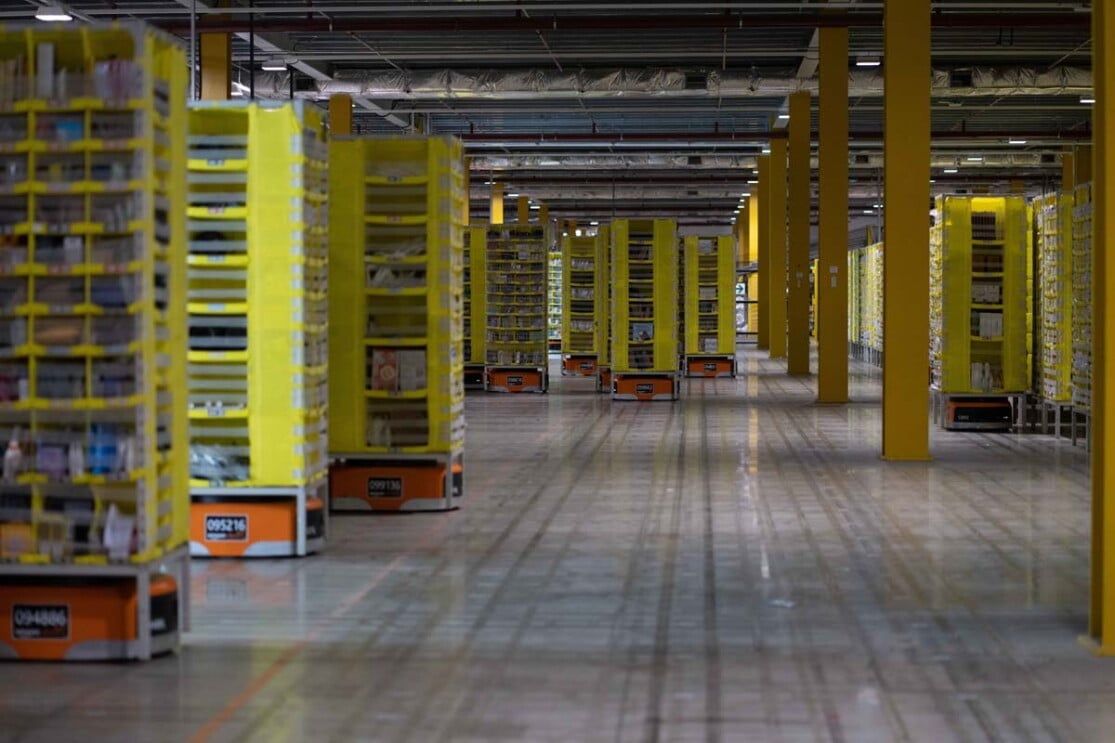
Fulfillment centers run on a relentless sequence of physical transfers. Inside a typical distribution warehouse, thousands of separate products arrive in bulk, get unpacked into storage shelves, and wait until an order is placed. Once a purchase registers, an item must be located, retrieved from its shelf, inspected, consolidated into a shipping box, sealed, and sorted into an outgoing truck route. For decades, human beings performed every link of that chain on foot, walking miles across concrete warehouse floors to push rolling carts from rack to rack.
When automated machinery takes over portions of that journey, the physical choreography of the facility changes completely. Wheeled carriers glide beneath tall shelving units and lift them off the floor, bringing storage racks directly to stationary human workers. Stationary robotic arms hover over moving conveyor belts to pluck packages from chaotic piles using suction grippers, while perception models interpret the orientation of arriving boxes. In theory, replacing human legs and human spines with automated machinery removes the dirty, heavy lifting that causes acute physical damage. In practice, the sudden removal of natural walking pauses alters the physical rhythm of the remaining human tasks.
The mechanics of warehouse strain depend on work cycles. When a person walks to a shelf, their body alternates between leg exertion, spinal loading, and brief recovery periods while traveling down an aisle. When mobile machines bring shelves to a fixed station, the worker stays planted in one spot and repeatedly reaches into plastic bins. If the machinery delivers bins faster, the human body performs the same upper-body grasping motion hundreds of times per hour. Removing transit time from the daily routine concentrates biomechanical stress on the shoulders, wrists, and lumbar spine.
Amazon now operates more than one million robotic units across its global network of fulfillment centers, representing the largest operational fleet of industrial robots in the world.1 At the same time, the company remains the second-largest corporate employer globally, employing more than 1.5 million full-time and part-time workers according to its 2025 annual report.1 The massive coexistence of human and synthetic labor creates an unprecedented testing ground for human-robot collaboration, where corporate efficiency targets intersect with biomechanical stress.
How do mobile fleets change the physical mechanics of order sorting?
Mobile robotic carriers alter warehouse physics by shifting static shelving into dynamic cargo that moves across floor grids. Amazon began developing this approach after purchasing the robotics firm Kiva Systems in 2012, which pioneered wheeled drive units capable of sliding under modular storage racks.1 Following the acquisition, the division became Amazon Robotics, focusing on manufacturing in-house drive units and robotic manipulators at facilities in Massachusetts.1 The company announced plans to expand that manufacturing capacity by constructing additional production factories in Austin, Texas, and Greenwood, Indiana.1
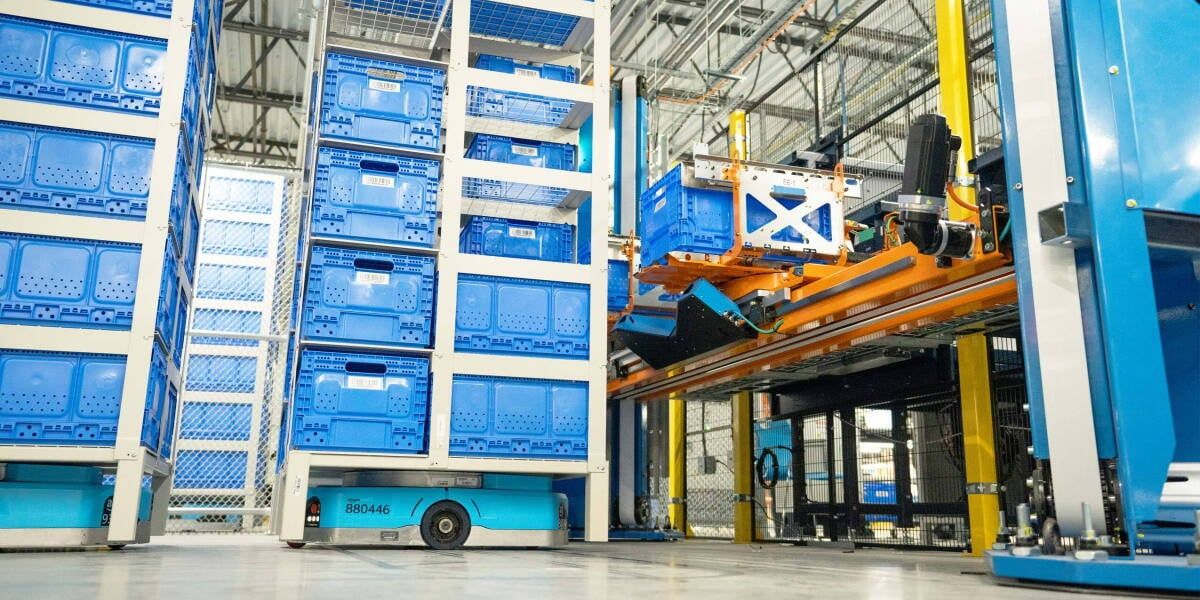
Within modern facilities, drive units named Hercules and Titan move through fenced storage zones that keep machinery separated from human employees.1 These machines, which match the dimensions of a pool table or a baby grand piano, slide underneath tall fabric shelving units known as pods and transport plastic tote containers directly to employee workstations.1 Amazon reports that an inventory management system known as Sequoia can store and identify items up to 75 percent faster by coordinating fleets of these mobile robots.1 To minimize congestion when hundreds of carriers navigate narrow corridors between pods, the company coordinates fleet traffic using DeepFleet, a suite of foundation models designed to anticipate and prevent robotic bottlenecks.1

A newer mobile carrier named Proteus departs from traditional safety barricades by operating safely in open environments.1 Built with obstacle-detection sensors, the unit moves alongside human workers rather than staying confined behind safety fences.1 Scott Dresser, vice president of Amazon Robotics, stated that the technical roadmap focuses on solving deep mechanical problems to assist associates while refining customer fulfillment operations.1 Most of the company's deployed million-machine inventory still consists of wheeled mobile carriers, but stationary sorting systems are rapidly expanding.1
Why does robotic sorting require specialized perception models?
Automated sorting arms must identify and grasp irregular packages that arrive in unpredictable, overlapping orientations on fast-moving conveyors. In 2021, Amazon began testing an in-house robotic arm named Robin, which formally debuted at an operations facility in Lakeland, Florida, in 2022.1 Robin uses eight individual suction cups to lift single packages from unorganized piles, utilizing machine vision to evaluate the scene before executing a physical lift.1 The arm inspects incoming parcels on the belt, ranks potential grasping points, and executes a planned motion path to deposit each parcel onto an outgoing drive carrier.1
Early sorting mechanisms depended on fixed algorithmic rules, which struggled when parcels overlapped or rested in unusual orientations. In a 2023 technical paper, researchers at Amazon Robotics noted that heuristics prioritizing larger packages often failed when smaller mailers lay on top of larger parcels, while strategies targeting top parcels struggled with partially buried items.1 The team addressed these limitations by implementing machine-learning models trained on more than 394,000 historical picking actions.1 The resulting online ranking model selected optimal pick sequences based on estimated probabilities of success.1
In operational trials, the machine-learning model achieved a 93.73 percent success rate, compared to 92.28 percent for the best traditional algorithm.1 While that difference appears modest, it yielded approximately 16,500 fewer failed picking attempts across an operating period of more than one million total picks.1 In a subsequent evaluation comprising two million picks presented at the International Symposium on Experimental Robotics in July 2025, the robotics team demonstrated that this machine-learning framework lowered the failed pick rate by 20 percent.1
Amazon expanded its arm portfolio in November 2022 by introducing Cardinal at a fulfillment site in Nashville, Tennessee.1 Cardinal manipulates heavier customer packages weighing up to 50 pounds, utilizing suction mechanisms to transfer parcels from conveyor belts into rolling transport carts bound for loading docks.1 Dresser likened this stacking process to a game of Tetris, noting that dense cart packing reduces transportation costs and carbon emissions.1 Former Amazon chief financial officer Brian Olsavsky stated during a July earnings call that the enterprise expected to more than double its deployed fleet of robotic arms during the year, while Dresser confirmed deployed arm counts were in the single-digit thousands.1
Handling individual catalog items proved more difficult than handling standard boxes, prompting the creation of a robotic arm named Sparrow.1 Sparrow relies on AI foundation models to identify, classify, and manipulate millions of distinct retail products stored inside container totes, eliminating the need to program individual object dimensions manually.1 Speaking at the Intelligent Robots and Systems conference in Pittsburgh on September 29, senior applied science manager Kapil Katyal explained that building ad hoc perception systems for every physical task and robot embodiment does not scale, motivating the creation of general perception foundation models.1 A newer arm named Vulcan entered testing in Spokane, Washington, and Hamburg, Germany, during 2025, adding force-feedback sensors that provide tactile touch to help manipulate inventory on pod shelves.
What happens to human injury rates when robots set the tempo?
Direct collaboration between workers and high-speed machinery creates biomechanical strain when machinery establishes an unbroken processing pace. Brian Greenwood, a professor of business at George Mason University, noted that historical industrial automation separated workers from dangerous operations through physical barriers.1 The introduction of collaborative warehouse robotics alters this relationship because machines work in direct proximity to people while dictating the operational tempo of the workstation.1
Public health figures illustrate the baseline physical risks associated with warehouse logistics. According to the United States Occupational Safety and Health Administration, injury and illness rates across the domestic warehousing industry have historically run more than double the national average across all private industrial sectors.1 Greenwood noted that the American warehousing sector employs nearly two million people and experiences chronic turnover alongside elevated workplace injury numbers.1
Independent research shows that automating the heaviest tasks yields mixed safety results for human workers. A study published in the academic journal ILR Review in April 2025 examined historical warehouse data covering more than 150 Amazon facilities from 2016 through 2019, combined with worker sentiment analysis. The study found that automated fulfillment centers experienced a 40 percent drop in severe, debilitating injuries compared to non-robotic warehouses, confirming that offloading heavy lifting prevents catastrophic musculoskeletal trauma. However, the exact same robotic facilities recorded a 77 percent increase in less severe injuries, such as strains and sprains caused by high-frequency repetitive motion.1
Greenwood explained that this divergence stems directly from operational pacing, as automated workstations achieve pick rates substantially higher than manual facilities.1 When machinery delivers items at an accelerated cadence, human workers perform reaching and grabbing motions with minimal physical recovery. Advocacy groups have raised similar alarms. Joan Moriarty, director of strategic research and campaigns at the Strategic Organizing Center, pointed to coalition analyses of government injury records from 2017 through 2020 showing elevated injury numbers in robotic facilities, alongside a 2021 survey of nearly 1,000 Amazon employees who reported that automated pacing amplified repetitive strain. A 2024 congressional investigation by the Senate Health, Education, Labor and Pensions Committee similarly found that robotic productivity quotas increased pressure on warehouse employees.1
How does the enterprise evaluate long-term workforce adjustments?
Workplace data reveals a clear boundary between severe trauma prevention and repetitive strain control. The findings from the ILR Review study demonstrate an observational association rather than a universal laboratory measurement: they reflect historical operating logs from 2016 through 2019 and cannot predict how newer tactile arms like Vulcan will alter physical strain once scaled. Furthermore, observational injury records do not capture ergonomic differences across individual worker body types or undocumented micro-breaks during shifts.
Amazon disputes allegations that automation elevates worker risk, pointing to long-term reductions in its corporate incident rates. A company spokesperson reported that between 2019 and 2026, the company's Global Recordable Incident Rate improved 43 percent, while its Global Lost Time Incident rate dropped 70 percent across its network.1 The enterprise maintains that automated facilities create high-wage employment paths, noting that advanced robotic fulfillment centers require 30 percent more technical personnel in reliability, maintenance, and engineering positions.1 Dresser reported that Amazon increased its internal roster of robotic maintenance technicians by more than 30 percent to service deployed hardware, while planned robot production hubs in Texas and Indiana will each support more than 300 manufacturing roles.1
Long-term planning discussions reflect ongoing questions regarding the ultimate size of the logistics workforce. Internal company strategy documents from October 2025 outlined potential projections where automation could reduce domestic hiring requirements by more than 160,000 personnel by 2027 and 600,000 personnel by 2033, though a corporate spokesperson stated at the time that the estimates represented the perspective of a single internal planning group.1 At the ground level, worker organizations continue pushing for structural protections, including a Safety Bill of Rights introduced by the Amazon Labor Union in Staten Island, New York, following its organization in April 2022.1 Greenwood emphasized that structured labor relations provide an effective path for identifying ergonomic improvements, establishing collaborative standards as robotic deployments multiply across global logistics networks.1
What this rests on
42 sentences trace to 1 source.
-
1
JH
Jeremy Hsu Document · arstechnica.com · 12 Oct 2026 Amazon has over 1 million robot workers. What’s next for human employees? See the source