Autonomous racing drone beats human champions using a single camera
A lightweight quadcopter navigated tight racing gates at highway speeds without external motion tracking, showing that high-speed robotic control can run on minimal onboard hardware.
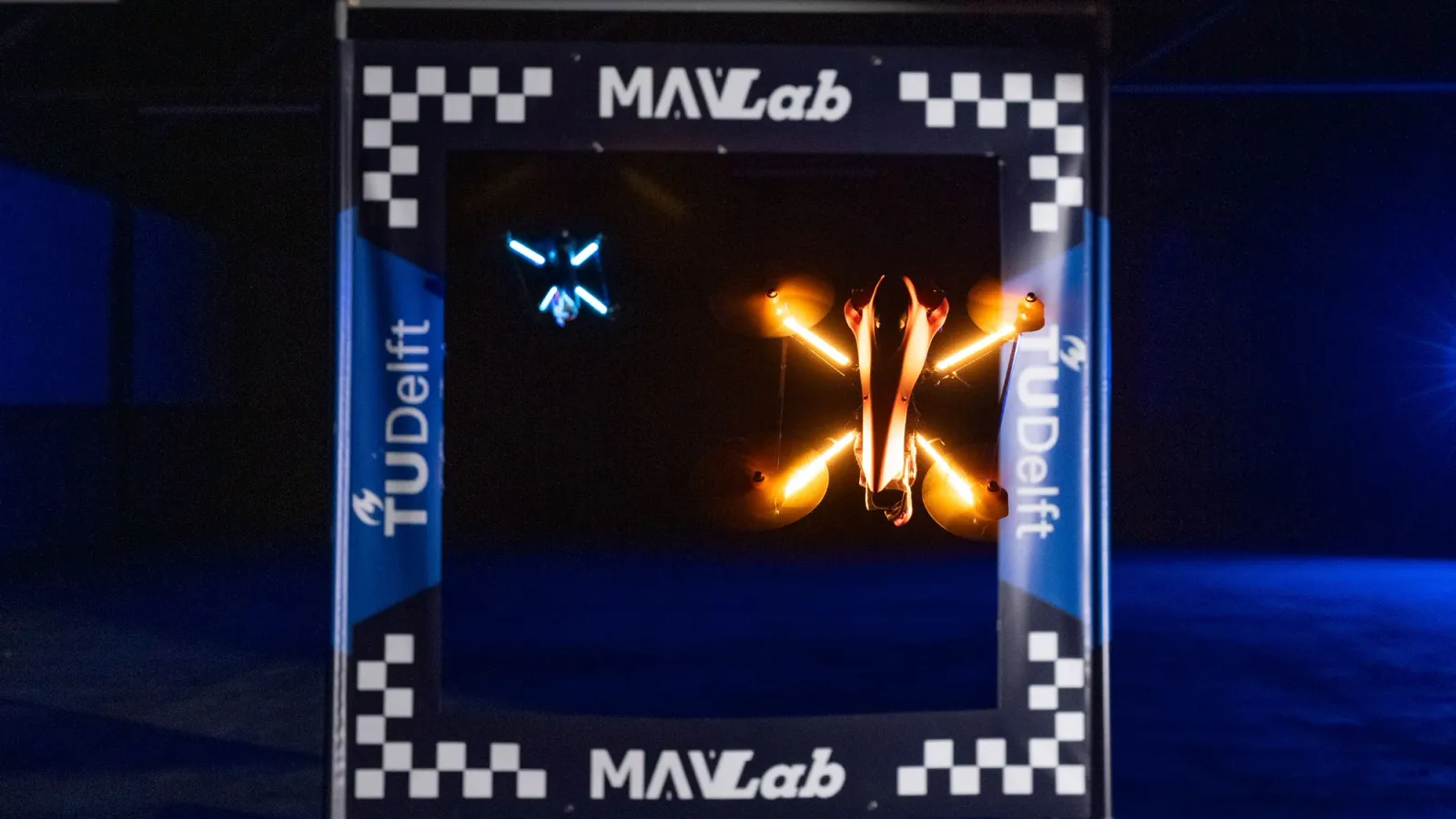
High-speed drone racing pushes the limits of human reaction time. Pilots wearing video goggles steer small quadcopters through narrow gates at speeds exceeding 60 miles per hour, making split-second corrections to roll, pitch, and yaw while flying entirely from a first-person perspective.1 A single minor miscalculation sends the aircraft into a metal barrier or out of bounds. For years, human pilots held a clear advantage over machines because biological brains can instantly interpret noisy, blurry visual scenes and coordinate physical maneuvers without heavy computing gear.
Autonomous flying machines, by contrast, have typically struggled when stripped of external aids. Navigating an unfamiliar race course at extreme velocity requires perceiving obstacles, calculating location in space, and firing motor commands hundreds of times per second. When autonomous systems previously outperformed human pilots in drone racing, they depended on laboratory infrastructure such as external motion-capture cameras, pre-mapped environments, or bulky multi-camera sensor rigs that cannot easily operate outside controlled spaces.21
That operational boundary shifted in research published on October 14, 2026, in the journal Science Robotics.31 A research team at Delft University of Technology created MonoRace, an autonomous quadcopter that beat three former human world-champion pilots in an international head-to-head racing tournament.32 The aircraft completed the feat without GPS signals, without external motion-capture cameras, and without preloaded track maps, relying instead on a single forward-facing camera and a compact onboard processor.32
How can an autonomous drone navigate at blinding speeds?
Navigating an aerial race track requires a fast, unbroken sequence of perception and physical adjustments. First, an onboard sensor must capture the flight environment despite heavy vibration and motion blur. Next, software must recognize upcoming obstacles, estimate where the craft sits relative to the course, and determine its velocity and rotation. Finally, the flight system must translate those state estimates into direct motor actions, spinning individual propellers faster or slower before the aircraft drifts off line. In racing conditions, this entire chain must execute hundreds of times each second.
MonoRace manages this sequence using an exceptionally lightweight hardware setup. The drone weighs 966 grams, or 2.13 pounds, and measures approximately 30 by 28 by 10 centimeters, or 11.8 by 11 by 3.9 inches.34 Instead of a multi-camera stereo rig or laser sensors, the quadcopter relies on a single rolling-shutter camera pointing forward.32 It pairs this visual feed with an inertial measurement unit, an onboard sensor that continuously measures acceleration and rotation.31
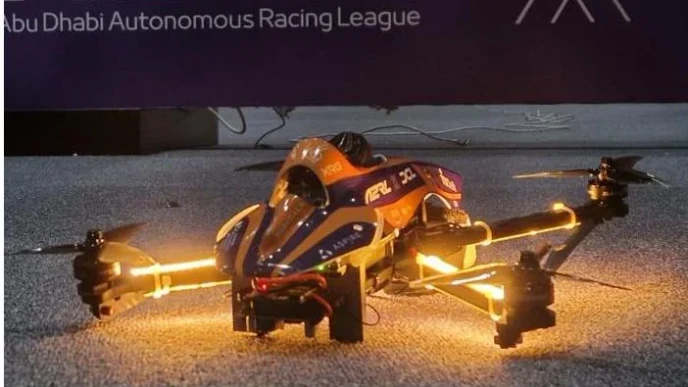
To turn those raw inputs into motion, the aircraft uses a specialized neural network, which is a machine-learning model that detects patterns in data. A convolutional network segments incoming images to spot the white borders and corners of racing gates.32 These visual sightings merge with the inertial data inside a state estimation pipeline, allowing the drone to deduce its location even when camera frames smear at high speed. The guidance network then issues motor commands directly to the four propellers at a frequency of 500 times per second through the onboard flight controller, bypassing conventional multi-layer flight software.23
What happened when the system faced human champions?
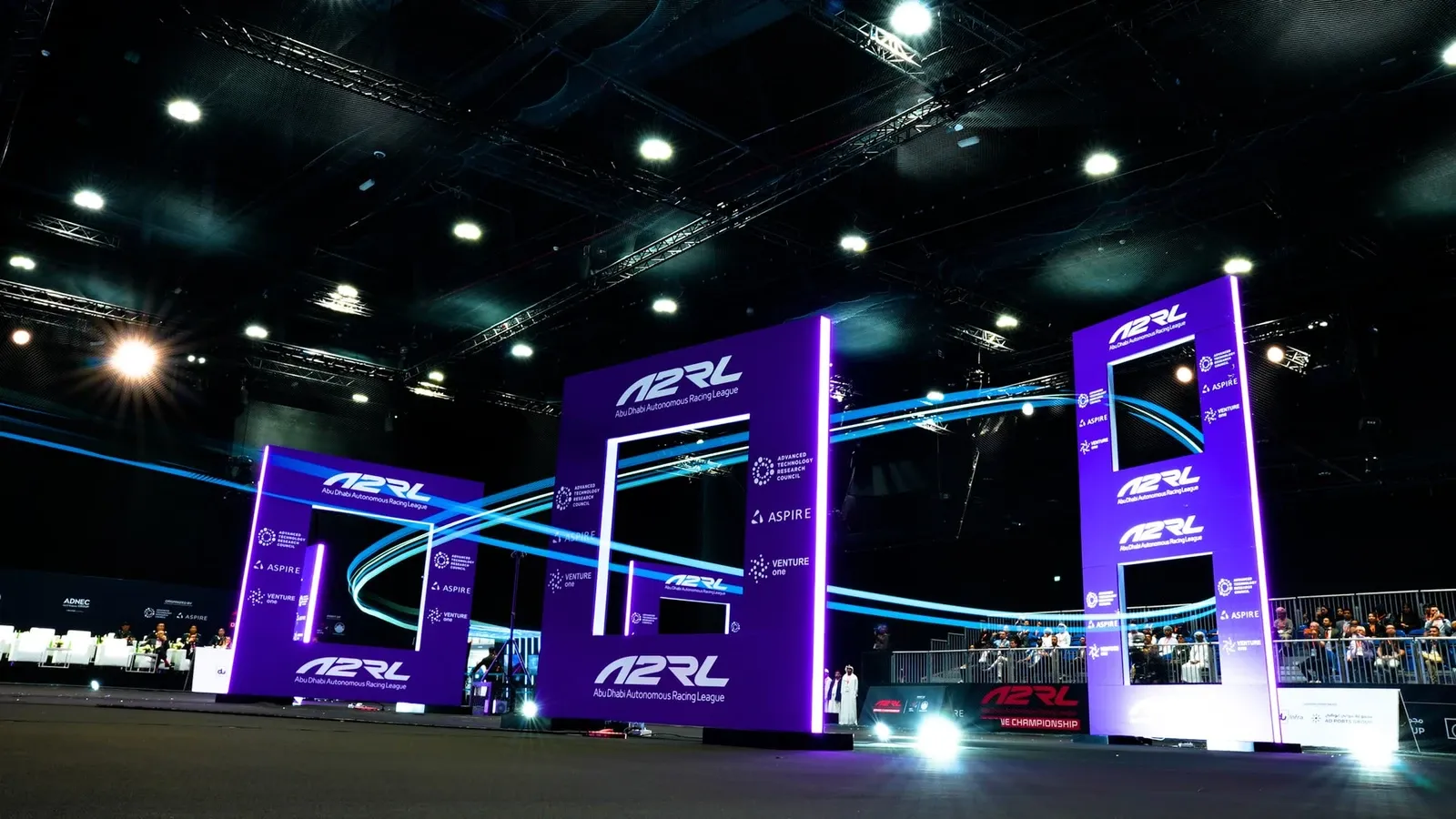
The autonomous system faced human competitors in April 2025 at the Abu Dhabi Autonomous Racing League drone competition.23 Held in an indoor venue measuring 100 by 30 meters, the course comprised 11 square gates, each with a 1.5-meter inner opening.2 The layout demanded aggressive aerobatics, including two double gates and a split-S maneuver where the drone flew through an upper gate and immediately plunged through a lower gate facing the opposite direction.2
MonoRace captured first place in both the individual Grand Challenge and the direct knockout tournament against former world-champion pilots.2 During official trials, the aircraft completed two consecutive laps through 11 gates in 16.56 seconds.32 The quadcopter reached a peak speed of approximately 63 miles per hour, or 102 kilometers per hour, on the indoor circuit.34 Across the knockout rounds, the system outpaced three former human world champions in direct competition, marking a significant milestone for autonomous robotics on tracks designed for human pilots.23
The aircraft also defeated every rival autonomous team entered in the competition. The researchers developed multiple control policies during the event, balancing risk and speed.2 Their fastest policy, designated M16, recorded the winning lap time, while a more conservative model called M23 achieved an 88.4 percent mission success rate across 43 competition flights, with most aborted runs tracing to mechanical or development issues.2
How did the flight policy learn to fly?
Reinforcement learning in a physics simulation allowed the flight controller to master high-speed racing without destroying physical hardware. Reinforcement learning is a training technique where an algorithm explores actions by trial and error, earning mathematical rewards for success and penalties for failure. Because mastering agile flight requires millions of trial attempts, the researchers trained the system inside a fast physics simulator rather than in the real world.34
The neural network learned flight dynamics from scratch. Initial training runs rewarded basic survival behaviors, such as avoiding collisions and reaching the opening gate.34 As training progressed, the algorithm learned to string together consecutive gates, fly tighter trajectories, and push motor throttles to their physical limits.
To prepare the policy for real-world flight, the researchers applied domain randomization across the simulation parameters. They varied physical factors including aircraft weight, battery voltage, aerodynamic drag, sensor noise, and propeller condition across training runs.34 Exposing the model to artificial turbulence and varied hardware states prevented it from overfitting to an idealized simulation, ensuring the resulting policy could pilot physical quadcopters across changing battery levels and minor component wear.
What are the limits of the current racing system?
The results demonstrate extreme agility on fixed courses, but the system remains bounded by specific design assumptions. MonoRace is an agile navigator for mapped or structured gate courses, not an all-purpose exploration robot. The perception model relies on recognizing predictable gate geometries, meaning it cannot detect unexpected obstacles or human bystanders who might wander onto a flight path.
The aircraft also lacks interactive collision-avoidance capabilities when sharing airspace. In the Abu Dhabi multi-drone event featuring four quadcopters flying simultaneously, MonoRace finished in third place because its flight policy did not account for rival drones cutting across its path.2 Furthermore, the underlying research, posted on the arXiv preprint server in January 2026 before formal journal publication, notes that real-world sensor saturation and vision-based localization errors still occasionally caused crashes, showing that physical reality remains more unpredictable than randomized simulation.
Where does lightweight autonomous control go next?
Demonstrating agile control on a compact microcontroller carries practical consequences far beyond competitive drone sports. Most commercial aerial vehicles and mobile robots operate with limited battery capacity and cannot carry heavy graphics cards or power-hungry computer clusters. Proving that a tiny, three-layer neural network running at 500 hertz can execute extreme physical maneuvers opens paths toward lighter, longer-lasting autonomous machines.2
The same control principles could soon optimize machines for energy efficiency rather than raw velocity. Adapting the neural policy to minimize electrical power instead of lap time could extend the range of inspection drones, automated warehouse robots, and lightweight search-and-rescue quadcopters operating in GPS-denied environments.35 By showing how much performance an algorithm can extract from minimal sensors and tiny chips, the research establishes that physical artificial intelligence can operate effectively within the tightest resource constraints.
The record
25 sentences trace to 5 sources.
-
1
P
popsci.com Third-party reporting · popsci.com · 14 Oct 2026 An AI-racing drone beat the best humans and set a world record See the source
-
2
A
arxiv.org Paper · arxiv.org MonoRace: Winning Champion-Level Drone Racing with Robust Monocular AI Preprint · may not have been peer reviewed See the source
-
3
AB
Alan Bradley Document · livescience.com · 19 Oct 2026 World's fastest AI-powered racing drone outflies the best human pilots See the source
-
4
U
UA.NEWS Third-party reporting · ua.news · 20 Oct 2026 MonoRace drone outruns former world champions in Abu Dhabi See the source
-
5
HO
heise online Third-party reporting · heise.de · 15 Oct 2026 Autonomous racing drone beats former world champions on course See the source