US judge orders detention of OpenAI engineer in bugging case
Federal prosecutors alleged a Saudi-funded escape plan and discovered a folder labeled Saudi Gov Docs after bugs appeared behind television screens.
A federal magistrate judge ordered former OpenAI engineer Abdulrahman Alfozan detained without bail, finding that the Saudi national posed a flight risk after allegedly planting covert listening devices in executive meeting rooms in San Francisco.12
United States Magistrate Judge Alex G. Tse issued the ruling in California federal court after prosecutors argued that Alfozan had the financial resources, foreign connections, and motivation to flee prosecution.1 Alfozan, 35, was arrested by the Federal Bureau of Investigation on Oct. 9 and charged with using or endeavoring to use an electronic, mechanical, or other device to intercept oral communications.23 If convicted, he faces a statutory maximum penalty of five years in prison, a $250,000 fine, and three years of supervised release.24
Assistant United States Attorney Craig Missakian filed a detention memorandum arguing that Alfozan had begun preparing to leave the country with his family before his arrest.1 Missakian wrote that Alfozan had booked a one-way flight to Riyadh for himself, his wife, and their infant son, with the tickets paid for by the Saudi government.1 Following his arrest, his wife and child departed the country on a separate flight to Doha, Qatar, that prosecutors stated was booked and paid for by a member of the Saudi military.1
Alfozan had worked at OpenAI since July 2025, earning an annual base salary of $325,000 alongside an equity grant of $2.2 million in profit participation units.12 Prosecutors told the court that Alfozan accumulated significant financial assets over more than a decade of employment across Silicon Valley technology companies and maintained at least two bank accounts in Saudi Arabia.1 Federal agents seized his Saudi passport upon arrest, but prosecutors argued that foreign officials could easily supply alternative travel documentation if he were released on bail.1
Discovery of covert devices
The criminal complaint details an internal investigation that began on Sept. 30, when OpenAI personnel discovered an unauthorized audio recorder plugged into a USB port on the back of a television inside an executive conference room.24 The device had been wrapped in toilet paper to conceal its presence.23 Technical analysis by OpenAI determined that the hardware had been installed around Sept. 28, and that the audio files stored on the device were encrypted.24
The conference room where the device was planted hosted sensitive discussions regarding proprietary research, product roadmaps, commercial partnerships, and engagements with United States government officials.23 Federal prosecutors stated that the recorder remained active for multiple days, spanning dates when company executives conducted meetings with federal personnel.1
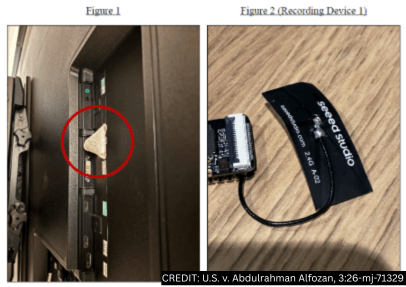
OpenAI security teams reviewed facility logs and closed-circuit television recordings to trace the device.24 Surveillance cameras recorded Alfozan near the conference room on multiple dates in September, despite company records showing that he lacked authorization to access the space or attend the meetings scheduled within it.23
On Oct. 5, security cameras captured Alfozan entering the executive conference room and peering behind the television where the recording device had been positioned.23 Later that same day, Alfozan left an unattended bag in a different room on the corporate campus.24 Security personnel inspected the bag and recovered his personal identification, his wallet, and a second recording device identical in design to the one recovered from the television port.23
OpenAI subsequently terminated Alfozan's employment and shared forensic findings with federal investigators.43 The company stated that it found no indication that core model weights, source code, or proprietary customer data were compromised or exfiltrated during the incident.43
Chatbot logs and browser activity
Federal investigators alleged that Alfozan utilized artificial intelligence tools to plan and construct the surveillance equipment.42 According to court filings, Alfozan used an internal productivity tool between Aug. 17 and Sept. 16 to submit inquiries about office addresses, conference room capacities, executive room schedules, and the locations where external partners conducted meetings.32
Investigators also reviewed search logs from a personal chatbot account registered to Alfozan's spouse, which shared technical identifiers with Alfozan's own devices.1 Between Sept. 24 and Sept. 30, prompts submitted through that account sought technical instructions on how to build continuous audio recorders, modify Wi-Fi connectivity, improve live listening capabilities, and encrypt removable storage media.24 On Sept. 27 and Sept. 28, the account submitted queries specifically containing the custom header and unique media access control address belonging to the device discovered behind the television.2
When questioned by agents, Alfozan declined to answer questions and requested legal representation.1 His wife told federal agents that she had observed her personal chatbot account active on his laptop computer while they discussed plans for her return to Saudi Arabia.1
A subsequent search of Alfozan's residence revealed additional hardware components matching the planted devices.1 On his mobile phone, agents uncovered photographic evidence showing television input and output panels across other OpenAI facilities, including a second conference room used for confidential leadership discussions.1 One photograph documented an additional concealed recording device.
Federal prosecutors highlighted phone records showing regular communications between Alfozan and an individual identified as a member of the Saudi royal family.1 The messaging exchanges began in 2025 and continued through early October.1 In one exchange, after receiving a message asserting that Saudi Arabia needed him more than the United States, Alfozan responded with the number 100.1
On Oct. 4, five days before his arrest, browser records showed that Alfozan accessed a digital storage folder titled Saudi Gov Docs.1 Following that folder access, Alfozan queried an enterprise productivity agent to generate a list of 10 senior OpenAI executives who would be suitable to attend high-level informal meetings with government ministers in Saudi Arabia.1
Defense response and federal posture
William Pernik, a defense attorney representing Alfozan, urged the court and the public to maintain the presumption of innocence while the defense reviews the government's evidentiary productions.3 Pernik stated that Alfozan arrived in the United States years ago as a student, completed degrees at the Massachusetts Institute of Technology and the University of California, Berkeley, and obtained lawful permanent residency in 2020.31
Pernik told Primary that the allegations appear wholly out of character for Alfozan, adding that the legal team intends to conduct an independent investigation into all evidence produced by the government to establish what took place.3
The prosecution is being handled by Assistant United States Attorney Nicolas Parker and Counterintelligence and Export Control Section Trial Attorney Kate Tagert.2 United States Attorney Craig Missakian stated that federal prosecutors are evaluating whether to bring additional charges against Alfozan as forensic examinations of seized electronic equipment continue.1
The government cited historical precedent involving foreign intelligence operations in Northern California, pointing to earlier criminal prosecutions where former technology workers accused of gathering intelligence for Saudi authorities fled the United States before trial.1 The magistrate judge agreed that the combination of foreign financial backing, family relocation, and prospective prison exposure justified keeping Alfozan in federal custody through trial.1
The record
43 sentences trace to 4 sources.
-
1
AB
Ashley Belanger Document · arstechnica.com · 19 Oct 2026 Accused OpenAI spy had folder called “Saudi Gov Docs,” FBI says See the source
-
2
J
justice.gov Official record · justice.gov Saudi National Arrested for Installing Surreptitious Audio Recording Device at OpenAI See the source
-
3
BN
BBC News Third-party reporting · bbc.com · 14 Oct 2026 Toilet paper and secret recorders: What we know about the arrest of the Saudi OpenAI engineer See the source
-
4
BN