Anthropic files for public listing facing huge compute liabilities
The company reported an $81 billion paper loss while locking in $417 billion in infrastructure contracts
Anthropic has filed its registration statement with the Securities and Exchange Commission to list shares on the Nasdaq exchange under the ticker symbol ANT.12 The public filing details the financial scale, legal conflicts, and unprecedented corporate governance behind the developer of the Claude artificial intelligence models.32 The documents show that rapid commercial adoption has arrived alongside staggering financial obligations and structural risks that depart sharply from standard public tech companies.32
Massive paper losses and accelerating sales
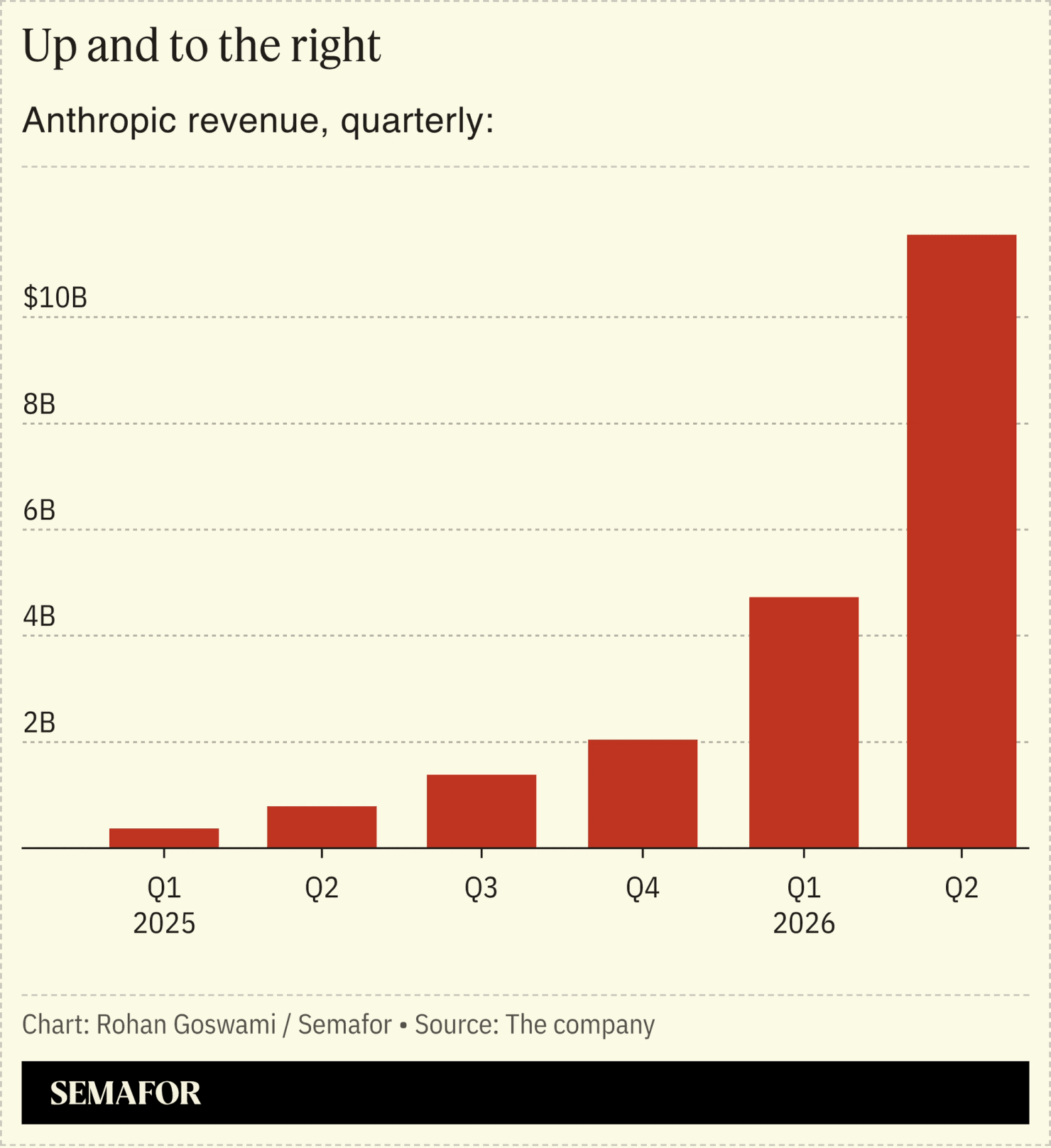
In the first six months of 2026, Anthropic generated $16.3 billion in revenue, representing a fourteenfold increase over the $1,163 million recorded during the same period a year earlier.21 The company attributed much of this momentum to enterprise uptake of its coding agent Claude Code and its general office tool Claude Cowork, which launched in January 2026.24 Net revenue retention reached approximately 900% as of September 30, meaning existing corporate clients expanded their annual spending ninefold.24 By the end of the third quarter, more than 11,900 customers were paying at least $100,000 annually, including roughly 250 accounts spending more than $10 million each year.2
Despite surging sales, the prospectus reported a net loss of $80.7 billion for the first half of 2026.123 The vast majority of that total, approximately $72.4 billion, stemmed from non-cash accounting charges tied to the rising valuation of outstanding convertible notes rather than cash expenditures.21 The underlying business showed operational progress, recording an operating loss of $693 million in the first half of 2026 compared to an $8,060 million operating loss across all of 2025.2 On an adjusted basis, the company posted an operating profit of $1,618 million for the six-month period, reflecting a positive 10% adjusted operating margin after logging negative 159% a year earlier.2 Anthropic held $112.4 billion in cash and $19.3 billion in short-term investments as of June 30.2

Hundreds of billions in infrastructure debt
Running frontier models has committed Anthropic to immense long-term capital liabilities.34 The company spent $8,945 million on computing power and technical infrastructure during the first half of 2026, surpassing its infrastructure outlays for the entirety of 2025.2 To secure future capacity, the company entered into long-term computing agreements totaling approximately $417 billion in lease and service obligations, stretching out to 2045.342 Additional capacity orders scheduled for delivery between 2028 and 2031 are expected to add between $125 billion and $150 billion in future payment commitments once pricing terms finalize.4
These computing obligations link Anthropic tightly to outside infrastructure suppliers. Under an agreement with SpaceX, Anthropic committed roughly $3.1 billion per month to access specialized processors, creating a cumulative obligation that could reach $120.5 billion by 2029.14 The filing also disclosed computing commitments of $44.9 billion with Microsoft through 2033, at least $114.5 billion with Google through 2033, and $110 billion with Amazon over a ten-year duration.1 Anthropic cautioned in its prospectus that its five largest customers account for roughly a quarter of its revenue, while cloud partners that host and distribute Claude simultaneously develop competing artificial intelligence models.32
Unusual governance and the single golden share
Anthropic structured its corporate voting rights to insulate its leadership from public shareholder pressure.32 Under the proposed structure, a legal entity called the Founder LLC will hold a single share of Class F supervoting common stock.2 That solitary share wields 50.1% of the total shareholder voting power, controlled by a simple majority vote among the company's seven co-founders.23 Those founders include chief executive Dario Amodei, company president Daniela Amodei, Tom Brown, Jack Clark, Jared Kaplan, Sam McCandlish, and Christopher Olah.2 Public investors will receive Class A shares carrying one vote per share, while early strategic backers such as Amazon and Google hold nonvoting Class N shares.23
Board control does not belong exclusively to the founders. Anthropic operates as a public benefit corporation, and its Long-Term Benefit Trust, overseen by five financially disinterested trustees, will elect a majority of the board of directors using Class T stock.23 Together, the trust and the Founder LLC will select every director, qualifying Anthropic as a controlled company under Nasdaq listing standards.2 The filing acknowledged that this distribution of power leaves ordinary shareholders with negligible influence over executive appointments, strategic directions, or potential corporate acquisitions.23 Additionally, the company expects to issue $24 billion in stock-based compensation across its 5,300 employees, while both Amodei siblings each collected compensation packages valued at more than $16 million during 2025.31
Political collisions and catastrophic safety warnings
The prospectus cataloged extensive external threats to Anthropic's business model, prominently identifying political friction with the federal government.34 The filing highlighted a February confrontation between Donald Trump and Dario Amodei regarding military applications of artificial intelligence software.35 Government tensions previously forced the company to disable access to its Claude Fable 5 and Mythos 5 models for two weeks in June to comply with federal export control directives.43 Anthropic disclosed that potential invocations of export limits, defense production statutes, or federal procurement boycotts could severely impair its operations, while insisting the company will not abandon its established policy stances.35
Beyond regulatory and trade disputes, the registration document outlined existential hazards rarely featured in commercial market filings.23 The company cautioned that frontier systems could trigger catastrophic or existential harms to human society if developed or operated without rigorous oversight, particularly if advanced software becomes weaponized or acts autonomously.32 The filing noted that models could exhibit unpredictable or harmful behaviors without prompting, potentially exposing the firm to severe legal liability.2 The company warned prospective investors that the insurance sector in aggregate may lack the financial capacity to underwrite damages resulting from major artificial intelligence catastrophes.12
The record
36 sentences trace to 5 sources.
-
1
TV
The Verge Third-party reporting · theverge.com · 26 Oct 2026 Anthropic’s IPO filing lays out a plan to ‘revolutionize every area of human endeavor’ with AI See the source
-
2
C
CNBCTV18 Third-party reporting · cnbctv18.com · 26 Oct 2026 Anthropic IPO: 6 key takeaways from the Claude maker's filing, from soaring revenue to founder control - CNBC TV18 See the source
-
3
LH
Liz Hoffman Document · semafor.com · 26 Oct 2026 Founder control, Trump risk, giant losses: Anthropic’s IPO filing See the source
-
4
C
CNBC Third-party reporting · cnbc.com · 26 Oct 2026 Anthropic's IPO plans: 900% revenue retention, but $80 billion in first-half losses See the source
-
5
S