Adaptive block diffusion speeds up automated document recognition
A new vision-language architecture resolves multiple text tokens in parallel while locking reliable prefixes into memory, accelerating page transcription.
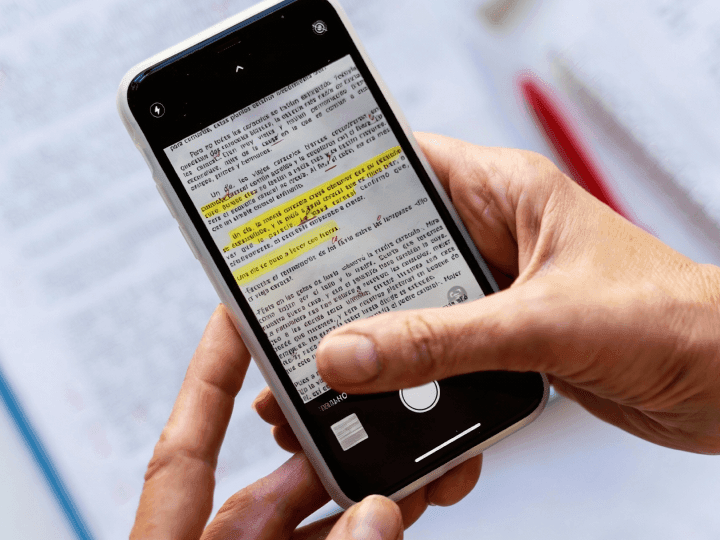
Transcribing dense printed documents into structured digital text requires machine-vision systems to convert complex page layouts, mathematical formulas, and text lines into exact computational sequences.1 Unlike open-ended conversational artificial intelligence where many phrasing variations remain valid, optical document transcription is strictly deterministic because the visual image dictates a unique textual output.1
Most modern vision-language models handle this task by generating digital text one token at a time in a sequential chain.1 In this autoregressive process, each newly generated character or word piece is appended to the input prompt before the system executes another complete computational pass to predict the next item.21 For multi-page reports or dense tables containing thousands of tokens, this one-by-one generation creates substantial processing latency and demands significant computing power.1
In a preprint paper posted on the arXiv repository on September 1, 2026, researchers Mingxu Chai, Ziyu Shen, Chenyu Liu, Jihua Kang, Tao Gui, and Qi Zhang described an architecture called the Prefix-Adaptive Block Diffusion Model. Designed for high-throughput document recognition, the model accelerates parsing by generating candidate token sequences in parallel while dynamically locking reliable text segments into memory.3
Why do standard diffusion models struggle with document text?
Standard masked diffusion models generate text across an entire canvas simultaneously by refining random or masked positions over multiple steps, but document recognition exposes critical structural weaknesses in full-sequence diffusion.1 Because the true length of a transcribed page is unknown before inference begins, setting a fixed canvas length often causes text truncation when the estimate is too short or hallucinated padding tokens when the estimate is too long.1 In addition, parallel decoding binds tokens to absolute positions in a non-causal manner, meaning an early misalignment error locks into place and fractures the remaining transcription.1
To address those alignment failures, earlier frameworks introduced block diffusion models, which split long sequences into fixed chunks.1 These hybrid systems generate text step by step across consecutive blocks while allowing parallel token generation within each individual block.1 As Marianne Arriola and colleagues reported in an earlier foundational study posted on arXiv in March 2025, block diffusion interpolates between autoregressive models and discrete denoising diffusion, enabling arbitrary-length generation alongside key-value caching.
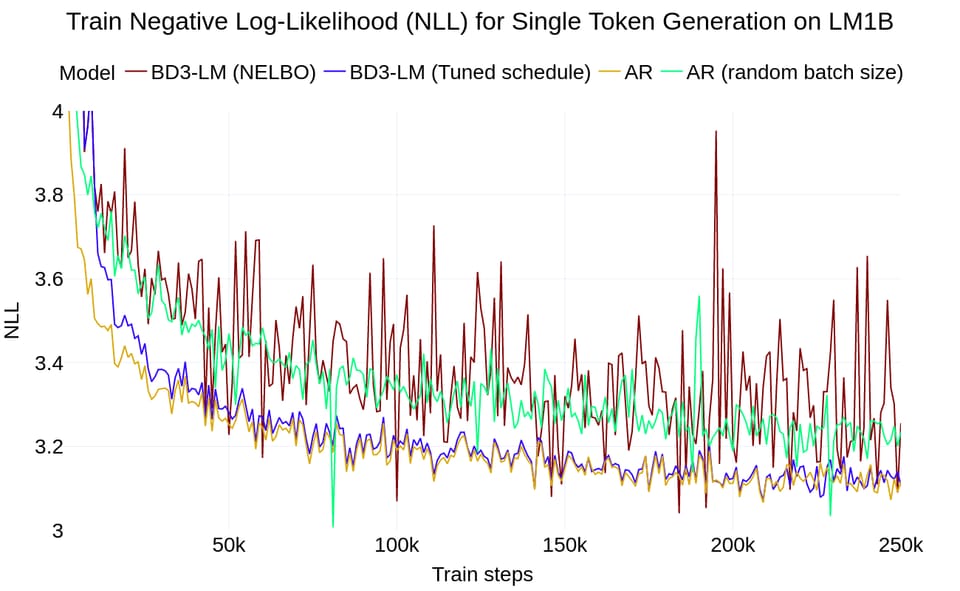
Even with block decomposition, rigid block boundaries impose severe efficiency penalties on document recognition.3 Inside each fixed block, bidirectional denoising allows tokens to inspect both past and future positions simultaneously, which conflicts with the strict left-to-right flow of reading and impairs structure-sensitive parsing.3 Furthermore, generation parallelism shrinks as tokens within the block finish denoising at different speeds, while completed tokens cannot be committed into the key-value cache until the entire block concludes.3
How does prefix-adaptive decoding accelerate transcription?
The Prefix-Adaptive Block Diffusion Model resolves these computational bottlenecks by restructuring how candidate tokens are generated and stored.3 Instead of bidirectional denoising within a block, the model enforces causal denoising that progresses systematically from prefix to suffix.3 The architecture also treats block size as a maximum candidate window rather than an unyielding commitment unit.3
During the training stage, the system applies a confidence-gated structural loss to establish stable, low-entropy prefixes before extending training passes to longer continuations.3 Qi, a co-author of the study, said in response to questions from Primary that without this gated loss, standard cross-entropy training caused noticeable instability because supervising later positions too early forced the model to learn continuations conditioned on an unstable prefix. In controlled experiments on the architecture, Qi noted that accuracy reached 94.1 percent with the confidence-gated loss compared with 82.7 percent under standard cross-entropy after 180,000 training steps.
During active inference, a process known as Progressive Prefix Commitment evaluates the candidate window, selects the longest dependable sequence of tokens, and commits them immediately into the key-value cache.3 Qi explained that the decoding algorithm scans predicted tokens from left to right using a default confidence threshold of 0.95, committing the longest contiguous sequence before the first low-confidence token. Because causal attention prevents committed tokens from depending on unresolved future positions, the model can safely lock the prefix into cache, reset its candidate window forward, and restore a wide parallel decoding space at each step.3
What performance gains did the researchers measure?
Experimental results published by Chai and colleagues indicate that a 3-billion-parameter Prefix-Adaptive Block Diffusion Model increased inference throughput by 71.6 percent compared with the 2.5-billion-parameter MinerU-Diffusion baseline.3 The authors also reported that their 3-billion-parameter model achieved higher recognition scores across multiple document parsing benchmarks.3

These throughput gains stem from a substantial reduction in the total number of forward passes required to transcribe a page.1 In standard sequential decoding, producing an output sequence requires one forward calculation per token.12 By combining causal diffusion with dynamic caching, block diffusion architectures can resolve multiple tokens in a single step, requiring significantly fewer steps per generated token.1
Qi told Primary that on a single NVIDIA RTX 4090 processor with a batch size of one, the 3-billion-parameter model reached 267.2 tokens per second compared with 155.7 tokens per second for the 2.5-billion-parameter baseline. When evaluating candidate window dimensions, Qi explained that a maximum window of 32 tokens delivered the best operational balance, achieving an accuracy score of 94.1 percent and committing an average of 8.4 tokens per forward pass. Expanding the candidate window to 64 tokens caused accuracy to slip to 92.8 percent and reduced average committed tokens to 8.1, as a sparser training signal made stable prefixes harder to form.
What are the remaining limits of block diffusion?
The reported findings describe benchmark evaluations and comparisons against existing open document models under specific testing setups.3 Like other diffusion-based vision frameworks, the model relies on confidence thresholds to decide when candidate tokens are sufficiently accurate to enter permanent cache storage.1 If an inaccurate token receives an erroneously high confidence score, committing it into memory creates a static error that cannot be revised in subsequent decoding steps.1
Qi acknowledged that the architecture still inherits hallucination tendencies common to vision-language models, such as substituting an image word with a more frequent vocabulary item that fits the local language context. The researchers have not yet conducted systematic testing on highly diverse layouts, mixed-language documents, or complex multilingual pages. Furthermore, the paper remains a preprint posted on the arXiv repository and has not yet completed peer review.
This piece was prepared from the arXiv preprint and public records together with answers from Qi to 6 questions from the Primary news team, completed September 2026.
The record
35 sentences trace to 3 sources and 1 contributor.
- 1 [Literature Review] DODO: Discrete OCR Diffusion Models See the source
- 2 Conduct your own LLM endpoint benchmarking - Azure Databricks See the source
-
3
MC
 Mingxu Chai, Ziyu Shen, Chenyu Liu, Jihua Kang, Tao Gui, Qi Zhang
Paper
· arxiv.org · 1 Sep 2026
Prefix-Adaptive Block Diffusion for Efficient Document Recognition
Preprint · may not have been peer reviewed
See the source
- 4 Contribution — Qi Zhang 15 statements added to this article
alphaxiv.org1 page
Article history
-
Published 30 Oct 2026, 14:17Assembled by the Primary desk from 3 sources · 1 contributor · 35 cited sentences
-
Qi Zhang
- Go to the sentence: The architecture also treats block size as a maximum candidate window rather than an unyielding commitment unit.
- Go to the sentence: During the training stage, the system applies a confidence-gated structural loss to establish stable, low-entropy prefixes before extending training passes to longer continuations.
- Go to the sentence: Qi, a co-author of the study, said in response to questions from Primary that without this gated loss, standard cross-entropy training caused noticeable instability because supervising later positions too early forced the model to learn continuations conditioned on an unstable prefix.
- Go to the sentence: In controlled experiments on the architecture, Qi noted that accuracy reached 94.1 percent with the confidence-gated loss compared with 82.7 percent under standard cross-entropy after 180,000 training steps.
- Go to the sentence: During active inference, a process known as Progressive Prefix Commitment evaluates the candidate window, selects the longest dependable sequence of tokens, and commits them immediately into the key-value cache.
- Go to the sentence: Qi explained that the decoding algorithm scans predicted tokens from left to right using a default confidence threshold of 0.95, committing the longest contiguous sequence before the first low-confidence token.
- Go to the sentence: Because causal attention prevents committed tokens from depending on unresolved future positions, the model can safely lock the prefix into cache, reset its candidate window forward, and restore a wide parallel decoding space at each step.
- Go to the sentence: Experimental results published by Chai and colleagues indicate that a 3-billion-parameter Prefix-Adaptive Block Diffusion Model increased inference throughput by 71.6 percent compared with the 2.5-billion-parameter MinerU-Diffusion baseline.
- Go to the sentence: The authors also reported that their 3-billion-parameter model achieved higher recognition scores across multiple document parsing benchmarks.
- Go to the sentence: Qi told Primary that on a single NVIDIA RTX 4090 processor with a batch size of one, the 3-billion-parameter model reached 267.2 tokens per second compared with 155.7 tokens per second for the 2.5-billion-parameter baseline.
- Go to the sentence: When evaluating candidate window dimensions, Qi explained that a maximum window of 32 tokens delivered the best operational balance, achieving an accuracy score of 94.1 percent and committing an average of 8.4 tokens per forward pass.
- Go to the sentence: Like other diffusion-based vision frameworks, the model relies on confidence thresholds to decide when candidate tokens are sufficiently accurate to enter permanent cache storage.
- Go to the sentence: If an inaccurate token receives an erroneously high confidence score, committing it into memory creates a static error that cannot be revised in subsequent decoding steps.
- Go to the sentence: Qi acknowledged that the architecture still inherits hallucination tendencies common to vision-language models, such as substituting an image word with a more frequent vocabulary item that fits the local language context.
- Go to the sentence: The researchers have not yet conducted systematic testing on highly diverse layouts, mixed-language documents, or complex multilingual pages.