Why orchard cameras still need human eyes to forecast fruit
Automated tools struggle with the nuances of living crops, turning farm work into a task of interpreting machine data rather than eliminating labor.
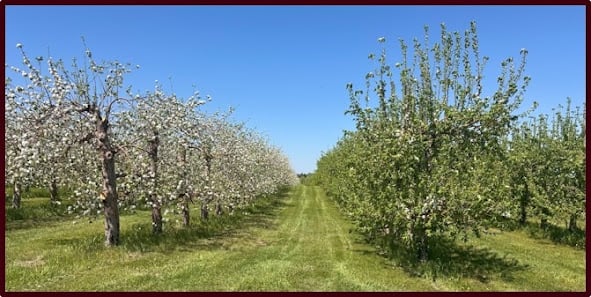
Growing fruit for grocery shelves requires an exacting balance between biology, weather, and market logistics. Long before harvest begins, a grower must look into the canopy of an apple, pear, or peach tree and project how many pieces of fruit will mature to market grade months down the road. That calculation governs nearly every downstream decision in the orchard business. It determines how many seasonal picking crews a grower must hire, how many wooden bins must be staged in the rows, how much refrigerated storage space must be reserved, and what delivery volumes can be guaranteed to packing houses and supermarket chains. If the estimate runs too low, ripe fruit rots unpicked in the heat; if it runs too high, expensive storage sits empty and contracts fall short.
For generations, arriving at that figure has been an exercise in manual approximation. A field worker walks the orchard rows, pauses at regular intervals to count the visible blossoms or immature green buds on a sample tree, and multiplies that sample across the acreage. It is repetitive, slow work, and because an orchard is not a uniform factory floor, a handful of trees can give a misleading snapshot of an entire block. Cold air pools in low swales, older trees bear differently than younger rootstocks, and warm spring afternoons trigger sudden blooms that may or may not survive a late frost.
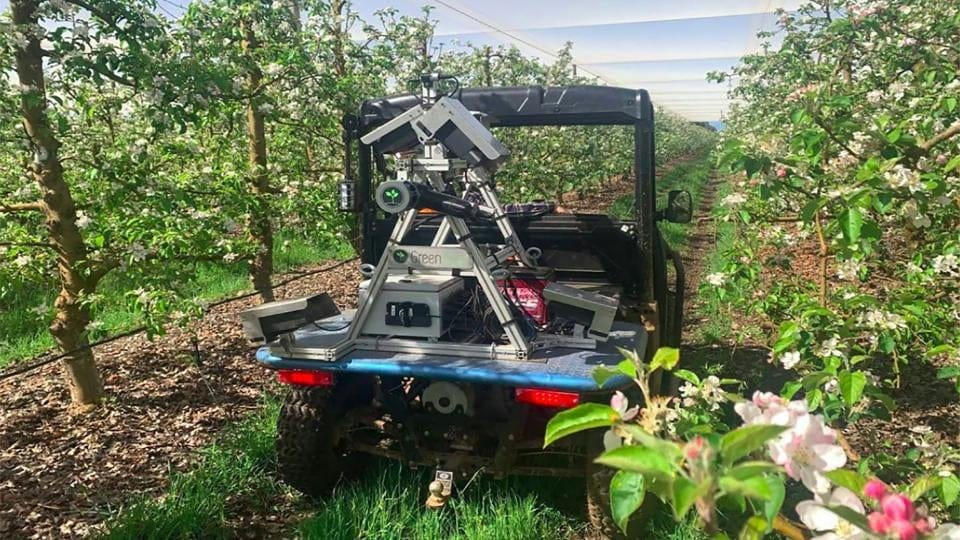
When automated camera systems mounted on utility vehicles and tractors entered commercial orchards, the promise appeared straightforward. An optical scanner rolling down tree rows can record every visible bud across thousands of branches, eliminating the crude sampling method of checking every sixth or seventh tree.12 Yet fruit trees behave according to ecological rules that optical sensors cannot interpret on their own. A camera can register the physical presence of a bud, but it cannot know whether a cold wind during pollination prevented that bud from setting fruit, or whether that specific patch of soil consistently sheds excess load during the summer. To turn raw machine counts into an actionable harvest projection, someone still has to translate what the camera sees into what the tree will actually do.
Why did an automated camera overestimate the harvest?
In a field trial documented by researchers at the University of California, Davis, an agricultural camera system designed to count fruit buds systematically overcounted what would end up in the bins.12 The digital tool had been deployed across tree blocks to replace the traditional hand count, recording images of branches as vehicles moved between the rows. On paper, imaging every tree offered complete coverage rather than an extrapolated sample. In practice, the system consistently generated inflated projections.
To prevent those inflated counts from distorting the season's business planning, an experienced farm manager on the property took matters into his own hands. Drawing on more than a decade of personal experience working those exact blocks of trees, the manager routinely knocked 14 percent off the camera system's total count.12 His downward revision reflected how those specific parcels had performed across past seasons and how recent temperature swings were likely to suppress fruit set. When the harvest arrived, the farm manager's discounted estimate proved closer to the actual yield than the unadjusted data produced by the machine.12
That discrepancy illustrates what social scientists term the last mile of agricultural automation.12 The equipment successfully automated the mechanical chore of counting visual markers across acres of trees, which had previously absorbed days of tedious manual effort. What the hardware could not reproduce was the contextual knowledge accumulated by a person who had watched the same ground respond to droughts, chills, and pruning cycles over many years. Without that human calibration, relying directly on the machine's figures would have led to costly miscalculations in packing capacity, storage leases, and forward sales contracts.1
How do specialty crops differ from row crops?
The technical hurdles that make orchard yield estimation difficult also explain why fruit trees have resisted the waves of mechanization that reshaped grain and soybean farming decades ago. In staple row crops such as corn, wheat, or soybeans, harvest machinery operates on volume and bulk efficiency.12 A combine harvester cuts broad swaths of plants simultaneously, thrashing grain from chaff in a single mechanical pass where visual blemishes, skin bruising, and minor cosmetic variations have little bearing on wholesale commodity value.
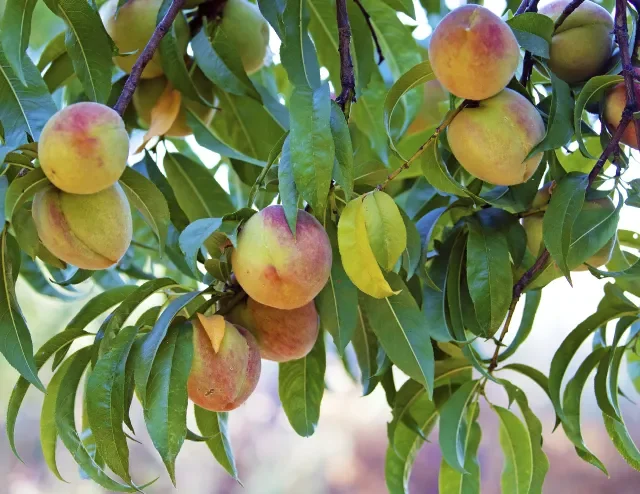
Fresh-market specialty crops operate under entirely different commercial constraints because consumer preference demands cosmetic perfection alongside physical ripeness. Workers picking dessert apples or fresh stone fruit cannot simply strip a branch clear. They must evaluate color, gauge diameter, feel for firmness, and handle each piece carefully to avoid indentations that cause spoilage during shipping. Furthermore, fruit on the same branch rarely ripens at a uniform rate, requiring crews to harvest mature fruit while leaving unripe pieces on the tree for subsequent passes days or weeks later.
Orchard economics compound those biological challenges. Unlike grain farmers who can rotate between crops year by year, orchardists make multiyear capital commitments when planting fruit trees. A single commercial orchard block represents an investment that commits the land for a decade or more.12 Growers cannot abruptly scrap rootstocks or alter planting architectures to accommodate an experimental machine that might be obsolete or unreliable within two seasons. Many automated picking prototypes have struggled to replicate the tactile discernment and judgment required for selective hand harvesting, keeping the industry dependent on experienced human crews even as labor costs rise and seasonal shortages intensify.12
What does technology actually change in the field?
Rather than eliminating the need for farm personnel, agricultural technology alters the structure of the tasks people perform each day. Lead author M. Anne Visser, a professor of community and regional development in the UC Davis Department of Human Ecology, and co-author Alex Bladimir Hernandez documented this transformation in a research study published in the academic journal New Technology, Work and Employment.12 Over three years, the researchers conducted 165 in-depth interviews with agricultural workers and orchard growers across 16 commercial fruit tree operations in California and Washington.12
The study found that technological adoption does not occur as an external event that suddenly sweeps human workers away from an orchard. Instead, workers and supervisors actively integrate digital equipment into daily routines, troubleshooting mechanical breakdowns, interpreting sensor readings, and bridging the gap between how an engineering model was designed to perform and how an actual farm operates. An employee who previously counted buds by hand does not disappear from the payroll; that individual often becomes the operator responsible for driving the sensor platform, validating its raw data, and cross-referencing its outputs against historical weather trends.
“Automation isn’t something that just happens to a farm or happens to a labor force,” Visser said. “People have to actively make it happen.”12
The researchers emphasize that substituting a specific manual task with a machine is fundamentally different from eliminating a complete employment role on an agricultural operation.
“Replacing a task on a farm is not the same as replacing a job,” Visser said. “These tools do not simply remove jobs on farms. They often change who does what and reshape the work around technology.”12
That restructuring can deliver genuine operational improvements. When autonomous equipment or robotic assists take over repetitive, strenuous field duties, they can reduce ergonomic strains, mitigate heat stress, and lower the frequency of ladder falls in an industry characterized by demanding physical exertion.12 At the same time, moving workers into technical oversight roles provides farms with greater flexibility when planning around recurring regional labor shortages.
What are the limits of the findings?
The qualitative conclusions drawn by Visser and Hernandez reflect detailed observations of working operations, but they carry clear methodological boundaries. The study examined 16 fruit tree operations across two western states, providing deep qualitative detail on how real workers negotiate specific machinery such as camera platforms and autonomous prototypes. That fieldwork approach captures nuances that large-scale aggregate surveys miss, yet it cannot establish the quantitative prevalence of these dynamics across the entire agricultural sector.
Furthermore, observational research into current equipment cannot forecast how future iterations of artificial intelligence or mechanical harvesters might alter farm work as sensor fidelity improves. The research was funded by the National Science Foundation and the University of California Office of the President, and the authors reported no financial conflicts of interest.12 The findings serve as a descriptive assessment of current field integration rather than an absolute prediction of long-term labor trajectories.
The findings also expose a subtle operational vulnerability for modern farms that adopt computerized tools. When an advanced digital sensor depends on a manager with a decade of accumulated experience to discount flawed readings by 14 percent, the technology is not truly autonomous. The true operating intelligence remains embodied in the individual worker. If that experienced specialist leaves the operation, the farm loses not just a pair of hands, but the corrective calibration that keeps the automated system from steering business planning astray.
What happens next for agricultural labor?
Public discussions surrounding farm automation often frame technological advancement as an adversarial contest between machines and human workers, treating technology as a foregone conclusion that simply clears the fields of labor. Visser noted that this displacement framing divides growers and farmworker advocates before anyone examines how tools function in commercial practice.12 Recognizing that automated machinery creates new demands for skilled interpretation opens opportunities for targeted workforce training, rural job stability, and realistic labor policy.
As robotic platforms and imaging arrays continue to deploy across specialty crop orchards, the primary operational challenge will not be finding machines that can replace people wholesale. Instead, agricultural operations will need to cultivate and retain workers who possess the biological intuition to teach those machines what living trees actually look like in the field.
The record
19 sentences trace to 2 sources.
-
1
S
 scientificinquirer.com
Document
· scientificinquirer.com
A Farm Manager Beat the Camera System by Knocking 14 Per Cent Off Its Count
See the source
- 2 The Assumption About Farm Automation That May Be Wrong See the source