A 24-pound suitcase computer changed how work leaves the desk
Mobile computing began not with slim glass panels, but with a heavy plastic briefcase that bundled everyday office software for under $1,800.
Modern portable computing appears almost weightless, mediated through thin sheets of glass, aluminum enclosures, and battery systems engineered to run an entire working day without tethering to a wall. For decades, computation was fundamentally geographic, anchoring workers to designated offices where heavy terminals sat permanently wired to mainframe systems or massive beige desktop cases. The idea that professional computing could occur anywhere else required dismantling the assumption that an office was a fixed physical room.
In April 1981, that physical tether began to snap at the West Coast Computer Faire in San Francisco.12 Adam Osborne introduced the Osborne 1, an odd contraption encased in rugged acrylonitrile butadiene styrene plastic, known as ABS, that resembled a piece of luggage far more than a desktop tool.13 Rather than waiting for microelectronics to shrink into pockets, Osborne repackaged full-scale business equipment into a single, self-contained shell that could close into a briefcase and slide beneath a commercial passenger airplane seat.13
The machine answered an emerging dilemma for mobile professionals who needed digital tools in transient environments. Before portable microcomputers existed, field workers such as traveling accountants, courtroom litigators, and investigative reporters had to collect information by hand on paper or manual typewriters, then travel back to a fixed terminal to process and transmit their files. The Osborne 1 demonstrated that an entire digital workstation, including its monitor, disk storage, and operating programs, could accompany a worker directly into hotel rooms, trial venues, and transit hubs.12
Why did a 24-pound machine change portable computing?
Operating a mobile workstation required a specific chain of physical hardware to work in concert outside traditional office infrastructure. A user had to transport the machine to a site, unlatch its protective casing, establish electrical power from a standard wall socket, load an operating system from magnetic storage, and view active character data without depending on stationary exterior peripherals. If any link in that chain required an immobile room installation, true portable computing remained impossible.
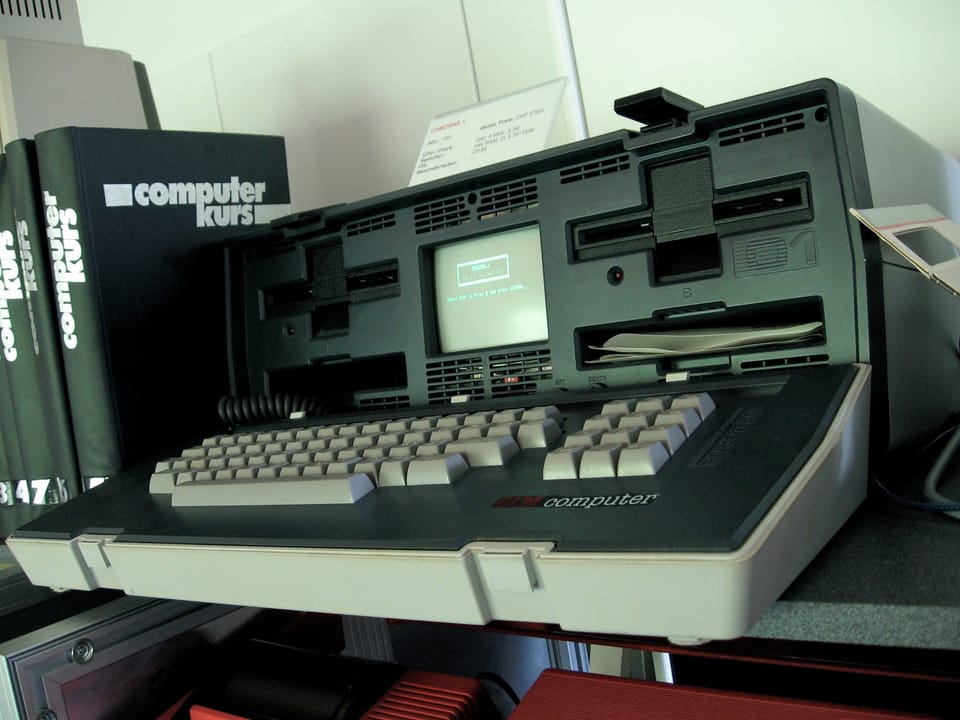
Osborne resolved this operational sequence by integrating every required component into a single fold-out chassis weighing 24.5 pounds, or roughly 11 kilograms.34 When unlatched, the front cover of the plastic housing dropped downward to serve as a detachable, 69-key full-sized keyboard.43 Behind the keyboard sat a central five-inch monochrome cathode-ray tube, or CRT, flanked on either side by two 5.25-inch single-sided floppy disk drives that could each store 90 kilobytes of data.13 The internal electronics ran on an eight-bit Zilog Z80 central processing unit operating at four megahertz, supported by 64 kilobytes of main random-access memory, or RAM.42
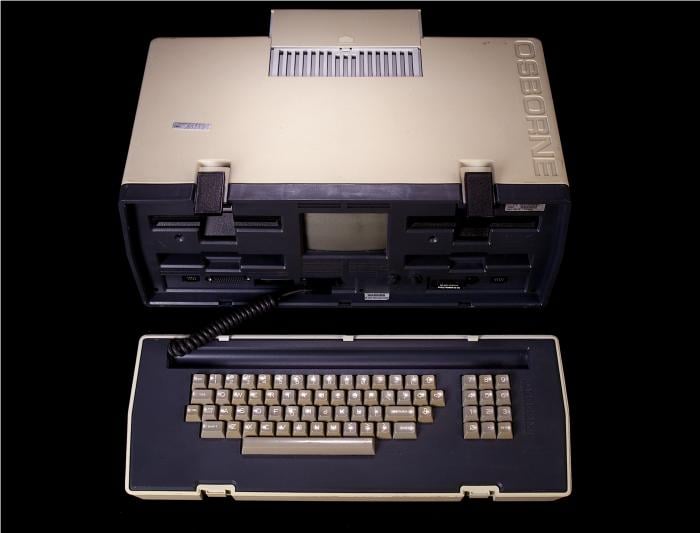
The device did not incorporate an internal battery, requiring a mains electrical outlet or an external battery pack that supplied roughly one hour of operational runtime.23 Despite its substantial bulk, which earned it the informal classification of a luggable computer, the configuration permitted users to close the lid, pick up the top handle, and transport an entire operational system between locations without disassembling delicate components or packing multiple separate crates.45
Equally critical to its immediate adoption was an aggressive commercial pricing model. Osborne set the retail price of the package at $1,795, a figure that incorporated not merely the physical chassis and central processor, but an extensive library of bundled commercial software.15 The machine ran Digital Research CP/M 2.2, a standard microcomputer operating system of the early 1980s that allowed users to execute programs across compatible eight-bit hardware.31 Included in the purchase price were the MicroPro WordStar word-processing program, the Sorcim SuperCalc electronic spreadsheet, and both Microsoft BASIC and Compiler BASIC programming languages.13
How did a tiny screen function as an entire office?
Displaying productive business documents on a five-inch diagonal monitor posed severe spatial constraints for everyday reading and text entry. Standard office monitors of the era presented 80 columns of text across 24 lines, matching the width of a printed sheet of typewriter paper. The internal cathode-ray tube of the Osborne 1 offered a viewing window restricted to 52 characters across 24 lines, creating initial skepticism among prospective buyers who feared the display would prove illegible during prolonged document drafting.14
The system compensated for this physical limit by treating the small glass face as a sliding window over a larger virtual text buffer stored in internal memory.3 Operators could scroll through lines to draft complex correspondence in WordStar or analyze numerical budgets in SuperCalc. For work environments where higher character density was mandatory, the chassis provided external video connections that allowed users to attach a larger standalone monitor, such as the 12-inch Osborne GM-12 display, which delivered standard full-width viewing while working at a desk.34
This combination transformed operational rhythms across several professions. Legal teams hauled the luggable boxes directly into courtrooms to inspect evidentiary files and legal briefs during trials.1 Traveling auditors entered balance sheets into SuperCalc while sitting across from corporate clients.1 Foreign correspondents carried the hardware on international assignments, including reporter David Kline, who hauled an Osborne 1 and an auxiliary power pack into the mountains of Afghanistan during 1982 to draft and transmit field reports.1
Commercial demand expanded at an unprecedented pace following initial deliveries in June 1981.1 Osborne Computer Corporation logged its first $1 million sales month in September 1981.13 Within its first eight months of general distribution, the company delivered 11,000 units, eventually reaching a production velocity of 10,000 computers per month.31 Total annual revenues climbed to $73 million during the first full year of operations and touched $100 million in the subsequent fiscal period.1
What caused the rapid collapse of Osborne Computer Corporation?
The sudden commercial success of the Osborne 1 revealed severe operational and technological limitations that soon overwhelmed the young enterprise. The machine was fundamentally a product of eight-bit CP/M architecture and single-density storage media, bound to an enclosure that suffered notable reliability issues. Its disk drives, manufactured with custom controller cabling that combined power and data lines, were vulnerable to heat accumulation and soldering flaws, while drive heads occasionally drifted past track zero and jammed.3
As competing manufacturers recognized the scale of the portable market, rivals introduced more capable hardware at comparable price brackets. In 1982, Non-Linear Systems introduced the Kaypro II, matching the $1,795 retail price while providing an expansive nine-inch display and double-density disk drives capable of storing twice the information per disk.13 Furthermore, the microcomputer landscape experienced a generational pivot toward 16-bit processing after IBM released the IBM Personal Computer in August 1981, followed in 1983 by the portable, IBM-compatible system produced by Compaq Computers.32
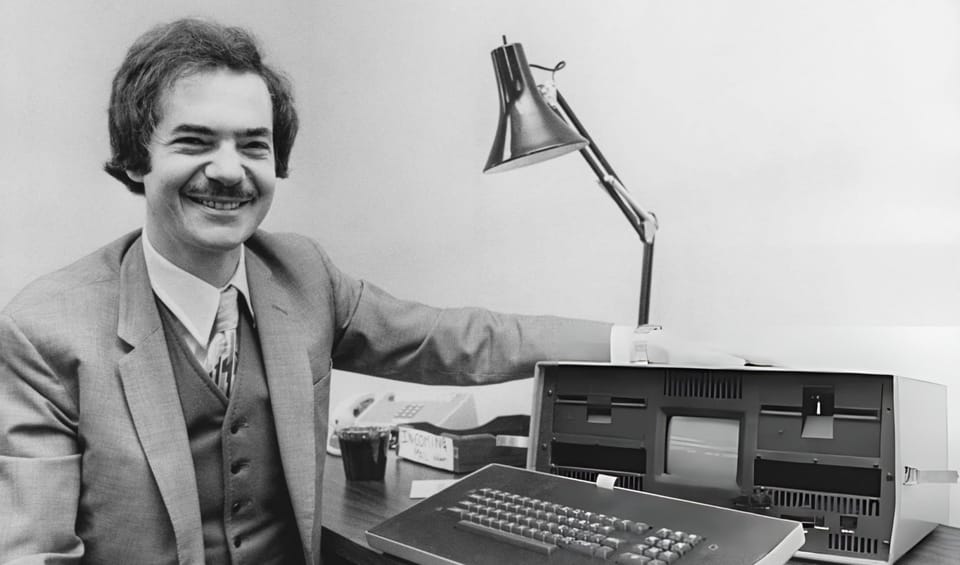
Caught between aging technical specifications and encroaching competitors, Adam Osborne committed a historic commercial blunder in early 1983 by publicly previewing upcoming product lines, including an enhanced portable called the Osborne Executive and an IBM-compatible project dubbed the Vixen.12 The announcements occurred long before the replacement hardware was ready for volume manufacturing. Anticipating superior displays and enhanced processing, wholesale dealers and end consumers abruptly cancelled standing orders for the Osborne 1, leaving warehouse inventories stranded without cash flow.12
The operational crisis forced rapid factory closures, mass employee layoffs, and the cancellation of an intended public stock offering.1 On September 13, 1983, Osborne Computer Corporation filed for bankruptcy protection.15 The business episode entered corporate textbooks under the title of the Osborne Effect, defining the hazard of prematurely announcing unreleased products and cannibalizing the sales life of an existing line before replacements can ship.12
What did the briefcase computer leave behind?
The physical form of the Osborne 1 did not endure as the final template for personal computing. Its bulk, absence of an internal power cell, and reliance on eight-bit instruction sets were quickly superseded by battery-powered notebook systems like the Epson HX-20 and the TRS-80 Model 100, which abandoned cathode-ray tubes for flat liquid-crystal screens and integrated keyboard designs.3 Osborne Computer Corporation attempted a brief reorganization, releasing the lighter Vixen in 1984, but closed its doors permanently in 1986.1
The fundamental principles proved profoundly durable. Osborne demonstrated that consumers valued bundled, out-of-the-box productivity software as highly as the physical computational silicon itself, establishing a commercial standard that defined personal microcomputing for subsequent decades. More importantly, the 24-pound plastic box proved that professional labor was no longer confined to corporate headquarters. By forcing computing into transit, the machine laid the social and operational groundwork for modern laptops, mobile workstations, and untethered knowledge work.
The record
33 sentences trace to 5 sources.
-
1
JS
 Jordan Strickler
Document
· zmescience.com · 31 Oct 2026
The World’s First Laptop Weighed 24 Pounds and Had a Five-Inch Screen, But It Changed Computers Forever
See the source
- 2 Osborne 1 - Computer - Computing History See the source
-
3
WF
 Wikimedia Foundation, Inc.
Third-party reporting
· en.wikipedia.org · 26 Mar 2003
Osborne 1 - Wikipedia
See the source
-
4
U
 uwaterloo.ca
Third-party reporting
· uwaterloo.ca
Early Portable Computers | Computer Museum | University of Waterloo
See the source
- 5 Osborne Computer Corporation | Selling the Computer Revolution | Computer History Museum See the source