Ethereum mining rewards funnel into four terminal accounts
Capital generated by block production settles into a tiny cluster of destination wallets that bypass the network's largest mining operators, according to new mathematical research.
Blockchains rely on distributed computing to prevent any single entity from gaining financial or operational dominance over the digital ledger. For years, observers evaluated network health by counting how many independent participants produced blocks, assuming that a wide dispersion of block creators guaranteed an equally decentralized economy. That assumption overlooked where the generated tokens traveled once operators received their payouts.
When a validator or miner confirms transactions on the Ethereum network, the protocol awards newly created tokens alongside transaction fees into the operator's digital wallet. Those funds rarely remain stationary. Node operators continually spend tokens to cover electricity bills, acquire processing hardware, distribute shares to pool participants, or transfer reserves onto commercial trading venues. Each transaction sends cryptocurrency hopping from one address to the next across an expanding web of transfers. If those diverging pathways continually branch outwards, the economic proceeds remain widely shared. If those pathways loop back toward common endpoints, economic control reconcentrates far away from the public block-production layer.
Why does validator revenue matter for network concentration?
Measuring where blockchain rewards ultimately flow determines whether economic influence over a decentralized network remains dispersed or concentrates into few hands. Traditional decentralization metrics focus almost entirely on the origination side of transactions, cataloging which mining pools or staking entities create each block.1 According to a preprint paper by Irene Aldridge, an academic and quantitative researcher, focusing strictly on who produces blocks leaves a blind spot regarding where value settles once payouts leave validator balances.1 Aldridge posted the study to the arXiv preprint repository and the RePEc economics network in July 2026.
If mining rewards migrate toward a tight group of custodial hubs, liquidity pools, or private treasuries, the operational decentralization of block production can mask financial centralization. A network might contain thousands of active validator nodes while its actual purchasing power and capital accumulation funnel directly toward a tiny cluster of final recipients. Understanding destination concentration provides a separate test of whether a distributed ledger remains economically decentralized after rewards leave their creators.
How do mathematical models trace long-run fund destinations?
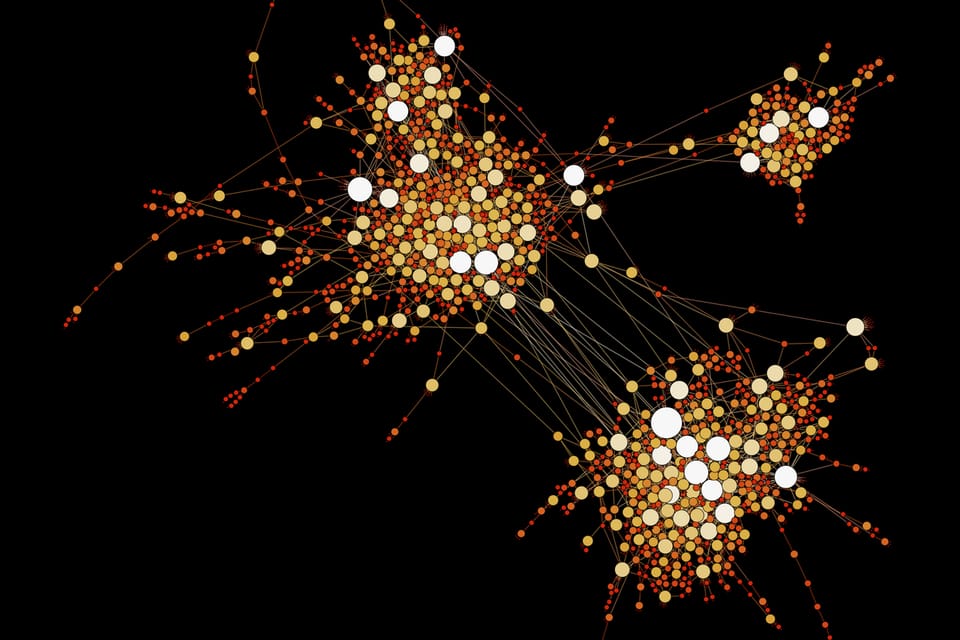
Treating digital addresses as interconnected points in a probability network allows researchers to calculate where cryptocurrency transfers settle after many transactions. To follow the flow of value without getting lost in millions of individual transactions, Aldridge modeled wallet-to-wallet transfers as a Markov chain, a mathematical framework where every wallet represents a discrete state and each transaction defines the probability of moving from one address to another.1 This approach maps the entire transaction web into a matrix of movement probabilities.
To trace these assets without following individual coins through every branching hop, the paper applies the Perron-Frobenius theorem, a fundamental linear algebra principle establishing that certain positive transition matrices possess a unique stable distribution.1 Aldridge used this theorem to compute steady-state probabilities across the network in near-real time, determining which digital addresses act as absorbing sinks where funds permanently settle over the long run.1 The author describes this system as a spectral methodology because it analyzes the structural spectra, or eigenvalues, of the underlying transfer matrix to reveal destination concentration.1
The mathematical permanence of those destination sinks depends strictly on whether funds ever move again. In response to questions from Primary about what would break this steady-state result in an active network, Irene said that the model would be falsified by "any of the four terminal wallets initiating an outgoing transaction." Irene explained that "as soon as any of the identified sink wallets send money elsewhere, they are no longer complete sinks."
What does terminal convergence reveal about Ethereum?
Mining rewards across thousands of participating Ethereum wallets funneled into four destination accounts, leaving little long-term capital with the network's largest block producers. Aldridge applied the spectral Markov chain framework to historical transaction records covering 76,855 Ethereum wallets drawn from four years of network mining data.1 The analysis showed that value flows across the entire network collapsed into just four terminal accounts.1
Unexpectedly, the paper reports that none of those four terminal destination accounts were among the network's three dominant identifiable revenue-earning miners.1 The entities that earned the largest share of mining rewards did not hold onto their capital, nor did their primary organizational wallets serve as the ultimate resting places for the network's wealth. Instead, mining proceeds moved out of producer accounts and converged upon an entirely different quartet of terminal endpoints. In response to questions from Primary, Irene noted that "the observed decoupling between origination-side and destination-side concentration raises a lot of questions about Ethereum structure and their network participants."
The exact mechanism behind this funnel remains an open question. Irene told Primary that while an intuitive initial guess might assume revenue concentrates because a few dominant miners earn it, "the evidence shows that the four accounts absorbing the payouts do not belong to the publicly identified miners." Irene added that the paper identifies how origination concentration and destination concentration point to different wallets, "but it has not identified why value specifically funnels to those four endpoints rather than dispersing."
The research presents clear boundaries regarding what its mathematical output can establish. Aldridge conducted the analysis on an academic preprint that has been posted online and has not yet undergone formal peer review. The mathematical model evaluates stationary probabilities within a closed graph of historical mining data, which represents a structural simulation of fund convergence rather than a forensic audit of transaction motives.1 Furthermore, the preprint identifies the mathematical existence of the four terminal accounts from network data but does not disclose the real-world owners, legal identities, or institutional roles behind those destination addresses.1
The author disputed framing the work as a simulation during discussions with Primary. Irene said that the research supports "a fairly narrow, well-scoped claim: in this four-year sample of miner-adjacent wallets, aggregate fund flow converges disproportionately on four addresses that are structurally distinct from the top revenue-earning miners." Regarding the identity of those addresses, Irene told Primary that "the paper does not attempt to identify the addresses: they are obscured by Ethereum design -- this is the intent of cryptocurrencies following Satoshi Nakamoto's principles."
The dataset itself reflects historical protocol activity rather than the current staking environment. In response to questions about the observation window, Irene told Primary that the analysis began in 2024 using transaction logs from January 2019 to August 2023, spanning three and a half years of historical records. Irene added that subsequent restrictions on Ethereum data downloads make it difficult to determine how sensitive the four-sink result is to alternate timeframes. Future research will need to examine whether modern proof-of-stake validators replicate this destination concentration or disperse value across a broader commercial landscape.
The record
20 sentences trace to 1 source and 1 contributor.
- 1 Where Does Ethereum Validators' Money Go? A Spectral Analysis Not published online
- 2 Contribution — Irene Aldridge 14 statements added to this article
Article history
-
Published 2 Nov 2026, 13:22Assembled by the Primary desk from 1 source · 1 contributor · 20 cited sentences
-
Irene Aldridge, an academic and quantitative researcher
- Go to the sentence: In response to questions from Primary about what would break this steady-state result in an active network, Irene said that the model would be falsified by "any of the four terminal wallets initiating an outgoing transaction."
- Go to the sentence: Irene explained that "as soon as any of the identified sink wallets send money elsewhere, they are no longer complete sinks."
- Go to the sentence: Aldridge applied the spectral Markov chain framework to historical transaction records covering 76,855 Ethereum wallets drawn from four years of network mining data.
- Go to the sentence: The analysis showed that value flows across the entire network collapsed into just four terminal accounts.
- Go to the sentence: Unexpectedly, the paper reports that none of those four terminal destination accounts were among the network's three dominant identifiable revenue-earning miners.
- Go to the sentence: In response to questions from Primary, Irene noted that "the observed decoupling between origination-side and destination-side concentration raises a lot of questions about Ethereum structure and their network participants."
- Go to the sentence: Irene told Primary that while an intuitive initial guess might assume revenue concentrates because a few dominant miners earn it, "the evidence shows that the four accounts absorbing the payouts do not belong to the publicly identified miners."
- Go to the sentence: Irene added that the paper identifies how origination concentration and destination concentration point to different wallets, "but it has not identified why value specifically funnels to those four endpoints rather than dispersing."
- Go to the sentence: The mathematical model evaluates stationary probabilities within a closed graph of historical mining data, which represents a structural simulation of fund convergence rather than a forensic audit of transaction motives.
- Go to the sentence: Furthermore, the preprint identifies the mathematical existence of the four terminal accounts from network data but does not disclose the real-world owners, legal identities, or institutional roles behind those destination addresses.
- Go to the sentence: Irene said that the research supports "a fairly narrow, well-scoped claim: in this four-year sample of miner-adjacent wallets, aggregate fund flow converges disproportionately on four addresses that are structurally distinct from the top revenue-earning miners."
- Go to the sentence: Regarding the identity of those addresses, Irene told Primary that "the paper does not attempt to identify the addresses: they are obscured by Ethereum design -- this is the intent of cryptocurrencies following Satoshi Nakamoto's principles."
- Go to the sentence: In response to questions about the observation window, Irene told Primary that the analysis began in 2024 using transaction logs from January 2019 to August 2023, spanning three and a half years of historical records.
- Go to the sentence: Irene added that subsequent restrictions on Ethereum data downloads make it difficult to determine how sensitive the four-sink result is to alternate timeframes.