Repainting visual scenes helps small robot policies master unfamiliar rooms
Stripping away surface textures and rendering objects in uniform role colors allows lightweight robotic controllers to manipulate items across altered tables and backgrounds without retraining.
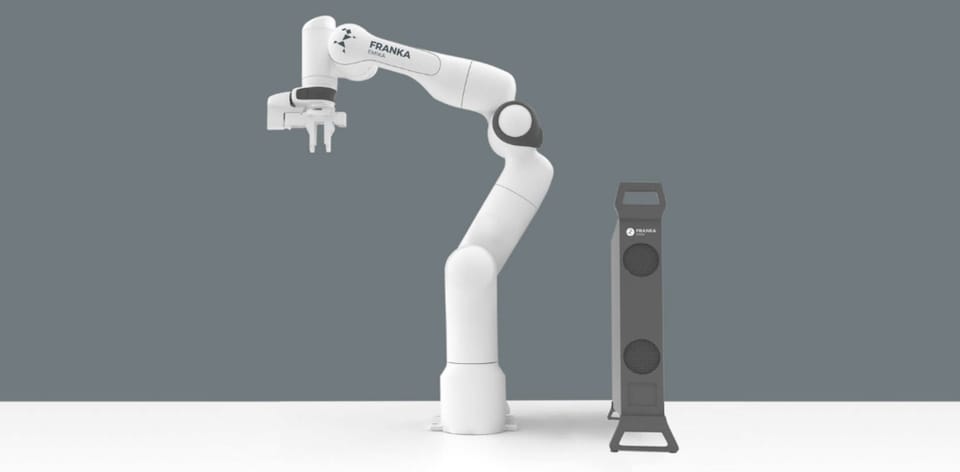
A robot trained to tidy a counter or grasp a cup in an engineering laboratory can execute its movements with remarkable precision. When that same machine faces a counter made of dark granite, or a yellow mug in place of a familiar red one, its physical dexterity frequently vanishes.1 The arm may hesitate, sweep through empty air, or crash clumsily into the tabletop. In typical imitation learning setups, a compact neural network learns to predict motor commands by connecting raw camera pixels directly to joint velocities, memorizing surface reflections and background grain alongside the object's physical position.1
Teaching robots to ignore these superficial visual shifts has traditionally demanded collecting hundreds of thousands of demonstrations across varied environments, an endeavor requiring immense operational fleets.12 Alternatively, enormous vision-language-action models can absorb broad visual contexts, but their computational size makes them difficult to run on compact processors embedded within robotic limbs.1 For practical deployment, control policies must remain lightweight and fast.
To understand why visual shifts disrupt robotic control, consider the causal chain behind a successful reach. First, a mounted camera records a grid of colored pixels representing the workspace. Second, a control policy scans that grid to locate the target and determine where the gripper sits in relation to it. Third, the policy calculates the joint rotations needed to close that distance. Fourth, motors apply electrical torque to move the arm along that trajectory. When the controller relies on raw color values, a change in lighting or surface paint breaks the second link in that chain. The target remains in the exact same physical position, yet the policy fails to recognize where the reach should begin.
An intuitive solution separates visual perception from motor control.1 If an auxiliary visual filter can identify the essential objects in the scene, erase background clutter, and present the control network with a clean, standardized map, the robot never has to wrestle with fluctuating paint colors.1 The control system can then focus entirely on physical geometry, steering the gripper toward the target using shapes and spatial relationships rather than shifting pixel colors.1
In a preprint posted on the arXiv server in September 2026, researchers at Mohamed bin Zayed University of Artificial Intelligence in Abu Dhabi demonstrated a framework based on this division of labor. Haoran Ding, Liang Ma, Yaxun Yang, Wen Yang, Tianyu Liu, Xiaodan Liang, Dezhen Song, Ivan Laptev, Yoshihiko Nakamura, and Anqing Duan developed a visual interface connecting pretrained vision foundation models with compact visuomotor policies.1 By stripping away extraneous textures and repainting objects into standardized role colors or geometric depth maps, the framework enabled small policy networks to maintain high manipulation accuracy across diverse appearance shifts without altering policy architectures.1
Why do small robot control policies struggle with new backgrounds?
Small robot control policies struggle with new backgrounds because their lightweight visual encoders treat background pixels and target items as an inseparable composite of color information.1 When a policy trains on demonstration trajectories, lighting, surface textures, and camera angles remain steady, leading the network to form rigid statistical associations between specific pixel patterns and motor velocities.1 When an environmental change occurs, such as moving the apparatus to a table with a distinct grain or introducing distracting objects nearby, incoming pixel values drift outside the training distribution.1 Small visuomotor policies lack the capacity to generalize across broad visual domains on their own, causing the policy to misjudge object boundaries or miss targets entirely.1
Earlier research addressed visual distraction by seeking spatial correspondences across viewpoints or by expanding demonstration datasets. A study by Peter Florence, Lucas Manuelli, and Russ Tedrake investigated self-supervised visual representations for manipulation, showing that learning coordinate mappings helps compact controllers locate keypoints across spatial changes. In related work, Jiange Yang and colleagues explored transferring foundation models to robotic manipulation by injecting segmentation masks alongside raw visual streams.2 However, feeding raw color imagery into downstream policies leaves them vulnerable whenever surface paint, grain, or illumination changes unexpectedly.
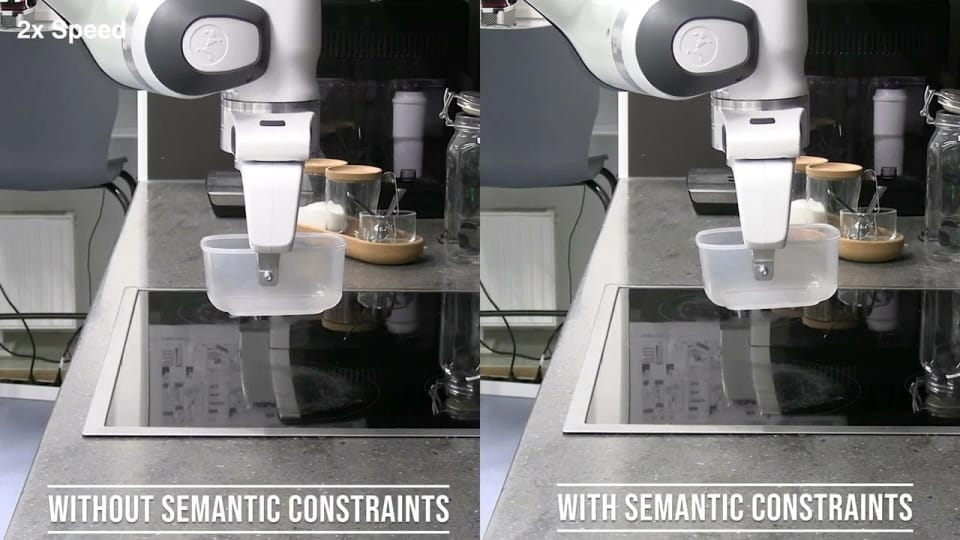
When robots predict entire trajectories rather than instantaneous steps, this visual sensitivity persists. In foundational work on visuomotor learning, Cheng Chi and colleagues established Diffusion Policy, demonstrating that formulating action prediction as a conditional denoising diffusion process improves training stability and handles complex action distributions across multiple benchmark suites. Even with advanced flow matching decoders, compact neural networks falter if their visual inputs mix essential target silhouettes with irrelevant table reflections.
How does semantic repainting standardize what the robot sees?
Semantic repainting standardizes what the robot sees by replacing raw camera images with synthetic observations where essential entities appear in uniform colors on a pitch-black background.1 In place of raw RGB images, Ding and his colleagues used Segment Anything Model 3, known as SAM 3, to detect and segment the primary actors in the workspace.1 Developed by Nicolas Carion and colleagues, SAM 3 detects, segments, and tracks visual objects prompted by short text concepts, drawing on a training dataset that contains four million unique concept labels across image and video sequences.
In the Abu Dhabi team's framework, SAM 3 receives task-specific text prompts identifying the mechanical arm and the target object.1 Anqing told Primary that the system relies on structured instructions during perception: "We used fixed prompt templates for each benchmark, with separate prompts identifying the robot or gripper and the task’s target object, such as ''Robot arm" and "Microwave". We observed that the foundation model is robust to alternative prompt phrasings." Once the segmentation model generates binary masks outlining those entities, a semantic rendering operator constructs a standardized three-channel image designated as the L0 observation.1
Within this repainted image, the robot gripper and the target object are filled with fixed, consistent role colors, while every remaining background pixel is turned black.1 This repainting operation strips away original surface colors, printed textures, reflections, and surrounding clutter.1 Because the visual interface discards raw color distributions while preserving spatial position and silhouette shape, a wooden cup, a metallic cup, and a plastic cup look identical to the downstream policy.1 The small control model receives an input that remains consistent across training and deployment, predicting joint actions without being misled by surface variations.1
Physical interaction often demands subtle alignment, but the interface leaves fine dynamics to demonstration learning. Addressing how policies cope without raw textures, Anqing said, "In our work, the policy learns to use the observations to predict actions from demonstrations, rather than explicitly predicting contact normals. The fidelity of fine boundaries and geometric details depends on segmentation and depth quality."
What role does depth play when objects lack visual texture?
Incorporating depth provides structural contours and spatial orientation that flat silhouettes erase.1 While the uniform coloring of the L0 representation effectively shields the policy from surface distractions, it also flattens the internal features of the target object.1 When an item possesses complex curves, handles, or indentations, rendering it in a single solid tone removes the visual edges that reveal which way the object is facing or where the gripper should clamp down.1
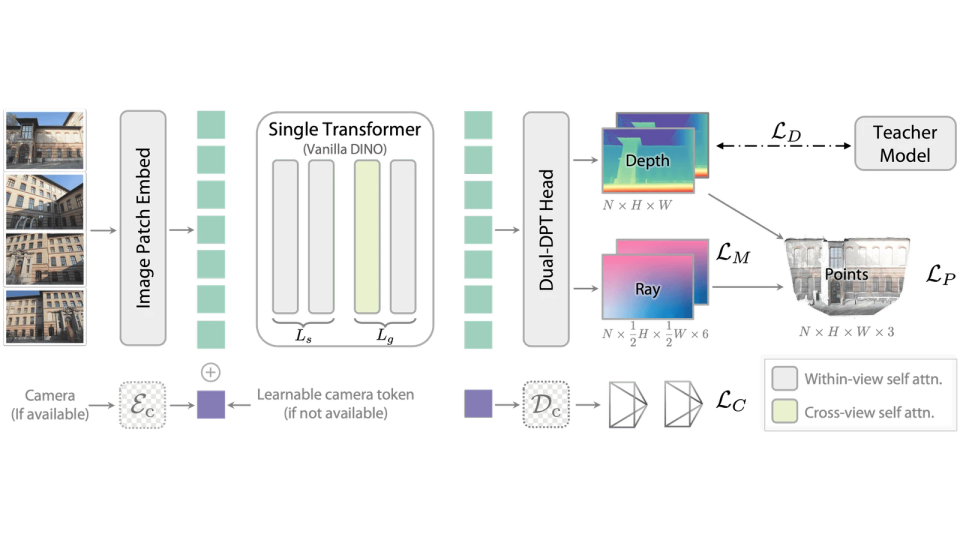
To address tasks requiring finer geometric awareness, Ding and his colleagues created a second observation representation designated as L1, integrating monocular depth estimates from Depth Anything 3.1 Introduced by Haotong Lin and colleagues, Depth Anything 3 predicts spatially consistent geometry from visual inputs using a transformer encoder, outperforming Depth Anything 2 on monocular depth estimation benchmarks.1 In the visual interface, Depth Anything 3 generates a depth map from the raw camera frame.1 The researchers extract the estimated depth values falling strictly inside the target object's segmentation mask and normalize those values between zero and one, capturing the relative relief and surface contours of the object.1
The normalized depth map is repeated across three color channels and inserted into the target object's silhouette, while the robot gripper retains its fixed role color and the background remains black. This hybrid representation supplies the policy with three-dimensional spatial cues without reintroducing chaotic background clutter or variable surface paint. Because both L0 and L1 observations are formatted as standard three-channel image arrays, the robotic policy processes them through its existing visual encoder without structural modifications.1
Integrating depth models into physical execution revealed unexpected calibration hurdles. Discussing early iterations with the depth foundation model, Anqing said, "One unexpected issue was that fine-tuning DA3 with recorded RGB–depth pairs resulted in noisy captured depth. We therefore used pretrained DA3 directly for our real-robot experiments."
To verify their design, Ding and his colleagues evaluated small flow matching policies, which model actions as continuous velocity paths that transform random noise into smooth robotic trajectories. The team tested the policies across established simulation suites, including RoboMimic for lifting tasks, ManiSkill for grasping objects from the YCB benchmark, and RLBench for manipulation challenges such as closing a grill, lowering a toilet seat, shutting a microwave, and opening a box.1 They also deployed the system on physical Franka robotic arms, testing manipulation success when target objects changed color and when background surfaces featured novel patterns or clutter.
Across these benchmarks, policies trained on repainted semantic and geometric observations maintained task success across appearance shifts that caused standard policies trained on raw RGB images to falter. Attributed measurements highlight the stark difference under surface variations. Anqing told Primary, "Using the same flow-matching policy architecture and training budget, semantic repainting increased average success from 18.4% to 90.7% for cube lifting under tabletop-color changes." The team additionally verified the visual interface with SmolVLA on RLBench, confirming that the benefits extended to a second policy architecture.1
The training procedure strictly separates visual perception adaptation from policy learning. When adapting the perception foundation models, Ding and his colleagues applied low-rank adaptation using the PEFT software library, optimizing auxiliary parameters while holding the base foundation models frozen. For SAM 3, the team inserted low-rank adapters with rank eight, an alpha scaling factor of 16, and a dropout rate of 0.05 into self-attention query and value projections within the final four transformer blocks of the text encoder. They trained these adapters for 50 epochs using AdamW with a learning rate of 0.0005, a weight decay of 0.01, and a combined loss pairing binary cross-entropy with a Dice loss weighted at 0.5, evaluating task success over three random seeds. For Depth Anything 3, adapters were placed in encoder projections and trained for 100 epochs with AdamW at a learning rate of 0.0001 using scale-invariant loss with a coefficient of 0.85, resizing images to a target dimension of 504 pixels with a patch size of 14. Once adapted on in-distribution training data, perception parameters were locked completely while the downstream policy trained on the resulting observations.1
Where does visual repainting reach its limits?
The framework's primary constraint is that the control policy becomes entirely dependent on upstream segmentation accuracy. If the vision foundation model fails to identify an object or hallucinates a phantom gripper, the downstream policy receives an incomplete observation and cannot execute its learned skill. Furthermore, the monocular depth calculations represent normalized relative contours within a segmented patch, leaving absolute metric distance unmeasured.1 The evaluations tested structured appearance shifts, such as novel tabletop hues and distractor objects, leaving open questions about dynamic visual disturbances like flickering ambient light, rapid camera motion, or severe physical occlusions.1 Because the research was posted as a preprint to the arXiv server in September 2026, it has not yet undergone formal peer review.1
The researchers acknowledge that discarding texture creates inherent blind spots for certain manipulation challenges. Anqing explained to Primary how severe optical interference degrades the pipeline: "The abstraction depends on correctly identifying the robot and target. Severe occlusion, low contrast, or strong reflections could cause segmentation to miss an entity or include the wrong region. Repainting would then present the policy with an incorrect shape or spatial relationship, and the policy cannot recover visual information that the interface has removed."
Tasks that inherently rely on surface patterns also expose the boundaries of uniform repainting. When asked what environment might fundamentally challenge this visual abstraction, Anqing said, "Conceivably, a task whose success depends on an object's color or texture will require a more sophisticated visual policy-learning strategy."
These experimental findings nevertheless demonstrate a practical division of responsibilities for physical machine learning. Instead of forcing a single compact neural network to decipher messy real-world visual environments while simultaneously generating precise motor commands, robotics developers can use pretrained vision models as visual filters that standardize incoming sensory streams.1 As vision foundation models become faster and more adept at tracking complex objects in real time, pairing them with lightweight action policies offers a viable pathway toward autonomous robots that can operate across unfamiliar homes and workplaces without stumbling over the color of the furniture.
The record
50 sentences trace to 2 sources and 1 contributor.
-
1
HD
 Haoran Ding, Liang Ma, Yaxun Yang, Wen Yang, Tianyu Liu, Xiaodan Liang, Dezhen Song, Ivan Laptev, Yoshihiko Nakamura, Anqing Duan
Paper
· arxiv.org · 16 Sep 2026
Foundation and Small Models Coordination for Visuomotor Policy Learning
Preprint · may not have been peer reviewed
See the source
-
2
A
arxiv.org
Paper
· arxiv.org
Transferring Foundation Models for Generalizable Robotic Manipulation
Preprint · may not have been peer reviewed
See the source
- 3 Contribution — Anqing Duan 10 statements added to this article
Other consulted pages1 page
arxiv.org3 pages
dspace.mit.edu1 page
Article history
-
Published 3 Nov 2026, 13:09Assembled by the Primary desk from 2 sources · 1 contributor · 50 cited sentences
-
Anqing Duan
- Go to the sentence: By stripping away extraneous textures and repainting objects into standardized role colors or geometric depth maps, the framework enabled small policy networks to maintain high manipulation accuracy across diverse appearance shifts without altering policy architectures.
- Go to the sentence: In the Abu Dhabi team's framework, SAM 3 receives task-specific text prompts identifying the mechanical arm and the target object.
- Go to the sentence: Anqing told Primary that the system relies on structured instructions during perception: "We used fixed prompt templates for each benchmark, with separate prompts identifying the robot or gripper and the task’s target object, such as ''Robot arm" and "Microwave". We observed that the foundation model is robust to alternative prompt phrasings."
- Go to the sentence: Addressing how policies cope without raw textures, Anqing said, "In our work, the policy learns to use the observations to predict actions from demonstrations, rather than explicitly predicting contact normals. The fidelity of fine boundaries and geometric details depends on segmentation and depth quality."
- Go to the sentence: Discussing early iterations with the depth foundation model, Anqing said, "One unexpected issue was that fine-tuning DA3 with recorded RGB–depth pairs resulted in noisy captured depth. We therefore used pretrained DA3 directly for our real-robot experiments."
- Go to the sentence: Across these benchmarks, policies trained on repainted semantic and geometric observations maintained task success across appearance shifts that caused standard policies trained on raw RGB images to falter.
- Go to the sentence: Anqing told Primary, "Using the same flow-matching policy architecture and training budget, semantic repainting increased average success from 18.4% to 90.7% for cube lifting under tabletop-color changes."
- Go to the sentence: If the vision foundation model fails to identify an object or hallucinates a phantom gripper, the downstream policy receives an incomplete observation and cannot execute its learned skill.
- Go to the sentence: Anqing explained to Primary how severe optical interference degrades the pipeline: "The abstraction depends on correctly identifying the robot and target. Severe occlusion, low contrast, or strong reflections could cause segmentation to miss an entity or include the wrong region. Repainting would then present the policy with an incorrect shape or spatial relationship, and the policy cannot recover visual information that the interface has removed."
- Go to the sentence: When asked what environment might fundamentally challenge this visual abstraction, Anqing said, "Conceivably, a task whose success depends on an object's color or texture will require a more sophisticated visual policy-learning strategy."