Power draw reveals whether graphics processors are training advanced artificial intelligence
Auditors could verify compliance with international computing treaties by measuring the electrical current pulled by server power cables.
When a semiconductor chip performs computational work, it pulls electric current in direct proportion to the rapid switching of its microscopic circuits. Processing a stream of continuous text requires a steady rhythm of calculations across the processor cores. Adjusting billions of mathematical weights across an entire network requires something entirely different: intense bursts of number crunching followed by quiet moments where data shifts heavily between the processor and external memory chips. These shifts create distinct electrical fluctuations along the power cables feeding the hardware.
International discussions surrounding artificial intelligence governance increasingly depend on knowing how massive computing clusters are being used. Regulators and safety auditors want to verify whether high-end computing facilities are adhering to agreed safety standards, export controls, or non-proliferation agreements. Today, monitoring largely depends on software reporting built into operating systems and processor drivers.12 If a facility operator controls the entire software environment, digital reporting counters can be faked, frozen, or replaced with simulated activity logs.12 Physical side channels, which measure the unavoidable thermal or electrical byproducts of computing, offer a potential way to audit hardware without trusting internal software.
Before evaluating any measurement, it helps to understand why training a model looks physically different from running one. When an artificial intelligence model generates text or processes an image, known as inference, it passes incoming information forward through a set of static numerical values called parameters. The computational tempo remains relatively uniform as each layer executes. During model training, the processor must complete that forward step, run a backward calculation to determine errors, and then execute an optimizer update that alters the model weights.1 That final update is constrained by memory transfer speeds rather than raw mathematical throughput. Because the processor cores briefly pause while waiting for memory transfers, the chip temporarily draws less current, creating a repeating electrical signature at lower frequencies.1
Simone Gargiulo, the lead author and a researcher at Pivotal Research, explained that current draw reflects how many transistors toggle per unit of time across different operational blocks of the chip. In response to questions from Primary, Gargiulo said that during forward or backward passes, the graphics processor operates at nearly full switching activity with all streaming multiprocessors active. By contrast, during the optimizer update those multiprocessors are mostly stalled while waiting on memory as weights stream through the High-Bandwidth Memory chips. The optimizer update results to be quieter for a sustained period of time, on the order of tens to hundreds of milliseconds, with its spectral content concentrated at slightly lower frequencies, presenting a unique signature that is absent during model inference.
How can electrical signals reveal what a computer is thinking?
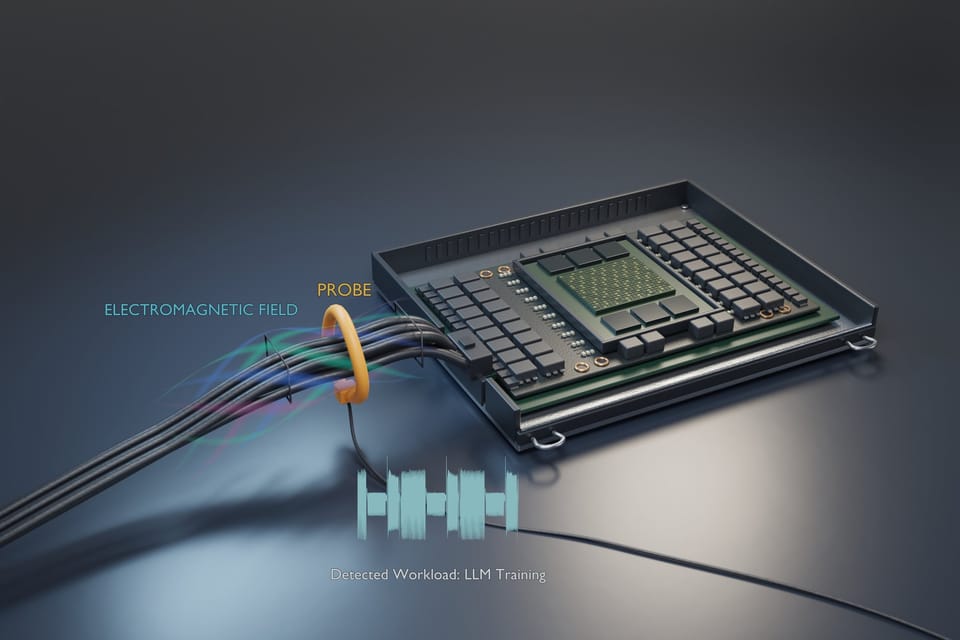
In an experimental preprint posted on the arXiv server, researchers Simone Gargiulo of Pivotal Research and Gabriel Kulp of Intelligence Security Laboratories demonstrated that an external sensor can identify the operational state of a graphics processing unit by observing its power draw.14 The elementary building block of AI compute is the graphics processor, and any activity it executes leaves an unavoidable physical trace.14 Working with an NVIDIA H200 NVL accelerator, the researchers attached an external Rogowski current probe around the positive conductors of the PCIe auxiliary power cables.1 The probe measures fluctuations in the magnetic field around the power cables caused by the changes in the current that supplies the GPU, without modifying the host machine or intercepting data packets.
Simone Gargiulo and Gabriel Kulp recorded 930 five-second power traces sampled at a frequency of 10 megahertz across seventeen open-source large language model families, with sizes ranging between 4 billion and 21 billion parameters.14 Their corpus included both dense models and mixture-of-experts architectures.1 To establish baseline comparisons, the corpus also incorporated 25 non-AI computing tasks, including scientific matrix calculations and an idle baseline state.1 Every training recording in the dataset captured at least one complete optimizer update cycle within its five-second window, using clean initializations to prevent prior GPU scheduling history from skewing the signal.
Using a two-stage random forest classifier that evaluated 30 frequency and time domain features independent of absolute signal volume, the detection framework first categorized whether a workload was machine learning activity, and second, whether that activity constituted model training. Gargiulo told Primary that the design actually uses 22 frequency-domain features and eight time-domain summary statistics. Fourteen of those frequency features capture spectral power within specific bands, while eight characterize overall spectral shape. Gargiulo explained that the three training substeps distribute their power differently across frequencies below 200 hertz and 2 kilohertz, allowing the classifier to separate training phases reliably without needing to measure raw current amplitude.
Evaluated across unseen model families in a grouped cross-validation setup, the system classified genuine workloads with an overall accuracy of 97% and a macro-averaged F1 score of 0.955.14 The analysis revealed that the spectral content most relevant for distinguishing these computational tasks lies predominantly below 20 kilohertz.14 Initial testing at 100 megahertz confirmed that nearly all relevant computational information was confined below 1 megahertz, demonstrating that high-rate physical sampling can capture fine-grained execution dynamics while remaining computationally tractable for auditing software.1
What happens when an operator tries to hide AI training?
An operator attempting to bypass governance rules might deliberately alter their computing routines to deceive an auditing probe. Simone Gargiulo and Gabriel Kulp explored this possibility by testing four simple software-based evasion strategies across all seventeen model families, generating an additional 680 adversarial power traces. These evasion tactics were designed to reshape power fluctuations and disguise training as routine model inference.
The tested evasion methods included splitting the optimizer update into smaller segments, interleaving real training steps with decoy inference passes, throttling compute frequencies, and applying diluted low-rank adaptation.1 Low-rank adaptation, or LoRA, modifies only a small fraction of a model parameters during training. In its diluted form, an operator spreads out these smaller parameter adjustments between longer sequences of genuine model inference, masking the distinct memory-bound electrical drop. Evading detection came with a substantial computational tax: the four evasion strategies reduced genuine training throughput by between 28.1% and 69.3% relative to an honest full fine-tuning baseline.1
When evaluated against a classifier hardened with examples of other evasion techniques in a leave-one-strategy-out setup, three of the four evasion strategies were detected with a success rate of 99% or greater.14 Diluted low-rank adaptation proved more difficult to expose, yielding detection rates between 48% and 88% under the hardened classifier.14 Gargiulo noted that diluting the optimizer update removes the sharpest signature of the training step, forcing the model to rely on subtle structural differences between forward and backward passes. Gargiulo told Primary that fusing the optimizer update directly into the backward calculation could degrade detection performance even further.
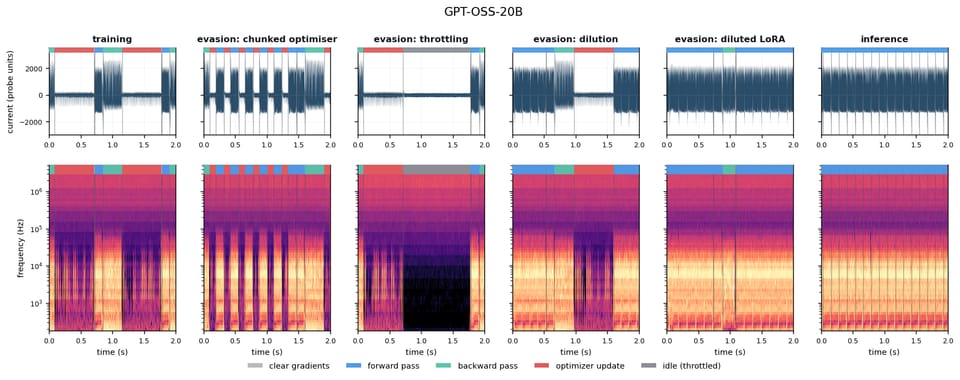
Because the optimizer phase still leaves a brief, characteristic spectral dip at low frequencies, the authors introduced an additional rescue rule that targeted this specific anomaly. Adding this frequency-gated rescue rule raised the detection rate for diluted low-rank adaptation to between 98% and 100% across the tested models.14 Asked about how this rule avoids triggering false alarms during benign operations, Gargiulo said the 10 kilohertz frequency boundary is set from physical observation. Gargiulo explained that an optimizer update concentrates its energy below 10 kilohertz, whereas an idle or throttled processor displays high-frequency noise and a distinct tone near 500 kilohertz. A calibrated mathematical threshold then specifies the exact drop depth required before an inference trace is relabelled as covert model training.
What are the physical limits of hardware auditing?
The findings from Simone Gargiulo and Gabriel Kulp represent an initial proof of concept on a single accelerator rather than a finalized surveillance protocol for commercial computing centers. The experimental dataset was collected entirely on a single NVIDIA H200 NVL unit hosted by Amodo Design. While previous studies using on-chip telemetry suggest that computational signatures remain consistent across hardware generations, verifying that current-based detection generalizes across diverse clusters, power delivery architectures, and multi-GPU nodes will require extensive further testing.
Distributed computing across multi-node clusters represents a critical testing boundary for physical monitoring. When asked where the current detection boundary breaks down, Gargiulo said detection may degrade when the optimizer update is sharded across multiple graphics processors. In that scenario, each processor updates only a small slice of model weights, shrinking the characteristic memory stall. However, Gargiulo expressed confidence that because sharded updates leave brief signatures on individual devices, physics-informed detectors looking for quiet dips could successfully scale to distributed server architectures.
The experimental results are also bounded by the specific evasion techniques evaluated so far. Gargiulo told Primary that a demonstration showing the ability to shape spectral leakage at will, masking underlying activities with arbitrary spectral features, would cause them to abandon the core claim that power traces reliably identify training. However, executing such broad-spectrum physical masking remains a formidable engineering hurdle for an operator. The preprint describing the research has been posted to the arXiv repository and has not yet undergone formal peer review.
Deploying physical side-channel auditing introduces considerable logistical challenges alongside its technical capabilities. Regulatory authorities would require physical access to facility cabling and tamper-resistant monitoring enclosures to verify that probes cannot be detached or falsified. Nevertheless, because external electrical measurements bypass the host operating system entirely, physical side channels force adversaries to alter the actual structure of their computation, establishing a new foundation for verifying international compliance in artificial intelligence development.
This piece was prepared from the arXiv preprint and public records together with answers from Simone Gargiulo to six questions from the Primary news team, completed September 2026.
The record
33 sentences trace to 3 sources and 1 contributor.
-
1
SG
 Simone Gargiulo, Gabriel Kulp
Paper
· arxiv.org · 2 Sep 2026
Workload Identification with Physical Side Channels for AI Governance
Preprint · may not have been peer reviewed
See the source
- 2 Adversarial detection of ML training on monitored GPUs - SPAR Project See the source
- 3 Contribution — Simone Gargiulo 17 statements added to this article
-
4
A
arxiv.org
Paper
· arxiv.org
Workload Identification with Physical Side Channels for AI Governance
Preprint · may not have been peer reviewed
See the source
Other consulted pages1 page
arxiv.org1 page
ethics.ai1 page
Article history
-
Published 13 Nov 2026, 14:16Assembled by the Primary desk from 3 sources · 1 contributor · 33 cited sentences
-
Simone Gargiulo, lead author
- Go to the sentence: During model training, the processor must complete that forward step, run a backward calculation to determine errors, and then execute an optimizer update that alters the model weights.
- Go to the sentence: Because the processor cores briefly pause while waiting for memory transfers, the chip temporarily draws less current, creating a repeating electrical signature at lower frequencies.
- Go to the sentence: In response to questions from Primary, Gargiulo said that during forward or backward passes, the graphics processor operates at nearly full switching activity with all streaming multiprocessors active.
- Go to the sentence: By contrast, during the optimizer update those multiprocessors are mostly stalled while waiting on memory as weights stream through the High-Bandwidth Memory chips.
- Go to the sentence: The optimizer update results to be quieter for a sustained period of time, on the order of tens to hundreds of milliseconds, with its spectral content concentrated at slightly lower frequencies, presenting a unique signature that is absent during model inference.
- Go to the sentence: Gargiulo told Primary that the design actually uses 22 frequency-domain features and eight time-domain summary statistics.
- Go to the sentence: Fourteen of those frequency features capture spectral power within specific bands, while eight characterize overall spectral shape.
- Go to the sentence: Gargiulo explained that the three training substeps distribute their power differently across frequencies below 200 hertz and 2 kilohertz, allowing the classifier to separate training phases reliably without needing to measure raw current amplitude.
- Go to the sentence: Gargiulo noted that diluting the optimizer update removes the sharpest signature of the training step, forcing the model to rely on subtle structural differences between forward and backward passes.
- Go to the sentence: Gargiulo told Primary that fusing the optimizer update directly into the backward calculation could degrade detection performance even further.
- Go to the sentence: Asked about how this rule avoids triggering false alarms during benign operations, Gargiulo said the 10 kilohertz frequency boundary is set from physical observation.
- Go to the sentence: Gargiulo explained that an optimizer update concentrates its energy below 10 kilohertz, whereas an idle or throttled processor displays high-frequency noise and a distinct tone near 500 kilohertz.
- Go to the sentence: A calibrated mathematical threshold then specifies the exact drop depth required before an inference trace is relabelled as covert model training.
- Go to the sentence: When asked where the current detection boundary breaks down, Gargiulo said detection may degrade when the optimizer update is sharded across multiple graphics processors.
- Go to the sentence: In that scenario, each processor updates only a small slice of model weights, shrinking the characteristic memory stall.
- Go to the sentence: However, Gargiulo expressed confidence that because sharded updates leave brief signatures on individual devices, physics-informed detectors looking for quiet dips could successfully scale to distributed server architectures.
- Go to the sentence: Gargiulo told Primary that a demonstration showing the ability to shape spectral leakage at will, masking underlying activities with arbitrary spectral features, would cause them to abandon the core claim that power traces reliably identify training.