Google releases Gemini 4 Hydrogen to balance speed and reasoning costs
A newly introduced orchestration system hands routine coding steps to a lighter model while reserving heavy frontier compute for architectural planning, cutting quota usage in benchmark tests.

When automated software agents attempt to solve engineering problems, they often run into an expensive trade-off. Running an advanced frontier model across every minor edit, terminal command, and automated test burns through computing budgets and slows down execution. Conversely, assigning an entire project to a faster, cheaper system often causes the workflow to stall whenever an unexpected architectural roadblock appears.
To work through complex software tasks effectively, automated systems need a division of labor. A multi-step development process typically begins with understanding requirements, auditing code dependencies, and designing a structured implementation plan. The subsequent phase involves routine execution: modifying files, running automated tests, and reading terminal output. When a tool call fails or a test fails, the agent must inspect the failure, adjust the high-level plan, and resume work.
Addressing that workflow, Google launched Gemini 4 Hydrogen on November 12, 2026, pairing the model with an automated routing engine called Antigravity Orchestrator.12 According to an announcement by Koray Kavukcuoglu, Senior Vice President at Google DeepMind and Chief AI Architect at Google, the model is built for rapid execution across agentic workflows while maintaining a one-million-token context window for text, image, audio, and video inputs.3
How does dynamic orchestration divide developer tasks?
Antigravity Orchestrator manages automated development by dynamically switching between different models during a single task rather than committing to a single model at the outset.12 As explained by The Antigravity Team in a technical overview, traditional model routers inspect an initial prompt and commit the entire run to one model.1 That static routing method tends to falter during long-running tasks where complexity changes as work progresses.1
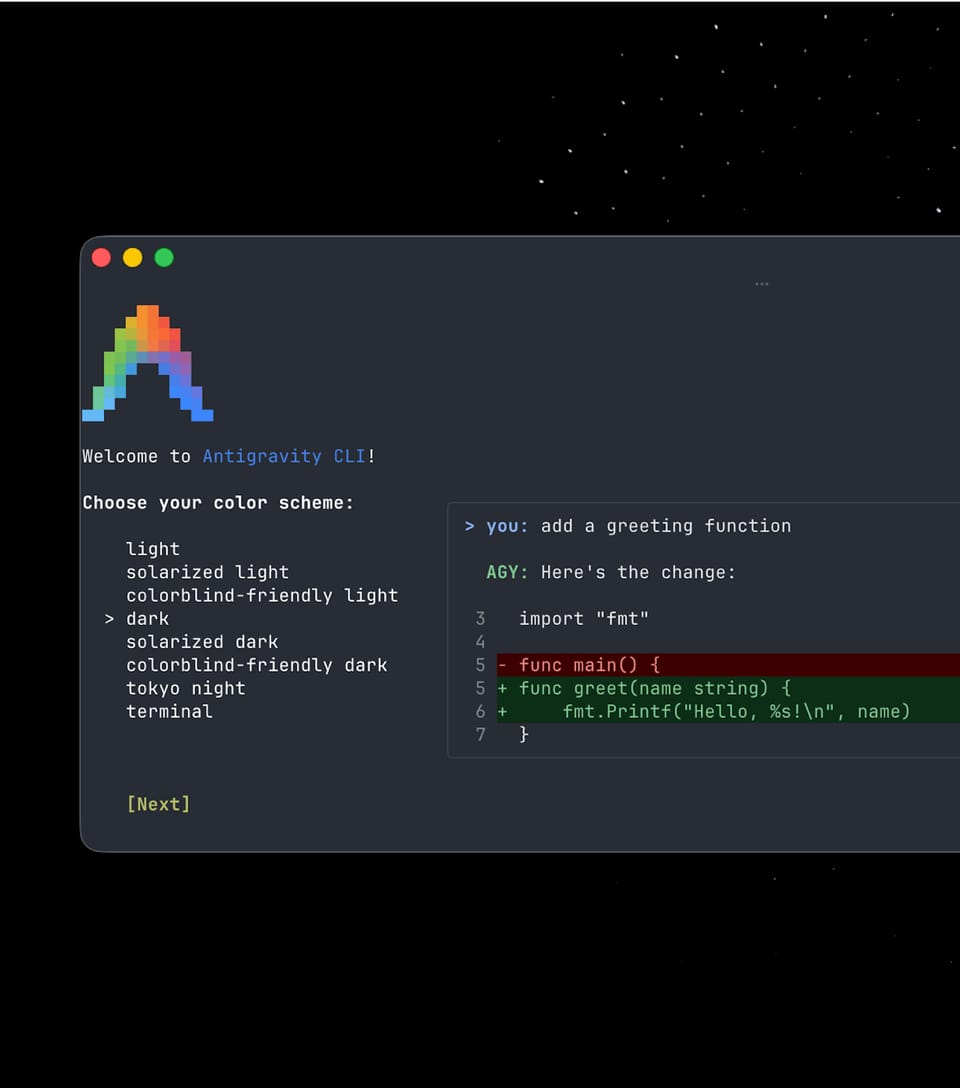
Within the Antigravity system, the frontier model Gemini 4 Carbon initiates a project by exploring repository dependencies, resolving ambiguities, and generating a structured execution plan.1 Gemini 4 Hydrogen then takes over routine execution steps, writing code edits, running tests, and updating software packages.1 If Hydrogen encounters an error or friction during execution, the system routes context back to Carbon to inspect the state and revise the plan.1 The Antigravity Team reported that across tests on Terminal-Bench 4.1, this dynamic collaboration reached near-Carbon success rates while consuming 24 percent less quota and completing tasks 19 percent faster on average.13
Developers seeking manual control can configure these interactions directly through the Antigravity software development kit.1 In an automated issue triage implementation described by The Antigravity Team, Hydrogen agents search codebases, answer clarifying questions, and implement pull-request feedback, while Carbon handles broader architectural refactors, feature design, and security evaluations.1
How does the model perform on standalone benchmarks?
Gemini 4 Hydrogen is designed to operate as a standalone model as well as a component in orchestrated pipelines.12 On the Terminal-Bench 4.1 coding benchmark, Hydrogen achieved a score of 57 percent, compared to 18.2 percent recorded by Gemini 3.8 Flash, according to launch materials published by Google and coverage by AlternativeTo.312 On the Artificial Analysis Intelligence Index, Hydrogen registered a score of 51 at its default high thinking level, surpassing Gemini 4 Argon at 50, and reached 54 when set to its xhigh thinking level.12
Google also evaluated the model across specialized domain assessments.2 Kavukcuoglu reported that Hydrogen scored 58.8 percent on HLE-Diamond, 52.3 percent on Vals Tax Agent Bench, and 55.8 percent on the Vals Legal Research Bench.2 In multimodal evaluations, the model registered 53.4 percent on the Multimodal Knowledge Agent benchmark and 71.6 percent on Agents' Last Exam version 1.1.2 On the Terminal-Bench 4.0 evaluation, Google stated that the model finished tasks 2.5 times faster than Gemini 3.8 Flash at its default high setting, while cutting fabricated claims by more than fivefold on internal evaluations.2

To control computational latency and output depth, Hydrogen provides four selectable thinking levels: low, medium, high, and xhigh.32 For pricing, Google set Hydrogen at $1.50 per million input tokens and $7.50 per million output tokens across its entire context window.32 AlternativeTo reported that this rate makes Hydrogen 25 percent cheaper than promotional pricing for Carbon and Argon, while remaining 50 percent more expensive than competing models such as GPT-6.1 Terra.3 Coverage also noted that while Hydrogen outperforms GPT-6.1 Terra and Claude Sonnet 5.5 across several benchmarks, Claude Sonnet 5.5 remains ahead in computer-use benchmarks.3
What are the boundaries of these benchmark results?
These benchmark scores and quota metrics are controlled performance evaluations and synthetic tests, not guarantees of real-world efficiency across every production codebase. The 24 percent quota reduction and 19 percent speed improvement represent average results on the standardized Terminal-Bench suite, where tasks have structured boundaries and programmatic verification steps.1 Performance in production software environments depends heavily on repository architecture, external network dependencies, and tool stability.
Furthermore, internal metrics such as a 94 percent score on Google's agent honesty evaluation and an 81 percent reduction in agentic overreach reflect specific internal benchmarking protocols rather than formal mathematical proofs of alignment.2 On consumer interfaces, Google noted that Hydrogen has been integrated into Google Search and the Gemini mobile application, where free users access the model through automated selection when an incoming query fits its profile.2
As autonomous software development moves toward larger multi-agent systems, the effectiveness of dynamic orchestration will depend on whether automated handoffs remain reliable across messier, unstandardized enterprise repositories.
The record
25 sentences trace to 3 sources.
- 1 Gemini 4 Hydrogen and Orchestrator | Google Antigravity Blog See the source
- 2 Introducing Gemini 4 Hydrogen See the source
- 3 Google launches Gemini 4 Hydrogen with 1M-token context and Antigravity Orchestrator Not published online