Benjamin Jarvie maps public restrooms across two countries
A free mobile application built by an Australian tradesman taps OpenStreetMap to direct users with medical needs or tight schedules to nearby stalls.
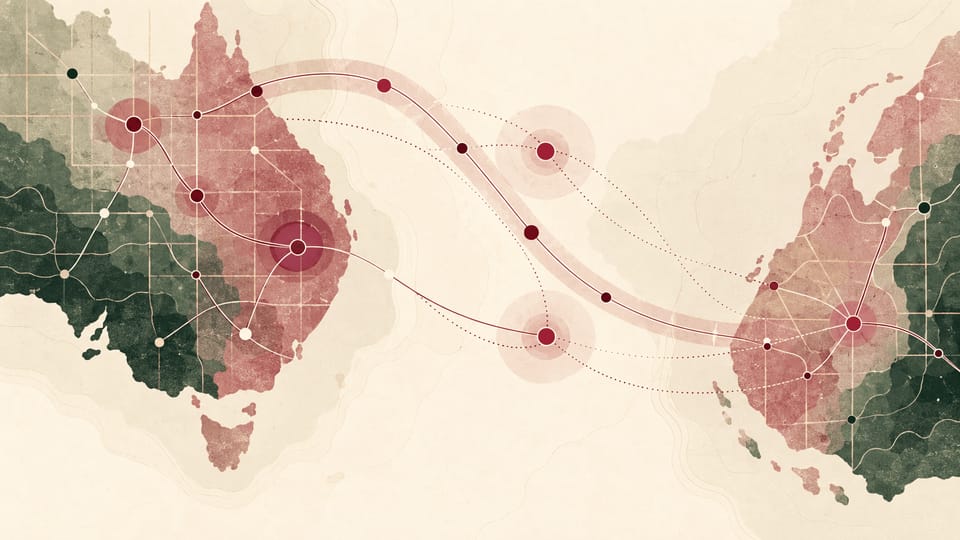
A tradesman in Melbourne has built a mobile application designed to direct people to the nearest public restroom in two taps.12 Benjamin Jarvie, who operates a timber deck restoration business in Australia, developed Dunny Dash as a free tool for people who face sudden medical needs or work long shifts on the road.12 The software, released ahead of the annual United Nations observance of World Toilet Day on November 19, operates across both Australia and the United States.13
Jarvie financed and coded the project himself alongside his daily manual trade work.1 He spent more than 17 years working across job sites where functioning bathrooms were rarely guaranteed, a routine that forced his crew to search for commercial facilities between customer visits.1 Conversations with clients and acquaintances gradually revealed that the absence of accessible bathrooms caused greater disruption for individuals managing chronic digestive and urological conditions.1
"Everyone jokes about toilets until they can't find one," Jarvie said in the announcement of the release.1 "I built Dunny Dash because my crew and I spend all day on the road, and finding a bathroom on the fly was a daily problem. Then people started telling me about their kids, their parents, their Crohn's. That's when I realized this matters far more than I thought."1
For people living with gastrointestinal conditions, delays in locating a stall can cause acute physical distress.1 Flare-ups associated with Crohn's disease often create sudden needs with minimal advance warning.1 Related digestive disorders such as ulcerative colitis, irritable bowel syndrome, and celiac disease require predictable proximity to sanitation.1 Other users include individuals managing urinary incontinence, overactive bladder, prostate conditions, pregnancy urgency, or restricted mobility during post-surgical recovery.1
Mapping data and two-tap routing
Dunny Dash runs on iOS devices running version 16.0 or later, taking up 157.5 megabytes of storage.2 The application is distributed without subscription fees, commercial advertisements, or paid purchases.2 A companion web directory operates at dunnydash.com, while an Android edition remains under active development.12
The underlying database draws directly from OpenStreetMap, a collaborative geographic project maintained by volunteer contributors.2 The app displays timestamps indicating when facility information was last refreshed alongside attribution to the source dataset.2 Municipal registries and road transit databases frequently lag behind local commercial turnover, leaving public directories incomplete or out of date. To compensate, Dunny Dash incorporates crowd-sourced reporting tools that allow community members to submit unlisted park facilities, welcoming cafes, or neighborhood amenities.12
The software interface centers on immediate dispatch.12 Users open the program and press a single prompt labeled "I'M BUSTING!" to load walking directions to the closest accessible stall without requiring text entry or manual map scrolling.12 For travelers planning extended drives, a route planning tool called Quick Plan automatically selects stops along an itinerary, while a separate setting allows drivers to place manual waypoints at custom intervals.12
Search filters allow individuals to sort results by wheelchair accessibility, baby changing tables, indoor placement, and current operating hours.12 Registered users can submit written reviews and upload photographs to confirm cleanliness and operational status before visiting.12 The software also incorporates a game feature called Throne Wars, where visitors claim locations, complete brief in-game challenges, and collect non-monetary Flush Tokens to advance on a community leaderboard.2
Global sanitation targets and public infrastructure
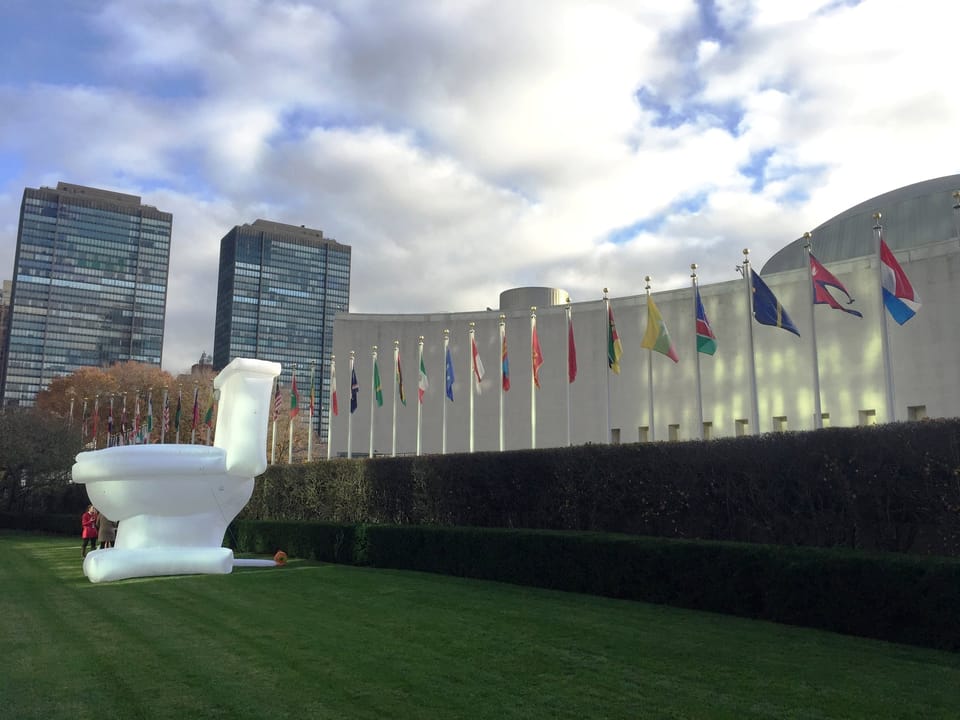
The release of the mobile directory coincides with the 2026 observance of World Toilet Day, an initiative coordinated through UN-Water, the United Nations inter-agency coordination mechanism on water and sanitation.13 Editorial coverage published on the United Nations website by contributor Yinuo notes that the annual observance falls on November 19 to support Sustainable Development Goal 6.3 The broader campaign focuses on sanitation equity under the official theme "Safe toilets. Equal futures."14
Sanitation access remains uneven across municipal centers and rural areas worldwide.34 United Nations monitoring reports indicate that 3.4 billion people globally still lack access to safely managed sanitation services.43 An estimated 1.7 billion people do not possess soap and water handwashing stations at home.4 The burden of inadequate sanitation falls heavily on vulnerable groups, with 1 in 5 adolescent girls between the ages of 10 and 19 forced to share unhygienic facilities or practice open defecation.4 Furthermore, fewer than one in three schools globally maintain menstrual waste receptacles in female restrooms.4
The UN SDG 6 Synthesis Report on Water and Sanitation 2026 documented that 1.2 billion people gained access to safely managed sanitation services over the past decade, while 1.6 billion people acquired basic hygiene infrastructure.3 Despite those gains, international agencies caution that the current rate of progress will not achieve universal coverage by the established 2030 target date.3 The 2026 UN Water Conference has called for accelerated investment to address structural deficits in public health systems.3
While international agencies focus primarily on basic plumbing networks and hygiene infrastructure in developing regions, public transit users and commercial drivers in wealthy economies face separate logistical obstacles. Municipalities across Australia and the United States have closed public restrooms in city centers due to maintenance costs and staffing shortages. When commercial chains restrict access to paying customers, delivery workers, transport operators, and tradespeople are left without predictable facilities.
Community contributions remain the primary mechanism for expanding the directory's coverage.12 "The restrooms are out there, but a lot of them are invisible to the people who need them," Jarvie said in the announcement.1 "We'd love the community's help to track them down. If you know a good one, put it on the map. For someone living with Crohn's or a parent with a toddler, that one listing could make their day."1
The record
43 sentences trace to 4 sources.
-
1
DD
 Dunny Dash
Press release
· einpresswire.com · 16 Nov 2026
Dunny Dash Launches Free Restroom Finder App Ahead of World Toilet Day
See the source
- 2 Dunny Dash: Restroom Finder App - App Store See the source
- 3 Background - World Toilet Day | United Nations See the source
- 4 World Toilet Day | United Nations See the source