European AI rules set higher threshold, German official says
Officials and tech executives say the region trails US scale while pursuing industrial data, open models, and lighter compliance.
The divide in scale and capital
European technology policymakers and corporate executives acknowledge that the continent remains behind the United States and China in financing, infrastructure, and raw computing capacity. United Kingdom Artificial Intelligence Minister Kanishka Narayan said the United States and China are "radically in a different league" when it comes to scale and capital.1
Narayan described the global hierarchy through an athletic comparison, saying those two nations are the only contenders in the Premier League of artificial intelligence, while the United Kingdom occupies the Championship, the division directly below.1 Narayan said he was "not happy enough" with that standing, as European governments face mounting pressure to support homegrown companies.1
The resource gap has prompted European firms to look away from direct competition with the largest American model builders. Instead of attempting to match the massive capital expenditures poured into proprietary frontier models, regional leaders are targeting narrower segments where European assets offer competitive advantages.
Targeting industrial data and sovereign models
European executives argue that the continent can establish defensive niches across specialized enterprise applications. Arthur Mensch, the chief executive of French developer Mistral, pointed to a rising demand for cheaper, open-source, and sovereign artificial intelligence systems.1 Mensch said companies seek models they can operate on their own premises without relying on American providers or exposing proprietary corporate data.1

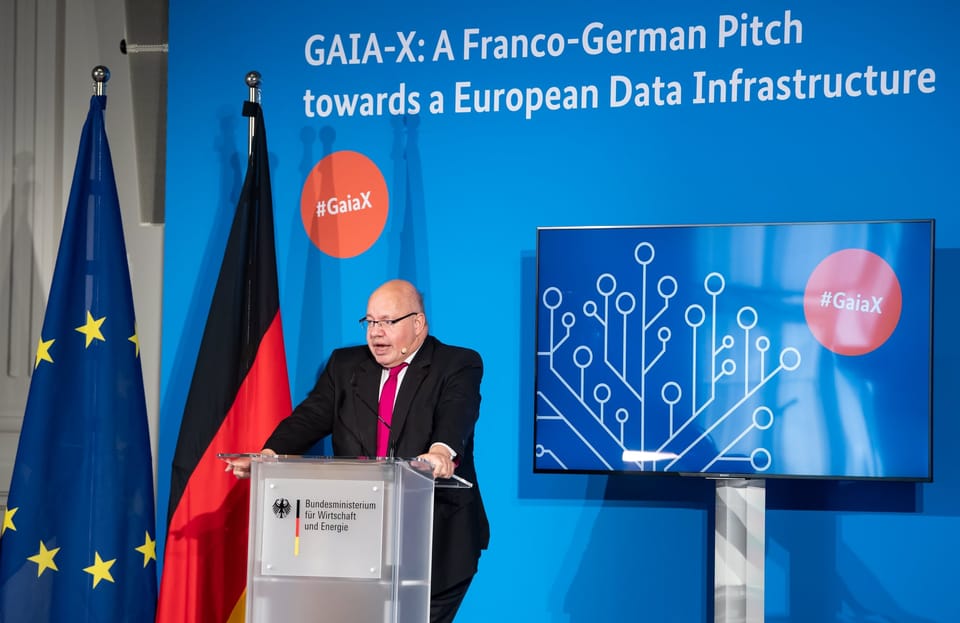
Germany is seeking to capitalize on its manufacturing sector to build domain-specific tools. Marco-Alexander Breit, director-general for digital policy and economic affairs at Germany's Federal Ministry for Digital Affairs and State Modernization, pointed to the extensive reserves of proprietary data held by industrial companies like Siemens and Bosch.12 Industrial datasets from factory operations and engineering supply chains represent information that consumer internet platforms do not possess.
National strategies reflect similar specialization. Narayan said the United Kingdom is pursuing progress in inference chips and artificial intelligence tools for drug discovery.1 Germany also intends to expand domestic computing infrastructure, with Breit stating that the country hopes to quadruple its data center capacity by 2030.2
Disputes over the regulatory burden
The European Union's regulatory framework remains a primary source of tension between industry advocates and officials. The European Union AI Act, which entered into force in August 2024 and became broadly applicable in August 2026, established uniform risk-based requirements across member states.34 Obligations covering prohibited practices took effect in February 2025, followed by governance rules for general-purpose models in August 2025.3
Breit argued that Europe needs more "innovation-friendly regulation" to maintain competitive footing.12 While Breit said he agreed with the vast majority of the measure, he argued the law "actually adds to a higher threshold for European companies to step up their game in the AI world."12

Breit stated that the regulatory burden "actually hurts our economy, even more than people maybe think in Silicon Valley that it hurts the US companies."2 He acknowledged that administrative red tape must be reduced so European technologists "don't need to leave Europe to work on AI and change the world and make a lot of money."2
Private investors have expressed harsher views of Brussels policy. Steve Jurvetson, managing director and founder of Future Ventures, said Europe is "trapped in a sort of regulatory doom loop" that smothers innovation.2 Jurvetson said "regulation is the elephant in the room" that "is stifling European innovation at every step of the way."2
Political leaders outside the European Union have raised similar objections. Former United Kingdom Prime Minister Rishi Sunak criticized the European Union approach, saying that "trying to legislate for every conceivable use case was not the right approach."12 Sunak added that he still supports targeted oversight because new technologies "bring new risks with them."2
The timeline for high-risk compliance
European authorities have adjusted implementation schedules to give businesses more time to prepare for high-risk rules. Legislative revisions through the AI Omnibus delayed strict obligations for sensitive high-risk deployments to December 2027, while rules for systems integrated into physical products were postponed to August 2028.34
Breit rejected total pessimism regarding the region's trajectory. "It's not all doom and gloom in Europe," Breit said, pointing to the combination of manufacturing data and specialized enterprise demand as an opening for European technical independence.12
The record
20 sentences trace to 4 sources.
-
1
JC
 J.D. Capelouto
Document
· semafor.com · 6 Nov 2026
Europe’s AI sector not ‘doom and gloom,’ but still lags
See the source
-
2
S
semafor.com
Third-party reporting
· semafor.com · 6 Nov 2026
Europe needs ‘innovation-friendly’ regulation to catch up on AI, German official says
See the source
- 3 AI Act See the source
- 4 Navigating the AI Act See the source