Autonomous coding tools can interrogate live telemetry to fix deployment errors
Software agents that inspect production runtime data directly after release catch invisible bugs that pass traditional automated continuous integration checks.

When software engineers deploy code, passing test suites and successful builds frequently conceal failures that emerge only under real user traffic.1 In automated software engineering, where generative artificial intelligence systems write and submit pull requests, that gap widens because models can produce code that passes synthetic validation while failing to execute in the wild.
Addressing that gap matters because enterprise repositories are often brownfield codebases, meaning complex existing systems that have accumulated years of technical debt and unwritten conventions. When autonomous tools generate large volumes of pull requests, human review quickly becomes an operational bottleneck. If automated systems cannot verify that their changes run properly under production conditions, undetected regressions can accumulate across customer environments.
The underlying operational chain requires several distinct transitions. First, an automated agent drafts a code modification to address a software requirement. Automated continuous integration tools run against that change, verify its syntax, confirm that pre-existing unit tests pass, and approve the merge. Next, the deployment system pushes that binary into production. When genuine user traffic hits the server, the modified routine might fail to execute, or return empty payloads, without triggering a crash. For an autonomous agent to detect that failure without human intervention, the system must inspect runtime execution records, trace the path taken by actual requests, compare that real-world behavior to the intended specification, and log a defect ticket when the observed behavior diverges.
Tammuz Dubnov, co-founder and chief technology officer of software firm AutonomyAI, introduced a framework designed to manage that lifecycle across legacy repositories.21 The system, called the Product Harness, maps existing application components and integrates with internal observability tools to allow coding agents to monitor their own software changes after release.21
How can an automated system learn an existing codebase?
Older corporate repositories contain implicit architectural conventions, shared components, and critical dependencies that generic programming models routinely overlook. Dubnov reported that AutonomyAI addresses this challenge by generating a structural model of an organization's existing user interface components, design systems, application programming interfaces, and test suites.12 The framework ingests configuration files already present in customer repositories, such as Claude instruction files, Cursor editor rules, and internal skill scripts, allowing the software to adopt existing team conventions.2 Dubnov explained that the harness updates its understanding of which code sections carry structural weight with every merged pull request.2
Automated repository mapping nevertheless encounters sharp limits in uninstrumented infrastructure. Dubnov told Primary that the mapping confidence is lowest in legacy backend code that lacks comprehensive test suites. In those environments, an autonomous agent can generate code modifications that appear syntactically sound but fail under operational stress. To mitigate that risk, AutonomyAI directs the system toward the client interface layer, where agents execute end-to-end verifications by simulating clicks, recording screen state, and verifying behavioral responses directly, while human software engineers retain responsibility for core backend modifications.
Why do traditional monitoring dashboards fail autonomous agents?
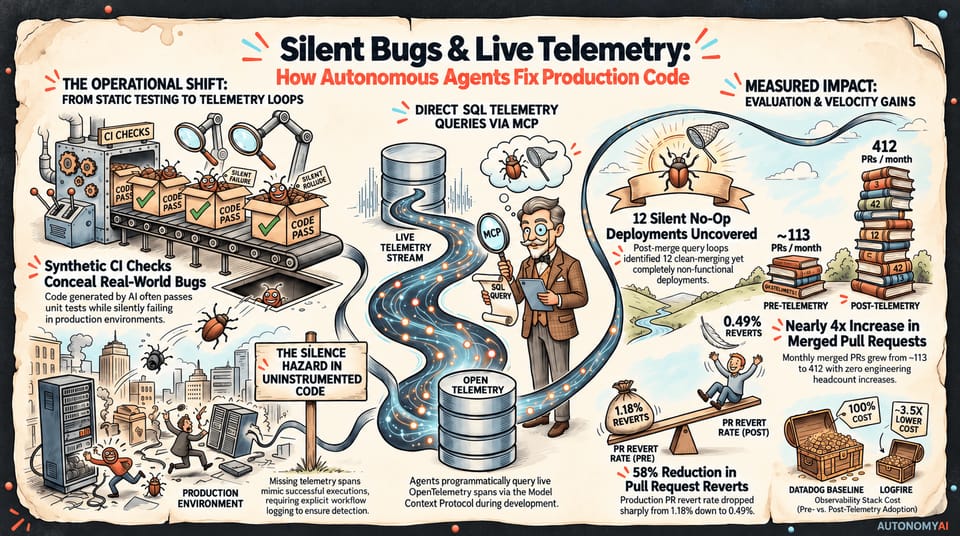
Visual monitoring dashboards are structured for human operators to inspect periodically, whereas automated coding agents require structured data they can query programmatically during execution. In a technical case study published by developer tooling firm Pydantic, AutonomyAI described replacing manual dashboard reviews with agent-queryable telemetry built on Pydantic Logfire.1 The Logfire platform collects OpenTelemetry records, which are standardized measurements of system performance, and exposes individual execution intervals, known as spans, through structured query language.1 By issuing queries across the Model Context Protocol, an open interface standard for connecting models to external tools, AutonomyAI agents inspect production telemetry while authoring changes and during the days following a deployment.1
Over a five-week evaluation period, AutonomyAI ran 105 merged pull requests through post-merge behavioral reviews against production telemetry.1 The automated query loop identified 12 silent no-op deployments where code merged cleanly but failed to execute when exposed to production traffic.1 Dubnov said in response to questions from Primary that the organization maintains a registry of merged modifications awaiting production verification, deferring evaluation until adequate real-world spans accumulate. Across that five-week window, the post-merge queries surfaced 65 operational issues from real user traffic, with 55 confirmed as genuine defects and 43 converted into tracked development tickets in the Linear issue management system.1 Dubnov told Primary that most of the remaining 10 detections were not false alarms, but rather concurrent discoveries of issues that engineers or parallel agents were already resolving.
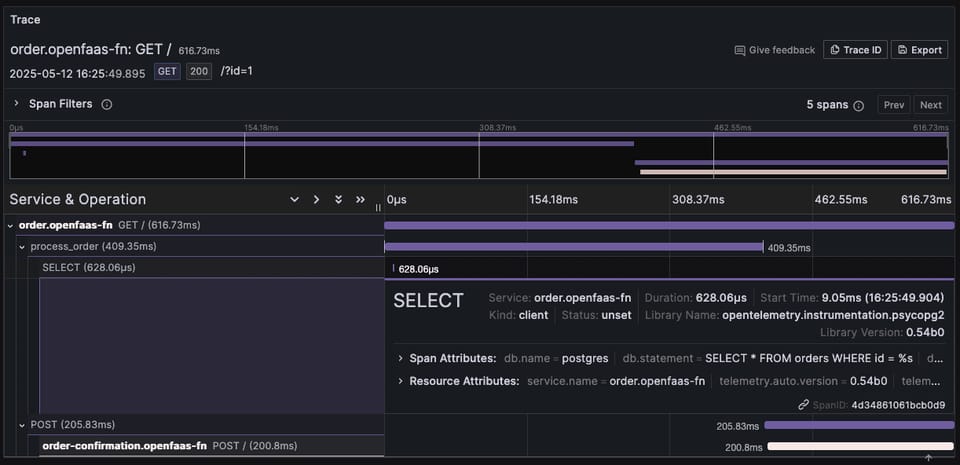
During a three-week monitoring period, the telemetry platform ingested more than 35 million spans, handling more than two million spans on a typical workday and exceeding 3.2 million spans at peak volume.1 AutonomyAI also reported that over a 30-day evaluation window, the team merged 412 pull requests out of 524 opened pull requests, compared with an average of roughly 113 merged pull requests per month before adopting Logfire in 2025.1 Dubnov told Primary that engineering team headcount remained constant across both periods. Across that same 30-day period, the team's pull request revert rate dropped from 1.18 percent to 0.49 percent.1 Dubnov stated that operating the Logfire observability stack cost roughly 3.5 times less than the company's Datadog monitoring deployment.1
What are the limits of telemetry-driven development?
Automated telemetry inspection cannot verify routines that never generate runtime data. Dubnov told Primary that the primary operational hazard stems from missing telemetry spans rather than malformed logs. When a workflow fails to emit spans to the observability server, the autonomous agent encounters complete silence, which can mimic a successful execution. AutonomyAI encountered this condition in background workflow tasks where missing telemetry spans initially produced unverified statuses until engineers added explicit instrumentation.
Furthermore, these operational figures reflect self-reported data from a single commercial software enterprise rather than an independent benchmark across multiple corporate codebases. The observed correlation between agent telemetry queries and reduced pull request revert rates also reflects broad engineering workflow adjustments rather than an isolated intervention.
As software teams delegate larger portions of routine development to autonomous systems, engineering oversight is shifting from writing code to defining runtime verification loops. Establishing mechanisms for agents to observe their own deployments suggests that software maintenance may increasingly rely on continuous operational feedback rather than static pre-merge reviews.
The record
24 sentences trace to 2 sources and 1 contributor.
- 1 How AutonomyAI’s agents catch their own regressions with Pydantic Logfire | Pydantic See the source
- 2 Autonomous Product Delivery See the source
- 3 Contribution — Tammuz Dubnov 13 statements added to this article
Other consulted pages1 page
obot.ai1 page
linkedin.com1 page
pydantic.dev1 page
x.com1 page
Article history
-
Published 24 Nov 2026, 15:33Assembled by the Primary desk from 2 sources · 1 contributor · 24 cited sentences
-
Tammuz Dubnov, co-founder and chief technology officer of software firm AutonomyAI
- Go to the sentence: Dubnov explained that the harness updates its understanding of which code sections carry structural weight with every merged pull request.
- Go to the sentence: Dubnov told Primary that the mapping confidence is lowest in legacy backend code that lacks comprehensive test suites.
- Go to the sentence: To mitigate that risk, AutonomyAI directs the system toward the client interface layer, where agents execute end-to-end verifications by simulating clicks, recording screen state, and verifying behavioral responses directly, while human software engineers retain responsibility for core backend modifications.
- Go to the sentence: By issuing queries across the Model Context Protocol, an open interface standard for connecting models to external tools, AutonomyAI agents inspect production telemetry while authoring changes and during the days following a deployment.
- Go to the sentence: The automated query loop identified 12 silent no-op deployments where code merged cleanly but failed to execute when exposed to production traffic.
- Go to the sentence: Dubnov said in response to questions from Primary that the organization maintains a registry of merged modifications awaiting production verification, deferring evaluation until adequate real-world spans accumulate.
- Go to the sentence: Across that five-week window, the post-merge queries surfaced 65 operational issues from real user traffic, with 55 confirmed as genuine defects and 43 converted into tracked development tickets in the Linear issue management system.
- Go to the sentence: Dubnov told Primary that most of the remaining 10 detections were not false alarms, but rather concurrent discoveries of issues that engineers or parallel agents were already resolving.
- Go to the sentence: AutonomyAI also reported that over a 30-day evaluation window, the team merged 412 pull requests out of 524 opened pull requests, compared with an average of roughly 113 merged pull requests per month before adopting Logfire in 2025.
- Go to the sentence: Dubnov told Primary that engineering team headcount remained constant across both periods.
- Go to the sentence: Dubnov told Primary that the primary operational hazard stems from missing telemetry spans rather than malformed logs.
- Go to the sentence: When a workflow fails to emit spans to the observability server, the autonomous agent encounters complete silence, which can mimic a successful execution.
- Go to the sentence: AutonomyAI encountered this condition in background workflow tasks where missing telemetry spans initially produced unverified statuses until engineers added explicit instrumentation.