Machine vision can demand higher data rates than human inspection
Discarding visual details under the assumption that algorithms need less data than human observers can degrade automated predictions when decision scopes expand.
A widely held assumption across computer engineering suggests that automated vision algorithms require far less digital transmission bandwidth than human viewers. Because people appreciate fine photographic textures, color grading, and crisp background detail, conventional wisdom holds that compressing data for a machine allows engineers to strip out most of the visual stream. Automated classifiers, under this view, should operate comfortably on a tiny fraction of the data needed to satisfy the human eye.
Digital networks routinely transport immense volumes of sensor measurements from mobile phones, autonomous vehicles, and environmental monitoring platforms to centralized computing facilities. If every machine analysis pipeline could inherently function on minimal data streams, telecommunications providers and cloud data centers could drastically reduce bandwidth requirements across global communication networks. When data streams must be transmitted over congested wireless links, assuming that machine receivers always permit aggressive data reduction can introduce unexpected operational failures.
To understand why this separation breaks down, consider how an information channel functions. An observation device captures physical measurements of an environment. An encoder condenses those measurements into a digital message by removing distinctions that seem unnecessary. A decoder reconstructs an output from that compact message. Finally, a decision maker evaluates that decoded output to perform a task, whether identifying an approaching obstacle or estimating agricultural crop yields. The volume of data required across the transmission link depends on the specific distinctions needed to support that eventual judgment.
In a research preprint posted to the arXiv repository on September 29, 2026, researchers Alireza Furutanpey of NeverBlink in Warsaw, Poland, and Kerstin Bunte of the University of Groningen in the Netherlands challenge this foundational assumption.1 Their study, which has not yet undergone formal peer review, demonstrates that dividing data compression into separate tracks for human observers and machine algorithms is misleading.1 The volume of information a compression system can safely discard depends on the explicit scope of downstream decisions rather than the physical identity of the receiver.1
Automated prediction models frequently exploit statistical patterns and high-frequency correlations that human eyes cannot reliably perceive.1 When a computer vision model depends on those imperceptible cues to minimize decision errors, the compression system must preserve those exact distinctions. A human observer looking at the same scene might only need to confirm a broad category, allowing the encoder to discard fine-grained variations. Under those specific conditions, transmitting data for an automated algorithm demands a higher bit rate than transmitting data for a human decision.1
Why does a machine sometimes need more data than a person?
An algorithm can require more transmission bandwidth than a human viewer because machine classifiers often achieve superior accuracy by relying on subtle image features that people overlook. Furutanpey and Bunte report that statistical models frequently capitalize on source distinctions invisible to human vision to drive down prediction risk. Prediction risk represents the mathematical expectation of error across a set of decisions.1 If an algorithm relies on those imperceptible details to prevent classification errors, a compression system must preserve enough information to maintain the required accuracy.
Alireza, the study's lead author, noted in response to questions from Primary that this bit rate inversion remains sensitive to context. Alireza said that "knowing that a model uses subtle visual cues is not enough to establish it" and pointed out that system designers must also determine the accuracy targets for each party. "A machine detecting whether an animal is present might need less information than an expert identifying its species," Alireza told Primary, emphasizing that reversing the assignments could reverse the bandwidth demands.
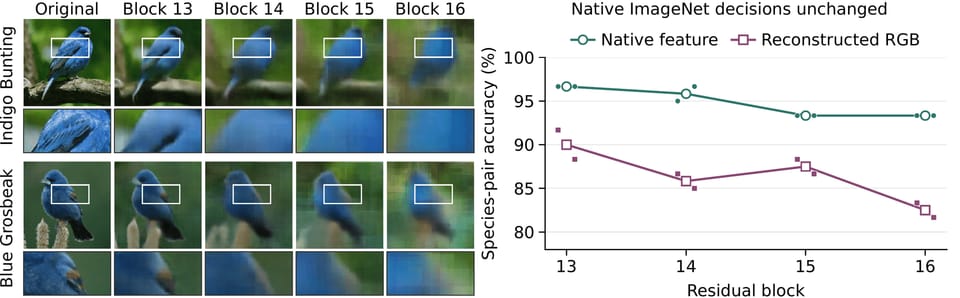
Furutanpey and Bunte demonstrate this behavioral divergence through an empirical experiment involving avian species identification using a convolutional neural network known as ResNet-50.1 The model was trained on the ImageNet database and used to inspect intermediate representations of two closely related bird species, the Indigo Bunting and the Blue Grosbeak.1 The researchers compared predictions made directly from the network's internal feature activations against predictions generated after reconstructing the RGB image from those compressed features.
The subtle color cue distinguishing the Indigo Bunting from the Blue Grosbeak, visible as a chestnut patch on the wing, becomes increasingly degraded across successive network layers. Furutanpey and Bunte measured species-pair classification accuracy using specialized reader models evaluated on 30 test photographs per species.1 At residual block 16 of the architecture, species-pair accuracy reached 93.3% when measured from native internal features, compared with 82.5% when evaluated on reconstructed RGB photographs, averaged across two fitted reader models.1 The network's original ImageNet classification decisions remained entirely unchanged at every residual block examined.1
Addressing the trial, Alireza told Primary that "this experiment was a small pilot intended to give readers an intuition for our core argument," cautioning that the 10.8 percentage point gap was not presented as a standalone proof. Alireza confirmed that "the 30 photographs per species were all the test images available for those species in the dataset’s official split" and noted that both reader fits on native features reached 93.3%, while the classifiers using reconstructed images dropped to 83.3% and 81.7%.
The test demonstrates that preserving enough information for a primary task does not guarantee that secondary predictions will remain reliable. A representation that successfully retains the general ImageNet classification label can simultaneously discard the precise color cues necessary to differentiate between two similar songbirds. Furutanpey and Bunte note that human expert inspection requires only that evidence relevant to a specific decision remains legible, rather than demanding comprehensive visual fidelity across the entire visual field.1
What happens when an encoder compresses intermediate features?
Splitting a neural network between a local sensor and a remote server forces the encoder to compress intermediate mathematical representations rather than raw observations. In this setup, known as split-feature coding, a local device processes sensor data through early neural network layers, producing an intermediate feature map.1 An encoder compresses this intermediate representation, transmits the resulting bitstream to a remote cloud server, and the remaining server layers complete the computational inference.
Furutanpey and Bunte examine how this split architecture compares mathematically with source coding, where the raw observation is encoded directly, and direct-feature coding, where the encoder observes the full input but optimizes transmission for a feature decoder.1 By applying indirect rate-distortion theory, a branch of information theory that measures the minimum data rate needed to satisfy downstream expected loss constraints, the authors prove that split-feature coding can incur a strict rate penalty when task demands expand.
When asked about the theoretical bottleneck behind that penalty, Alireza told Primary that "intermediate features can discard distinctions before the encoder gets to use them." When new tasks are introduced, those discarded distinctions can prevent the encoder from distributing errors efficiently. Alireza said that "a source encoder can use that information to meet the same accuracy requirements with fewer bits," whereas a split encoder that cannot see the raw distinctions loses that optimization flexibility.
When an encoder observes only a transformed feature representation, the intermediate mapping can collapse distinct source states together. Furutanpey and Bunte explain that if a feature mapping merges states that carry different conditional target probabilities, the minimum achievable prediction error can increase.1 Bayes risk denotes the lowest possible expected prediction error attainable from a given observation.1 An encoder that cannot observe raw distinctions loses the flexibility to allocate compression errors where they cause the least statistical harm.
To illustrate this mechanism, Furutanpey and Bunte examine a binary classification scenario evaluated under standard zero-one loss.1 Suppose two distinct environmental states produce posterior probabilities of 0.6 and 0.9 for the first category.1 Both states yield an identical optimal prediction of category one. Predicting the opposite category increases conditional error by 0.2 for the first state and by 0.8 for the second state.1 An encoder observing the raw input can allocate more coding errors to the state with posterior probability 0.6, where misclassification carries a smaller cost.1 An encoder that observes only an intermediate feature that merges these states loses this optimization capability.1
How does the scope of a task alter data requirements?
Expanding the set of downstream objectives fundamentally alters the minimum data rate required to preserve accurate predictions. Furutanpey and Bunte show that while an intermediate feature representation may match raw source coding efficiency for a single isolated task, that rate parity dissolves when multiple tasks draw from the same transmitted bitstream.1 If a secondary task assigns substantial error penalties to environmental states that were inexpensive for the initial task, the compression system must preserve additional source distinctions.1
Cloud computing providers frequently offer feature compression services to third-party developers without knowing the precise downstream analysis pipelines those developers will deploy. Furutanpey and Bunte argue that rate savings achieved on designer-selected tasks provide no guarantee that the compressed representation will support other client applications.1 Unless a codec explicitly defines the task scope it supports, including target predictions, tolerated error levels, and allowed decoding procedures, downstream models may experience severe prediction degradation.1
The paper also emphasizes that human decision making can be highly constrained. A human operator tasked with making a single binary verification decision might require very few transmitted bits, whereas an automated algorithm performing multi-class detection across diverse categories could demand substantial bandwidth.1 Dividing compression tools into fixed categories based on whether a machine or a person reads the output obscures the mathematical reality that task breadth dictates information retention.
Asked what findings would lead researchers to reconsider this framework, Alireza told Primary that "if receiver type reliably predicted how much data was needed for comparable decisions and accuracy, I would give that distinction much more weight in codec design." However, Alireza cautioned that perceptual abilities are not static, noting that "a codec might preserve everything needed to match a current expert’s performance while discarding a cue that a better-trained expert could use in the future."
What are the boundaries of these compression findings?
The findings presented by Furutanpey and Bunte carry several clear boundaries that limit their immediate operational reach. The mathematical derivations in the study operate within asymptotic rate-distortion theory, which assumes arbitrarily long data blocks rather than the practical, latency-constrained packet buffers used in real-world networking hardware. Furthermore, the empirical demonstrations focus on specific neural network architectures, such as ResNet-50 evaluated on standardized photographic benchmarks, rather than an exhaustive survey of production computer vision deployments.1 The work was posted as an open-access preprint and has not completed peer review.1
Addressing the architectural focus, Alireza told Primary that "our central theoretical result does not depend on a particular architecture" because it concerns the information available to the encoder and required by downstream tasks. While the mathematical relationships remain consistent across model designs, Alireza explained that ResNet-50 was selected as a computationally accessible benchmark, noting that "limited GPU access constrained the experimental scope" from evaluating broader modern architectures.
Engineers designing distributed perception systems for autonomous platforms and internet-of-things devices must reassess how they specify compression targets. Rather than adopting generic machine-oriented codecs under the presumption of universal bandwidth savings, system architects need to audit the specific predictive risk constraints and inspection tasks their networks must sustain. Furutanpey and Bunte have made their analysis code and empirical records publicly available on GitHub to assist researchers in evaluating task-specific coding boundaries.1
The record
40 sentences trace to 1 source and 1 contributor.
-
1
AF
 Alireza Furutanpey, Kerstin Bunte
Paper
· arxiv.org · 30 Sep 2026
On Task Scope and Information Retention in Source Coding
Preprint · may not have been peer reviewed
See the source
- 2 Contribution — Alireza Furutanpey 18 statements added to this article
Other consulted pages1 page
Article history
-
Published 24 Nov 2026, 15:33Assembled by the Primary desk from 1 source · 1 contributor · 40 cited sentences
-
Alireza Furutanpey
- Go to the sentence: The volume of information a compression system can safely discard depends on the explicit scope of downstream decisions rather than the physical identity of the receiver.
- Go to the sentence: Automated prediction models frequently exploit statistical patterns and high-frequency correlations that human eyes cannot reliably perceive.
- Go to the sentence: Under those specific conditions, transmitting data for an automated algorithm demands a higher bit rate than transmitting data for a human decision.
- Go to the sentence: Alireza, the study's lead author, noted in response to questions from Primary that this bit rate inversion remains sensitive to context.
- Go to the sentence: Alireza said that "knowing that a model uses subtle visual cues is not enough to establish it" and pointed out that system designers must also determine the accuracy targets for each party.
- Go to the sentence: Furutanpey and Bunte measured species-pair classification accuracy using specialized reader models evaluated on 30 test photographs per species.
- Go to the sentence: At residual block 16 of the architecture, species-pair accuracy reached 93.3% when measured from native internal features, compared with 82.5% when evaluated on reconstructed RGB photographs, averaged across two fitted reader models.
- Go to the sentence: Addressing the trial, Alireza told Primary that "this experiment was a small pilot intended to give readers an intuition for our core argument," cautioning that the 10.8 percentage point gap was not presented as a standalone proof.
- Go to the sentence: Alireza confirmed that "the 30 photographs per species were all the test images available for those species in the dataset’s official split" and noted that both reader fits on native features reached 93.3%, while the classifiers using reconstructed images dropped to 83.3% and 81.7%.
- Go to the sentence: By applying indirect rate-distortion theory, a branch of information theory that measures the minimum data rate needed to satisfy downstream expected loss constraints, the authors prove that split-feature coding can incur a strict rate penalty when task demands expand.
- Go to the sentence: When asked about the theoretical bottleneck behind that penalty, Alireza told Primary that "intermediate features can discard distinctions before the encoder gets to use them."
- Go to the sentence: Alireza said that "a source encoder can use that information to meet the same accuracy requirements with fewer bits," whereas a split encoder that cannot see the raw distinctions loses that optimization flexibility.
- Go to the sentence: Asked what findings would lead researchers to reconsider this framework, Alireza told Primary that "if receiver type reliably predicted how much data was needed for comparable decisions and accuracy, I would give that distinction much more weight in codec design."
- Go to the sentence: However, Alireza cautioned that perceptual abilities are not static, noting that "a codec might preserve everything needed to match a current expert’s performance while discarding a cue that a better-trained expert could use in the future."
- Go to the sentence: Furthermore, the empirical demonstrations focus on specific neural network architectures, such as ResNet-50 evaluated on standardized photographic benchmarks, rather than an exhaustive survey of production computer vision deployments.
- Go to the sentence: Addressing the architectural focus, Alireza told Primary that "our central theoretical result does not depend on a particular architecture" because it concerns the information available to the encoder and required by downstream tasks.
- Go to the sentence: While the mathematical relationships remain consistent across model designs, Alireza explained that ResNet-50 was selected as a computationally accessible benchmark, noting that "limited GPU access constrained the experimental scope" from evaluating broader modern architectures.
- Go to the sentence: Furutanpey and Bunte have made their analysis code and empirical records publicly available on GitHub to assist researchers in evaluating task-specific coding boundaries.