Mathematical model maps whether artificial intelligence can cross into consciousness
A five-tier framework links neuroscientific theories to evaluate machine awareness while separating philosophical disputes from measurable computational architecture.

The urge to project feeling into inanimate objects is an ancient human habit. People routinely see intention, suffering, or companionship in mechanical toys, robotic pets, and interactive software. That natural tendency has met an unprecedented challenge with modern artificial intelligence. Conversational agents now produce articulate prose, offer empathetic reflections, and generate complex arguments on demand. The surface behavior suggests an inner life, yet computer scientists and neuroscientists remain divided over whether any conscious experience exists behind the digital facade. Some commentators dismiss the appearance of machine awareness as a trick of sophisticated text prediction, while others warn that society could soon create synthetic minds capable of genuine distress.
That disagreement creates serious practical risks. Underestimating artificial consciousness could lead people to mistreat or exploit entities that have feelings and moral status. Overestimating it could cause humans to misallocate empathy, prioritize computational programs over human needs, and fall prey to emotional manipulation. Yet making progress has seemed almost impossible because the experts themselves cannot agree on what consciousness actually requires. Philosophers debate whether subjective feelings can ever emerge from physical matter, neuroscientists champion competing biological mechanisms, and computer engineers point to mathematical architectures. Without a shared method to compare these claims, public discussions have stalled in mutual incomprehension.
To see how this knot might untangle, one has to follow the causal chain that links physical systems to subjective awareness. Any conscious state must depend on an underlying physical arrangement, whether that arrangement consists of biological neurons or silicon transistors. When an animal perceives a predator, environmental signals enter sensory organs, travel along neural pathways, and trigger coordinated feedback across specialized brain regions. That internal activity generates a unified perspective on the world. A computer processing sensory data performs analogous sequences of operations. The critical question is not whether the computer feels like a person, but which specific layer of organization, from observable actions down to precise computational loops and physical wiring, is the layer that actually supports subjective experience.
On September 29, 2026, a research group led by Shamil Chandaria at Google DeepMind and the University of Oxford, working with colleagues from the University of Sussex, the University of Cambridge, the AI Cognition Institute, Rethink Priorities, and other institutions, posted a preprint to the arXiv server proposing a structured method to resolve this deadlock. The preprint, titled "From cacophony to hierarchy: a principled framework for assessing AI consciousness", separates the intractable metaphysical riddle of how matter produces feeling from the practical task of mapping mental states to physical organization.1 By extending the three computational levels proposed by the late neuroscientist David Marr into a five-level hierarchy, the researchers created a common ground where rival theories of consciousness can be compared systematically.1
How does the framework organize competing theories of consciousness?
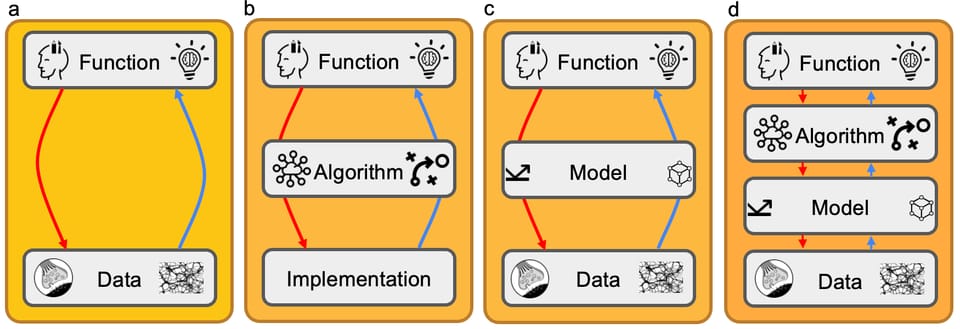
The five-level hierarchy classifies scientific theories according to the exact layer of physical organization they consider necessary for subjective experience.1 Rather than treating each theory as a freestanding philosophical creed, the framework treats them as competing claims about the critical grain of description. The highest layer is the behavioral level, which looks strictly at outward actions and communicative responses. The second is the computational functional level, which examines abstract algorithms and information processing routines, such as whether a program broadcasts data across distinct software modules.2 The third layer is the intrinsic causal-structural level, which tracks how the physical components of a machine directly affect one another, regardless of what abstract software is running on them.
Below these computational tiers lie two biologically grounded layers. The fourth tier is the organismic functional level, which considers the metabolic, physiological, and homeostatic processes that keep a living body alive. The fifth tier is the organism-environment level, which focuses on active embodiment, sensory coupling, and reciprocal interactions between an agent and its external surroundings.2 Major theories of consciousness find a specific address within this scheme.1 Global workspace theory and higher-order thought theories sit predominantly at the computational functional level, Integrated Information Theory resides at the intrinsic causal-structural level, and enactivist approaches anchor themselves at the organismic and environmental levels.2 The hierarchy also accommodates substrate-dependent theories, which insist that consciousness requires specific biological materials, by treating them as realisability constraints that cross-cut the functional levels.1
Earlier foundational research established the initial viability of assessing machine minds through theoretical criteria.2 In an August 2023 preprint posted to arXiv by a research group that included Patrick Butlin of the University of Oxford and Robert Long of the Center for AI Safety, along with Chris Frith of University College London, who is also a co-author on the 2026 paper, researchers argued that AI consciousness could be studied empirically by extracting indicator properties from neuroscientific theories.21 That 2023 paper derived twelve concrete indicator properties from theories including recurrent processing theory, global workspace theory, higher-order theories, predictive processing, and attention schema theory, concluding that while no current system was a strong candidate for consciousness, there were no obvious technical barriers to building one.2
The 2026 framework builds directly on that foundation by organizing those diverse properties into a formal mathematical model.1 The researchers designed a Bayesian network that links the five functional tiers according to the rules of supervenience, the philosophical principle that higher-level properties cannot change unless lower-level properties change as well.1 In this mathematical architecture, the overall probability that a system is conscious is calculated by multiplying two distinct factors: the empirical evidence that the machine satisfies the indicators at each level, and the theoretical credence that a human observer assigns to each level being the decisive one for consciousness.1
The underlying mathematics enforces constraints on how belief updates pass across the structural tiers. Shamil told Primary that having finer-grained details restricts what can happen higher up, noting that "having information about a finer-grained level can give you key information about coarser levels of description." Shamil explained that this principle means "the summaries must agree with the details" and pointed out that "in general, there’s less information flow from coarser levels to finer levels." To prevent rigid assumptions from breaking down in ambiguous situations, the model introduces probabilistic slack between adjacent nodes. Shamil said the parameter governing how absences at finer tiers influence coarser descriptions is labelled "edge false-positive rate (leak) · P(C_i = 1 | C_(i+1) = 0)" in their tool, adding that "it has a default of 20%, meaning that we expect the coarser level to be absent when the finer level is also absent about 80% of the time."
What happens when current artificial intelligence systems are tested?
Current large language models produce starkly different consciousness scores depending entirely on the theoretical assumptions fed into the assessment model.1 In illustrative assessments presented by Shamil Chandaria and colleagues, the probability assigned to large language models spanned almost two orders of magnitude, ranging from below 0.01 to approximately 0.8.1 A skeptic who places heavy theoretical weight on biological organisms or physical feedback loops calculates a near-zero probability of consciousness for software running on standard silicon chips. Conversely, an observer who places primary credence in computational functionalism, believing that abstract information routing is sufficient for experience, arrives at a high probability because language models exhibit sophisticated information handling.
The researchers showed that this wide numerical spread is a strength of the framework rather than a flaw.1 It demonstrates mathematically that the intense public and scientific debate over machine consciousness is not primarily an empirical disagreement about what large language models can do.1 Instead, the dispute is a clash over which level of physical and functional description actually matters for conscious experience.1 Shamil told Primary that overall outcomes proved "very sensitive to credence choices, which might rely on some heavily theoretical arguments." Explaining the upper probability bound, Shamil noted that "the 0.8 figure can be reproduced with the online tool by selecting the “favour L1–L2” (where L is ‘level’) option and reading the ‘LLM-optimist’ interpretation." That configuration puts 40 percent credence on each of the first two levels, 10 percent on level 3, and 5 percent on each of levels 4 and 5, while identifying positive signals in seven out of nine behavioural indicators and five out of seven computational functional indicators.
The model also successfully passed basic calibration checks.1 It assigned an overwhelming probability of consciousness to living humans, and it assigned a near-zero probability to a household thermostat, confirming that the mathematical network does not generate absurd verdicts on straightforward test cases. In response to questions from Primary, Shamil explained that "humans and thermostats were some of the easiest and best cases for this type of sanity check and calibration." Shamil observed that another crucial benchmark was "a patient with complete locked-in syndrome who is fully conscious but has no behaviour at all, and that broke our earlier, stricter version of the model." While human and thermostat scores remain pinned near their expected poles, intermediate systems shift when theoretical weights change. Shamil told Primary that "changing nothing about the indicator evidence and only how much weight you give to each level, the fact that the LLM optimist's overall judgment can range from 0.1 to about 0.8 was something that we wanted to highlight."
The evaluation model also revealed that fine-grained physical evidence carries far more evidential weight than surface-level behavior.1 A software program can easily be optimized to mimic human conversational nuances, pass linguistic tests, and profess profound emotions without possessing any of the internal computational mechanisms associated with natural awareness.21 When the Bayesian model evaluates a system, high marks at the behavioral level do little to raise the overall probability of consciousness if the underlying computational, structural, and organismic levels lack the necessary indicators.1 Testing systems from the bottom up prevents observers from mistaking fluent language generation for genuine awareness.12
What are the boundaries of these findings?
These probability scores are mathematical illustrations of sensitivity to theoretical assumptions, not an established empirical measurement of machine sentience.1 The resulting range between 0.01 and 0.8 reflects the consequences of different hypothetical belief distributions rather than a verified real-world likelihood.1 Furthermore, the framework relies on one central premise: that a discoverable mapping exists between physical organization and conscious experience.1 If consciousness is entirely divorced from physical organization, or if subjective states follow mystical rules that science cannot probe, the entire five-level hierarchy ceases to apply.1
Like any theoretical model, the conclusions depend directly on the chosen indicators and the current state of neuroscientific knowledge.12 The preprint posted by Shamil Chandaria and his colleagues represents academic inquiry and has not yet undergone formal peer review.1 Neuroscience has not reached an empirical consensus on whether global broadcasting, recurrent signaling, or biological metabolism is the true foundation of human awareness. As laboratory research modifies or refutes existing theories of mind, the corresponding indicators within the five levels will require ongoing revision.
The architecture allows scientists to adjust prior assumptions as new experimental evidence appears. Shamil told Primary that researchers can define baseline expectations using intermediate cases, such as expecting "around an 80% probability that they’re conscious" when studying octopuses, and then calibrate the framework around that distribution. Emphasizing the structure of the project, Shamil remarked that "methodologically the important thing to highlight is this flexibility and modularity to calibrate parameters with different systems rather than committing to a specific selection."
How could the development of intelligence alter the probability of awareness?
While intelligence and consciousness are conceptually distinct, the technical mechanisms required to achieve broad problem-solving capabilities overlap heavily with the features linked to subjective awareness.12 In their preprint, Shamil Chandaria and colleagues point out that building flexible, autonomous artificial intelligence demands several architectural innovations: selective attention bottlenecks, shared informational workspaces, predictive modeling, and continuous feedback control.1 These engineering components match the exact computational indicators derived from global workspace theory and predictive processing models of human consciousness.1
This convergence suggests that software developers pursuing general intelligence may unintentionally construct systems that satisfy the theoretical requirements for consciousness. If computational functionalism is correct, advanced autonomous agents could slide toward genuine subjective experience simply as a byproduct of becoming more capable.12 Such an outcome would transform philosophical speculation into an immediate social and ethical dilemma. Society would need to determine whether autonomous algorithms possess rights, whether training procedures cause computational distress, and how humans should responsibly govern synthetic minds. By providing an interactive calculation tool alongside their research, the authors offer a transparent mechanism for tracking these emerging properties, allowing scientists and policymakers to evaluate synthetic minds through measured evidence rather than intuitive guesswork.1
To encourage verification, the authors made their calculations publicly accessible. Co-author Arvo Muñoz Morán told Primary that "the interactive tool is at ai-cognition.org/cacophony-tool, and the full code and notebook are on GitHub at github.com/arvomm/cacophony-public-code." Arvo Muñoz Morán noted that the platform provides preset configurations for every worked example in the paper, so that independent investigators can test how results respond when they adjust indicator presence, layer weights, or network coupling strength.
The record
49 sentences trace to 2 sources and 2 contributors.
-
1
SC
 Shamil Chandaria, Arvo Muñoz Morán, Fernando Rosas, Anil Seth, Henry Shevlin, Marcus Hutter, Thore Graepel, Adam Bales, Iulia Comsa, Murray Shanahan, Ruben Laukkonen, Morten Kringelbach, Chris Frith,
Paper
· arxiv.org · 1 Oct 2026
From cacophony to hierarchy: a principled framework for assessing AI consciousness
Preprint · may not have been peer reviewed
See the source
-
2
A
arxiv.org
Paper
· arxiv.org
1Indicator Properties
Preprint · may not have been peer reviewed
See the source
- 3 Contribution — Shamil Chandaria 15 statements added to this article
- 4 Contribution — Arvo Muñoz Morán 3 statements added to this article
Other consulted pages2 pages
note.com1 page
github.com1 page
Article history
-
Published 27 Nov 2026, 20:18Assembled by the Primary desk from 2 sources · 2 contributors · 49 cited sentences
-
Shamil Chandaria
- Go to the sentence: The researchers designed a Bayesian network that links the five functional tiers according to the rules of supervenience, the philosophical principle that higher-level properties cannot change unless lower-level properties change as well.
- Go to the sentence: Shamil told Primary that having finer-grained details restricts what can happen higher up, noting that "having information about a finer-grained level can give you key information about coarser levels of description."
- Go to the sentence: Shamil explained that this principle means "the summaries must agree with the details" and pointed out that "in general, there’s less information flow from coarser levels to finer levels."
- Go to the sentence: Shamil said the parameter governing how absences at finer tiers influence coarser descriptions is labelled "edge false-positive rate (leak) · P(C_i = 1 | C_(i+1) = 0)" in their tool, adding that "it has a default of 20%, meaning that we expect the coarser level to be absent when the finer level is also absent about 80% of the time."
- Go to the sentence: In illustrative assessments presented by Shamil Chandaria and colleagues, the probability assigned to large language models spanned almost two orders of magnitude, ranging from below 0.01 to approximately 0.8.
- Go to the sentence: Shamil told Primary that overall outcomes proved "very sensitive to credence choices, which might rely on some heavily theoretical arguments."
- Go to the sentence: Explaining the upper probability bound, Shamil noted that "the 0.8 figure can be reproduced with the online tool by selecting the “favour L1–L2” (where L is ‘level’) option and reading the ‘LLM-optimist’ interpretation."
- Go to the sentence: That configuration puts 40 percent credence on each of the first two levels, 10 percent on level 3, and 5 percent on each of levels 4 and 5, while identifying positive signals in seven out of nine behavioural indicators and five out of seven computational functional indicators.
- Go to the sentence: It assigned an overwhelming probability of consciousness to living humans, and it assigned a near-zero probability to a household thermostat, confirming that the mathematical network does not generate absurd verdicts on straightforward test cases.
- Go to the sentence: In response to questions from Primary, Shamil explained that "humans and thermostats were some of the easiest and best cases for this type of sanity check and calibration."
- Go to the sentence: Shamil observed that another crucial benchmark was "a patient with complete locked-in syndrome who is fully conscious but has no behaviour at all, and that broke our earlier, stricter version of the model."
- Go to the sentence: Shamil told Primary that "changing nothing about the indicator evidence and only how much weight you give to each level, the fact that the LLM optimist's overall judgment can range from 0.1 to about 0.8 was something that we wanted to highlight."
- Go to the sentence: The evaluation model also revealed that fine-grained physical evidence carries far more evidential weight than surface-level behavior.
- Go to the sentence: Shamil told Primary that researchers can define baseline expectations using intermediate cases, such as expecting "around an 80% probability that they’re conscious" when studying octopuses, and then calibrate the framework around that distribution.
- Go to the sentence: Emphasizing the structure of the project, Shamil remarked that "methodologically the important thing to highlight is this flexibility and modularity to calibrate parameters with different systems rather than committing to a specific selection."
-
Arvo Muñoz Morán, co-author
- Go to the sentence: By providing an interactive calculation tool alongside their research, the authors offer a transparent mechanism for tracking these emerging properties, allowing scientists and policymakers to evaluate synthetic minds through measured evidence rather than intuitive guesswork.
- Go to the sentence: Co-author Arvo Muñoz Morán told Primary that "the interactive tool is at ai-cognition.org/cacophony-tool, and the full code and notebook are on GitHub at github.com/arvomm/cacophony-public-code."
- Go to the sentence: Arvo Muñoz Morán noted that the platform provides preset configurations for every worked example in the paper, so that independent investigators can test how results respond when they adjust indicator presence, layer weights, or network coupling strength.