Coordinating robot fleets over 5G networks requires simulating wireless traffic jams
Training autonomous machines inside graphics engines often ignores how cellular networks congest under heavy traffic, leaving warehouse fleets unprepared for the transmission delays that occur when multiple robots compete for radio airwaves.
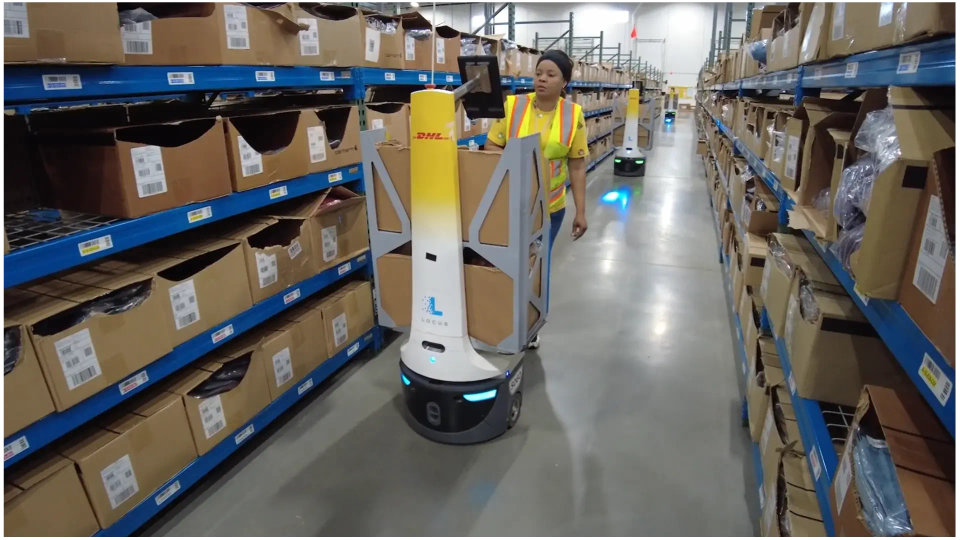
In automated logistics centers and factories, mobile robots no longer operate in physical isolation. Wheeled transport platforms, autonomous forklifts, and robotic arms share floor space while relying on wireless communication to coordinate their actions.1 These machines transmit sensor readings, laser scans, and camera frames to edge servers, which process data and dispatch navigation commands back to the fleet.1 When dozens of autonomous vehicles operate simultaneously within an industrial building, their transmissions travel over private Fifth-Generation, or 5G, New Radio cellular networks.1
Because radio frequencies are finite physical resources, wireless communication creates a bottleneck where physical motion and digital data collide. When multiple platforms enter the same warehouse aisle or encounter an obstruction, their onboard sensors generate bursts of diagnostic data. If every vehicle transmits immediately, the radio airwaves congest.1 Under congested conditions, messages are delayed, transmissions fail from electrical interference, and data packets accumulate inside onboard buffers.1 Autonomous vehicles that rely on timely commands may receive movement updates fractions of a second late, increasing the risk of physical gridlock or collisions.
Understanding how wireless congestion disrupts robotic movement requires tracing the sequential path a radio transmission follows through a cellular network. First, an autonomous robot detects an obstacle and writes a status message into its outgoing memory queue.1 Second, because cellular protocols prevent devices from transmitting unprompted, the robot broadcasts a brief scheduling request to the local base station, known in telecommunications as a next-generation NodeB, or gNB.1 Third, the base station reviews incoming scheduling requests, evaluates each robot's radio signal quality, and assigns specific transmission time slots and radio frequencies to individual devices.1 Fourth, the robot transmits its message payload during its granted time interval.1 Fifth, if physical obstructions, distance, or radio interference corrupt the signal, the base station detects the decoding error and initiates a fast retransmission procedure called Hybrid Automatic Repeat reQuest, or HARQ.1 Sixth, while those retransmissions are pending, newly generated messages remain trapped in the robot's memory buffer, causing subsequent reports to age and leaving the central server to guide the machine using outdated situational data.1
To teach robotic fleets how to coordinate effectively under real-world conditions, artificial intelligence developers train control policies inside massively parallel physics engines running on graphics processing units, or GPUs.1 In a research paper posted to the arXiv preprint server in October 2026, researchers Zifan Zhang and Yuchen Liu of North Carolina State University, along with Mingzhe Han and Kannan Athreya of The Ohio State University, reported that current robotic simulators fail to represent these dynamic wireless bottlenecks.12 Existing parallel physics simulators typically model wireless transmission as a fixed numerical delay or as a random pause drawn independently for each data packet, an oversimplification that cannot capture how radio contention spreads among neighboring machines.12 To bridge this gap, the authors developed Isaac-Net, a GPU-accelerated 5G New Radio simulation module designed to execute directly alongside parallel physics engines.12
According to the preprint, Isaac-Net allows simulation frameworks to model the physical motion and per-slot radio contention of more than one million robots simultaneously on a single graphics processor.12 The authors reported that when running a validated 5G New Radio configuration without the buffer-report grant procedure under a random movement policy, Isaac-Net sustained 1,048,576 robots at 1.24 control steps per second on one GPU, retaining 83 percent of the baseline 1.50 control steps per second achieved by the Isaac Lab physics engine operating without any network simulation. The researchers stated that this throughput makes it feasible to train autonomous robot teams with network dynamics directly inside the reinforcement learning loop, an approach they termed network-in-the-loop training.1
Why do conventional robot simulators struggle to capture wireless congestion?
Standard robotics simulators struggle to model wireless communication because traditional network simulation software was designed for central processing units that advance one scenario at a time.12 The authors noted that established network simulators, such as ns-3 equipped with its 5G-LENA module, simulate telecommunications by processing discrete network events in chronological order.1 While this event-driven architecture produces detailed packet-level fidelity, the paper reported that a pool of 12 parallel ns-3 5G-LENA processes running on a shared central processing unit delivers only 2,100 to 2,900 robot-steps per second. Furthermore, the authors measured that a single ns-3 process synchronized with a robot controller operating at 10 hertz keeps pace for only 48 robots before falling behind real-time execution.1
In contrast, modern robotics simulators achieve parallel scale by stepping thousands of simulated environments simultaneously on graphics cards. The researchers measured that the Isaac Lab physics simulator alone, running simplified sphere-shaped robots without wireless networking, achieves approximately 1.57 million robot-steps per second on a single graphics processing unit.1 Adding the per-slot 5G uplink simulation in Isaac-Net yielded 1.30 million robot-steps per second on the same hardware.1 Previous research that linked robotic simulations with network simulators through middleware such as the Robot Operating System typically paired one robot scene with one network instance, restricting simulation speeds to wall-clock time or slower.1
Because traditional network simulators could not match GPU speeds, robotics developers previously turned to statistical approximations that ignore shared radio resources. Many simulators represent network latency by delaying robot commands by a predetermined number of physics steps or by sampling independent random delays from an idealized distribution.1 The authors observed that treating each data packet as an independent event fundamentally misrepresents real cellular networks.1 In an actual 5G deployment, delays arise from base station scheduling decisions, queue buildup, and radio retransmissions that persist across multiple consecutive messages.1 The paper reported that assuming an independent delay per message leaves the tail of the Age of Information distribution approximately three times too light compared with realistic network execution, underestimating the risk of prolonged communication blackouts.12
How does the system advance radio scheduling alongside physical motion?
Isaac-Net coordinates radio scheduling with physical movement by restructuring the telecommunications stack into fixed-dimensional mathematical tensors that graphics processors calculate in parallel.1 Rather than maintaining dynamic queues of chronological events, the researchers organized each robot's radio channel state, message buffer, transmission timers, and retransmission processes into multi-dimensional arrays indexed by environment and robot identifier.1 Because 5G New Radio Medium Access Control operations occur at standardized slot boundaries, specifically 0.5-millisecond intervals under common 30-kilohertz subcarrier spacing, the software advances all communication channels across all environments through a synchronized loop of tensor operations.12
The simulation module aligns this high-frequency radio loop with the broader rhythms of robotic control and physical simulation. The paper states that robotic policies typically act at control intervals of 100 milliseconds, representing a 10-hertz operating frequency, while the underlying physics engine calculates motion across five distinct substeps of 20 milliseconds each.1 To span a single 100-millisecond control step, Isaac-Net executes 40 uplink slots across every simulated environment simultaneously. At the start of a control step, robots enqueue new messages into first-in, first-out buffers using one-hot binary masks, avoiding data transfers between the graphics processor and the host central processor.
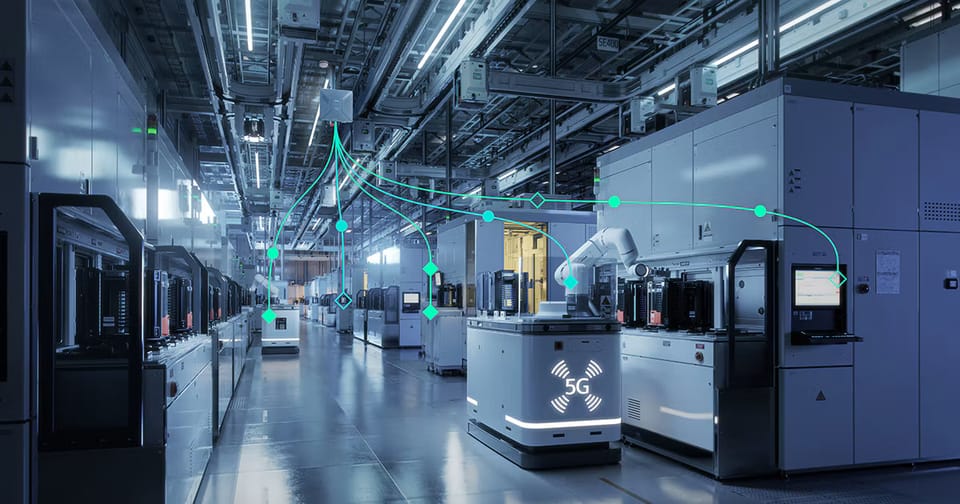
During each radio slot, the simulated base station executes scheduling, link adaptation, and message transmission across all simulated environments at once.1 The system evaluates the signal-to-noise ratio for each robot by interpolating physical coordinates across four poses per control step, accounting for path loss and correlated shadowing only. Base stations schedule pending retransmissions first and then distribute remaining radio resources among active robots using a proportional fair scheduling algorithm.1 When a base station issues an uplink grant of data bytes, the engine serves queued bytes in strict order from the robot's buffer.1 The paper describes this allocation through a mathematical formula where the served bytes of an active message depend on grant size, remaining message bytes, and preceding bytes already fulfilled by that grant.1
What happens when simulated robots confront realistic radio bottlenecks?
Simulated robots operating under realistic 5G conditions experience data staleness and buffer congestion that simplified delay models fail to replicate. The authors evaluated their configurable 5G New Radio engine by comparing its output against ns-3 5G-LENA across diverse traffic loads.12 The paper reports that Isaac-Net reproduced the per-run median transmission delay of ns-3 5G-LENA within a median absolute error of 2.5 percent to 4.8 percent from light to saturated network loads.1 When tested on a narrower, previously untested carrier bandwidth, the simulated median delay remained within 5 percent to 10 percent of the reference simulator, and in closed-loop testing with 32 robots per environment, the median delay was 9 percent higher than the ns-3 baseline.
Capturing these network dynamics alters the operational metrics observed by robot controllers. In closed-loop evaluations featuring a hand-written fleet controller, Isaac-Net matched the Age of Information observed over ns-3 5G-LENA, tracking the age of the newest report the server has received—how much time has passed since that report was generated. Most of the delay variance lies between robots, and a robot's successive messages have strongly correlated delays, so a robot in a poor radio position keeps seeing long delays and its information age keeps growing; independent draws would instead spread long delays over all robots. The authors reported that simplified baseline models that assign independent random delays fail to capture these cascading delays, masking the prolonged communication dropouts that occur in physical facilities.1
These experimental findings reflect specific simulation models rather than universal guarantees for physical robot deployments. The reported throughput and delay figures represent computational experiments conducted in simulated environments, which depend on idealized mathematical models of radio path loss, spatial fading, and cellular scheduling. Furthermore, the largest simulation scale of 1,048,576 robots was measured under a random control policy and omitted the dynamic buffer-status grant procedure because the fused GPU kernel does not yet support it. The preprint containing these results was posted to the arXiv server and has not yet undergone formal peer review.12
If GPU-accelerated cellular simulation proves robust across broader robotic tasks, roboticists could fundamentally change how multi-agent control policies are trained. Instead of designing robot controllers under the assumption of perfect communication, engineering teams could train fleets to anticipate wireless congestion, throttle non-essential data transmissions during traffic peaks, and adjust physical formations when approaching communication dead zones. The researchers have released Isaac-Net as an open-source software package, providing integration hooks for the Isaac Lab environment along with validation bridges to ns-3 5G-LENA and the OpenAirInterface cellular stack.1
The record
40 sentences trace to 2 sources.
-
1
ZZ
 Zifan Zhang, Mingzhe Han, Kannan Athreya, Yuchen Liu
Paper
· arxiv.org · 5 Oct 2026
Network-in-the-Loop at Scale: GPU-Batched 5G Simulation for Massively Parallel Robot Learning
Preprint · may not have been peer reviewed
See the source
-
2
A
arxiv.org
Paper
· arxiv.org
Network-in-the-Loop at Scale: GPU-Batched 5G Simulation for Massively Parallel Robot Learning
Preprint · may not have been peer reviewed
See the source
Other consulted pages2 pages
github.com3 pages
- isaac-net/docs/STATUS.md at main · ZzZTripleZzZ/isaac-net
- isaac-net/docs/validation-5g-lena.md at main · ZzZTripleZzZ/isaac-net
- GitHub - ZzZTripleZzZ/isaac-net: GPU-batched 5G network simulation for massively parallel robot learning: thousands of Isaac Lab / MJX environments, network-in-the-loop on one GPU, validated against ns-3 5G-LENA and OAI