Shrinking neural networks can cause hidden calculation errors
A dynamic correction method adjusts for residual output errors during inference, preserving deep neural network accuracy across computer vision and language benchmarks while saving compute.
When modern artificial intelligence systems generate an image, translate text, or identify objects in video, almost the entirety of their processing energy goes toward repeatedly multiplying enormous grids of numbers. To make these systems small enough and fast enough to run on practical computer hardware, engineers have long relied on mathematical compression. They take the massive matrices of learned numerical weights stored inside a neural network and substitute them with simpler, compact mathematical structures. In standard benchmarks, these compressed matrices appear to mimic the original numbers with remarkable precision, shaving away gigabytes of memory and billions of arithmetic cycles. Yet when the compressed model actually encounters fresh real-world data, subtle errors can suddenly multiply across layers, distorting complex outputs such as detailed image segmentation maps or fine-grained robotic vision features.
The root of this persistent degradation lies in an overlooked distinction between weight compression and output accuracy. Traditional matrix compression methods focus entirely on approximating static weights while ignoring the moving stream of numbers, known as input activations, that flow through the network during live operation. When an incoming data signal enters a layer, it does not interact with the static weights in isolation. The incoming activation numbers multiply against whatever tiny residual errors were left behind when the weight grid was compressed. If an incoming activation vector happens to align with those uncaptured mathematical directions, it acts as an amplifier, blowing up what seemed like an insignificant mathematical discrepancy into a massive distortion in the layer's final output.
Understanding this breakdown requires tracing the basic chain of events that takes place whenever a neural network processes information. First, an input such as an image patch or a word token arrives at a computational layer as a vector of activation values. Second, the system multiplies this activation vector against a large grid of stored parameters to determine the features of the next layer. Third, to save time, compression routines replace that full parameter grid with a streamlined approximation, leaving behind an uncomputed remainder called a residual matrix. Fourth, in an uncompressed system, the true output equals the product of the activation and the streamlined grid plus the product of the activation and the residual grid. When systems discard that second product to save time, the loss is not just a static fraction of the weights. The actual error equals the input activations multiplied directly by the residual grid, meaning the error changes shape and magnitude with every single input the network receives.
Why do traditional weight approximations break down during inference?
Static weight approximations fail because they attempt to minimise error in stored parameters rather than in the dynamic output activations that govern model behaviour. In research posted to the arXiv preprint server in October 2026, Daewon Chae, Hyunwon Chung, and Hun-Seok Kim of the University of Michigan, together with Changwoo Lee of Qualcomm AI Research, showed that static compression methods leave neural networks vulnerable to input-dependent signal amplification.1 Standard techniques such as low-rank singular value decomposition, alongside block-structured patterns like Monarch matrices and Block-Level Adaptive Structured matrices, known as BLAST, optimize their compact forms before the network ever encounters live data.13 In a Vision Transformer model such as ViT-L/16, linear layers account for approximately 96.7% of total floating-point operations, making them the primary target for computational pruning.14 When researchers replace these dense layers with weight-only approximations, the discrepancy between the full weights and the compressed weights remains static, but the incoming data does not.1
The vulnerability first emerged during systematic testing of compressed models against diverse evaluation datasets. Hun-Seok Kim, a researcher in the Department of Electrical Engineering and Computer Science at the University of Michigan and an author of the study, explained that the team did not initially set out to build an online correction framework. "We initially developed a method to improve static compression while minimizing degradation in inference accuracy," Kim said in response to questions from Primary. "However, tests of various static compression techniques revealed that model accuracy varied significantly across inputs, even when the same compressed weights were used. By closely examining cases with substantial accuracy loss, we identified the mechanism responsible for input-dependent error amplification."
The researchers demonstrated this issue on DINOv3, an advanced computer vision foundation model. When they replaced all dense linear layers in DINOv3 with weight-centric approximations designed to eliminate 60% of floating-point operations, principal component analysis visualizations revealed severe structural breakdown.1 Features that originally outlined semantic boundaries became noisy, disorganized, and visually degraded.1 In dense prediction benchmarks on ADE20K semantic segmentation, a standard weight-only approximation suffered a 54.1-point drop in mean intersection over union under that same 60% reduction in floating-point operations.1 Kim told Primary that "the baseline mIOU score of the uncompressed DINOv3 was 62." The stored weights were mathematically close to the originals, but because the compressed matrices could not adjust to how incoming activations weighted different mathematical directions, the resulting outputs drifted far from the ground truth.
How does dynamic residual approximation correct calculation errors on the fly?
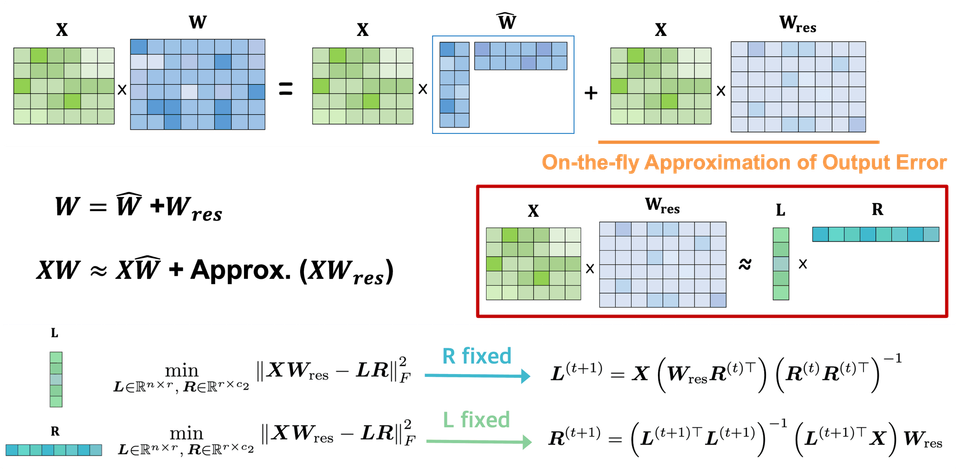
Dynamic residual approximation corrects output drift by computing an on-the-fly mathematical estimate of the discarded residual product during the forward pass itself. Rather than abandoning the missing product between incoming activations and the residual weight grid, the method, called DyRA, computes a low-rank approximation of that missing output directly in the output activation space.1 The authors formulated this challenge as an optimization problem where the product of the input matrix and the residual weight matrix is approximated by the product of two slim matrices, denoted as a left factor and a right factor. Crucially, the system cannot afford to calculate the full residual product before approximating it, as performing that dense multiplication would eliminate the computational savings of compression in the first place.
To bypass that bottleneck, the authors designed a fast solver based on alternating least squares. Alternating least squares works by freezing one factor matrix and solving for the best mathematical fit of the other, then reversing the roles in an alternating sequence. The researchers observed that intermediate steps in this solver can be carried out through low-rank projections, avoiding any explicit materialization of the giant dense residual product. In the left-factor calculation, the residual weight matrix is projected onto the low-rank right factor first, which shrinks the output dimension down to a small target rank and allows the input activations to multiply against a slim matrix. In the right-factor step, the input matrix is similarly compressed against the left factor before multiplying the residual weight. Evaluating Vision Transformer layers on ImageNet samples, the researchers discovered that the alternating least squares formulation converged near its optimal rank-bounded solution within just one or two iterations, enabling the system to capture the majority of the mathematical correction in a single step.1
The speed of this numerical convergence stems directly from the underlying mathematical structure of the discarded signal. When asked what allows a single projection cycle to capture the necessary correction, Kim told Primary that the rapid settling reflects how residual errors behave across realistic data distributions. "Our approach assumes that the input-dependent error has a very low rank, which is essential for limiting computational overhead," Kim said. "Under this assumption, the optimal solution is a well-conditioned matrix with a relatively small gap between its largest and smallest singular values. The proposed alternating least-squares method is known to converge rapidly for such matrices."
This single-step implementation unlocks a major computational shortcut. Because the initial right factor can be fixed beforehand, the calculation of the initial left factor relies only on the fixed residual weights and the static initial right factor. The authors recognized that this entire left-side projection matrix can be precalculated offline before inference ever begins. At runtime, the model computes the left factor simply by multiplying incoming activations by this slim precalculated matrix. The dynamic computational work during inference is thus largely confined to updating the right factor, which incorporates the incoming activations through an inner product term that scales with the actual input. The authors proved mathematically in Proposition 1 that while a static rank expansion merely adds fixed weight directions, DyRA aligns those directions with the incoming data covariance, automatically adjusting to the specific input signals encountered during execution.
What runtime savings can the method achieve across different tasks?
Combining static structured matrices with dynamic residual correction yields substantial gains in execution speed while preserving accuracy across computer vision, speech, and natural language workloads.1 In image classification experiments using a pre-trained ViT-L model on ImageNet, the authors set the dynamic correction rank to eight and applied structured approximations across all dense linear layers in both multi-layer perceptron blocks and attention projections.1 At roughly a 55% reduction in floating-point operations, standard low-rank and BLAST baselines suffered top-1 accuracy drops of 66.1% and 17.4%, respectively.1 Adding DyRA to those same approximations limited the accuracy drops to 2.4% for low-rank and 1.6% for BLAST under matched computational budgets.1 In a theoretical comparison where a static baseline was given extra rank parameters to match the floating-point operations consumed by the dynamic correction, DyRA still maintained a lower normalized Frobenius error across attention and multi-layer perceptron layers.1
The uniform assignment of rank eight across diverse layers reflects a deliberate trade-off between architectural simplicity and raw performance. Addressing the rationale behind choosing eight dimensions across both attention heads and feed-forward layers, Kim explained that the algorithm maintains consistent stability regardless of how capacity is distributed. "Empirical results show that DyRA’s performance and reliability are relatively insensitive to how rank is allocated between residual approximation and static compression, provided that the overall FLOP complexity remains constant," Kim told Primary. "Based on this observation, we evaluate DyRA using a uniform rank allocation across layers. A layer-adaptive allocation could further improve performance, and developing an optimal strategy for selecting layer-specific ranks is an interesting direction for future work."
These mathematical efficiencies translated into measurable latency reductions when tested on physical graphics processing units. To prevent the dynamic updates from stalling on memory bottlenecks, the researchers authored custom software kernels in the Triton programming language.1 Their custom kernels fuse the base projection, bias addition, low-rank residual reconstruction, and output summation into single hardware execution passes, preventing intermediate tensors from writing back out to high-bandwidth graphics memory. When tested on DINOv3, this implementation achieved a 1.52-fold end-to-end graphics processing unit speedup while incurring only one third of the accuracy loss recorded by weight-only baselines running at that exact same speed.1
That measured speedup, however, depends heavily on batching conditions and sequence lengths. Co-author Hyunwon Chung told Primary that workload scale determines whether the custom execution kernels maintain their edge. "The observed 1.52× speedup was achieved with a sequence length of approximately 3,000 tokens and a batch size of 8," Chung said. "The benefit diminishes when both the sequence length and batch size are small (for example, with fewer than 1,000 tokens and a batch size of 1) because fused-kernel launch overhead becomes dominant in those cases."
What limitations remain in dynamic residual estimation?
The reported performance gains represent benchmark simulations and specific hardware kernel evaluations rather than universal speedups across all deployment platforms. The mathematical savings depend directly on the assumption that a low rank, such as rank eight or 16, provides enough expressiveness to capture the critical subspace of the discarded residual activations. If a model encounters highly complex or noisy inputs that spread activation energy evenly across all mathematical dimensions, a low-rank residual projection will fail to capture the missing information. Furthermore, while the mathematical formulation reduces total floating-point operations, actual wall-clock execution speed depends heavily on how efficiently a target processor handles small matrix inverses and dynamic memory transfers.
The experimental record also reflects pre-trained models evaluated under test-time approximation without extensive architectural retraining across every tested domain. While the authors demonstrated that DyRA can be combined with post-training calibration or fine-tuning, the reported test-time results represent zero-shot structural replacements on frozen weights. Because the work is documented in a preprint posted to arXiv and has not yet completed formal peer review, independent laboratory verification of its runtime kernels and cross-hardware generalizability has not yet been established.1 The reported end-to-end acceleration of 1.52 times specifically reflects execution on high-end graphics hardware running specialized Triton routines and may differ substantially on edge microcontrollers, central processing units, or dedicated neural processing units lacking high register bandwidth.
How could adaptive calculation reshape future model deployment?
If dynamic residual approximation proves robust across broader machine learning settings, it could alter how engineers design compression pipelines for edge computing, autonomous robotics, and real-time audio systems. Historically, deploying large models on mobile chips or local sensors required choosing between severe parameter pruning, which risked catastrophic failure on edge cases, or costly retraining procedures that demanded massive computational budgets. Dynamic correction introduces a hybrid compromise where a rigid, highly compressed core model is continuously steered by lightweight, input-sensitive adjustment factors computed at runtime. Because DyRA is agnostic to the underlying static compression format, it can wrap around standard low-rank decompositions as easily as block-level structures such as BLAST or Monarch matrices.
The next challenge for researchers lies in extending dynamic residual approximations to the sequential decoding phases of large autoregressive language models, where computational constraints shift from dense matrix multiplication throughput to memory bandwidth bottlenecks. Future research must also examine whether dynamic correction can be implemented on specialized neural accelerators that lack the programmable register flexibility of graphics processing units. For computer vision and speech recognition systems operating under tight power budgets, the ability to recover lost mathematical precision on the fly brings foundation models one step closer to reliable, low-power edge execution.
The record
29 sentences trace to 3 sources and 2 contributors.
-
1
DC
 Daewon Chae, Hyunwon Chung, Changwoo Lee, Hun-Seok Kim
Paper
· arxiv.org · 5 Oct 2026
DyRA: Dynamic Residual Approximation for Efficient Matrix Multiplication in DNNs
Preprint · may not have been peer reviewed
See the source
- 2 Contribution — Hun-Seok Kim 11 statements added to this article
-
3
A
arxiv.org
Paper
· arxiv.org
BLAST: Block-Level Adaptive Structured Matrices for Efficient Deep Neural Network Inference
Preprint · may not have been peer reviewed
See the source
-
4
A
arxiv.org
Paper
· arxiv.org
DyRA: Dynamic Residual Approximation for Efficient Matrix Multiplication in DNNs
Preprint · may not have been peer reviewed
See the source
- 5 Contribution — Hyunwon Chung 2 statements added to this article
Other consulted pages2 pages
arxivdaily.com1 page
github.com2 pages
x.com1 page
Article history
-
Published 27 Nov 2026, 15:31Assembled by the Primary desk from 3 sources · 2 contributors · 29 cited sentences
-
Hyunwon Chung, co-author
- Go to the sentence: "The observed 1.52× speedup was achieved with a sequence length of approximately 3,000 tokens and a batch size of 8," Chung said.
- Go to the sentence: "The benefit diminishes when both the sequence length and batch size are small (for example, with fewer than 1,000 tokens and a batch size of 1) because fused-kernel launch overhead becomes dominant in those cases."
-
Hun-Seok Kim, a researcher in the Department of Electrical Engineering and Computer Science at the University of Michigan…
- Go to the sentence: In research posted to the arXiv preprint server in October 2026, Daewon Chae, Hyunwon Chung, and Hun-Seok Kim of the University of Michigan, together with Changwoo Lee of Qualcomm AI Research, showed that static compression methods leave neural networks vulnerable to input-dependent signal amplification.
- Go to the sentence: "We initially developed a method to improve static compression while minimizing degradation in inference accuracy," Kim said in response to questions from Primary.
- Go to the sentence: "However, tests of various static compression techniques revealed that model accuracy varied significantly across inputs, even when the same compressed weights were used. By closely examining cases with substantial accuracy loss, we identified the mechanism responsible for input-dependent error amplification."
- Go to the sentence: In dense prediction benchmarks on ADE20K semantic segmentation, a standard weight-only approximation suffered a 54.1-point drop in mean intersection over union under that same 60% reduction in floating-point operations.
- Go to the sentence: Kim told Primary that "the baseline mIOU score of the uncompressed DINOv3 was 62."
- Go to the sentence: Evaluating Vision Transformer layers on ImageNet samples, the researchers discovered that the alternating least squares formulation converged near its optimal rank-bounded solution within just one or two iterations, enabling the system to capture the majority of the mathematical correction in a single step.
- Go to the sentence: "Our approach assumes that the input-dependent error has a very low rank, which is essential for limiting computational overhead," Kim said.
- Go to the sentence: "Under this assumption, the optimal solution is a well-conditioned matrix with a relatively small gap between its largest and smallest singular values. The proposed alternating least-squares method is known to converge rapidly for such matrices."
- Go to the sentence: In image classification experiments using a pre-trained ViT-L model on ImageNet, the authors set the dynamic correction rank to eight and applied structured approximations across all dense linear layers in both multi-layer perceptron blocks and attention projections.
- Go to the sentence: "Empirical results show that DyRA’s performance and reliability are relatively insensitive to how rank is allocated between residual approximation and static compression, provided that the overall FLOP complexity remains constant," Kim told Primary.
- Go to the sentence: "Based on this observation, we evaluate DyRA using a uniform rank allocation across layers. A layer-adaptive allocation could further improve performance, and developing an optimal strategy for selecting layer-specific ranks is an interesting direction for future work."