Weighted quantum circuits compress polynomial transformations for neural networks
Modulating quantum signal processing with classical weights slashes circuit depth and removes parameter redundancies when modeling complex mathematical functions.
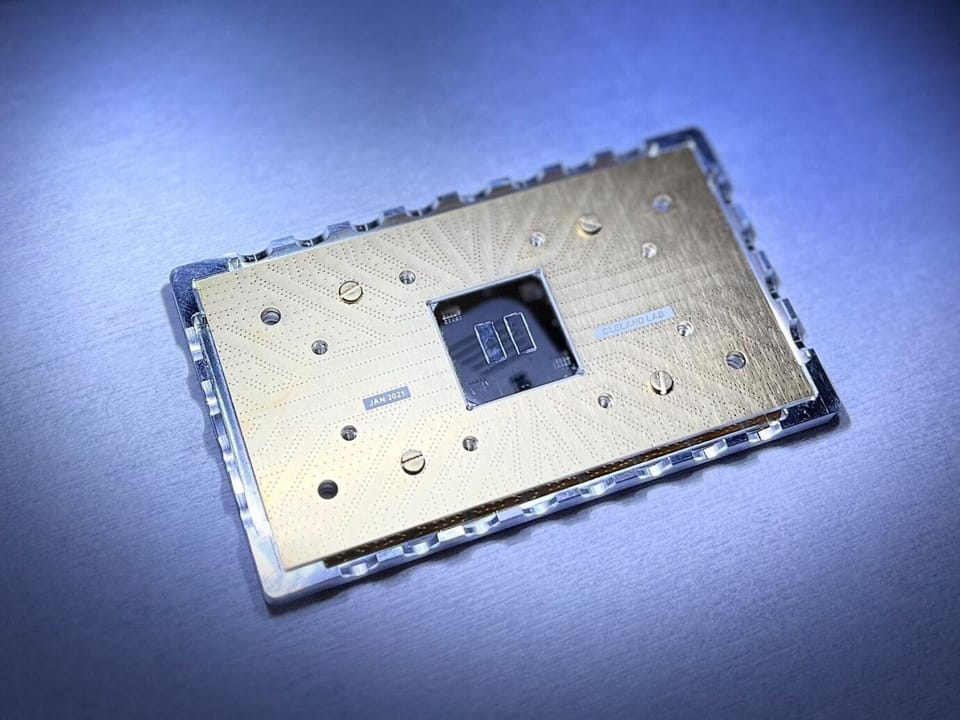
A fundamental goal of quantum computation is turning physical quantum states into versatile computational tools. For decades, researchers envisioned quantum processors primarily as giant linear-algebra engines, relying on complex collections of logic gates to simulate physics, invert matrices, or search unsorted databases. Yet physical quantum devices operate under severe physical constraints, because qubits inevitably lose their fragile quantum states through environmental noise, thermal fluctuations, and control imperfections. When an algorithm requires thousands of sequential quantum operations to evaluate a mathematical function, noise accumulates rapidly, degrading the output before the calculation finishes.
To solve practical problems in machine learning and data science, quantum computers must evaluate nonlinear transformations without collapsing under the weight of excessive gate sequences. In classical computing, nonlinear functions are routine: a conventional digital processor computes logarithms, trigonometric values, or machine learning activation functions using simple floating-point routines. On a quantum computer, however, the fundamental operations are strictly unitary, meaning they correspond to linear, norm-preserving rotations in complex vector spaces. Calculating an arbitrary curve or approximating an empirical function therefore requires building a polynomial approximation out of repeated quantum interactions.
The sequence of operations must unfold in a very specific causal order to produce a target curve on a quantum processor. First, an input value must be mapped into a physical quantum rotation, creating an elementary signal operation that tilts the state of a single qubit. Second, that signal rotation must be paired with an adjustable phase shift, which shifts the quantum phase along an orthogonal axis to steer the resulting wave interference. Third, this basic cycle of signal rotation and phase steering must be repeated many times in sequence, allowing the individual mathematical powers of the input to accumulate degree by degree. Fourth, constructive and destructive interference among all the intermediate paths combines these individual powers into a single composite polynomial transformation. Finally, measuring the qubit yields a probability distribution whose amplitude tracks the desired mathematical curve across its entire domain.
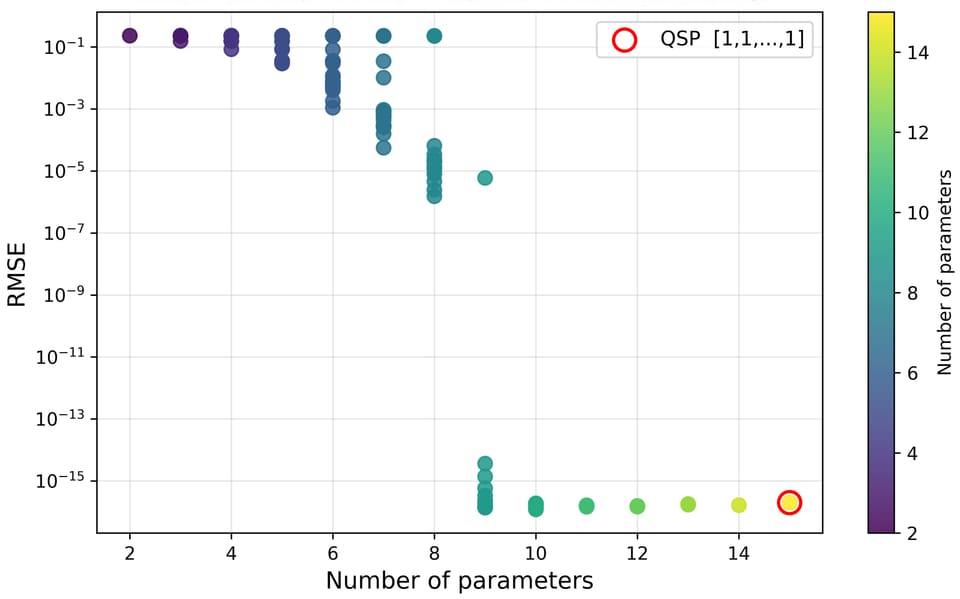
In a preprint posted on the arXiv repository on September 18, 2026, Rohit Sarma Sarkar, Rupayan Bhattacharjee, Elias F. Combarro, Michele Grossi, Lirandë Pira, Carmen G. Almudéver, Sergi Abadal, and Eduard Alarcon introduced an architectural framework named Weighted Quantum Signal Processing, or WQSP. The authors reported that by incorporating classical weight values directly into the central quantum rotation operator, a quantum circuit can synthesize bounded univariate polynomials, which are single-variable polynomial curves whose absolute values do not exceed one, using dramatically fewer physical operations than conventional methods. According to the preprint, this weighted extension reveals that standard quantum signal processing harbors significant parameter redundancies, allowing researchers to prune away surplus operations and achieve linear-to-exponential parameter reductions while preserving approximation quality.1
Why do standard quantum polynomial methods struggle on real hardware?
Standard quantum algorithms struggle with arbitrary mathematical curves because conventional single-qubit signal processing is constrained by strict algebraic symmetries. The foundational method known as Quantum Signal Processing, developed by Low, Guang Hao and Chuang, Isaac L in a 2017 paper published in Physical Review Letters, and expanded in a doctoral thesis by Low, Guang Hao at the Massachusetts Institute of Technology, demonstrated that interleaving single-qubit signal rotations with adjustable phase shifts can synthesize high-degree polynomial transformations of operator eigenvalues.1 In his doctoral thesis, Low, Guang Hao showed that such single-qubit dynamics can emulate arbitrary bits of precision using constant space, providing a unified foundation for optimal Hamiltonian simulation and matrix manipulation. Yet standard Quantum Signal Processing imposes a rigid parity restriction on the polynomials it can realize: each circuit generates an upper-left matrix entry that is strictly even or strictly odd.
Because realistic mathematical functions are rarely purely even or purely odd, standard Quantum Signal Processing forces circuit designers to decompose target curves into separate parity components.1 To approximate an asymmetric function, an engineer must split the target into its even part and its odd part, build two distinct quantum circuits to generate them independently, and then recombine those pieces using ancillary helper qubits and techniques such as linear combinations of unitaries and amplitude amplification.1 That recombination process substantially inflates the total circuit depth and introduces significant hardware overhead. In near-term, noisy intermediate-scale quantum devices, every extra two-qubit gate and controlled interaction between a register qubit and an ancilla accelerates decoherence, causing errors to outrun the computation before the final transformation can be measured.
Earlier attempts to bypass these parity barriers created their own physical bottlenecks.1 A method known as Generalized Quantum Signal Processing relaxed the parity constraint by introducing generic two-dimensional unitary rotations, known as SU(2) rotations, alongside extra ancillary control qubits.1 However, implementing an arbitrary SU(2) rotation on physical quantum hardware typically requires decomposing the operation into a sequence of two to three separate physical laser or microwave pulses via Euler angle decomposition.1 This pulse expansion roughly doubles or triples the effective physical duration of the circuit, multiplying gate noise and compounding fidelity losses across the device.1
How does weighting the rotation operator simplify the circuit?
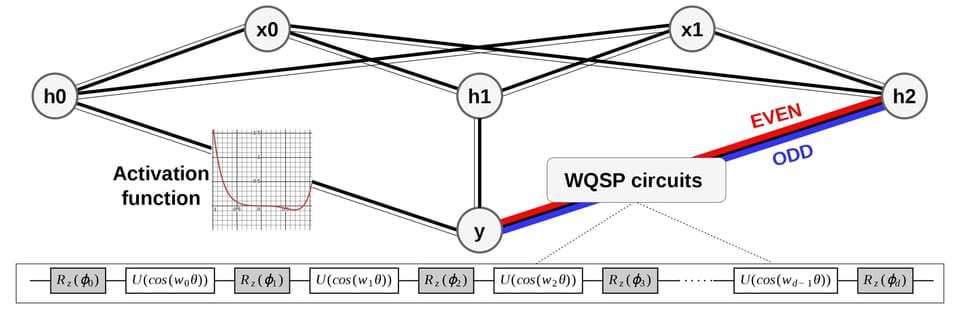
Weighted Quantum Signal Processing bypasses these structural bottlenecks by modulating the central quantum rotation operator with classical weights instead of adding extra physical control gates. In standard Quantum Signal Processing, the signal operator is applied repeatedly with uniform, unit scaling throughout the circuit sequence. Rohit Sarma Sarkar and colleagues demonstrated that standard Quantum Signal Processing is actually just a restricted special case of their broader framework, corresponding to a setting where every weight is fixed to one.1 By allowing each signal step to carry a distinct numerical weight, the authors opened a new design space that directly shapes the interference patterns inside the qubit.
When these classical weights are chosen as natural numbers greater than one, the weighted circuit behaves as a pruned version of a traditional signal processing sequence.1 Instead of requiring a separate physical phase adjustment after every single elementary rotation, several rotation stages can be aggregated together into a single modulated pulse. Rohit Sarma Sarkar and colleagues reported that this aggregation removes redundant parameters, transforming what would have been an unnecessarily long chain of alternating operations into a condensed, low-depth circuit.1 For integer weight vectors, the paper established that Weighted Quantum Signal Processing can realize arbitrary bounded univariate polynomials with a linear-to-exponential reduction in the number of trainable phase parameters compared to standard Quantum Signal Processing.1
Explaining this mechanism, Rohit said that finding the phase angles of the weighted framework is effectively solving a linear system whose mathematical nature changes depending on the weights chosen. Rohit observed that a solution always exists for standard quantum signal processing, but it is not the only case where solvable systems emerge, noting that for non-trivial weight vectors a similar phenomenon can be observed and that is why the weighted framework exposes parameter redundancy in the older method. Rohit added that one is sacrificing intermediate degrees of freedom while still obtaining results because not all degrees of freedom are equally important, remarking that researchers are just pruning out the redundant ones.
Addressing what dictates whether this parameter compression scales linearly or exponentially, Rohit noted that the mathematical property does not primarily lie in the target polynomial but in the weights chosen. Generally, a parity fixed polynomial is chosen and choosing weights such as 1, 2, 3... or 1, 2, 4... can reduce the parameters quadratically to exponentially, Rohit said. Rohit added that if the polynomial coefficients in a Chebyshev basis follow certain bounds, those weight schedules act as an effective alternative to standard unit weights where parameter counts run higher.
The engineering advantage of this weight assignment becomes particularly visible at the hardware level. While generalized methods demand multi-pulse decompositions and ancillary registers, the weighted framework relies on standard single-axis rotations around the x-axis, denoted as R_x rotations.1 These single-axis rotations can be executed on physical hardware using a single modulated control pulse rather than the two or three pulses required for generic SU(2) gates.1 By eliminating ancilla control interactions and minimizing physical pulse counts, the weighted framework substantially lowers the cumulative gate errors that typically cripple variational quantum algorithms on near-term hardware. Asked what physical hardware conditions could threaten this operational advantage, Rohit said that high gate noise affecting the R_x and R_z operators represents the primary hazard.
Can compressed quantum polynomials power machine learning architectures?
Beyond deterministic mathematical approximation, the authors showed that weighted signal processing can serve as an efficient, trainable backbone for quantum machine learning models. In classical artificial intelligence, deep neural networks such as multilayer perceptrons approximate complex multivariate relationships by passing numerical inputs through layers of fixed, point-wise nonlinear activation functions, such as rectified linear units or sigmoids. However, conventional multilayer perceptrons often suffer from the curse of dimensionality, demanding millions of trainable weights to model intricate scientific phenomena. A recent classical alternative, known as the Kolmogorov-Arnold Network, replaces fixed node activations with flexible, learnable univariate functions placed directly along the network edges.1
Kolmogorov-Arnold Networks draw their theoretical foundation from the Kolmogorov-Arnold Representation Theorem, which originated from David Hilbert's thirteenth problem.1 The theorem proves that every continuous multivariate function defined on a bounded domain can be expressed as a finite composition and addition of continuous single-variable functions.1 In a classical Kolmogorov-Arnold Network, each edge function is typically parameterized using numerical spline curves, which can become memory-intensive and computationally cumbersome to train across high-dimensional datasets. Rohit Sarma Sarkar and colleagues proposed substituting these edge splines with univariate polynomial functions generated by compact Weighted Quantum Signal Processing circuits.1
By deploying weighted quantum circuits to represent the individual edge functions, the resulting hybrid architecture, termed WQSP-KAN, captures intricate nonlinear relationships without running into the massive circuit depths that usually plague quantum machine learning.1 Existing quantum implementations of Kolmogorov-Arnold Networks have relied on complex block-encoding procedures that require multiple ancilla qubits and deep gate ladders.1 The authors reported that using weighted signal processing parameterizes each edge activation as a native, low-depth single-qubit circuit, avoiding block-encoding overheads entirely while maintaining the expressive, compositional benefits of the Kolmogorov-Arnold decomposition.1
When training these quantum edge activations, optimization routines can sometimes freeze if parameter gradients vanish into barren plateaus. Discussing optimization dynamics during edge training, Rohit said the researchers did not observe significant barren plateaus until reaching moderately high degrees where the polynomial contained many terms. In a standard computer setup, Rohit recalled seeing no plateaus up to degree 200, though Rohit noted that the current code is just a start and requires modifications to match literature methods that approximate millions of degrees.
What are the limits of the new quantum framework?
These theoretical and architectural results do not imply that quantum computers can immediately replace classical neural networks for everyday data tasks. The preprint by Rohit Sarma Sarkar and colleagues is an algorithmic and analytical proposal that has been posted to the arXiv preprint repository and has not yet undergone formal peer review.1 While the authors established explicit mathematical bounds on approximation error for generic weight vectors, the actual numerical accuracy depends on the choice of the weight vector itself. For arbitrary non-integer weights, compressing the circuit depth incurs a controlled increase in approximation error, requiring practitioners to navigate a quantitative trade-off between hardware efficiency and functional precision.1
Exploring this non-integer regime revealed unexpected algebraic trade-offs alongside physical interpretation hurdles. Rohit said that when choosing fractional weights of 0.5, the parity requirement vanished immediately, removing a central bottleneck of standard signal processing. However, Rohit emphasized that non-integer weights still require physical meaning, observing that an algorithm cannot query a black-box operation half a time because such fractional queries make no physical sense as of yet.
The scope of empirical validation for network architectures also remains preliminary. Rohit said the researchers introduced the network architecture primarily as an application of the weighted framework, with a dedicated paper planned for subsequent publication. Rohit stated that the team has tested functions with up to five or six variables with promising results, including simple functions alongside complex benchmarks such as the Rastrigin function, but has not yet tested the approach on non-smooth functions.
Furthermore, calculating the optimal classical weights and quantum phase angles remains a nontrivial computational task. Although the authors demonstrated both deterministic linear-system solutions and gradient-based learning approaches for recovering phase parameters, optimizing large-degree polynomial approximations in noisy environments can encounter local minima and training instabilities. The presented results focus on univariate polynomial synthesis and its modular integration into network edges, meaning the broader multivariate scaling of the hybrid system will still face the communication and synchronization overheads inherent in linking classical neural network layers to quantum coprocessors.
Looking ahead, the weighted signal processing framework provides a clear blueprint for near-term quantum algorithm design. The authors pointed to several immediate avenues for further exploration, including evaluating the resilience of weighted polynomial circuits against physical decoherence on trapped-ion and superconducting quantum processors, developing automated compilers to discover optimal integer weight distributions, and scaling hybrid quantum Kolmogorov-Arnold Networks to complex scientific learning tasks. By showing that classical weight modulation can eliminate redundant quantum operations, the research offers a practical pathway toward executing sophisticated mathematical transformations on constrained quantum hardware.
The record
35 sentences trace to 1 source and 1 contributor.
-
1
RS
 Rohit Sarma Sarkar, Rupayan Bhattacharjee, Elias F. Combarro, Michele Grossi, Lirandë Pira, Carmen G. Almudéver, Sergi Abadal, Eduard Alarcon
Paper
· arxiv.org · 21 Sep 2026
Weighted Quantum Signal Processing: Low-Depth Polynomial Approximation with Applications to Kolmogorov-Arnold Networks
Preprint · may not have been peer reviewed
See the source
- 2 Contribution — Rohit Sarma Sarkar 18 statements added to this article
Other consulted pages2 pages
alphaxiv.org1 page
dspace.mit.edu2 pages
Article history
-
Published 27 Nov 2026, 20:17Assembled by the Primary desk from 1 source · 1 contributor · 35 cited sentences
-
Rohit Sarma Sarkar
- Go to the sentence: According to the preprint, this weighted extension reveals that standard quantum signal processing harbors significant parameter redundancies, allowing researchers to prune away surplus operations and achieve linear-to-exponential parameter reductions while preserving approximation quality.
- Go to the sentence: For integer weight vectors, the paper established that Weighted Quantum Signal Processing can realize arbitrary bounded univariate polynomials with a linear-to-exponential reduction in the number of trainable phase parameters compared to standard Quantum Signal Processing.
- Go to the sentence: Explaining this mechanism, Rohit said that finding the phase angles of the weighted framework is effectively solving a linear system whose mathematical nature changes depending on the weights chosen.
- Go to the sentence: Rohit observed that a solution always exists for standard quantum signal processing, but it is not the only case where solvable systems emerge, noting that for non-trivial weight vectors a similar phenomenon can be observed and that is why the weighted framework exposes parameter redundancy in the older method.
- Go to the sentence: Rohit added that one is sacrificing intermediate degrees of freedom while still obtaining results because not all degrees of freedom are equally important, remarking that researchers are just pruning out the redundant ones.
- Go to the sentence: Addressing what dictates whether this parameter compression scales linearly or exponentially, Rohit noted that the mathematical property does not primarily lie in the target polynomial but in the weights chosen.
- Go to the sentence: Rohit added that if the polynomial coefficients in a Chebyshev basis follow certain bounds, those weight schedules act as an effective alternative to standard unit weights where parameter counts run higher.
- Go to the sentence: These single-axis rotations can be executed on physical hardware using a single modulated control pulse rather than the two or three pulses required for generic SU(2) gates.
- Go to the sentence: Asked what physical hardware conditions could threaten this operational advantage, Rohit said that high gate noise affecting the R_x and R_z operators represents the primary hazard.
- Go to the sentence: By deploying weighted quantum circuits to represent the individual edge functions, the resulting hybrid architecture, termed WQSP-KAN, captures intricate nonlinear relationships without running into the massive circuit depths that usually plague quantum machine learning.
- Go to the sentence: The authors reported that using weighted signal processing parameterizes each edge activation as a native, low-depth single-qubit circuit, avoiding block-encoding overheads entirely while maintaining the expressive, compositional benefits of the Kolmogorov-Arnold decomposition.
- Go to the sentence: Discussing optimization dynamics during edge training, Rohit said the researchers did not observe significant barren plateaus until reaching moderately high degrees where the polynomial contained many terms.
- Go to the sentence: In a standard computer setup, Rohit recalled seeing no plateaus up to degree 200, though Rohit noted that the current code is just a start and requires modifications to match literature methods that approximate millions of degrees.
- Go to the sentence: For arbitrary non-integer weights, compressing the circuit depth incurs a controlled increase in approximation error, requiring practitioners to navigate a quantitative trade-off between hardware efficiency and functional precision.
- Go to the sentence: Rohit said that when choosing fractional weights of 0.5, the parity requirement vanished immediately, removing a central bottleneck of standard signal processing.
- Go to the sentence: However, Rohit emphasized that non-integer weights still require physical meaning, observing that an algorithm cannot query a black-box operation half a time because such fractional queries make no physical sense as of yet.
- Go to the sentence: Rohit said the researchers introduced the network architecture primarily as an application of the weighted framework, with a dedicated paper planned for subsequent publication.
- Go to the sentence: Rohit stated that the team has tested functions with up to five or six variables with promising results, including simple functions alongside complex benchmarks such as the Rastrigin function, but has not yet tested the approach on non-smooth functions.