Tidal will ban fully synthetic music in December
The streaming service plans to delete roughly 27 million catalog tracks after automated uploads reached 43 percent of recent submissions.

Tidal will begin rejecting and removing every wholly artificial-intelligence-generated track from its streaming catalog on December 9, 2026.12 Robert Andersen, who leads Tidal at parent company Block, estimated the purge will eliminate approximately 29 million songs by the start of 2027.34 The company will also prohibit digital distributors from delivering fully automated tracks, projecting between 80,000 and 85,000 rejected submissions every day.31
The policy escalates rules introduced in July 2026, when Tidal began applying labels to synthetic recordings and withholding royalties while leaving files accessible to listeners.31 Internal figures showed that wholly synthetic creations made up 43 percent of all recordings delivered to Tidal over a 90-day span, culminating on November 6 when automated tracks exceeded 60 percent of incoming daily submissions.12
Those synthetic deliveries accumulated rapidly in the company database without attracting genuine listener interest.13 Tagged artificial tracks grew to represent roughly 27 million recordings, or 6.3 percent of the entire Tidal catalog.12 Company metrics indicated that 96 percent of those flagged files received zero streams over three months.12 Tidal separately removed more than 65,000 recordings for suspected artist-name impersonation, where automated uploads mimicked real performers to divert streaming payments and confuse subscribers.12
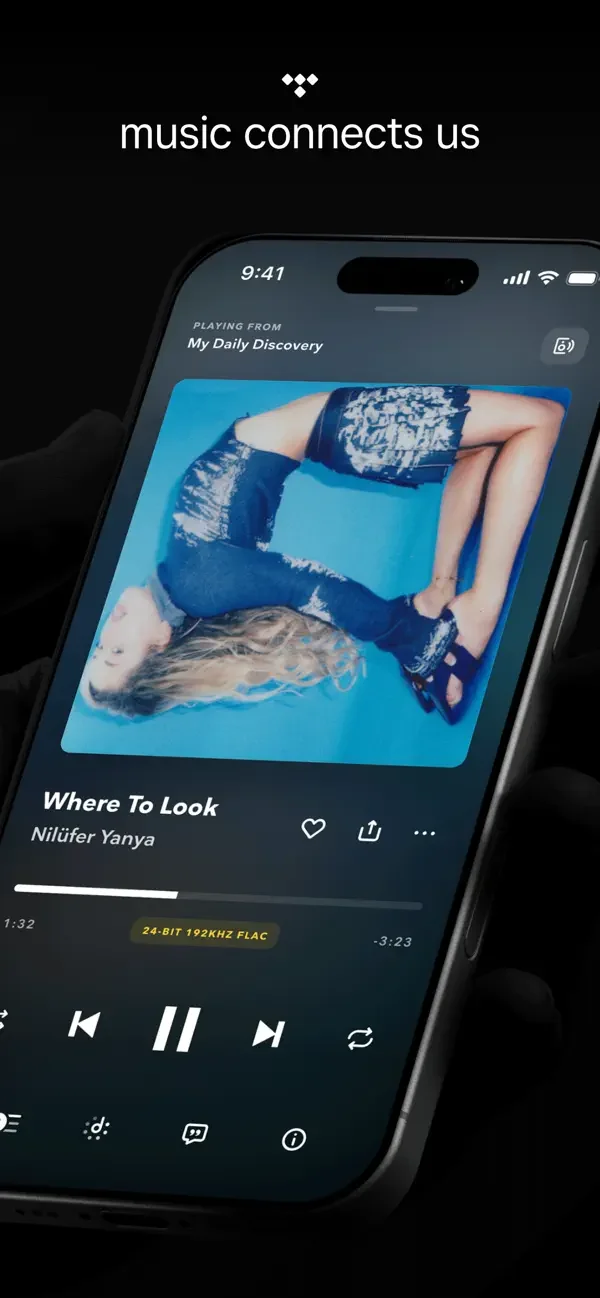
In its public statement announcing the enforcement, Tidal argued that synthetic music risked overwhelming genuine creators.12 "If you make music, you should be able to put it on TIDAL knowing it won't be buried under tracks no one asked for, or copied by someone pretending to be you," the statement said.12 The platform stated that protecting creator compensation remains central to the policy.1 While fully synthetic audio faces outright removal, recordings created with technological assistance remain permitted.14 As Tidal stated, "Tracks that were assisted by AI tools, but not the sole outputs, will be allowed on the platform."23
Tidal explained in documentation that its narrow focus on completely synthetic tracks stems from technical constraints.34 The platform noted that "to avoid false positives, we will only be taking action with respect to wholly AI-generated recordings."34 The company does not penalize artificial-intelligence compositions when human musicians perform the actual recording, and it acknowledged that partially assisted works may remain unlabeled.34 Musicians whose work is flagged by mistake must appeal through a designated review form for copyright, trademark, and tagging disputes, though published documentation provides no specific procedure for mixed human and software workflows.34
Enforcement will operate across two screening layers, combining distributor metadata declarations with acoustic analysis provided by detection partner Ircam Amplify.13 Ingest systems will automatically discard tracks whose distributor metadata identifies them as solely machine-generated.14 For unflagged submissions, Ircam Amplify software analyzes audio files for frequency markers.3 Research into audio models indicates that music generators leave subtle spectral peaks across audio layers inherent to model architectures.3

Independent technical evaluations suggest the automated detection network will encounter meaningful hurdles across different generator models and file formats.3 In October 2026, researchers at the University of Georgia, Virginia Commonwealth University, the University of Tennessee, and Cornell released MUSEBENCH, a benchmark evaluating commercial audio detectors across 4,500 synthetic tracks and 1,990 human recordings.3 Testing Ircam Amplify at a 0.5 confidence threshold, the researchers found the tool achieved 98.6 percent precision on positive calls and caught every tested track produced by Suno versions 2 through 3.5.
Detection performance dropped sharply on other generator architectures and degraded audio files.3 The benchmark revealed that Ircam Amplify missed 28.9 percent of synthetic tracks across all tested systems, failing to catch 30.4 percent of Udio recordings and 79.2 percent of tracks from Google's Lyria RealTime. Converting 300 synthetic tracks to MP3 files at 128 kilobits per second caused the detector's miss rate to reach 63.6 percent, as compression smeared the spectral peaks used for identification.3 The researchers also recorded a 9.0 percent false-positive rate on human-made recordings, pointing to friction for legitimate musicians whose work might trigger automated flags.3
The rush of synthetic music into commercial catalogs has been fueled partly by organized royalty manipulation. In October 2026, a federal court in New York sentenced North Carolina resident Michael Smith to 18 months in prison for streaming fraud.3 Federal prosecutors established that Smith used automated software to produce hundreds of thousands of songs and deployed up to 10,000 bot accounts to stream them, illegally collecting more than $8 million in royalties before being ordered to forfeit $8,091,843.64.3 In April 2023, Smith's bot accounts generated 80.9 million plays on family subscription plans on YouTube Music, surpassing the 9.3 million family-plan plays recorded by Taylor Swift's entire catalog during the same month.3
Streaming companies have diverged on how to manage the deluge of automated files.35 Spotify has allowed synthetic music while purging tens of millions of spam uploads and suppressing low-engagement files from recommendation queues.35 Bandcamp banned music generated wholly or in substantial part by artificial intelligence through user reports and manual review. Deezer implemented its own acoustic detector to identify synthetic material, keeping flagged songs out of playlists and taking down tracks that receive no streams for six months. By purging synthetic recordings from its library and barring distributors from delivering them, Tidal has established the strictest barrier among major subscription streaming services.53
The record
33 sentences trace to 5 sources.
-
1
A
 AlternativeTo
Document
· alternativeto.net · 27 Nov 2026
TIDAL will ban & delete all fully AI-generated music from its platform starting December 9
See the source
- 2 Tidal to Ban AI-Generated Music - Mixonline See the source
- 3 Tidal Bans AI-Generated Music: How It's Detected See the source
- 4 Tidal Will Ban Fully AI-Generated Music on December 9 See the source
- 5 Tidal will ban fully AI-generated music See the source