Stock market order flow reveals order splitting consistency in anonymous exchange records
A study of Johannesburg Stock Exchange transactions shows anonymous trades admit order-splitting reconstructions that match universal market-impact regularities, even while hidden parent orders remain fundamentally non-unique.

When an investor watches the stream of transactions across a major stock exchange, the direction of each trade appears to carry a long memory.12 A buy order executed at ten o'clock in the morning often predicts whether another buy order will arrive minutes or even hours later.2 Yet this persistence does not mean that stock prices themselves wander predictably over time. While price changes fluctuate rapidly and wash out quickly, the sequence of buy and sell decisions exhibits a slow, enduring autocorrelation that can stretch across entire trading days.21
For decades, economists wondered whether this long memory was the result of a crowd of independent investors all reacting simultaneously to the same underlying news.21 An alternative explanation, known in market microstructure as order-splitting theory, suggests a far more mechanical cause.12 When an investor executes a substantial trading program, executing the entire amount in a single block would displace liquidity and trigger severe slippage.2 Market participants therefore divide their total execution target into a sequence of smaller transactions that are released gradually into the limit order book.21
When dozens of market participants split their positions across overlapping horizons, the resulting tape creates a persistent stream of same-direction trades.21 The causal chain is straightforward: a participant initiates a trading campaign; to manage market friction, execution algorithms divide that objective into small child orders; these orders interleave with executions from other market actors; and the aggregate market tape ends up reflecting the prolonged lifespan of those underlying commitments. The mathematical formulation of this process, established by Fabrizio Lillo, J. Doyne Farmer, and Rosario N. Mantegna alongside subsequent work by Szabolcs Mike, relates the decay rate of trade-sign correlation directly to the size distribution of institutional orders.13
A preprint posted on the arXiv server by Ezra Goliath and Tim Gebbie at the University of Cape Town investigates whether this foundational mechanism can be proven using only anonymous, publicly available market data. Historically, testing the relation required proprietary datasets containing unique broker codes and trader identifiers, which allowed researchers to track which child orders belonged to which institutional parent.14 By attempting to reconstruct synthetic metaorders from public records of the Johannesburg Stock Exchange, the researchers established a constructive consistency proof showing that public feeds admit reconstructions compatible with order-splitting theory, even though the microscopic assignments are not uniquely identifiable.1
Why does order flow retain memory while prices do not?
Financial markets absorb persistent directional trading through order-splitting behavior that leaves long-range autocorrelations in trade signs while keeping price changes unpredictable. In order-splitting models, a metaorder represents a persistent sequence of orders of the same sign associated with a specific synthetic trader.1 When many synthetic traders execute overlapping metaorders of widely varying lengths, the trade tape exhibits power-law autocorrelation that decays slowly over thousands of transactions.3 Yet price efficiency is preserved because the limit order book responds nonlinearly, flattening the cumulative price impact into a concave curve.6
This nonlinear response prevents persistent order flow from producing predictable price trends that could be exploited by arbitrageurs.contributed The price change induced by an order sequence follows a square-root scaling relative to traded volume, ensuring that later trades within a sequence exert less incremental impact than earlier trades.16 The central puzzle of market microstructure is how this event-based microscopic persistence maps into diffusive, unpredictable price changes in physical calendar time.contributed
Public exchange feeds conceal the identities of the market participants who place orders, leaving observers with an anonymous stream of prices, volumes, and execution directions.12 According to the preprint posted on arXiv, institutional parent orders remain private because revealing an ongoing trading schedule would expose the institution to predatory trading and price slippage.12 As a result, researchers attempting to verify market theories on public data must infer how individual child orders link together into continuous campaigns.1
Tim Gebbie, an associate professor in statistical science at the University of Cape Town and co-author of the preprint, explained that public feeds lack the necessary tags to separate distinct market participants cleanly.contributed In response to questions from Primary, Tim said that with anonymous data researchers cannot claim to identify the true parent orders in any particular market regime, observing that what the methods identify is a class of latent order-flow partitions consistent with the observed data and the imposed structural assumptions.contributed The paper therefore functions as an identifiability study, asking whether synthetic groupings can recover the distributional regularities of order splitting without assuming that individual institutional portfolios have been isolated.1
How can anonymous trades be grouped into synthetic metaorders?
Reconstruction algorithms assign anonymous transactions to synthetic traders using participation distributions to assemble contiguous sequences of same-signed trades. The preprint notes that prior reconstruction techniques built on the work of Guillaume Maitrier, Gr'egoire Loeper, and Jean-Philippe Bouchaud assign individual transactions to a predetermined number of synthetic traders using participation distributions.6 If a synthetic trader receives several successive trades of the same sign, those transactions are compiled into an estimated metaorder.16
This synthetic grouping allows researchers to calculate how much the price moved during execution and how that price impact relaxed after trading ceased.16 Ezra Goliath and Tim Gebbie evaluated synthetic trade reconstruction across three full years of tick-level transaction records from the Johannesburg Stock Exchange.14 The dataset, sourced through the BMLL Data Lab platform, covered the largest 239 stocks by market capitalisation on the exchange from January 1, 2023, to December 31, 2025.4 The authors removed the opening and closing 10 minutes of each trading day to prevent opening imbalances and closing auction volatility from distorting the intraday trade sequences.1
Addressing that filtering procedure, Tim told Primary that no quantitative threshold was optimised to select ten minutes.contributed Tim said it was a fixed preprocessing choice made before the reconstruction and calibration, explaining that the first ten minutes were removed to exclude the opening-auction and overnight-imbalance transient, while observations from 16:50 onward were removed because the JSE closing auction begins then.contributed Tim added that the window was not selected to improve either the theoretical exponent relation or the market-impact fits, noting that the data was strictly restricted to continuous-trading states.contributed
The researchers conducted a parameter grid search across 50 unique configurations per stock year, testing synthetic trader populations ranging from 5 to 1,500 active agents alongside power-law participation exponents ranging from 1.5 to 5.1 Each parameter configuration generated a distinct set of synthetic metaorders, which the authors then evaluated against four established empirical benchmark patterns of institutional trading.14
Tim said that no empirical threshold uniquely fixed those parameter endpoints.contributed The team used a deliberately broad exploratory grid, moving from very concentrated to highly fragmented participation, and selected configurations using calibration criteria without adjusting the grid to force particular results.contributed Each configuration was measured against the square-root law of price impact, which dictates that the price change induced by an institutional metaorder scales with the square root of the executed volume normalised by total daily volume.6 The second benchmark evaluated whether the impact was independent of the total duration of the trade.6 The third and fourth benchmarks tested whether the price moved in a concave trajectory during execution and decayed concavely once execution ended.1 Finally, the authors tested whether the synthetic metaorders satisfied the theoretical relation from order-splitting theory, where the power-law exponent of the metaorder length distribution directly matches the decay exponent of trade-sign autocorrelation.13
What does the calendar-time mismatch reveal about price formation?
The discrepancy between event-time order-splitting properties and calendar-time price impact demonstrates that operational market dynamics transform order flow as it translates into prices.contributed When Ezra Goliath and Tim Gebbie selected configurations that minimised errors across the four physical impact benchmarks, the synthetic metaorders matched the square-root law and the execution profiles but yielded a poor fit to the theoretical exponent relation.14 Conversely, when the authors forced the calibration to minimise discrepancies with the theoretical order-splitting relation, the algorithm recovered the target formula by construction.1
Under this selection, several broad impact features remained intact, but the individual stock-level execution curves and post-trade decay fits became noticeably weaker.1 Tim told Primary that the breakdown became clear after revising an earlier draft of the study.contributed In that earlier effort, the researchers followed the methods of Guillaume Maitrier and colleagues using illustrative parameter choices that seemed to produce realistic impact curves alongside an approximate exponent match.7 After receiving feedback from Jean-Philippe Bouchaud highlighting that those parameters were not formally identified from the Johannesburg market data, the authors began a systematic grid search.contributed
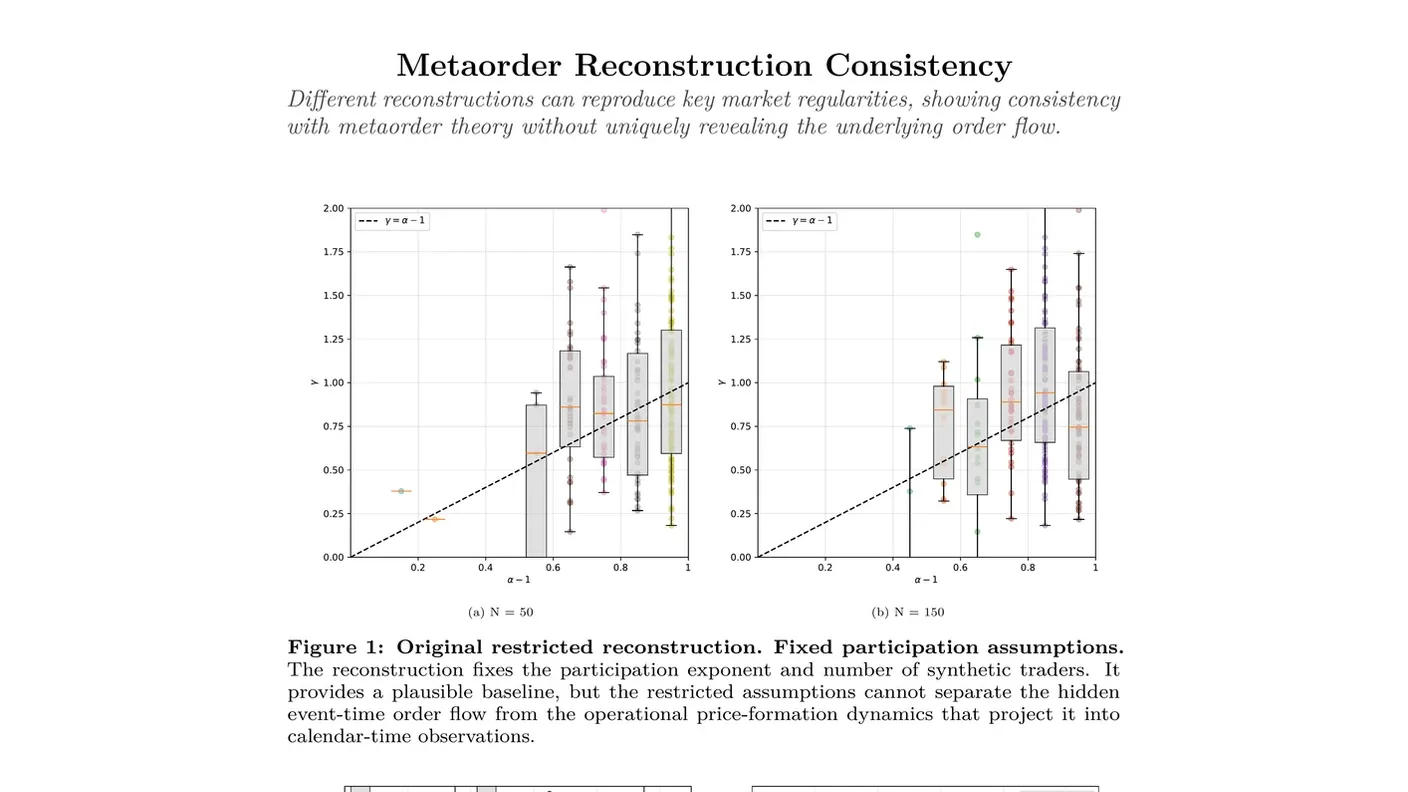
To document how different parameter selections alter empirical consistency, the authors presented three separate diagnostic scenarios. The first diagnostic illustrated the initial baseline constraints:
Figure 1: Original restricted reconstruction. Original reconstruction under fixed participation assumptions. The anonymous transaction record was partitioned into synthetic metaorders using a fixed participation exponent and fixed numbers of synthetic traders. This produced a plausible initial event-time reconstruction, but the restricted parameters did not adequately separate the event-time order-flow structure from its subsequent operational and calendar-time projections.contributed
When calibration targeted calendar-time price movements directly, the resulting metaorders captured macroscopic impact while departing from event-time order splitting:
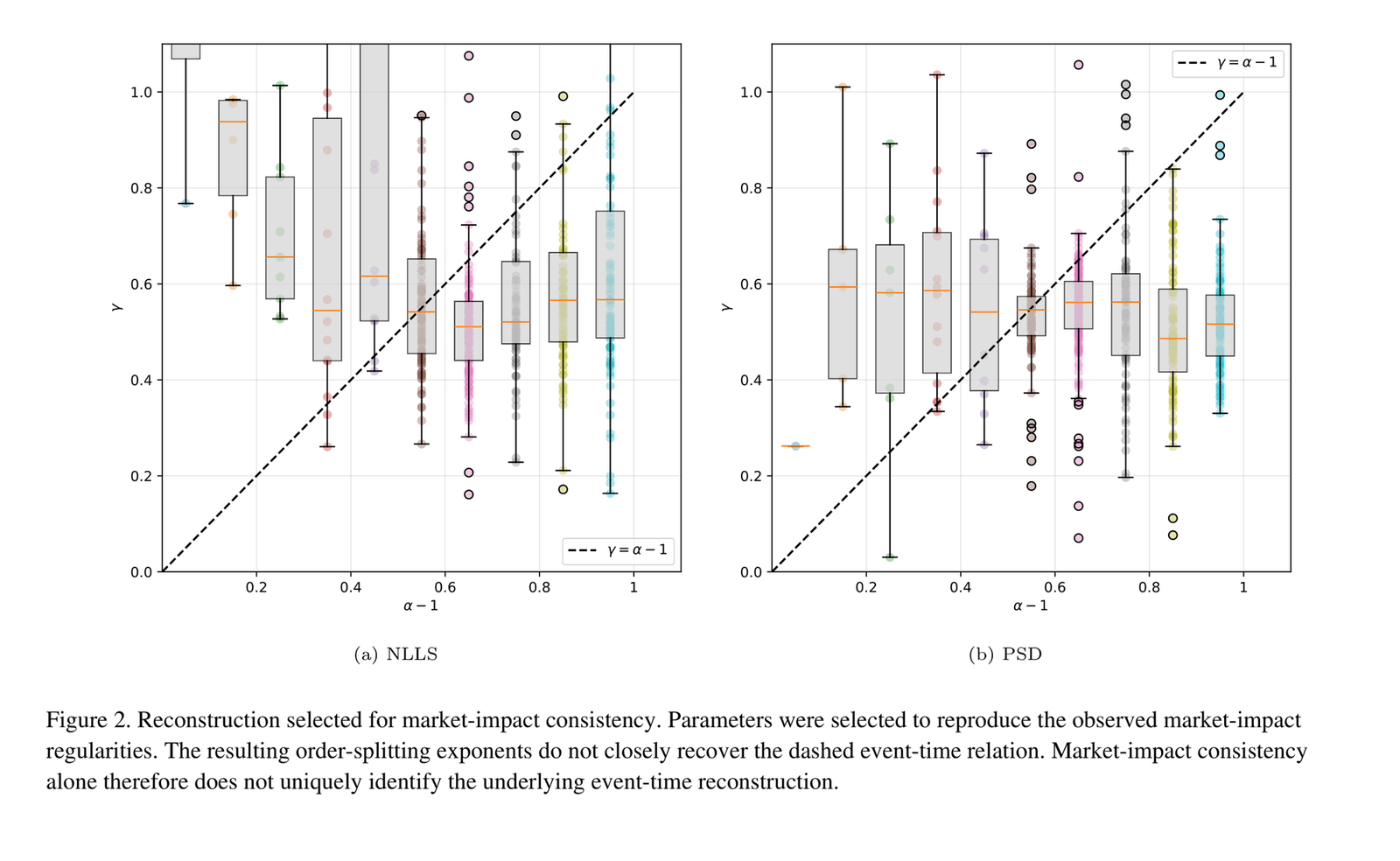
Figure 2: Selection from the calendar-time side. Reconstruction selected for market-impact consistency. Parameters were selected to reproduce the observed market-impact regularities after synthetic order flow had been mapped into price changes. The resulting order-splitting exponents do not closely recover the dashed event-time relation. This does not constitute a failure of the order-splitting mechanism: calendar-time impact has already been transformed by the intervening reaction-front dynamics and does not uniquely identify the underlying event-time reconstruction.contributed
By contrast, selecting parameters from the event-time side demonstrated that the public record remains fully compatible with theoretical order splitting:
Figure 3: Selection from the event-time side. Reconstruction selected for order-splitting consistency. Parameters were selected for agreement with the event-time relation between metaorder-length tails and trade-sign memory. The aggregate medians align closely with the dashed theoretical relation, although individual stock-years remain dispersed. This establishes that the anonymous record admits reconstructions consistent with order-splitting theory, while the intervening operational price-formation layer prevents the reconstruction from being uniquely inferred from calendar-time prices.contributed
In response to questions from Primary, Tim said that with anonymous data researchers do not observe the microscopic trader process directly, adding that what weakened first under the constrained reconstruction were some of the stock-level execution-profile and post-execution decay diagnostics.contributed In stocks with fewer reconstructed metaorders, the estimates became noisier because fewer observations fell into the relevant analytical bins.contributed Tim interpreted the deterioration primarily as weaker identification at the individual-stock level rather than evidence that a particular microscopic mechanism had failed.contributed
Can public exchange feeds identify true parent orders?
Anonymous public transaction feeds do not contain the broker codes or trader identifiers required to infer unique parent orders.1 The findings presented in the preprint represent a statistical simulation study of reconstruction methods rather than a direct measurement of institutional trading activity.1 The authors relied on high-frequency Level 1 event data, which records prices, volumes, and trade directions but excludes the full depth of the order book and the private participant identifiers required to track actual parent orders. Furthermore, the analysis was conducted on a single equity venue, the Johannesburg Stock Exchange, whose liquidity profile and participant composition may differ from larger venues such as the Tokyo Stock Exchange or the New York Stock Exchange.1
The study also assumes that daily volatility can be captured by the normalised high-low mid-price spread and that trader participation follows simple power-law distributions. In addition, the paper was posted as a preprint that may not have been peer reviewed on the arXiv repository and was subsequently withdrawn by the primary author to incorporate revisions, meaning its conclusions have not undergone formal peer review.48
Tim pointed out that the square-root law itself represents an aggregate relationship rather than a unique fingerprint of underlying parent orders.contributed Synthetic metaorders regroup real transactions while retaining their actual execution prices, trade volumes, and chronological ordering.1 As Tim told Primary, changing the latent trader assignment changes which trades are grouped together, but does not manufacture a new market price path.contributed The persistence of the square-root curve across different groupings suggests that the law reflects how markets prevent arbitrage rather than how individual parent orders are designed.contributed
The findings suggest that the Lillo-Mike-Farmer theory remains consistent with anonymous public data, but public data alone cannot provide an independent test of its validity.1 Tim told Primary that falsification on anonymous feeds should not rest on whether a single synthetic partition misses the theoretical exponent relation, because the true division of traders remains unobserved.contributed Instead, Tim suggested that a stronger test asks whether an order-splitting model, once enforced locally, produces aggregate behaviour that contradicts observed market prices.contributed
Because enforcing the theoretical relation did not destroy observed aggregate regularities, the researchers describe their findings as consistency rather than direct validation.1 Proving whether order splitting is the true microscopic driver of market memory still requires datasets with verified broker and trader identifiers.1 Rather than attempting to isolate unique parent orders from anonymous data, future research will likely focus on inferring probabilistic distributions over possible trading configurations, testing whether those latent distributions align with actual institutional behaviour across global equity markets.
What this rests on
77 sentences trace to 7 sources and 1 contributor.
-
1
EG
Ezra Goliath, Tim Gebbie Paper · arxiv.org · 1 Sep 2026 Metaorder modelling and identification from public data Preprint · may not have been peer reviewed See the source
-
2
Q
quantmemo.com Third-party reporting · quantmemo.com The Lillo-Mike-Farmer Splitting Model See the source
-
3
A
-
4
A
- 5 Contribution — Tim 36 statements added to this article
-
6
A
-
7
A
-
8
A
Other consulted pages1 page
ideas.repec.org1 page
quantmemo.com1 page
Article history
-
7 statements 4 Sep 2026, 06:41What was added
The findings suggest that the Lillo-Mike-Farmer theory remains consistent with anonymous public data, but public data alone cannot provide an independent test of its validity.
On the record as reference 5What was addedYet price efficiency is preserved because the limit order book responds nonlinearly, flattening the cumulative price impact into a concave curve.
On the record as reference 5What was addedTim Gebbie, an associate professor in statistical science at the University of Cape Town and co-author of the preprint, explained that public feeds lack the necessary tags to separate distinct market participants cleanly.
On the record as reference 5What was addedUnder this selection, several broad impact features remained intact, but the individual stock-level execution curves and post-trade decay fits became noticeably weaker.
On the record as reference 5What was addedBy attempting to reconstruct synthetic metaorders from public records of the Johannesburg Stock Exchange, the researchers established a constructive consistency proof showing that public feeds admit reconstructions compatible with order-splitting theory, even though the microscopic assignments are not uniquely identifiable.
On the record as reference 5What was addedTim said that no empirical threshold uniquely fixed those parameter endpoints.
On the record as reference 5What was addedThe authors removed the opening and closing 10 minutes of each trading day to prevent opening imbalances and closing auction volatility from distorting the intraday trade sequences.
On the record as reference 5T Tim · Contributor -
Published 22 Sep 2026, 13:06Assembled by the Primary desk from 7 sources · 1 contributor · 77 cited sentences