Foreign investors bought $942 billion in US equities
Second-quarter purchases reached a record $426 billion as Asian portfolio caps and artificial intelligence shares accelerated cross-border capital flows.

Overseas buyers expanded their holdings of American shares at the fastest annual pace in four decades, pouring money into technology equities while paring back acquisitions of federal debt.
Data compiled by the US Treasury Department showed that net purchases of American equities and investment fund shares by overseas accounts reached $942 billion across the twelve months through July.12 That volume marked the highest rolling twelve-month total recorded since the department began assembling the tracking series in 1985.12 The buying ran without interruption through the spring and early summer, leaving cross-border investors as net buyers of domestic shares for six consecutive months.12
The momentum gathered speed in the middle of the year before easing. Cross-border accounts purchased $110 billion in net equities during April and lifted their acquisitions to $182 billion in June, according to federal records.12 Net inflows decelerated sharply to $3.7 billion in July, yet remained positive.12
Quarterly volume eclipses past high
The concentration of demand was most pronounced between April and June. Net purchases recorded by the US Bureau of Economic Analysis climbed to $426 billion during the second quarter, establishing a fresh single-quarter record.312 That three-month total represented a 62 percent increase compared to the second quarter of 2025 and surpassed the previous quarterly high-water mark of $299 billion reached in 2022.12
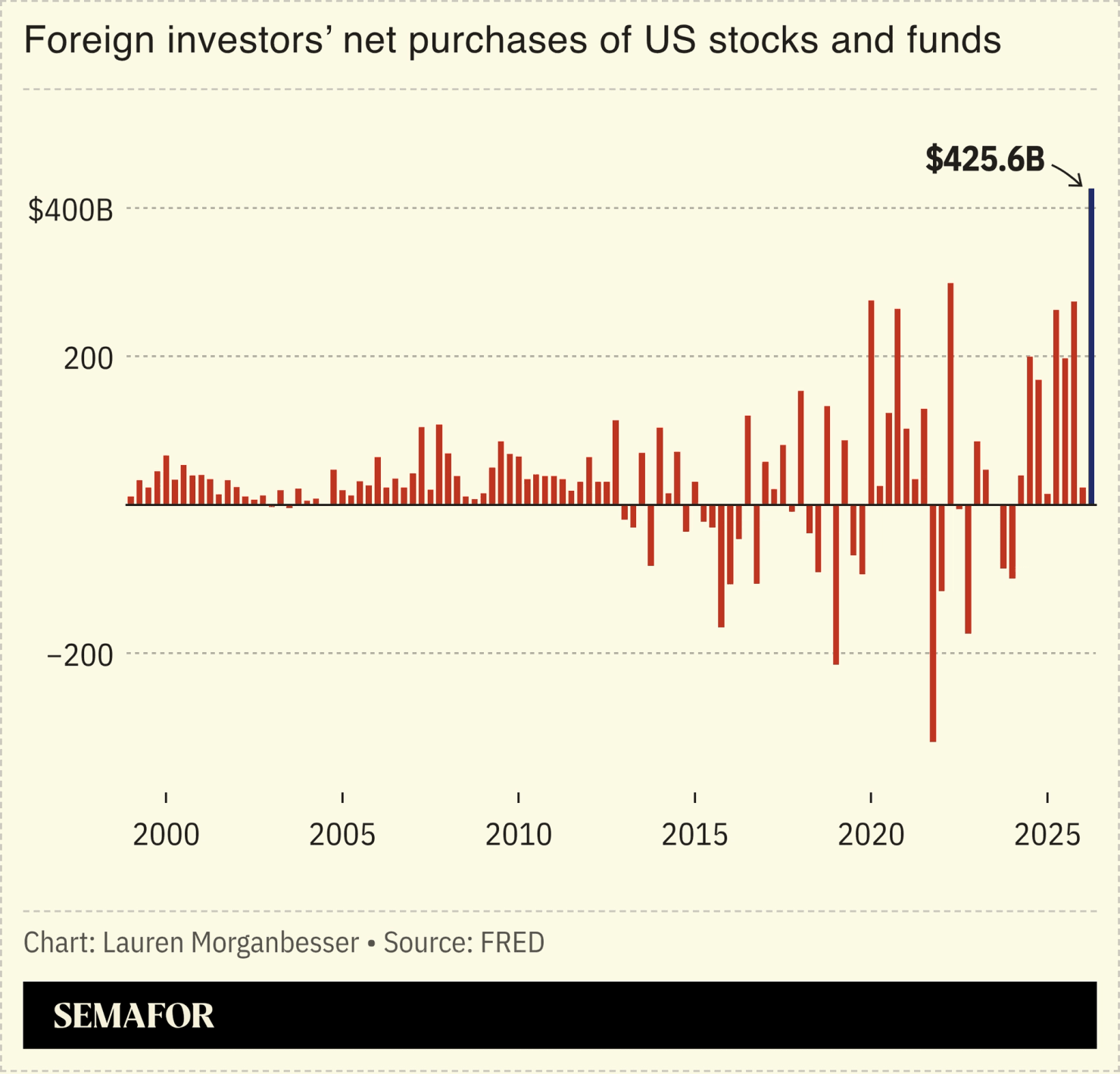
Those inflows tracked substantial gains across major American stock benchmarks over the same period. The benchmark S&P 500 advanced approximately 20 percent across the twelve months through July, anchored by earnings growth at prominent technology and hardware firms including SanDisk, Western Digital, and Intel.12 During the second quarter alone, the index gained 14.9 percent, marking its strongest quarterly advance since the comparable period in 2020.12 The quarterly climb unfolded despite a sharp, temporary drop that occurred when conflict broke out in Iran.12
Brad Setser, a senior fellow at the Council on Foreign Relations, noted that the second-quarter surge may have caught up some delayed transactions from the start of the year.12 He pointed out that the unusually large buying in the spring might partly mirror a delayed reflection of softer purchases recorded in the first quarter, though the underlying pattern still demonstrated historic cross-border appetite for American equities.12
Rebalancing pressures in Seoul and Taipei
Part of the overseas rotation was propelled by equity dynamics in East Asia rather than direct sentiment on Wall Street. Extended rallies among major hardware exporters in South Korea and Taiwan elevated the weighting of domestic chipmakers inside local portfolios, pushing institutional holdings beyond permitted concentration caps.12
A portfolio concentration limit establishes a ceiling on how much exposure an asset manager may hold in an individual corporation to avoid disproportionate losses.2 When share prices for manufacturers such as Samsung Electronics and SK hynix climbed rapidly, institutional managers found themselves bumping against those statutory barriers.12 To bring their accounts into compliance, managers liquidated portions of their domestic holdings and redirected the capital into global equities, directing the majority into American companies.12

Setser cited those Asian equity rallies as an essential driver of the cross-border reallocation.12 "You rarely see South Korea see one-way outflows of more than $200 billion into global equity markets, and most of it goes to US stocks," Setser said, observing that the shift in capital flows coincided with dollar strength.12
Divergence from government debt
The enthusiasm for domestic corporate shares stood in stark contrast to international demand for sovereign debt. While equity inflows set records, foreign net buying of US debt securities fell to $188 billion in the second quarter, down from $314 billion during the first three months of the year.12
The retreat in sovereign paper purchases coincided with balance-sheet adjustments among major sovereign holders. Official Chinese holdings of US Treasuries dropped to $618 billion, touching their lowest level since August 2008 as reserve managers shifted allocations toward agency debt and gold.2
Setser observed that this divergence presents complications for financing the federal deficit. When global capital rotates heavily into corporate equity instead of public debt instruments, federal auctions must rely more heavily on domestic balance sheets or offer elevated borrowing yields to attract buyers.1
"It feels like the whole world is extremely bullish on US stocks," Setser said, summarizing the broad geographic appetite that has reshuffled international capital accounts.13
What this rests on
22 sentences trace to 3 sources.
-
1
G
gmt8press.com Third-party reporting · gmt8press.com GMT EIGHT - Foreign capital is madly buying US stocks! Net inflows of $942 billion over the past 12 months, a record since 1985. See the source
-
2
SE
Seoul Economic Daily Third-party reporting · en.sedaily.com · 27 Sep 2026 Foreign Buying of U.S. Stocks Hits Record on AI Boom See the source
-
3
BR
Brendan Ruberry Document · semafor.com · 27 Sep 2026 Foreign investors buy into US equities at record rate See the source