Gulf building contracts fall 37% to $47.4 billion
Gas and chemical commitments expanded while Oman plunged 97% and Saudi Arabia delayed marquee projects including NEOM Stadium.
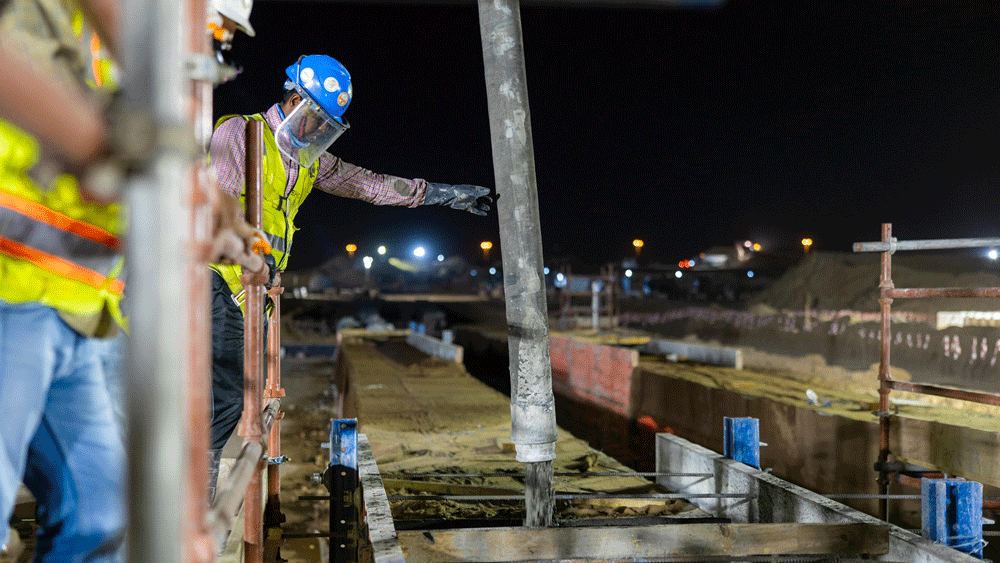
Builders across the Gulf Cooperation Council signed $47.4 billion in project awards during the third quarter of 2026, a 37.2 percent drop from $75.6 billion in the same period a year earlier.123 The quarterly slide recorded by Kuwaiti investment group Kamco Invest reflected double-digit annual contractions across every member state, as regional conflict, export disruptions, and fiscal reallocations curbed civil development.13
Oman experienced the sharpest pullback in the region.31 Contract awards in the sultanate dropped 96.6 percent year-on-year to $76 million during the three-month period.31 Across the broader six-nation bloc, general construction remained the single largest category by value at $14.8 billion, yet that headline total represented a 44.7 percent drop compared to the third quarter of 2025.23
The contraction occurred alongside significant operational strain across regional energy logistics. In April, the International Monetary Fund estimated that military strikes and precautionary shutdowns had reduced regional crude production by 13 million barrels a day, while natural gas output declined by the equivalent of roughly 3.5 million barrels a day.2 The fund lowered its 2026 economic growth projection for the Middle East and Central Asia region, excluding Israel and the Palestinian territories, to 1.4 percent, a downgrade of 2.3 percentage points from its prior autumn estimate.2
Energy spending buffers the quarterly slide
Industrial spending on hydrocarbons and downstream processing prevented a steeper regional decline. Energy companies pushed gas contract commitments up 59.9 percent year-on-year to $13.5 billion, while chemical awards surged nearly fivefold from $750 million to $3.5 billion.32 Those two segments were the only tracked sectors to register annual expansion during the third quarter.123
National oil producers drove the bulk of that activity. Abu Dhabi National Oil Company awarded a $1 billion contract for its Umm Shaif Gas Cap and Surface Pressure Boosting project, lifting quarterly gas awards in the United Arab Emirates to $6.2 billion.2 In Saudi Arabia, where state energy producer Aramco allocated between $50 billion and $55 billion in capital expenditures for 2026, gas awards climbed 80.1 percent to $6.9 billion.2 Aramco has directed $12.3 billion toward upstream hydrocarbon contracts through September.2
Thanks to those industrial outlays, cumulative nine-month project commitments across the Gulf rose 2.5 percent year-on-year to $204.1 billion, up from $199.1 billion in the first nine months of 2025.3 Saudi Arabia led all regional markets by awarding $24.4 billion during the quarter, followed by the United Arab Emirates with $15.6 billion and Qatar with $5.2 billion.32 Qatar posted a 76.1 percent quarter-on-quarter surge on the back of $5 billion in oil deals, while Bahrain grew 4.3 percent.23
Vision 2030 recalculates its marquee pipeline
Despite the sharp quarterly slowdown, the Gulf maintains a forward development pipeline of $2.05 trillion in announced ventures, with approximately half situated in Saudi Arabia.1 Yet fiscal constraints and shifting timelines have forced the kingdom to reassess several of its largest flagship initiatives.
Saudi Arabia recorded $73.4 billion in total contract awards during the first nine months of 2026, down from $79.5 billion in the comparable period of 2025.2 Projections from the Saudi Ministry of Finance point to an expanding fiscal deficit and a 3.6 percent contraction in real gross domestic product, driven by lower petroleum revenue.4 Independent macroeconomic forecasts prepared by Oxford Economics and the Institute of Chartered Accountants in England and Wales project the wider Gulf economy will shrink 6.4 percent this year, led by a 4.6 percent drop in Saudi economic output.
Those pressures have materialized directly within the kingdom's giga-project portfolio. Development authority NEOM halted construction on The Line until after 2030, incurring an estimated $16 billion liability to unwind existing supplier and contractor commitments.1 Public Investment Fund governor Yasir Al-Rumayyan confirmed in April that The Line was no longer an immediate operational priority, while maintaining that planned developments had not been formally abandoned.4
World Cup preparations have also absorbed adjustments. Saudi organizers placed the planned $2.5 billion NEOM Stadium on indefinite hold, shelving the 46,000-seat arena that had been designed to sit suspended within The Line.1 The kingdom intends to host the 48-team 2034 tournament across 15 stadiums in five cities, relying on active developments elsewhere such as the Aramco Stadium in Al Khobar, where ticket sales have begun ahead of scheduled matches in January.
What this rests on
21 sentences trace to 4 sources.
-
1
MA
Manal Albarakati Document · semafor.com · 9 Oct 2026 New construction projects in the Gulf plunge 37% See the source
-
2
A
arabnews.com Third-party reporting · arabnews.com · 8 Oct 2026 GCC project awards rise 2.5% in 9 months on gas, chemicals surge: Kamco See the source
-
3
G
gdnonline.com Third-party reporting · gdnonline.com Middle East Business: GCC contract awards plunge 37pc in Q3 amid geopolitical turmoil See the source
-
4
T
thecooldown.com Third-party reporting · thecooldown.com · 8 Oct 2026 Saudi Arabia's planned $2.5 billion World Cup stadium officially put on hold See the source