SPOZZ adds artist subscriptions to music streaming app
Musicians receive 80% of membership fees directly while managing catalog playback, customer databases, and merchandise sales.

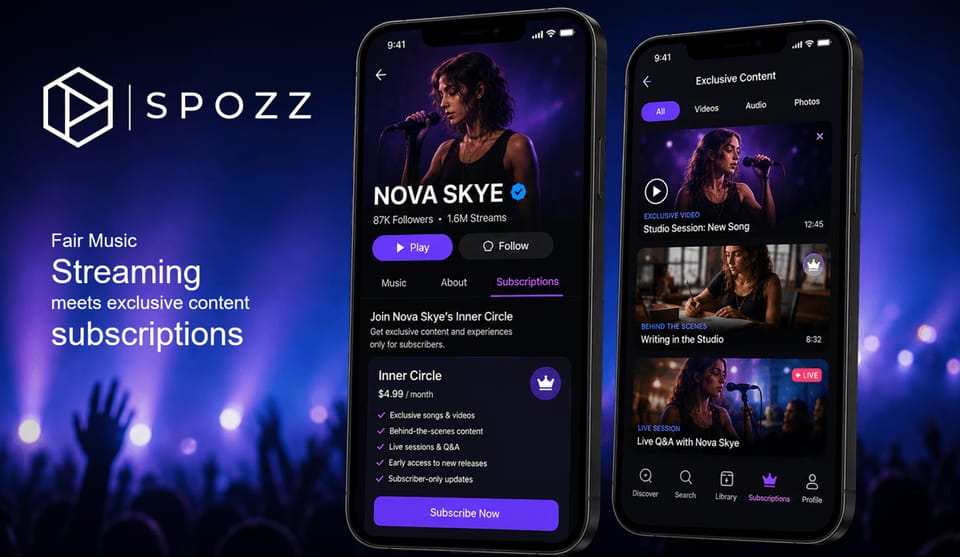
Direct-to-fan music platform SPOZZ is integrating paid artist subscriptions directly into its music streaming application, allowing musicians to collect recurring fan payments alongside listening activity.12
The Zurich-based platform, developed by Envision Finance Technologies AG, announced the update on September 1, 2026, positioning the change as an effort to unify streaming distribution with subscriber-only community access.2
Under the expanded setup, listeners can stream an artist's catalog and subscribe to that same artist without navigating to an external membership service.12
Subscribers receive access to material reserved for paying supporters, including unreleased tracks, videos, behind-the-scenes recordings, and live sessions.12
In its announcement, the company compared the functionality to creator platforms such as Patreon and OnlyFans, arguing that keeping those tools inside a streaming player prevents audience fragmentation.12
Streaming mechanics and credit deductions
Streaming compensation has drawn sustained criticism from independent musicians who receive fractions of a cent per play on dominant services. SPOZZ maintains that its streaming tier pays creators higher compensation per stream than conventional competitors, using a pay-per-stream credit structure rather than a pooled royalty distribution model.13
Listeners purchase platform credits to play tracks across web browsers, iOS devices, and Android applications.34
Each playback deducts credits, except for free playback of purchased songs and public-domain content, and credits the recording artist directly, connecting streaming income to individual plays.
Addressing the payout flow, founder Christian Mueller explained how playbacks convert into funds for creators. "Microtransactions such as streams are credited in SPOZZ Credit, a SPOZZ internal currency," Mueller told Primary. "Earned SPOZZ Credits can be exchanged to USDT on the SPOZZ Website 1:1 at no cost and be transferred to any Crypto Exchange for Chang to USD, Euro, etc.."
By layering subscriptions on top of that listening model, the company aims to convert regular listeners into monthly patrons. The payout mechanics allow musicians to convert per-stream digital tokens into stablecoins before moving them into fiat currencies.
Consolidating fan relationships on the web
Christian Mueller, founder of SPOZZ, has argued that artists face structural risks when separating their streaming catalogs from audience communications.46
When expanding the platform to web browsers in June 2026, Mueller stated that the platform aims to give musicians direct authority over audience data, engagement tools, and revenue pipelines.4
"The future of music belongs to artists who own their audience relationships," Mueller said when announcing the web launch.4
"SPOZZ brings streaming, commerce, fan engagement and audience ownership together in one platform, giving creators more control over their careers and revenue."4
Clarifying the progression of platform capabilities, Mueller told Primary that web access consolidated existing software. "The specific June rollout was our web player, which made SPOZZ’s music streaming and direct-to-fan experience available in a browser alongside iOS and Android," Mueller said. "It connected listeners to tools already in the SPOZZ ecosystem: artist pages, music sales, fan databases and CRM, newsletters, direct messaging, memberships, live video, merchandise and bookings."
Mueller added that the deployment unified pre-existing infrastructure rather than debuting each instrument simultaneously. "Artists can use those tools to understand and communicate with their audience and offer music and other content directly to fans," he said. "I want to be precise about the timeline: we announced the web expansion in June, not the launch of every tool on that list."
Commercial terms and distribution roles
The company first introduced artist stage subscriptions in January 2026 before integrating them into the core playback application in September.1
Under the platform's published terms, artists retain 80 percent of all net subscription revenue, with payouts issued without recurring monthly software charges.
Detailing the subscription revenue split, Mueller told Primary that payments move across standard payment processing rails. "The artist receives 80 percent of the subscription payment directly through Stripe, and SPOZZ receives 20 percent," Mueller said. "The transaction is between the artist and the fan. There is no additional SPOZZ subscription fee or monthly software charge. Applicable taxes depend on where the artist and fan are located and the rules governing that transaction."

Platform documentation states that SPOZZ acts solely as a technical intermediary.7
The service does not purchase, sell, or license catalog copyrights directly.7
All transactions, whether for monthly fan memberships or individual song sales, take place directly between creators and listeners.7
Mueller defined the intermediary posture, saying rights holders govern catalog access. "The rights holder decides what content to offer and under which license terms," Mueller said. "When a fan buys or streams that content, the applicable license is between the creator and the fan, subject to SPOZZ’s platform terms. SPOZZ provides the tools to present the offer, record the transaction, deliver access and allocate the payment. We take a platform commission, but we do not acquire the artist’s catalog copyrights or act as the publisher of their music. Artists remain responsible for having the rights needed to offer their work."
The legal framework leaves copyright control with creators. "Rights holders retain ownership of their catalogs and decide which recordings to make available on SPOZZ and under what terms," Mueller told Primary. "They grant SPOZZ the permission needed to host and deliver those recordings, without transferring ownership or granting SPOZZ exclusive distribution rights. Rights holders can continue to distribute their music elsewhere, subject to any agreements they have with other parties. Licenses issued to fans define their permitted uses of the music; some may also include a right to participate in revenue generated under the specific license terms. Those rights do not transfer ownership of the underlying copyrights."
Catalog identification and artificial intelligence boundaries
Alongside commercial terms, the platform enforces direct licensing agreements with rights holders and includes International Standard Recording Code management tools for catalog tracking.4
Explaining catalog administration, Mueller told Primary that public ledgers document transactions. "Rights holders can enter and update the ISRC and other metadata for releases they manage on SPOZZ," Mueller said. "Beyond catalog identification, SPOZZ provides a direct licensing framework: the rights granted in transactions on the platform are recorded in a public ledger, so the terms and transaction history can be traced. This gives rights holders a clearer record than they typically receive through indirect distribution arrangements. SPOZZ does not provide legal enforcement or monitor uses of a recording outside the platform."
In an explicit restriction on machine learning uses, SPOZZ mandates that music distributed through its service cannot be used for artificial intelligence training without affirmative consent from copyright owners.4
Discussing the enforcement limits of that restriction, Mueller acknowledged operational boundaries. "Our current licensing terms prohibit using music on SPOZZ for AI training," Mueller told Primary. "We make that restriction explicit in the rights granted to users, but we cannot claim to technically prevent every unauthorized use outside our platform or provide legal enforcement on behalf of rights holders. In the future, we may give rights holders the option to authorize specific, paid uses of their material for AI training. That would require an affirmative opt-in; it is not permitted by default."
Whether independent musicians embrace an integrated environment depends on audience migration. Convincing listeners to fund credits and manage individual artist subscriptions while entrenched platforms dominate casual listening habits remains the central operational challenge for alternative streaming networks.
The record
43 sentences trace to 6 sources and 1 contributor.
-
1
EF
 Envision Finance Technologies AG
Press release
· einpresswire.com · 1 Sep 2026
SPOZZ Brings Artist Subscriptions Directly Into Music Streaming
See the source
- 2 SPOZZ Brings Artist Subscriptions Directly Into Music Streaming See the source
- 3 Earn with music streaming on SPOZZ - SPOZZ Artist Guide See the source
- 4 SPOZZ Challenges Platform Dependency with Artist-Owned Music Ecosystem See the source
- 5 Contribution — Christian Mueller 21 statements added to this article
- 6 The SPOZZ Music Network Turns Artist Websites Into a Home for Fan Communities See the source
- 7 SPOZZ Commercial Terms See the source
Other consulted pages2 pages
soundstock.com2 pages
help.spozz.club1 page
spozzforartists.spozz.club1 page
einpresswire.com4 pages
- SPOZZ Challenges Platform Dependency with Artist-Owned Music Ecosystem
- The SPOZZ Music Network Turns Artist Websites Into a Home for Fan Communities
- Envision Finance Technologies AG Press Releases - EIN Presswire - Press Release Distribution Service
- Music Industry Press Releases - EIN Presswire - Press Release Distribution Service
Article history
-
Published 27 Nov 2026, 13:50Assembled by the Primary desk from 6 sources · 1 contributor · 43 cited sentences
-
Christian Mueller
- Go to the sentence: "Microtransactions such as streams are credited in SPOZZ Credit, a SPOZZ internal currency," Mueller told Primary.
- Go to the sentence: "Earned SPOZZ Credits can be exchanged to USDT on the SPOZZ Website 1:1 at no cost and be transferred to any Crypto Exchange for Chang to USD, Euro, etc.."
- Go to the sentence: When expanding the platform to web browsers in June 2026, Mueller stated that the platform aims to give musicians direct authority over audience data, engagement tools, and revenue pipelines.
- Go to the sentence: "The specific June rollout was our web player, which made SPOZZ’s music streaming and direct-to-fan experience available in a browser alongside iOS and Android," Mueller said.
- Go to the sentence: "It connected listeners to tools already in the SPOZZ ecosystem: artist pages, music sales, fan databases and CRM, newsletters, direct messaging, memberships, live video, merchandise and bookings."
- Go to the sentence: "Artists can use those tools to understand and communicate with their audience and offer music and other content directly to fans," he said.
- Go to the sentence: "I want to be precise about the timeline: we announced the web expansion in June, not the launch of every tool on that list."
- Go to the sentence: Under the platform's published terms, artists retain 80 percent of all net subscription revenue, with payouts issued without recurring monthly software charges.
- Go to the sentence: "The artist receives 80 percent of the subscription payment directly through Stripe, and SPOZZ receives 20 percent," Mueller said.
- Go to the sentence: Platform documentation states that SPOZZ acts solely as a technical intermediary.
- Go to the sentence: The service does not purchase, sell, or license catalog copyrights directly.
- Go to the sentence: "The rights holder decides what content to offer and under which license terms," Mueller said.
- Go to the sentence: "When a fan buys or streams that content, the applicable license is between the creator and the fan, subject to SPOZZ’s platform terms. SPOZZ provides the tools to present the offer, record the transaction, deliver access and allocate the payment. We take a platform commission, but we do not acquire the artist’s catalog copyrights or act as the publisher of their music. Artists remain responsible for having the rights needed to offer their work."
- Go to the sentence: "Rights holders retain ownership of their catalogs and decide which recordings to make available on SPOZZ and under what terms," Mueller told Primary.
- Go to the sentence: "They grant SPOZZ the permission needed to host and deliver those recordings, without transferring ownership or granting SPOZZ exclusive distribution rights. Rights holders can continue to distribute their music elsewhere, subject to any agreements they have with other parties. Licenses issued to fans define their permitted uses of the music; some may also include a right to participate in revenue generated under the specific license terms. Those rights do not transfer ownership of the underlying copyrights."
- Go to the sentence: Alongside commercial terms, the platform enforces direct licensing agreements with rights holders and includes International Standard Recording Code management tools for catalog tracking.
- Go to the sentence: "Rights holders can enter and update the ISRC and other metadata for releases they manage on SPOZZ," Mueller said.
- Go to the sentence: "Beyond catalog identification, SPOZZ provides a direct licensing framework: the rights granted in transactions on the platform are recorded in a public ledger, so the terms and transaction history can be traced. This gives rights holders a clearer record than they typically receive through indirect distribution arrangements. SPOZZ does not provide legal enforcement or monitor uses of a recording outside the platform."
- Go to the sentence: In an explicit restriction on machine learning uses, SPOZZ mandates that music distributed through its service cannot be used for artificial intelligence training without affirmative consent from copyright owners.
- Go to the sentence: "Our current licensing terms prohibit using music on SPOZZ for AI training," Mueller told Primary.
- Go to the sentence: "We make that restriction explicit in the rights granted to users, but we cannot claim to technically prevent every unauthorized use outside our platform or provide legal enforcement on behalf of rights holders. In the future, we may give rights holders the option to authorize specific, paid uses of their material for AI training. That would require an affirmative opt-in; it is not permitted by default."