Belgium opens 500-satellite factory for European constellation
Aerospacelab will assemble 264 spacecraft under a €2.4 billion contract as governments seek alternatives to American networks.
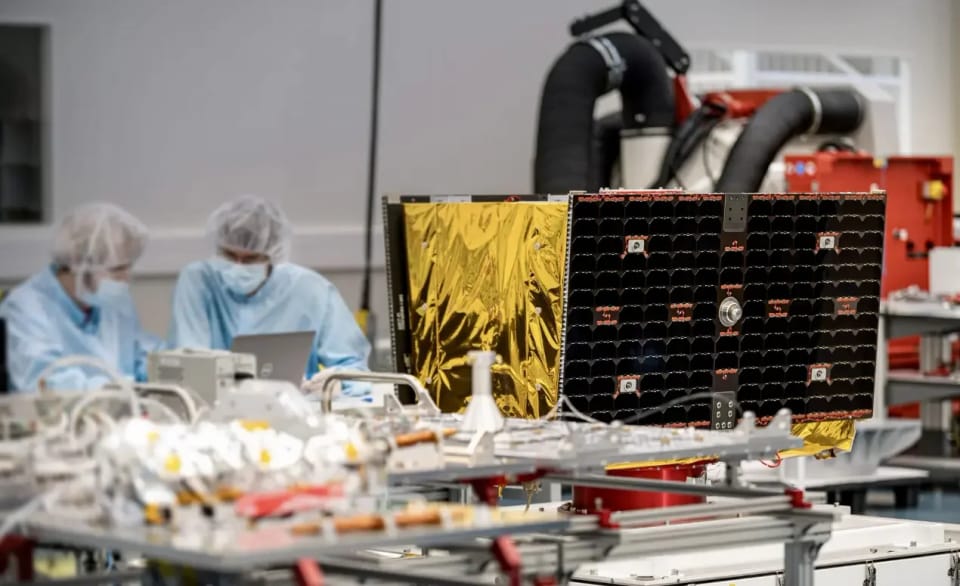
King Philippe of Belgium formally inaugurated a 20,000-square-metre satellite factory in the industrial district of Marcinelle on November 24, 2026.12 The €100 million site, developed by Belgian aerospace firm Aerospacelab, represents the largest spacecraft manufacturing facility in Europe and the third largest worldwide.12 At full operational cadence, the facility will hold the capacity to build roughly 500 satellites each year, creating an industrial base for the European Union's sovereign orbital ambitions.31
The plant anchors Europe's drive to establish an autonomous communications network named IRIS², short for Infrastructure for Resilience, Interconnectivity and Security by Satellite.13 Valued at €15.6 billion, the multi-orbit constellation is designed to provide secure data transmission for European governments, military commands, and commercial users.34 European leaders launched the programme to insulate the continent from dependence on foreign networks such as SpaceX's Starlink and its military derivative, Starshield.31
A flagship manufacturing hub in Charleroi
Aerospacelab announced during the opening ceremony that it will rebrand under the name Ectro on November 30, 2026.13 Founded in 2018 by chief executive Benoît Deper, the company has rapidly evolved into a major contractor for European institutional space programmes.15 In September 2026, the company secured a €2.4 billion contract through French satellite operator Eutelsat to manufacture and deliver 264 of the 348 satellites scheduled for the primary IRIS² constellation.12
"We've grown even faster than our own ambitions," Deper told attendees at the Charleroi opening, noting that the enterprise expanded from a startup into a large-scale project supporting European space sovereignty.51 Deper described the megafactory as an industrial tool whose physical scale was constructed specifically for production runs of this magnitude.2 Reflecting on the opening, Deper said: "It feels like a new era for the Aerospacelab."4
The physical structure spans 160 metres on the former site of the Ateliers de constructions électriques de Charleroi industrial complex, which was dismantled in the late 1980s.2 Built on three vertical levels reaching 14 metres in height, the building features a 7,000-square-metre ground floor.12 This lower level incorporates 4,000 square metres of ISO-controlled cleanrooms alongside 3,000 square metres allocated for environmental testing, component decontamination, and materials storage.12
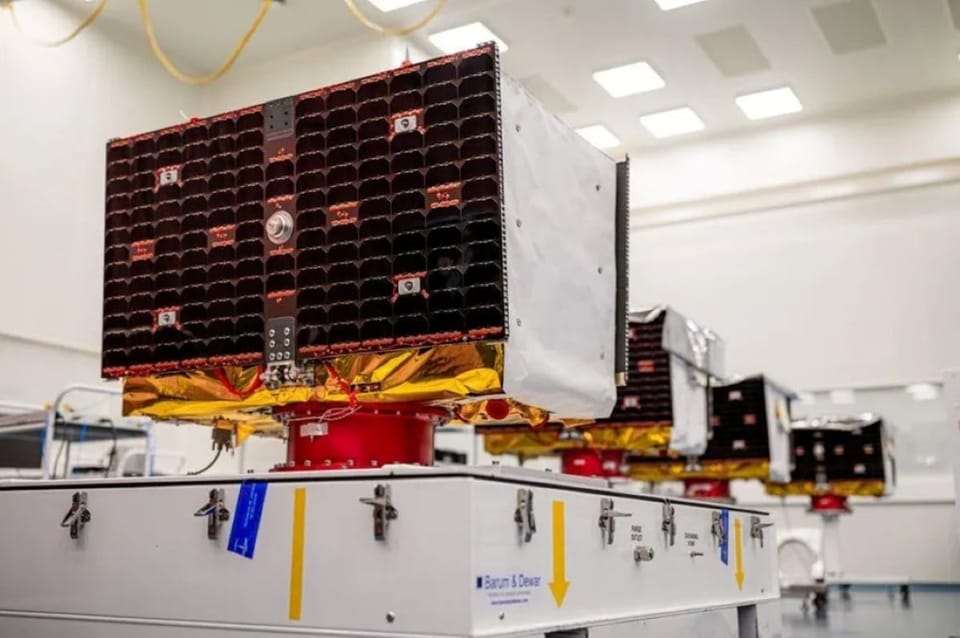
Inside the eight-metre-high cleanrooms, filtration systems, humidity, and temperature will be maintained under strict environmental regulation.12 Deper compared a single microscopic dust particle settling on satellite optical equipment to placing an oily finger directly on a camera lens.12 Upstairs, the plant features an open administrative area designed to house up to 400 workstations.2
Ramping up production for 2028
The vast interior halls currently sit idle while contractors finalize technical installation work.51 Factory keys were formally transferred to company leadership days before the royal visit, with personnel scheduled to begin moving equipment into the building in January 2027.12 Full manufacturing operations are projected to begin by the end of 2028, leading into initial constellation launches slated for 2030.12
To support this delivery schedule, Aerospacelab is recruiting more than 30 technical and administrative personnel each month.12 Company leadership projects total headcount will reach 600 staff by the end of 2026 before expanding beyond 1,250 employees by late 2027.12 Around 500 workers will be stationed at the Marcinelle site at steady state, while the company plans to retain its existing production workshop in Louvain-la-Neuve. Grégoire Dupuis, chief executive of regional investment group Carbon, confirmed that recruitment spans aerospace design engineers and cleanroom assembly technicians alongside accounting specialists.12
The IRIS² architecture distributes responsibilities across several European aerospace contractors within the SpaceRISE consortium.13 While Aerospacelab builds the platforms for the second low-Earth-orbit layer representing roughly 80 percent of the low-altitude fleet, Airbus Defence and Space holds responsibility for the initial 66 low-orbit platforms.1 Thales Alenia Space is contracted to deliver communications payloads, and German manufacturer OHB secured an agreement valued at nearly €1 billion to construct platforms for 18 medium-Earth-orbit spacecraft.1
Unlike pure low-altitude architectures, IRIS² mixes altitudes to balance latency and geographic breadth.3 Lower spacecraft provide rapid transmission times, while higher craft stationed in medium Earth orbit maintain wider coverage footprints.3 In August 2026, the European Commission expanded the constellation baseline with 66 additional dedicated satellites for defense and emergency services, expanding secure governmental transmission capacity by 60 percent.3 Full operational capability across the complete constellation is scheduled for 2032.1
The strategic impulse behind European sovereignty
European momentum behind the Charleroi megafactory intensified following operational vulnerabilities revealed during the conflict in Ukraine. Western forces and Ukrainian units relied heavily on commercial Starlink terminals and Starshield military services for tactical communications, artillery coordination, and drone interception.3 That reliance generated acute political friction when commercial service parameters shifted without warning.3

In mid-October 2026, Ukrainian military units discovered that their Starshield terminals lost data links when moving faster than 160 kilometres per hour.3 The sudden velocity cap disrupted mobile missions and impaired efforts to track high-speed attack drones.3 Full service resumed on October 24, but front-line forces encountered renewed connection cutoffs across occupied territories in November 2026.3 Ukrainian President Volodymyr Zelensky confirmed that technical restrictions persisted over occupied operational zones, while SpaceX publicly asserted that no changes had been made to the system.3
The disruptions created deep unease among European security officials who watched vital battlefield connectivity become subject to external political decisions. British Defense Minister Wes Streeting stated that the service controversy had "really dented confidence and trust" among defense ministers across the continent.3 Laurynas Mačiulis, chief executive of Lithuanian laser communications firm Astrolight, remarked that sovereign alternatives are now a necessity for Western nations seeking to avoid operational dependence on a single commercial vendor.3
The steep financial cost of autonomy
Building an independent European communications network carries severe financial penalties compared to established American systems. An analysis by the Kiel Institute for the World Economy calculated that each low-orbit IRIS² satellite will cost approximately €33 million to manufacture and launch.3 By comparison, a mass-produced Starlink satellite carries an estimated production cost of €1.2 million.3 Even Europe's existing commercial network, Eutelsat OneWeb, operates at a lower average price of €6.2 million per satellite.3
National procurement programmes compound these financial disparities. Germany plans to spend between €8 billion and €10 billion on a separate sovereign military constellation named SATCOMBw 4, comprising 100 to 200 spacecraft.3 The Kiel Institute estimated that individual satellites in the German military network will cost between €40 million and €100 million each.3 Defense economist Johannes Binder, a co-author of the Kiel Institute report, pointed out that European governments are ordering duplicate networks simultaneously rather than consolidating procurement volume.3
The Kiel Institute researchers estimated that the combined requirements for IRIS², SATCOMBw 4, and the planned expansion of OneWeb will demand between €27 billion and €29 billion, requiring approximately €20 billion in public funding.3 A 2026 computer simulation study determined that Starlink outperformed the planned European network in general connectivity metrics, though IRIS² provided clear operational advantages in specialized strategic settings.3
European venture investment in space technology reached a record $3.9 billion across 2026, surpassing the previous record of $2.5 billion established in 2021.16 For European policymakers, the decision to construct dedicated facilities like the Marcinelle plant is guided by strategic self-determination rather than unit-cost parity with commercial American rivals.
The record
47 sentences trace to 6 sources.
- 1 King Philippe Opens 500-Satellite Plant in Charleroi 2026 See the source
- 2 Aerospacelab's Megafactory: Charleroi gets ready to build satellites by the hundred See the source
-
3
TP
 Tibi Puiu
Document
· zmescience.com · 27 Nov 2026
Europe Opens Massive Satellite Factory to Challenge Elon Musk’s Starlink and Starshield
See the source
- 4 Aerospacelab's €2.4B Iris2 contract and new Megafactory signal European space push See the source
-
5
E
 euronews.com
Third-party reporting
· euronews.com · 25 Nov 2026
Belgium opens Europe's largest satellite factory
See the source
- 6 Belgium opens Europe's largest satellite plant, backed by €2.4B EU deal | Dealroom News See the source