Roger Patterson family says 1967 Bigfoot footage was staged
A newly scanned 16-millimeter reel discovered in a safe reveals what researchers describe as a 1966 dress rehearsal

On October 20, 1967, Roger Patterson and Bob Gimlin rode horses into the Six Rivers National Forest along Bluff Creek in Northern California and emerged with 59 seconds of 16-millimeter film.12 The color footage showed a large, ape-like figure walking across a gravel clearing before turning its head toward the camera.13 Nicknamed Patty, the figure became the foundation of modern cryptozoology, generating six decades of television specials, museum debates, academic disputes, and amateur expeditions.12
A documentary titled Capturing Bigfoot, directed by Marq Evans, now presents archival material and on-camera testimony that points to an elaborate fabrication.14 The project centers on an unreleased 16-millimeter film reel dating to 1966, discovered inside a safe belonging to an acquaintance of Patterson.15 In the documentary, Patterson's widow, Patricia Patterson, and his son, Clint Patterson, acknowledge on camera that the famous 1967 encounter was staged.16
The unreleased 1966 reel
The newly surfaced footage sat locked for decades inside a safe belonging to Norm Johnson, who managed a film department at Boeing in Washington state during the 1960s.15 Johnson's brother, Dave Johnson, knew Patterson, and family accounts indicated the brothers assisted in handling film processing for Patterson's projects.1 In 2022, Johnson's daughter, Teresa Brooks, an instructor at Olympic College, approached Evans, who also taught at the institution, to examine what was stored on the reel.16
Evans arranged a digital scan of the approximately 40-second reel.153 The scan showed a different costumed figure walking through a forest clearing, executing movements and a head turn toward the camera that closely mirror the choreography of the famous 1967 clip.16 Edge markings on the physical film stock indicate a 1966 manufacturing date, placing the footage approximately one year prior to the expedition at Bluff Creek.12
Researchers and participants in the documentary interpret the 1966 recording as an early test run for the staged encounter.16 Patterson's nephew, Vaile Thompson, stated that the figure in the earlier footage resembled Al DeAtley, Patterson's brother-in-law.1 Thompson noted that the group tested DeAtley in an early costume but concluded that his walking gait looked too human, prompting Patterson to seek another performer.16
The production also released a 4K digital transfer made from a film print in the Patterson family collection.3 Technical analysts have noted that historical evaluations of the 1967 footage depended heavily on assumed camera frame rates.73 While analysts historically debated whether Patterson filmed at 16 or 18 frames per second, the modern presentation plays at 24 frames per second, demonstrating how projection speed can alter the perceived naturalness of the subject's movement.37
The production at Bluff Creek
Before his trip to Northern California, Patterson was an amateur filmmaker and former rodeo cowboy from Yakima, Washington, who developed an intense preoccupation with reports of giant primates.17 In 1966, he self-published a book titled Do Abominable Snowmen of America Really Exist, which featured his own detailed anatomical drawings of male and female forest creatures.17 To finance his work, Patterson frequently sought loans and investments from acquaintances and local associates.17
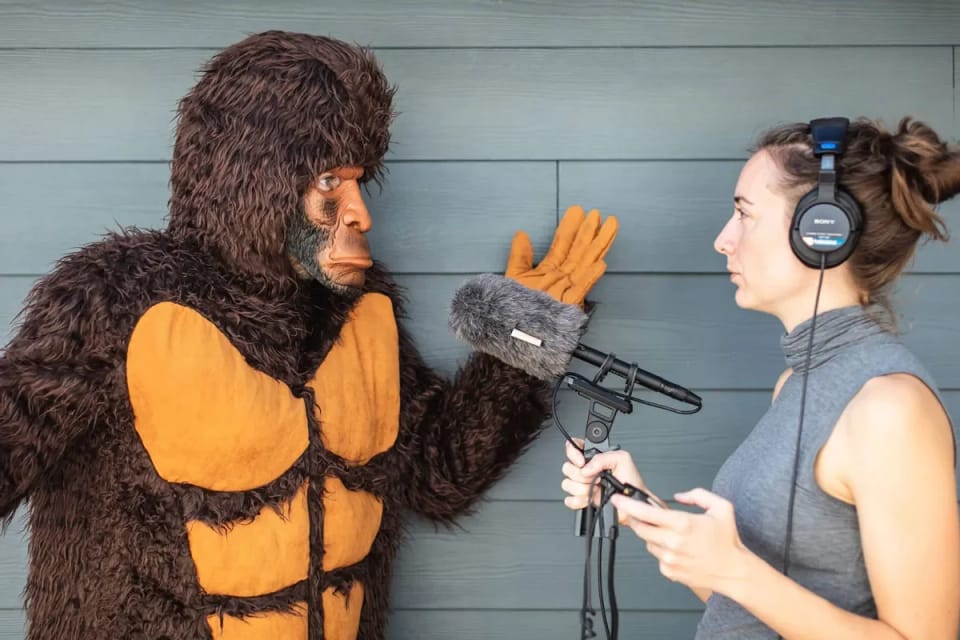
Patterson turned to DeAtley, the operator of Superior Asphalt, to help finance a planned docudrama about men hunting Bigfoot.2 During the spring of 1967, Patterson recruited local acquaintances to appear in dramatized scenes for the unfinished movie.17 Among those hired was Bob Heironimus, a young Yakima resident who stated decades later that Patterson had recruited him to wear a creature suit.17
Heironimus stated that Patterson and Gimlin offered him $1,000, roughly equal to $10,100 in 2026, to put on the suit and walk along the creek bed.17 Heironimus recounted that the costume was assembled from secondhand fur coats stored in Patterson's shed, and that he never received the promised payment.21 In Capturing Bigfoot, Heironimus recreates the heavy, loping stride seen in the 1967 footage and describes being directed on how to glance back toward the camera.12
Independent costume maker Philip Morris in Charlotte, North Carolina, previously stated that he sold Patterson a six-piece gorilla suit for $435 in August 1967.7 Morris recounted that Patterson called him to ask how to conceal the garment's rear zipper, prompting Morris to advise brushing the surrounding fur downward over the seam.7 A visible line runs down the back of the figure in the 1967 film along the exact placement of that zipper.7
A touring enterprise and family fractures
Patterson died of Hodgkin's lymphoma on January 15, 1972, at age 38, having maintained throughout his final years that the footage depicted a living animal.71 After his death, the commercial enterprise built around the film fractured into bitter disputes.17 Patterson and DeAtley had converted the 59-second clip into a traveling theatrical presentation that screened in auditoriums and sports arenas across North America, charging $2 per ticket.12 In an archival interview, DeAtley recalled generating $84,000 at a single venue, an amount equivalent to roughly $850,000 in 2026.1
While DeAtley directed substantial box-office revenue into his construction business and real estate, Gimlin received nothing from the roadshow earnings.27 Gimlin filed a lawsuit against Patterson's estate and DeAtley in 1974, securing a legal settlement in 1978.7 That agreement awarded 51 percent of the footage and cassette rights, along with full ownership of the original 952 film frames, to researcher René Dahinden, while Patricia Patterson retained television rights and a 49 percent interest in the footage.7
Physical custody of the footage subsequently collapsed.7 The original camera negative was last inspected in 1980 by Dahinden and researcher Bruce Bonney in a California vault.7 Between 1980 and 1996, the original negative disappeared from the facility, leaving researchers dependent on multi-generation copies that degrade fine surface detail with each photochemical duplicate.73
Inside the Patterson household, the film created a quiet crisis.16 Clint Patterson grew up surrounded by the myth of his father's discovery, but gradually determined that the encounter had been manufactured.16 When Clint told his mother that he wanted to speak publicly about the deception, the resulting disagreement led to an eight-year estrangement.16 Patricia Patterson later agreed to participate in the documentary, confirming on camera that the encounter had been staged.16
The biological and field evidence
For decades, proponents pointed to the creature's physical proportions and gait as proof that no human could occupy the suit.15 Biomechanics specialist D. W. Grieve in London and anthropology professor Grover Krantz analyzed the film, arguing that the intermembral index and low foot clearance appeared non-human. Special effects builder Bill Munns and Idaho State University anatomy professor Jeff Meldrum similarly maintained that the musculature visible beneath the fur exceeded what 1960s costume technology could achieve.27
Field biology and ecology, however, have provided no corroboration for an unclassified North American primate.12 A sustainable breeding population of 800-pound hominids would require thousands of individuals distributed across mountain ranges to prevent fatal inbreeding over centuries.2 Decades of commercial logging, road construction, aerial reconnaissance, trail camera networks, and environmental surveys across the Pacific Northwest have recovered no skeletal remains, teeth, or carcasses.12
Laboratory genetics has systematically dismantled putative biological samples.1 In a 2014 study published in Proceedings of the Royal Society B, scientists screened 37 hair samples collected from alleged Bigfoot and Yeti sites.1 Out of 30 samples that yielded viable DNA sequences, all matched recognized mammal species, including horses, cattle, and bears.1 No unknown primate genetic signatures were detected.1
Field studies also point to common misidentifications in forested terrain.1 A 2024 analysis published in the Journal of Zoology examined reported sightings across North America and found a strong statistical correlation with local populations of American black bears, which frequently stand and move short distances on their hind legs.1 While enthusiasts have suggested Bigfoot could represent a relict population of Gigantopithecus blacki, a 2024 study published in Nature documented that the giant Asian ape vanished between 295,000 and 215,000 years ago due to changing forest habitats, leaving no fossil footprint in the Western Hemisphere.1
Belief and the persistence of the film
The persistence of the Patterson-Gimlin film reflects the psychology of ambiguous images.1 A 2022 study in Consciousness and Cognition noted that individuals with strong paranormal inclinations show lower perceptual sensitivity when separating visual signals from background noise.1 When presented with grainy, distant imagery, human visual processing often constructs complete forms to match preexisting expectations.13
The social structure of the cryptozoology community reinforced that visual investment.12 Researchers spent decades building reputations, publishing monographs, and attending annual conferences devoted to defending the authenticity of Patty.17 Acknowledging that the figure was a staged performance threatens not just an interpretation of a single film strip, but decades of personal identity, social standing, and commercial ventures.16
Gimlin, who remained away from public events for decades, began attending commercial Bigfoot conventions in 2003, turning appearances into regular speaking engagements and a public role.12 Bill Munns, who appears in Evans' documentary, continues to argue that the 1966 reel falls short of definitively proving a hoax, illustrating how deeply entrenched opinions remain despite new archival findings.14
The discovery of the 1966 safe reel, combined with the admissions from Patterson's surviving family, shifts the 59-second film from a biological mystery into a study of American entertainment.12 Roger Patterson sought commercial success through film, and the myth he assembled at Bluff Creek sustained an industry for sixty years.12
The record
65 sentences trace to 7 sources.
-
1
TT
 Tudor Tarita
Document
· zmescience.com · 27 Oct 2026
The End of Bigfoot? New Evidence May Finally Expose the World’s Most Famous Sighting as a Hoax
See the source
- 2 New Documentary Claims to Solve Mystery Behind Famous Bigfoot Footage See the source
- 3 Bigfoot: Φιλμ 60 ετών αποκαλύπτει πιθανή πρόβα πίσω από το θρυλικό βίντεο του 1967 See the source
- 4 Capturing Bigfoot Documentary — Capturing Bigfoot See the source
-
5
G
 ground.news
Third-party reporting
· ground.news
60-Year-Old Found Footage Proves Famous Bigfoot Footage Is a Hoax
See the source
-
6
LA
 Los Angeles Times
Third-party reporting
· latimes.com · 20 Oct 2026
Was Bigfoot a hoax? Through evidence and testimonials, 'Capturing Bigfoot' argues yes
See the source
- 7 BIGFOOT FINALLY DEBUNKED? | What the Media Isn’t Telling You About the New Patterson Film Evidence! - Weird Darkness See the source