White House weighs 90-day diesel export ban
European fuel prices jumped 7% while cabinet officials and industry analysts warned that restricting shipments would harm domestic refineries.

The United States government is preparing a proposal to halt diesel exports for 90 days as consumer fuel costs reach unprecedented highs across the country.1 The White House has considered the export restrictions to stem domestic inflation, moving forward despite objections raised by multiple cabinet secretaries and warnings from energy market analysts who project that the policy could backfire on domestic refiners.1
Opposition across cabinet agencies
Internal administration deliberations have drawn resistance across multiple departments. The energy secretary publicly rejected export restrictions, stating that such a "blunt tool… definitely doesn't work."1 That assessment echoed concerns voiced by the interior secretary, while the Treasury secretary also mounted pushback in administrative discussions over the economic risks of cutting off foreign buyers.1
Resistance extends to former federal energy officials as well. A former energy chief under Donald Trump warned that an export ban delivers a "terrible investment signal" to domestic energy producers.1 Market researchers at S&P Global calculated that a full ban on outbound shipments would compel American refineries to reduce their operating run rates by as much as 10%. Refiners unable to place surplus distillate into international markets would be forced to dial back crude processing entirely.

International market reaction was immediate, with European diesel prices climbing 7% on Wednesday morning following reports of the policy review.1 Analysts warned that choking off transatlantic supply would drive international price benchmarks higher, eventually rebounding against American buyers who rely on localized fuel imports to supply deficit regions along the Atlantic seaboard.1
Escalating prices squeeze commercial transport
The White House proposal follows weeks of surging domestic transport costs driven by geopolitical turmoil abroad.21 Hostilities in the Strait of Hormuz have slowed maritime shipping traffic, lifting crude oil values back into the $100 per barrel range for the first time since July.2 The resulting spike in feedstock costs has passed directly into transportation fuels, creating severe price pressure for trucking companies and retail distribution networks across the country.2
According to survey data compiled by Jenna Hume, diesel retail averages crossed historic thresholds in mid-September as maritime bottlenecks tightened.2 Data published by the U.S. Energy Information Administration documented that the national average on-highway diesel price climbed 32 cents in a single week to hit $6.285 per gallon on September 15.23 The climb continued unchecked through the following week, with the Energy Information Administration recording a further 0.244-dollar rise to reach $6.529 per gallon on September 21, as tracked in weekly industry reporting from IndexBox Inc.3
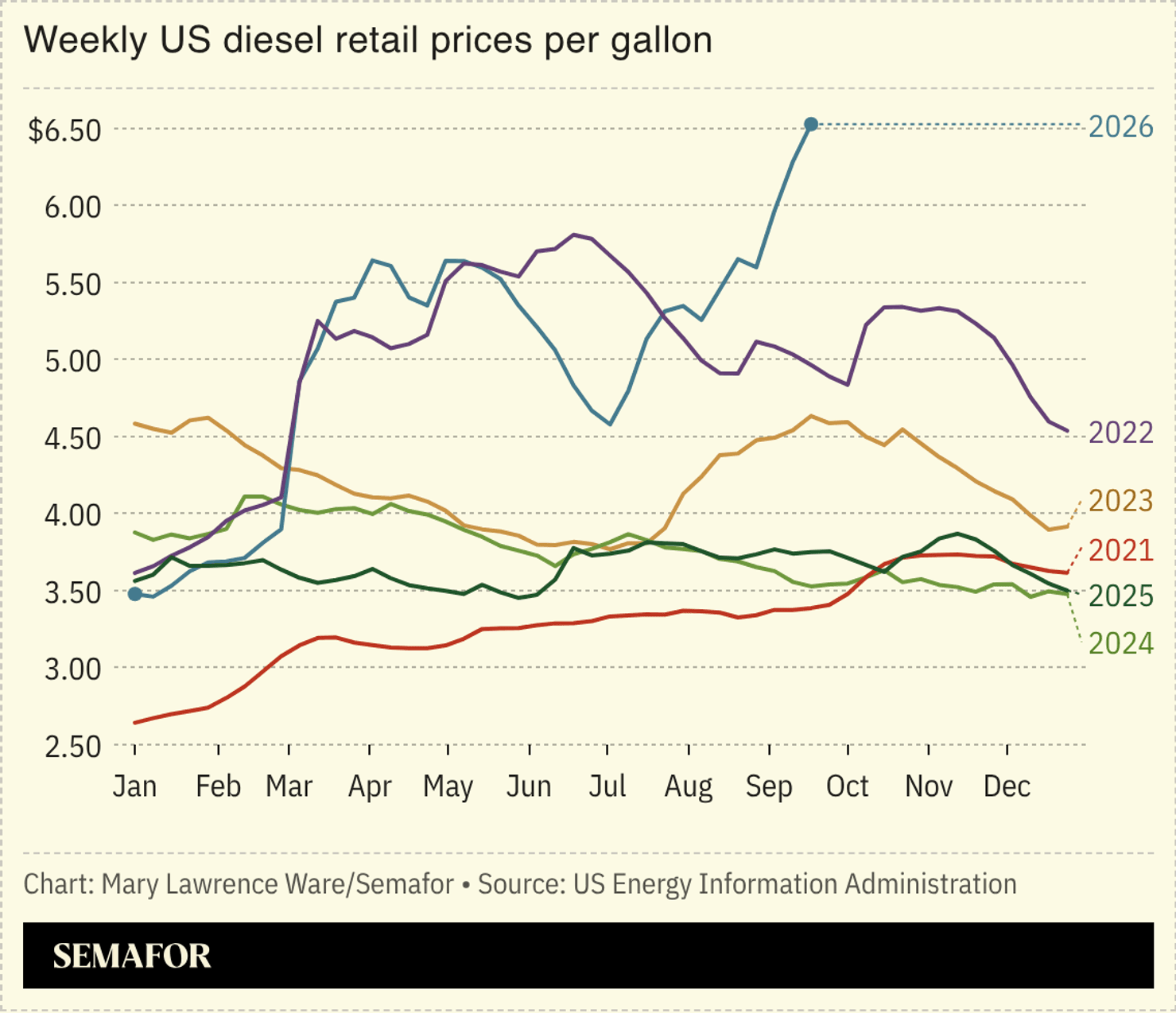
The rapid run-up has outpaced prior price cycles by wide margins. The September 21 average of $6.529 per gallon sat $2.780 above the level recorded one year earlier and $2.990 above the price measured two years prior.3 Regional fuel markets experienced sharp upward shifts, with East Coast diesel prices climbing to $6.268 per gallon, while the West Coast marked the highest regional numbers in the country after hitting $7.250 per gallon during the initial mid-September surge.32
Strait of Hormuz tensions fuel inflation
Gasoline markets have tracked a similar upward trajectory, compounding transport inflation across commercial fleets and consumer vehicles. Weekly federal figures recorded regular gasoline climbing to $4.478 per gallon nationally on September 21, an increase of 0.159 dollars in one week and $1.305 higher than the benchmark recorded twelve months earlier.3 In California, pump prices passed $6.003 per gallon, while major metropolitan centers including San Francisco and Los Angeles saw regular fuel push toward $6.071 and $5.984 per gallon.
The sustained fuel inflation has coincided with high-stakes international positioning surrounding shipping channels in the Middle East. On September 14, Trump stated on his social media platform that he remained open to negotiations with Iran, writing that the country wanted to make a deal and that he would decide whether the United States engages.2 Iranian officials, however, maintained a rigid stance, with the secretary of the Supreme National Security Council demanding that national conditions be fulfilled before any direct talks take place.2
With crude supply chains constrained through Persian Gulf transit routes, domestic fuel stockpiles remain under sustained pressure. Industry analysts argue that prohibiting finished fuel shipments cannot resolve crude shortages and risks triggering retaliatory trade disruptions. For now, the administration continues to weigh whether direct market intervention can offer political relief before autumn election cycles, or whether capping exports will disrupt processing plants across the Gulf Coast.
What this rests on
20 sentences trace to 3 sources.
-
1
BR
Brendan Ruberry Document · semafor.com · 23 Sep 2026 US considers 90-day diesel export ban amid fuel crunch See the source
-
2
F
FleetOwner Third-party reporting · fleetowner.com · 16 Sep 2026 Record diesel prices top $6 as Strait of Hormuz unrest raises trucking costs See the source
-
3
II
IndexBox Inc. Third-party reporting · indexbox.io · 22 Sep 2026 EIA Weekly Update: U.S. Gasoline and Diesel Prices Climb for September 22, 2026 - News and Statistics - IndexBox See the source