Democrats secure 54 Senate seats in sweeping midterm victory
Victories across seven Republican states flipped control of the upper chamber after strategic ad spending broadened the electoral map.

Democrats have secured control of the Senate, capturing at least 54 seats in a dramatic reversal of the legislative map that ended two years of Republican rule.12 The sweep erased a conservative Senate majority that began the midterm cycle defending 22 of the 35 seats on the ballot.3 By Wednesday morning, Democratic challengers had unseated Republican incumbents or captured open Republican seats across Maine, Ohio, Texas, Kansas, Iowa, South Carolina, and North Carolina.14 The scale of the defeat left party officials bracing for internal conflict after a campaign season that had initially favored the incumbent majority.1
A senior Republican strategist said the outcome represented a generational wipeout that would produce a full-on civil war within the party.1 Entering election night, Republicans held a 53-47 majority in the upper chamber, meaning the party could afford to drop at most three seats while relying on Vice President JD Vance to break tie votes.31 Instead, Republican candidates lost across nearly every competitive contest on the board, including states Donald Trump carried comfortably two years earlier.15
Democratic leaders credited disciplined message coordination and early candidate fundraising with opening pathways into deep-red territory. Senate Democratic Leader Chuck Schumer told reporters at a midnight press conference that the party had achieved a generational remake of the Senate map by turning the Republican red wall into a pile of bricks.12 Schumer said Republican lawmakers had chosen to follow Trump over a cliff, pursuing policies that raised household costs on electricity, healthcare, and everyday consumer goods.1 Schumer pledged that the new Democratic majority would deliver for the public with or without White House cooperation.1
Southern races unlock national resources
The foundation of the Democratic majority was laid early Tuesday evening in the South, where incumbent Sen. Jon Ossoff in Georgia and former Gov. Roy Cooper in North Carolina won double-digit victories.1 Ossoff defeated Republican Rep. Mike Collins, while Cooper defeated Republican Michael Whatley to secure a North Carolina seat that Democrats had failed to win for 18 years.14 Both campaigns had accumulated enormous financial advantages months before the vote, with Cooper collecting more than $49 million through mid-October and Ossoff raising more than $100 million.1
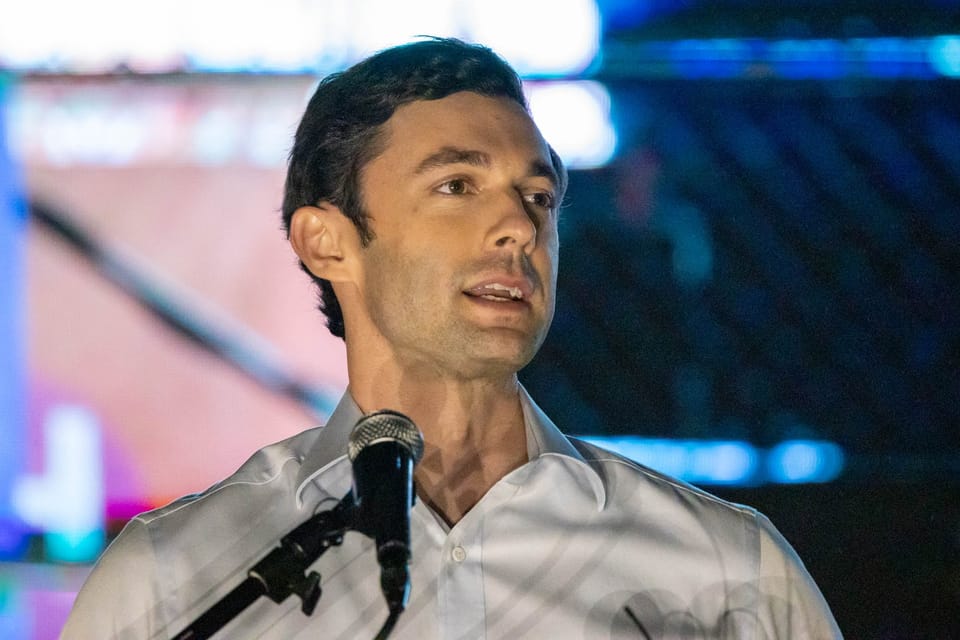
Those fundraising totals allowed party strategists to alter their national advertising footprint weeks before balloting concluded. Senate Majority PAC, the primary Democratic Senate super PAC, pulled down scheduled advertising in North Carolina and Georgia, conserving $22 million in North Carolina and $11 million in Georgia.1 The Democratic Senatorial Campaign Committee made parallel decisions to cancel late airtime buys in both states.1 With Southern territory secure, party leadership redirected that conserved capital into offensive targets that had long been considered out of reach.
Lauren French, a spokesperson for Senate Majority PAC, said the strength of the Cooper and Ossoff campaigns permitted the committee to reinvest initial resources into an expanded battleground map.1 Democratic spending committees authorized fresh advertising drives in Kansas, South Carolina, and Mississippi.1 The DSCC infused $500,000 into the South Carolina contest down the stretch, following an earlier $500,000 investment in Mississippi.1 The maneuver allowed national groups to pressure Republican targets while simultaneously defending battleground campaigns against substantial spending from the Republican Senate Leadership Fund.1
Midwestern upsets break decades of Republican control
The geographic realignment extended through the Midwest, where Democratic candidates dismantled longstanding Republican advantages. In Kansas, the Reverend Adam Hamilton defeated incumbent Republican Sen. Roger Marshall, becoming the first Democrat elected to represent the state in the Senate in 94 years.452 Hamilton campaigned on economic affordability and appealed directly to moderate voters. Speaking on Wednesday morning, Hamilton said he intended to focus on restoring decency and bipartisan cooperation in Washington, pledging to establish a close working relationship with Kansas Republican Sen. Jerry Moran.2
In Iowa, state representative Josh Turek won the seat vacated by retiring Republican Sen. Joni Ernst, defeating Republican Rep. Ashley Hinson.54 Turek built support among rural and agricultural voters affected by high fuel costs and economic headwinds during the Trump administration.5 In Ohio, former Sen. Sherrod Brown completed a political comeback by unseating Republican Sen. Jon Husted, who had been appointed to replace Vance.51 Brown had represented Ohio in the Senate from 2007 until his defeat in 2024, utilizing broad name recognition to capitalize on an extraordinarily favorable political climate.5

The upper chamber will also see a historic first from Michigan, where Democrat Abdul El-Sayed won an open seat by seven percentage points against Republican former representative Mike Rogers.2 El-Sayed, an epidemiologist and former local health director, will become the nation's first Muslim senator.5 The contest concluded with unexpected cross-party dynamics after Democratic Rep. Haley Stevens, who lost to El-Sayed in the primary, endorsed Rogers over the weekend before Election Day.2 In New Hampshire, Democrat Chris Pappas defended the seat left open by retiring Sen. Jeanne Shaheen, defeating Republican former senator John Sununu to become the first openly gay male member of the Senate.54
Historic breakthroughs in Texas and Maine
The most consequential single upset occurred in Texas, where Democratic state representative James Talarico defeated Republican Attorney General Ken Paxton.45 The victory made Talarico the first Democrat to win a Senate seat in Texas since Lloyd Bentsen won reelection in 1988.45 Paxton had secured the Republican nomination with Trump's endorsement after defeating longtime incumbent Sen. Jon Cornyn in the primary, a choice that proved vulnerable in the general election amid high personal unfavorability ratings.5
Speaking after his victory, Talarico said Texas voters had delivered an unmistakable message to big donors that the state was not for sale, noting that billionaire Elon Musk had invested more than $150 million to support Paxton.2 On his weekly podcast, Republican Sen. Ted Cruz called the Texas outcome a Watergate-level repudiation and an ass kicking, confirming he had telephoned Talarico to offer congratulations. Cruz said the election proved that conservative, libertarian, and independent voters had actively rejected Republican nominees across the ballot.2
In Maine, longtime Republican Sen. Susan Collins conceded her race to Democratic state Senate president Troy Jackson early Wednesday morning.45 Jackson, a 58-year-old fifth-generation logger, entered the race in July with roughly 100 days to organize a statewide campaign after replacing Graham Platner as nominee.5 In South Carolina, Democrat Annie Andrews defeated appointed Republican Sen. Darline Graham, capturing the seat previously held by Lindsey Graham.41
Speaking on Wednesday, Schumer signaled that the incoming majority would prepare rigorous legislative friction against administration initiatives, pledging that whenever the White House defies the law or the public will, lawmakers will launch investigations, initiate court challenges, and entangle executive actions in legislative razor wire.2 Senate Republican Whip John Barrasso conceded that the party had endured a punishing night, writing on social media that Republicans lost distinguished colleagues in challenging races and needed to prioritize voter affordability.2 In deep-red Mississippi, Democratic candidate Scott Colom held an advantage of just over 1,000 votes against Republican Sen. Cindy Hyde-Smith as election officials prepared to process several thousand outstanding absentee and affidavit ballots, leaving Republicans facing the possibility of further erosion to their ranks.2
The record
40 sentences trace to 5 sources.
-
1
BE
 Burgess Everett
Document
· semafor.com · 4 Nov 2026
Senate goes Democratic in a ‘generational wipeout’ of Trump’s party
See the source
-
2
CN
 CBS News
Third-party reporting
· cbsnews.com · 3 Nov 2026
2026 Senate midterm election results as Democrats win control, Schumer vows
See the source
-
3
AN
 AP News
Third-party reporting
· apnews.com · 1 Nov 2026
2026 U.S. Senate Election Results
See the source
-
4
S
semafor.com
Third-party reporting
· semafor.com · 4 Nov 2026
Massive blue wave hands Congress to Democrats
See the source
- 5 US Senate election results 2026: Democrats clinch control of upper chamber See the source