Trump administration demanded 10 percent equity stake from Intel
Federal court filings show officials threatened unspecified consequences unless the chipmaker surrendered shares to unlock $8.9 billion in federal subsidies.
A federal official instructed the chief financial officer of Intel Corporation in August 2025 not to treat discussions over a government equity stake as a commercial bargaining session.12 Commerce Department lawyer David Shapiro delivered the message directly, telling the semiconductor manufacturer that Donald Trump expected an agreement within days.12 Shapiro added that while directors retained the technical right to turn down the proposal, declining would carry consequences that he could not forecast.12
Details of the exchange appear in internal corporate records disclosed through a federal shareholder lawsuit.12 The documents outline an aggressive pressure campaign directed at one of the country's most prominent technology manufacturers, conditioning the release of previously approved federal manufacturing subsidies on the transfer of corporate ownership. Days after the warning, Intel's board capitulated to the demand, transferring a 10 percent ownership position to the federal government without receiving any cash payment in return.12
A freeze on manufacturing subsidies
The confrontation stemmed from statutory funding approved during the Biden administration under the CHIPS and Science Act.12 Intel had initially secured awards for up to $11 billion in government grants and contracts intended to support domestic assembly facilities and semiconductor fabrication.12 By March 2025, the manufacturer had collected approximately $2.2 billion of that total allocation.12 Progress stalled when Trump publicly condemned the legislative program before Congress, calling the statute a horrible measure and directing officials to halt remaining disbursements while terms were rewritten.1
Around the same time, Intel appointed Lip-Bu Tan as its chief executive officer to help navigate declining commercial revenue and ongoing operational difficulties.12 His arrival quickly attracted political scrutiny in Washington over previous business ties to Chinese technology enterprises. Cadence Design Systems, where Tan had served as chief executive, had previously pleaded guilty to violating export sanctions after selling semiconductor designs to a restricted Chinese military university, resulting in more than $140 million in penalties.12 Although Tan was never charged individually in that case, critics seized on the corporate record to question his fitness to lead an American semiconductor manufacturer receiving federal assistance.12
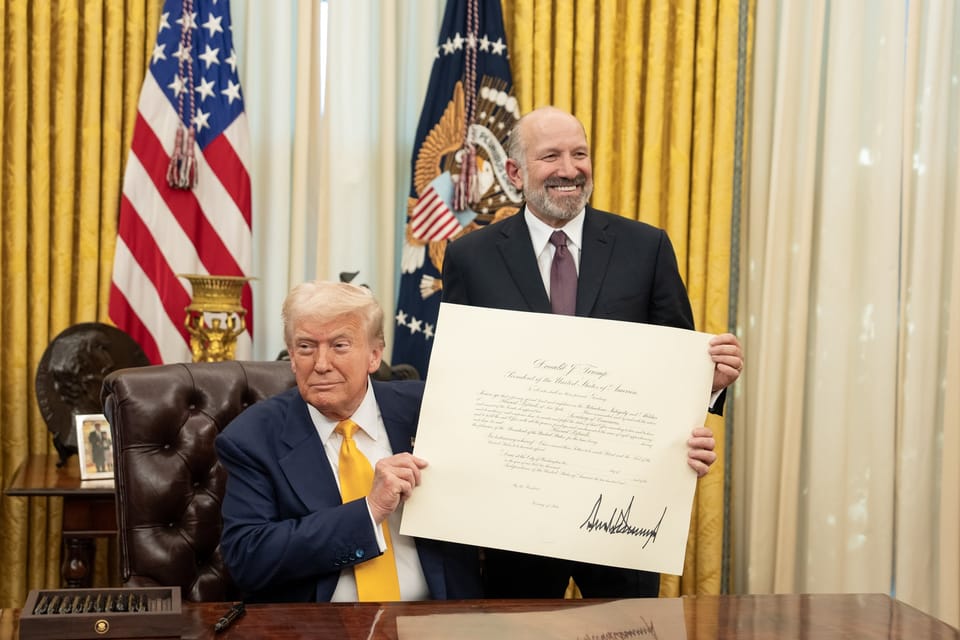
Public pressure escalated when Trump posted on social media that Tan faced irreconcilable conflicts of interest and demanded his immediate resignation.12 Seeking to resolve the dispute, Tan traveled to Washington on August 11, 2025, for a 40-minute Oval Office meeting with Trump, Commerce Secretary Howard Lutnick, and Treasury Secretary Scott Bessent.12 Tan defended his commercial background, offered to place his remaining foreign financial holdings into a blind trust, and sought to preserve the funding Intel required to maintain operations.12
The ultimatum from Commerce
Discussions shifted rapidly from executive vetting toward financial concessions. Internal records cite a verbal offer made on August 18, 2025, by Shapiro, who had joined the government after working as a partner at the law firm Wachtell, Lipton, Rosen & Katz.12 Shapiro informed Intel that releasing the remaining $8.9 billion in federal grants would require transferring roughly a tenth of the company's equity to the government without payment.12
When company executives sought room to negotiate, Shapiro closed the door. According to summaries prepared for Intel directors and included in the court filings, Shapiro told company leadership to weigh the commercial advantages of maintaining a collaborative relationship with the White House.12 The lawyer stressed that cooperation could assist Intel with prospective customers, whereas resistance would carry unpredictable risks.
Intel's board convened to review the terms and registered immediate resistance. Formal board minutes submitted in the lawsuit show directors determined that the economic arrangement presented by the administration was unattractive in its proposed format.12 The company nonetheless accepted the structure. Richard Paisner, the shareholder who filed the legal action, alleged in court papers that directors caved to government extortion while operating under the shadow of direct presidential threats.12
Attorneys representing Intel contested that characterization in a motion to dismiss the lawsuit. Defense counsel maintained that company negotiators engaged in substantive exchanges that improved the final framework. In their filing, Intel lawyers argued that the completed transaction freed up immediate grant funding while strategically aligning the commercial interests of public shareholders with those of the federal government.12

A public celebration and widening scrutiny
The administration moved quickly to celebrate the acquisition. On August 25, 2025, Lutnick appeared in a promotional video seated alongside Tan.12 During the broadcast, Tan addressed the Commerce Secretary directly, stating that he looked forward to having the government as a shareholder and expressing hope that both sides could collaborate to restore Intel's position.12 The presentation surprised employees within the semiconductor company, where several staff members privately likened the appearance to a forced statement.12
Trump followed with public statements celebrating the transaction as an unprecedented victory for taxpayers. Writing on his personal social media platform, the president announced that the federal government owned and controlled 10 percent of Intel at zero acquisition cost, estimating the current market valuation of the equity stake at approximately $11 billion.12
The agreement formed part of an aggressive approach to corporate intervention across the technology sector. Federal court records indicate the administration pursued similar financial extractions from rival chipmaker Nvidia, seeking a 15 percent payment on sales of its H20 model processor to buyers in China, followed by a 25 percent levy on shipments of advanced H200 chips.12 Paisner subsequently initiated separate legal proceedings against Nvidia, arguing that such levies operated as unlawful surcharges that damaged corporate governance.12
Governance specialists have warned that using discretionary executive power to demand equity and revenue shares distorts fundamental corporate responsibilities. Scott Lincicome, a vice president at the Cato Institute, characterized the dynamic in legal proceedings as direct coercion.12 When political demands dictate corporate strategy, companies begin prioritizing bureaucratic preferences over long-term shareholder value and technical innovation, creating broad risks for sensitive industries.
Neither the White House nor the Commerce Department answered inquiries regarding the court filings, and Intel declined to comment on the litigation.12 The case remains pending before a federal judge, who must decide whether directors violated their fiduciary obligations by yielding to administrative pressure or acted within legal boundaries to secure billions in vital industrial funding.
The record
29 sentences trace to 2 sources.
-
1
NS
 Noah Shachtman, wired.com
Document
· arstechnica.com · 27 Nov 2026
Intel faced a choice: Give Trump 10% or face the consequences
See the source
-
2
AT
 Ars Technica
Third-party reporting
· wired.com · 27 Nov 2026
Intel faced a choice: Give Trump 10% or face the consequences
See the source