Autonomous laboratories aim to accelerate biological engineering across federal research centers
Coordinated artificial intelligence systems and robotic workstations could shorten enzyme design timelines and extract critical minerals from industrial scrap without corrosive chemical waste.

Biological materials drive nearly every living function, yet reproducing or directing those molecular systems in a laboratory remains an exacting, slow process. Living cells rely on specialized protein catalysts known as enzymes to construct complex molecules, while diverse microbial communities interact with minerals to dissolve and concentrate chemical elements from surrounding soil and rock. Because even a single functional protein consists of hundreds of precisely ordered amino acids, finding a specific sequence that performs an industrial task requires sorting through astronomical numbers of physical configurations.
To design an artificial enzyme or adapt a bacterium for industrial processing, researchers traditionally follow an iterative physical cycle. First, a laboratory worker screens scientific literature and biological databases to locate an existing gene sequence that resembles the target function. Next, technicians synthesize that sequence, insert it into a host organism, culture the cells, and purify the resulting molecule. Finally, researchers expose the biological agent to experimental reaction conditions, measure yields, and record where the compound degraded or failed. A single complete cycle through this design and testing pipeline routinely requires months of human attention before revealing whether a tiny molecular modification achieved the desired reaction.
Modern biological engineering projects funded under the Department of Energy Genesis Mission seek to bypass these manual bottlenecks by linking automated reasoning software directly to physical laboratory instruments.1 Through three distinct initiatives known as OPAL, IDeA, and MELT-REE, researchers at Argonne National Laboratory are pairing computational models with automated physical workstations.1 Rather than treating artificial intelligence merely as an analytical archive, the laboratory is building automated systems that generate chemical hypotheses, dispatch instructions to mechanical pipettes and robotic arms, monitor incoming physical measurements, and immediately calibrate the subsequent round of experimental tests.1
How can autonomous systems coordinate biological experiments across multiple facilities?
Coordinating complex life science experiments across geographically distant institutions requires standardizing how automated instruments interpret instructions and trade physical samples. Under the Orchestrated Platform for Autonomous Laboratories to Accelerate AI-Driven BioDesign, or OPAL, Argonne National Laboratory collaborates with Lawrence Berkeley National Laboratory, Oak Ridge National Laboratory, and Pacific Northwest National Laboratory to establish an autonomous experimental network.1 Within this cooperative framework, scientists Dion Antonopoulos, Ian Foster, and Arvind Ramanathan lead Argonne's research team.1
The institutional division of labor reflects the distinct physical strengths of each national laboratory. Argonne concentrates its experimental operations on protein design, Lawrence Berkeley National Laboratory and Pacific Northwest National Laboratory focus their shared infrastructure on analyzing microbial behavior, and Oak Ridge National Laboratory examines plant biology.1 Across these four facilities, an autonomous planning agent formulates experimental protocols, transmits specific assignments to physical instruments, tracks the resulting measurements, and revises subsequent parameters without requiring continuous human direction.1
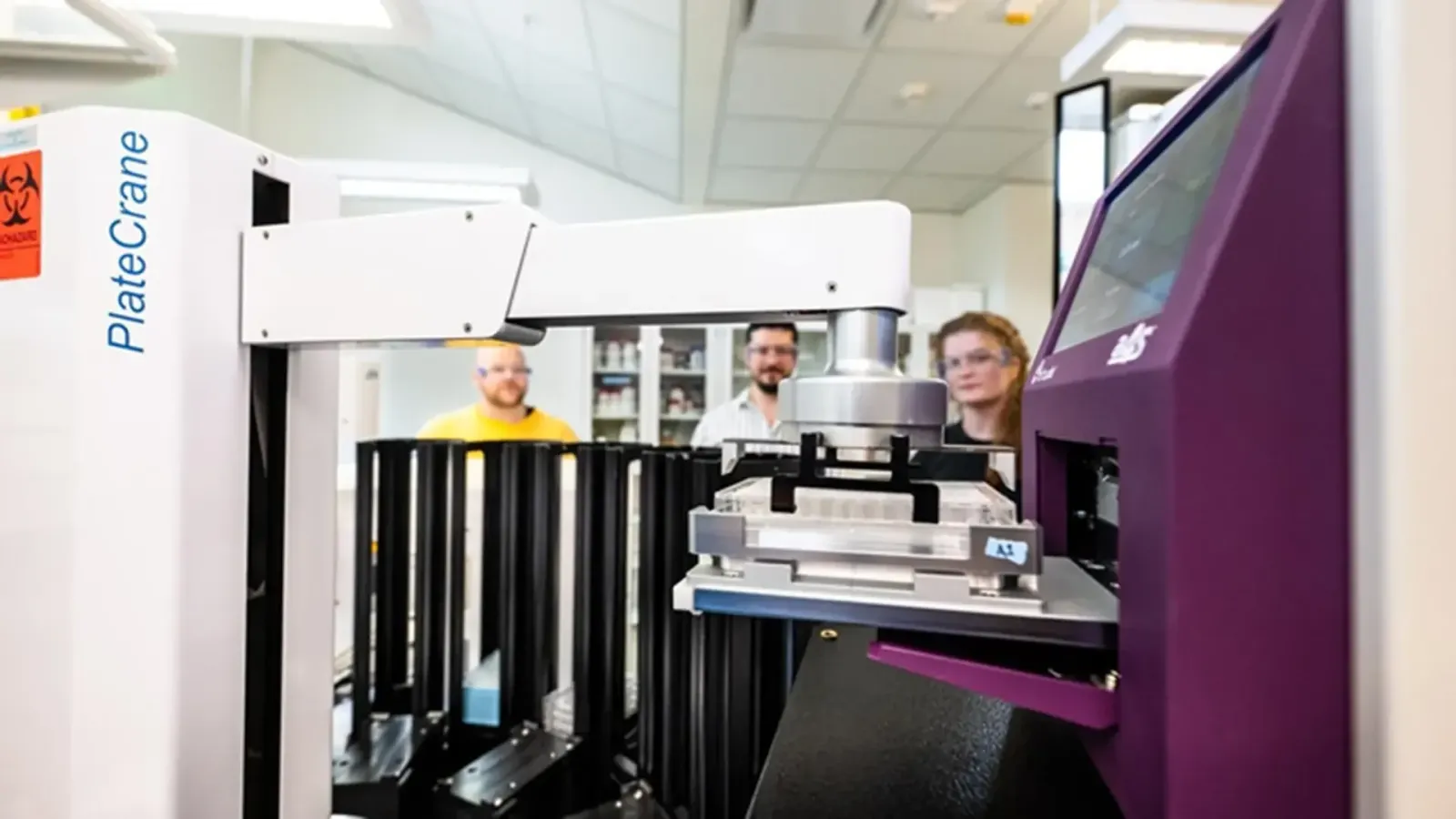
Physical manipulation in these automated facilities extends beyond standard liquid-handling instruments that transfer measured fluid volumes. Because routine experimental workflows require interacting with legacy equipment designed exclusively for human operators, Argonne is teaching humanoid robotic machines to perform manual procedures.1 These physical units learn to adjust instrument settings, observe optical cues, and handle equipment originally fabricated for human hands.1 Arvind Ramanathan, who co-leads the project, explained that specialized physical platforms remain vital for certain experimental procedures.1
“There are some experiments for which we need robots that can do specific types of experiments,” Ramanathan said.1 “We’re pushing on that. We have humanoid robots in the lab where we are experimenting with what they can do and how we train them.”1
Can automated reasoning software shorten the timeline for enzyme development?
Synthesizing and characterizing a newly discovered enzyme through traditional experimental procedures typically requires a team of trained researchers to invest a year or more of continuous laboratory work.1 The Intelligent Design Assistant for Enzyme Discovery and Biosynthetic Pathway Optimization, known as IDeA, intends to compress that development cycle down to several weeks.1 Led by Ramanathan, the project deploys a coordinated array of autonomous digital agents to investigate chemical databases, review published research, evaluate structural configurations, and propose prospective molecular designs in parallel.1
The immediate practical objective of the IDeA platform centers on identifying biological catalysts capable of synthesizing biopolymers comparable to industrial nylon.1 Under conventional workflows, discovering and refining a viable candidate enzyme demands extensive literature evaluation, cross-database matching, and manual reagent preparation.1 According to project specifications, running the specialized computational agents on a supercomputer allows the system to process approximately 3 million scientific documents within roughly one week, identifying potential starting genes far more rapidly than manual review allows.1
To ensure that these computational agents produce reliable molecular predictions rather than hallucinations or unsupported speculation, Argonne trains reasoning models on internal laboratory data.1 When independent digital agents propose conflicting metabolic hypotheses, the software applies internal resolution criteria designed to preserve consistency with established biochemical principles.1 Oak Ridge National Laboratory serves as the physical experimental partner for the initiative, generating biological measurement data that computational models absorb to refine subsequent cycles.1
“Argonne hosts some of the best bioinformatics data sets on the planet,” Ramanathan said, noting that linking institutional computational infrastructure with continuous experimental feedback enables the system to close the loop between automated modeling and bench testing.1

How do biological organisms extract critical metals from industrial waste?
Microbial bioleaching uses specialized bacterial strains to release valuable minerals bound inside solid debris without consuming the fossil fuels or caustic reagents required by conventional smelters. The Multimodal Engineering and Leaching Technology for Rare-Earth Extraction initiative, or MELT-REE, focuses on recovering critical rare-earth elements from mining debris and electronic scrap.1 Modern electronic equipment and defense hardware rely heavily on rare-earth minerals, yet standard chemical separation methods require substantial thermal energy and generate large volumes of hazardous corrosive waste.1
“Biology offers a fundamentally different approach: a microbe that does the same job without the chemical footprint,” said Argonne bioscientist Daniel Schabacker, who co-leads the MELT-REE initiative alongside Ramanathan.
Despite the environmental advantages of bioleaching, biological extraction faces steep mechanical barriers that prevent direct industrial application. As bacteria metabolize solid waste, they release acidic compounds that gradually accumulate in the surrounding solution until the low pH halts bacterial growth.1 Increasing dissolved metal concentrations similarly poisons the working culture.1 Furthermore, natural bacterial populations lose processing efficiency whenever solid mineral feedstock makes up more than about 1% of the total slurry by weight, whereas viable commercial processing requires handling feedstocks of 10% or higher.1
To overcome these environmental thresholds, the MELT-REE project combines high-throughput biological screening with computational modeling. Schabacker's group uses automated laboratory equipment to evaluate a specialized collection of 2,733 bacterial strains engineered by collaborators at Cornell University, with each distinct lineage carrying a single disabled gene.1 As the automated system measures how each genetic deletion alters mineral recovery, the resulting screening data flows directly to Ramanathan's computational group.1 Artificial intelligence models evaluate the incoming measurements to pinpoint crucial metabolic pathways, providing blueprints to engineer robust bacterial strains that can withstand heavy metal exposure and thrive in concentrated industrial feedstocks.1
What limits the current scope of autonomous biological discovery?
These automated platforms represent emerging exploratory frameworks rather than finished industrial manufacturing systems. Autonomous laboratory networks depend entirely on the physical reliability of robotic equipment, the accuracy of biological sensor readings, and the validity of experimental models trained on existing molecular literature. When an automated planning agent encounters an unexpected biological contamination or an unmodeled physical variation in a reagent batch, algorithmic reasoning models cannot compensate without explicit physical calibration or human diagnostic intervention.
The initial projects operate within tightly defined experimental envelopes funded through the Department of Energy Office of Science Biological and Environmental Research program.1 The bioleaching initiative evaluates bacterial genetics within specialized liquid cultures rather than active commercial waste tailings, and the IDeA computational system focuses its initial synthesis pipelines on specific nylon-like biopolymers.1 Expanding automated reasoning agents to govern broader classes of chemical manufacturing will require validating that multi-agent planning systems can avoid compound errors across extended physical iterations without drifting from verified biochemical mechanisms.
What this rests on
33 sentences trace to 1 source.
-
1
N
newswise.com Document · newswise.com Argonne Puts Artificial Intelligence to Work on Biology’s Big Challenges See the source