Chugai scientists win Lasker prize for Hemlibra clotting discovery
The clinical honor recognizes three researchers whose engineered bispecific antibody replaced missing factor VIII for 30,000 hemophilia patients worldwide.
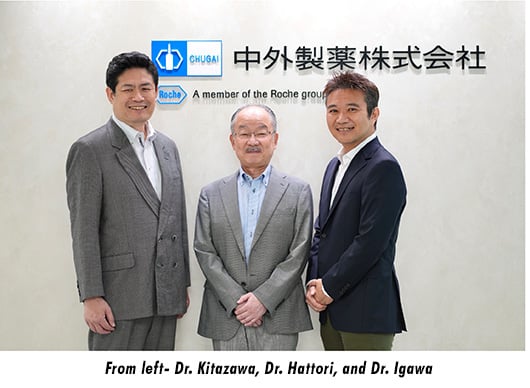
Three scientists at Chugai Pharmaceutical have received the 2026 Lasker-DeBakey Clinical Medical Research Award for designing a bispecific antibody that mimics coagulation factor VIII in patients with hemophilia A.12 The award presentation in New York marks the first time three Japanese researchers have simultaneously shared the prize in clinical medicine since the Lasker Foundation established the honors in 1945.13
The foundation named Kunihiro Hattori, formerly a senior fellow at Chugai, alongside Takehisa Kitazawa, deputy head of the company research division, and Tomoyuki Igawa, the research division head, as the recipients of the clinical prize.12 Their project produced emicizumab, marketed commercially as Hemlibra by Roche and Genentech.12 The medicine was approved in the United States in 2017 and has reached more than 30,000 people across more than 120 countries, according to company records as of June 30, 2026.2
The biological problem in hemophilia A
Hemophilia A is an inherited bleeding disorder linked to genetic mutations on the X chromosome, appearing in roughly one in 4,000 to 5,000 male births.124 Individuals with the condition produce defective or insufficient quantities of factor VIII, an essential cofactor protein in the human blood coagulation cascade.12 Without sufficient factor VIII activity, blood fails to form stable fibrin clots to arrest bleeding.12
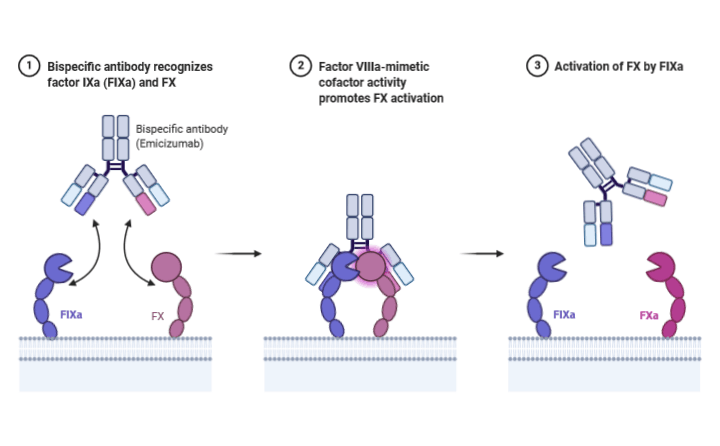
When vascular injury occurs, platelets aggregate at the site of damage, exposing negative phospholipids such as phosphatidylserine on their cell membranes. In healthy physiology, activated factor VIII binds to this platelet membrane surface, where it acts as a molecular scaffold.24 It positions activated factor IX alongside factor X in a precise spatial orientation, allowing the enzyme to cleave factor X into activated factor X.21 That enzymatic conversion drives subsequent reactions that yield thrombin and polymerize fibrin.24
Severely affected individuals regularly suffer spontaneous hemorrhage into major weight-bearing joints, including knees, elbows, and ankles.12 Over months and years, repeated joint bleeds trigger persistent synovitis and permanent cartilage erosion, resulting in hemophilic arthropathy in roughly 90 percent of untreated patients by early adulthood.41 Unchecked internal bleeds can form intramuscular hematomas that compress peripheral nerves, and intracranial hemorrhage in infancy presents immediate mortality risks.14 Historical data from the mid-twentieth century recorded an average life expectancy of only 11 to 13 years for severe cases.4
Limits of standard replacement therapy
Therapy advanced significantly in 1965 when Judith Graham Pool developed cryoprecipitate from frozen human plasma, concentrating crude factor VIII.4 By the 1970s, freeze-dried plasma concentrates enabled early home infusions and prophylactic regimens.4 That reliance on pooled human plasma caused catastrophic viral transmissions before universal viral inactivation methods took hold in the 1980s, infecting an estimated 60 to 70 percent of severe hemophilia A patients with HIV and nearly all with hepatitis C virus.4
Recombinant factor VIII proteins cloned in 1984 entered human clinical testing in 1989, eliminating viral contamination threats.42 Yet recombinant protein infusions left serious mechanical and biological barriers intact. Factor VIII exhibits an intravascular half-life of 8 to 12 hours in humans, forcing patients to endure intravenous needle punctures two or three times every week to sustain preventive clotting thresholds.421 In young children whose peripheral veins collapse under frequent cannulation, surgeons routinely place permanent central venous access ports, creating recurrent risks of thrombosis and bacteremia.4
The most disabling complication of protein replacement remains inhibitor development.24 Because factor VIII is absent or defective from birth, the immune system views infused recombinant factor VIII as a foreign antigen.12 Neutralizing alloantibodies, known clinically as inhibitors, emerge in approximately 30 percent of patients with severe disease.42 Once inhibitors arise, replacement infusions become inactive, forcing doctors to resort to bypassing agents that provide erratic hemostasis at heavy financial and physical expense.14
A mechanical substitute for a broken scaffold
In 2000, Hattori observed structural research describing how coagulation enzymes orient on platelet membranes.24 He recognized that factor VIII functions not as an active catalytic enzyme, but as an inert physical bridge that holds factor IXa and factor X in adjacent positions.21 Looking at the geometry of standard human immunoglobulin G molecules, Hattori noted that the physical span separating the two antigen-binding variable arms of an antibody measures roughly the distance between the factor IXa binding pocket and the factor X cleavage site on factor VIII.24
Standard therapeutic monoclonal antibodies work through subtraction, locking onto disease targets to neutralize toxins, block cellular receptors, or trigger immune destruction.13 Hattori proposed an additive mechanism.13 He reasoned that an engineered bispecific antibody could grasp factor IXa with one arm and factor X with the other, mechanically enforcing the spatial alignment needed for factor X activation on platelet surfaces.24
The concept faced steep skepticism because antibodies evolved to bind targets with high affinity, whereas dynamic enzymatic reactions require rapid substrate turnover. If an antibody bound the clotting factors too tightly, it would act as a competitive inhibitor rather than an activator. Hattori initiated the experimental project at Chugai, directing Kitazawa to lead pharmacological and biological testing while Igawa managed protein engineering and chemical synthesis.2
Early experiments proved delicate. A preliminary candidate showed improved clotting times in test tubes but aggravated bleeding in animal models.2 The researchers discovered that the candidate antibody bound non-activated factor IX and factor X with moderate affinity, allowing product factor Xa to release rapidly and join prothrombinase complexes instead of remaining trapped in the antibody cleft.4
Overcoming the assembly bottleneck
To identify viable configurations, the team immunized mice, rats, and rabbits with human factor IXa or human factor X.42 They isolated genes for roughly 200 monoclonal antibodies targeting factor IXa and 200 targeting factor X, expressing them in human embryonic kidney cells to create an exploratory combinatorial library of approximately 40,000 distinct bispecific IgG variants.42 They screened these variants using an assay where the activation of factor X produced a distinct yellow color change upon substrate cleavage.2
Testing proved that bispecific binding was mandatory.2 Single-arm fragments or mixtures of separate monospecific antibodies produced no factor VIII cofactor activity.2 The screening yielded an initial active molecule, but commercial manufacturing presented an obstacle rooted in antibody biology. Natural antibodies contain two identical heavy chains and two identical light chains.2 When a host cell expresses two distinct heavy chains and two distinct light chains, random genetic assortment generates 10 different molecular pairings, only one of which represents the desired asymmetric bispecific antibody.2
Igawa and his engineering team developed proprietary protein modifications, later designated as ART-Ig technology, to eliminate this assembly puzzle.13 First, they screened light chains until they identified a single common light chain capable of pairing productively with both the factor IXa-binding heavy chain and the factor X-binding heavy chain.24 This common light chain reduced the possible assortment outcomes from 10 combinations down to three.2
Second, the engineers applied opposite electrostatic charges to the contact interfaces of the heavy chain constant regions.24 By engineering positive charges on one heavy chain and negative charges on the other, homodimers with identical chains repelled each other, while heterodimers attracted.2 This electrostatic steering elevated the proportion of the desired bispecific heterodimer from 50 percent to greater than 90 percent of the total output.2 Finally, they altered surface charges so that residual homodimers carried net positive or negative charges, leaving the bispecific antibody neutral and easily purified by standard ion-exchange chromatography.2
Refining the clinical molecule
Between 2000 and 2010, the team synthesized and characterized 2,400 individual bispecific antibodies to balance safety, physical stability, and biological durability.2 Early variants had short circulating half-lives in mice. The team engineered the amino acid backbone to reduce nonspecific pinocytosis and clear unwanted receptor interactions, ultimately achieving an intravascular half-life of 29 days in humans.24
The researchers also modified surface residues to raise solubility. High solubility allowed the drug to dissolve at high concentrations in small liquid volumes, making routine subcutaneous injection feasible.24 In animal studies, the candidate molecule, designated ACE910, demonstrated 86 percent subcutaneous bioavailability in nonhuman primates.4 When tested in cynomolgus monkey models where acquired hemophilia was induced through factor VIII neutralizing antibodies, ACE910 prevented spontaneous joint bleeds and curbed induced muscle hematomas without triggering systemic thrombosis.24
Crucially, emicizumab binds only to specific regions of factor IX and factor X, showing negligible structural homology to native factor VIII.24 Because its molecular shape differs completely from factor VIII, pre-existing factor VIII inhibitors cannot recognize or bind it.21 Clinical assays confirmed that emicizumab retains full procoagulant function in plasma loaded with high-titer factor VIII neutralizing antibodies, while failing to provoke new factor VIII inhibitor antibodies in human subjects.14
Clinical confirmation across the HAVEN program
Chugai formed an alliance with Nara Medical University, whose pediatric department had treated Japanese hemophilia patients for decades under Midori Shima.12 In 2016, Shima published clinical data demonstrating that weekly subcutaneous injections of ACE910 reduced annualized bleeding rates in 18 patients with severe hemophilia A, including those with refractory inhibitors.24 Chugai partnered with parent company Roche and its subsidiary Genentech to fund global clinical evaluation.13
The pivotal HAVEN 1 phase III trial evaluated 109 individuals aged 12 years and older who had severe hemophilia A with inhibitors.42 Patients receiving emicizumab prophylaxis achieved an 87 percent reduction in treated bleeds compared to patients receiving episodic bypassing therapy.42 HAVEN 2 extended testing to 85 pediatric patients under 12 years old with inhibitors, demonstrating annualized bleeding rates between 0.2 and 2.2 across weekly, biweekly, and monthly subcutaneous regimens.4 The reduction allowed many young patients to have permanent venous catheters surgically removed.4
Subsequent trials expanded the evidence to broader populations. In HAVEN 3, testing emicizumab in 152 patients without inhibitors, weekly and biweekly regimens reduced treated bleeding rates by 96 percent and 97 percent compared with no prophylaxis, and lowered bleeding rates by 68 percent compared to previous factor VIII intravenous prophylaxis. HAVEN 4 verified that a 6 mg/kg maintenance dose administered once every four weeks maintained protective trough concentrations, while HAVEN 7 showed sustained bleed prevention in infants.1
Across an integrated analysis of 391 participants in HAVEN 1 through 4, the overall annualized bleeding rate for treated bleeds remained at 1.4 events per year.13 The proportion of patients experiencing zero treated bleeds stood at 70.8 percent during weeks one through 24, rising to 82.4 percent between weeks 121 and 144.13 The most common adverse reaction was local injection-site irritation in 27.8 percent of participants.12 A clinical safety signal emerged in trials only when patients repeatedly co-administered activated prothrombin complex concentrates alongside emicizumab to manage breakthrough bleeds, resulting in rare thrombotic microangiopathy events.2
Broader impact on antibody therapeutics
Since the initial approvals of Hemlibra, 14 other bispecific antibodies have secured regulatory clearances worldwide.2 Eleven of these medicines target oncology indications, such as lymphomas and myelomas, where they tether cytotoxic T cells directly to malignant cell surface markers to induce immune-mediated lysis.2 Emicizumab remains the only approved bispecific antibody designed to substitute for a missing biological enzyme cofactor.21
The award ceremony for the 2026 Lasker-DeBakey Clinical Medical Research Award is scheduled for September 17, 2026, at The Pierre Hotel in New York City.13 The clinical prize honors the trio alongside basic research laureates Emmanuel Mignot and Masashi Yanagisawa, who discovered the orexin sleep pathway, and public service recipient Michael J. Fox for his Parkinson's disease research advocacy.56
"I am deeply honored that our collective efforts, together with many researchers and clinicians, dedicated to advancing science for society and for patients, have been recognized through this award," Hattori said in comments released through Chugai.13 In reflections on the program, Kitazawa noted the role of clinical trial volunteers, while Igawa stated that overcoming technical hurdles during drug design was sustained by the goal of reducing treatment burdens for patients and their families.
What this rests on
71 sentences trace to 6 sources.
-
1
B
BioSpace Document · biospace.com Three Chugai Researchers Behind the Discovery of Hemlibra for Hemophilia A Receive Prestigious U.S. Lasker Award, One of the World’s Most Respected Scientific Honors See the source
-
2
L
laskerfoundation.org Third-party reporting · laskerfoundation.org · 22 Aug 2026 Bispecific antibody for treating hemophilia A - Lasker Foundation See the source
-
3
C
chugai-pharm.co.jp Third-party reporting · chugai-pharm.co.jp Sep 09,2026 | Three Chugai Researchers Behind the Discovery of Hemlibra for Hemophilia A Receive Prestigious U.S. Lasker Award, One of the World’s Most Respected Scientific Honors - Recognized for the invention of a bispecific antibody that transformed treatment paradigm through an unconventional approach – | News | CHUGAI PHARMACEUTICAL CO., LTD. See the source
-
4
J
jci.org Third-party reporting · jci.org JCI - Kunihiro Hattori, Tomoyuki Igawa, and Takehisa Kitazawa share Lasker Award honors for revolutionary hemophilia A therapy See the source
-
5
B
bioworld.com Third-party reporting · bioworld.com Laskers go for Hemlibra, orexin insights, Parkinson’s advocacy See the source
-
6
B