Tiny diamond sensors can track spreading cancer without radiation
A miniature optical probe uses magnetic nanoparticles and diamond defects to pinpoint sentinel lymph nodes through keyhole surgery incisions.
When cancer cells break away from a tumor in the breast, they move through the lymphatic system, usually settling first in a cluster of sentinel lymph nodes under the arm.12 To determine whether a malignancy has begun to spread, surgeons must identify and extract these specific gateway nodes for examination.12 Finding them in the operating room requires a physical tracer injected near the tumor, which travels along the exact fluid pathways the cancer cells would take.21 Once the tracer settles in the sentinel nodes, a detector guides the surgical incision directly to the affected tissue.
For decades, this navigational guide has relied on either radioactive isotopes or visible blue dyes.21 Radioactive tracers require specialized handling facilities that many community hospitals cannot support, while exposing both surgical staff and patients to low doses of ionizing radiation.21 Blue dyes provide a visual cue without radiation, but the substances carry an allergic reaction risk in approximately one in 100 patients and can leave long lasting skin discoloration at the injection site.21
Why does tracking cancer spread require a physical guide?
Surgeons locate the earliest path of tumor spread by following fluids that drain directly from the breast into the lymphatic network.12 When fluid leaves the breast tissue, it flows along tiny lymphatic channels toward regional lymph nodes. A tracer injected into the primary tumor enters these same channels, accumulating in the very first node that filters the drainage.2 By detecting where that tracer gathers, the surgical team can remove that sentinel node while leaving healthy tissue intact.12
Liquid suspensions of superparamagnetic iron oxide nanoparticles offer a safe alternative to radiation and dye, remaining non-toxic and non-radioactive while moving naturally through the lymphatic channels.21 Yet detecting these magnetic particles during an operation has introduced its own mechanical hurdles. Conventional magnetic probes often rely on alternating current coils that require bulky handheld batons and can generate tissue heating through electrical resistance.2 Other magnetic probes are simply too wide to fit through the narrow ports used in minimally invasive surgery.2
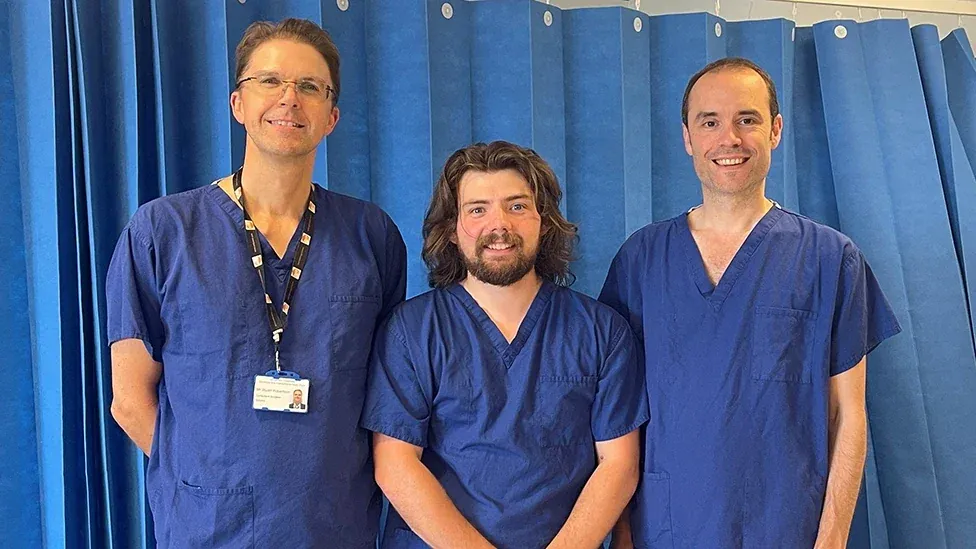
Researchers at the University of Warwick, working with staff at University Hospitals Coventry and Warwickshire, have designed a miniature magnetic sensor that fits inside a flexible endoscopic tube.12 The work, led by doctoral researcher Alex Newman and senior author Gavin Morley in the Department of Physics at the University of Warwick, was published in the journal Physical Review Applied and detailed in a preprint posted to arXiv.12 The team packaged a diamond-based magnetic sensor into a probe head measuring 10 millimeters in maximum diameter, making it small enough to pass through standard surgical access ports.12
How can a diamond detect magnetic particles in tissue?
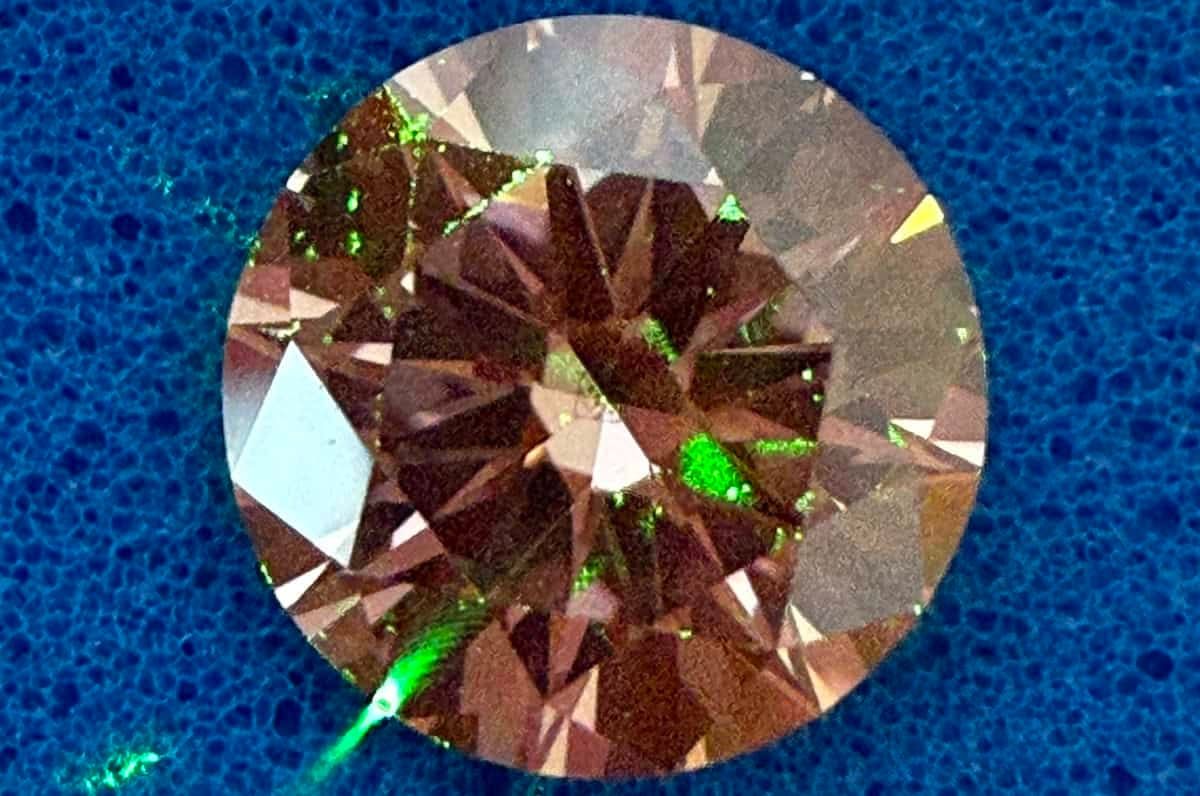
Tiny atomic defects inside the diamond crystal change their light emission when exposed to a magnetic field.12 These defects, known as nitrogen vacancy centers, occur when a nitrogen atom replaces a carbon atom adjacent to an empty space in the crystal lattice.12 When green laser light shines on the diamond, the defects emit red photoluminescence, and the brightness of that emitted red light shifts in response to local magnetic fields.
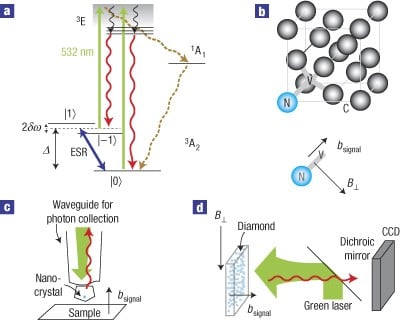
To build the probe, Newman and colleagues attached a synthetic diamond cube measuring 0.5 millimeters across to the tip of a flexible optical fiber. Instead of using electrical coils to generate an alternating field, the researchers glued a tiny permanent neodymium magnet to the side of the fiber tip. This small magnet magnetizes the nearby iron nanoparticles while providing a steady bias field that tunes the diamond defects to peak sensitivity.2 Laser excitation and returned red fluorescence travel through the same single optical fiber, eliminating the need to deliver electrical power directly to the sensor head.2
Laboratory measurements reported by the authors demonstrated that the probe can detect an iron mass as low as 0.56 milligrams in a 200 microliter vial, representing one tenth of the standard clinical concentration and one hundredth of the typical total dose used in breast cancer procedures.21 At this 10 percent concentration, corresponding to 2.8 milligrams of iron per milliliter, the sensor detected the sample at a working distance of 5.8 millimeters.2 At the full concentration of 28 milligrams per milliliter, the maximum working distance expanded to 14.6 millimeters.2
What are the limits of the current laboratory probe?
The experimental sensor has so far demonstrated detection only in laboratory vials rather than living tissue during an operation. Newman and colleagues evaluated the device by mounting the 10 millimeter probe head on a automated three-dimensional printing stage and scanning it over diluted vials of commercial magnetic tracer fluid.2 The data reflect controlled benchtop measurements, not clinical surgical outcomes or in vivo animal trials.2 In addition, the magnetic signal drops off sharply as the distance between the probe and the magnetic material increases, meaning surgeons must position the tip within roughly 6 to 15 millimeters of the node depending on local tracer concentration.
If the technology translates successfully to surgical suites, the reduced probe diameter could extend magnetic node mapping to minimally invasive keyhole procedures.2 Beyond breast cancer, the authors note that the approach could assist in detecting tumor spread during endoscopic or laparoscopic operations for lung, liver, colorectal, and oesophageal cancers, where rigid probes cannot easily navigate.12
What this rests on
26 sentences trace to 2 sources.
-
1
BN
BBC News Document · bbc.co.uk Diamond sensor could be cancer 'game-changer' See the source
-
2
A
arxiv.org Paper · arxiv.org Endoscopic fiber-coupled diamond magnetometer for cancer surgery Preprint · may not have been peer reviewed See the source