Fingertip thermal illusions make virtual temperature shifts feel faster
Coordinating micro-actuators across the skin exploits sensory summation to cut perceived temperature switching delays in half without bulky cooling hardware.
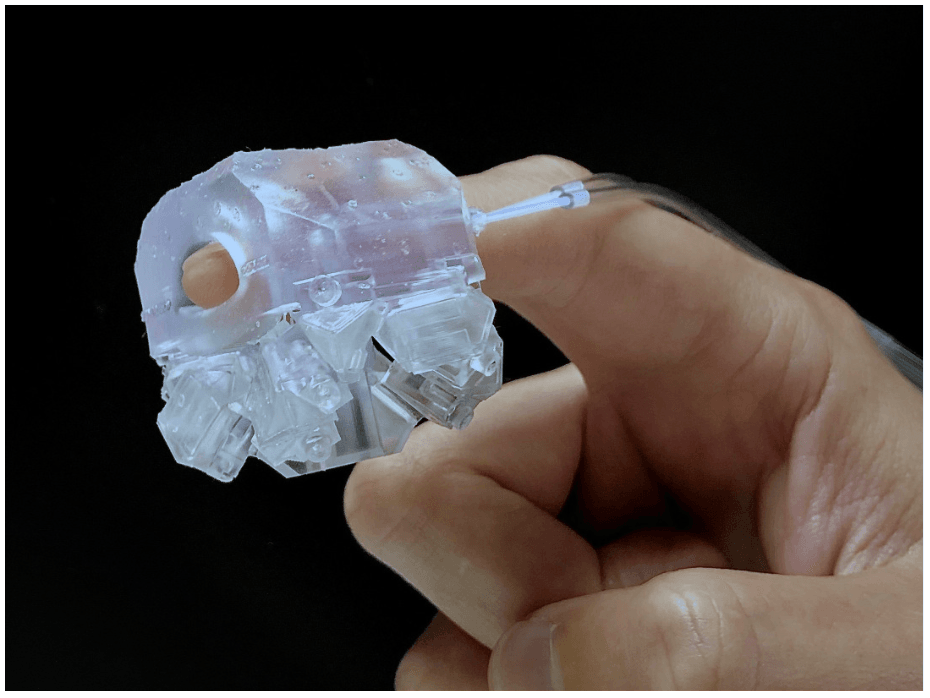
When human skin encounters a sudden change in environment, such as touching an iced drink or stepping into direct sunlight, the body registers the shift in temperature within a fraction of a second. Translating that immediate thermal transition into digital simulations has long proven difficult for engineers designing haptic interfaces.12 While digital displays update visual scenes in milliseconds, physical hardware designed to heat and cool skin responds on a sluggish curve that lags seconds behind user actions.2
This mismatch breaks sensory immersion in simulated environments.2 In interactive virtual spaces where users manipulate dynamic elements, such as casting spells of flame and frost or picking up chilled objects, visual cues arrive instantly while temperature feedback crawls slowly upward or downward. When physical sensations arrive out of rhythm with visual events, digital interaction loses its believability.
The human skin does not evaluate surface temperature like an isolated thermometer reading a single coordinate. To perceive warmth or chill, temperature-sensing nerve endings across adjacent patches of tissue pool their signals into the central nervous system to establish an integrated sensation.2 In parallel, the skin undergoes sensory adaptation, steadily muting its responsiveness to sustained or gradual thermal stimulation.2 Together, these neural mechanisms enable minor temperature shifts in small patches of skin to go entirely unnoticed if neighboring skin zones maintain a clear, dominant baseline sensation.2
By harnessing this quirk of human perception, researchers led by Zining Zhang at the University of Maryland and Jin Ryong Kim at the University of Texas at Dallas have developed a system that makes temperature changes feel noticeably quicker.1 In a preprint paper posted to the arXiv server and conditionally accepted to the ACM Symposium on User Interface Software and Technology, the team introduced TherMosaic, a method that coordinates independent thermal subregions across the fingertip to reduce perceived latency.32
Why do physical thermal devices lag behind digital displays?
Heat transfer through solid materials remains an inherently gradual physical process. Most wearable thermal displays rely on thermoelectric devices known as Peltier modules, which transfer heat between opposite surfaces when an electrical current flows through them.2 These solid-state actuators are constrained by the thermal conductivity and heat capacity of physical components, typically requiring several seconds to swing between hot and cold operating states.2
Earlier engineering attempts tried to bypass this material bottleneck by adding active hardware mechanisms.2 Some setups used liquid-cooling circuits, high-conductivity substrate layers, or motorized mechanical switches that physically swap hot and cold modules against the skin.2 Although these approaches improve physical thermal transfer rates, they introduce heavy assemblies, noisy pumps, and high electrical loads that become impractical for compact, wearable interfaces mounted on the hand.2
The fingertip presents an exceptionally demanding environment for haptic display design. While the human finger pad provides high tactile and thermal sensitivity, its minute surface area cannot accommodate heavy cooling plumbing or complex motorized switches without compromising natural movement and dexterity.2
How does spatiotemporal feedback accelerate perceived thermal transitions?
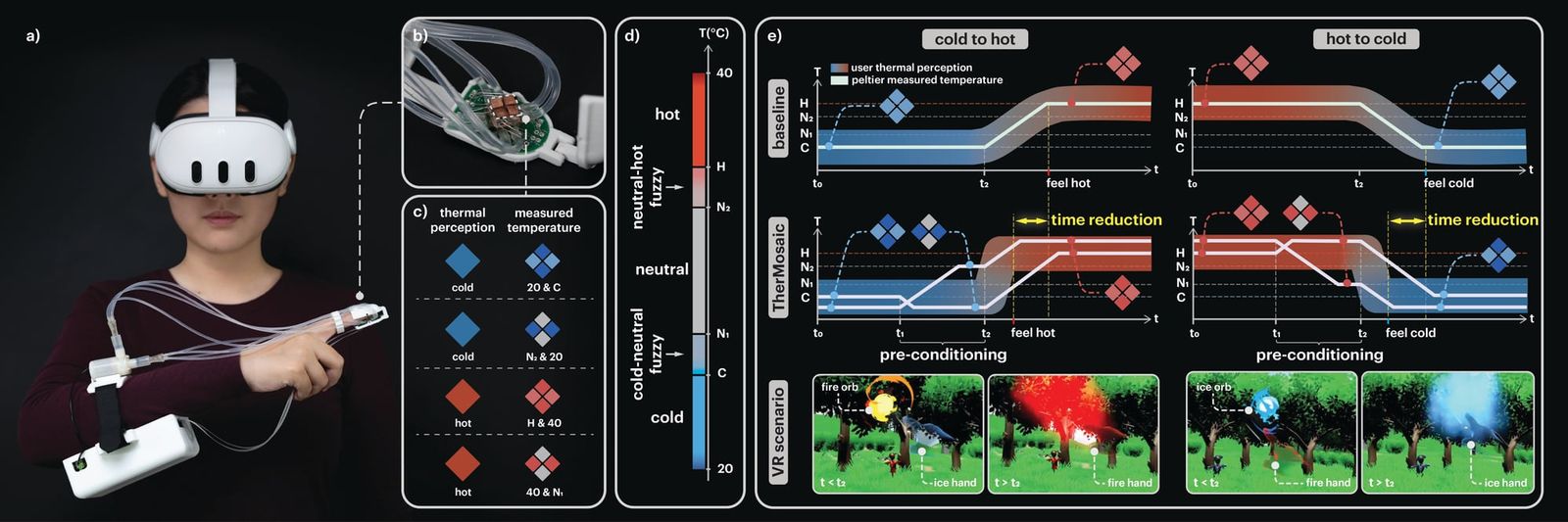
Preconditioning individual segments of the skin surface allows a thermal display to initiate temperature shifts before a person consciously detects any variation. Rather than forcing a single uniform actuator to ramp through a broad temperature range after an interactive event begins, the TherMosaic system divides the fingertip contact area into a two-by-two grid of four miniaturized, independently controlled Peltier elements.12 By altering the temperatures of individual actuators while preserving the overall category of sensation across the combined finger pad, the display prepares the skin for an upcoming shift.2
Huaishu, a researcher on the project, explained in response to questions from Primary how this coordination works across the skin without ruining the sensory illusion beforehand.contributed Huaishu said that spatial summation acts as a general property of thermal perception where the skin integrates nearby inputs into one sensation, while perceptual boundaries remain broad.contributed
What allows us to precondition the fingertip without producing the new overall sensation is that thermal perception is categorical, with fuzzy transition zones between cold, neutral, and hot. During preconditioning, we gradually move only part of the fingertip toward the upcoming target, bringing those regions into the relevant transition zone rather than into the target category. At the same time, thermal adaptation makes these gradual local changes less noticeable. As a result, spatial summation still produces a dominant overall sensation that remains in the original hot or cold category, even though part of the fingertip has already moved substantially toward the next state.contributed
When the virtual environment triggers the target transition, every module across the array drives toward the goal simultaneously.contributed Because several elements have already traversed intermediate temperatures, the integrated sensory output crosses the perceptual category boundary far earlier than a uniform actuator could achieve from a dead stop.contributed
Across three controlled perceptual studies examining temperatures within a safe operating range between 20 and 40 degrees Celsius, the authors confirmed that spatial summation and thermal adaptation successfully mask localized shifts.1 When the system initiated a transition toward an opposite temperature, pre-adjusting subregions reduced perceived transition times by about 30% to 40% for shifts originating from hot or cold states.15
Clarifying that measurement, Zining Zhang told Primary that the baseline comparison kept all four actuators at the original temperature during the preconditioning phase before triggering them together.contributed "We did not observe a simple effect of transition direction, such as heating versus cooling," Zhang said. "Instead, the key factor was the starting perceptual state. We saw reliable improvements when preconditioning could build on an already established cold or hot percept, while transitions starting from neutral did not show a reliable benefit."contributed
To confirm that this sensory illusion functions in practice, the investigators built a standalone, cable-free wearable prototype and integrated it with an interactive virtual reality scenario.12 In trials featuring simulated elemental fire and ice magic tasks, the authors observed that the spatiotemporal feedback significantly reduced perceived thermal lag and improved synchronization between thermal sensations and visual events compared to standard uniform displays.12 Zhang added that participants noted the faster transition from TherMosaic matched the visual magic better than the slower baseline.contributed
What are the limitations of relying on thermal illusions?
Preconditioned sensory shifts cannot alter the underlying rate at which heat moves through physical materials.2 The thermal elements heat and cool at their normal physical pace, meaning the observed transition advantage exists entirely within human perception.2 For the system to execute preconditioning effectively, software must anticipate interactive user actions several seconds in advance to begin warming or cooling subregions ahead of time.
The current experimental findings are strictly confined to the fingertip pad.contributed "Spatial summation itself is a general property of thermal perception, but our experimental evidence is limited to the fingertip," Zhang told Primary, explaining that adapting the technique to the palm or forearm would require separate calibration because perceptual sensitivity varies across the body.contributed
The precise physical boundary where the sensory illusion breaks down remains an open question. In response to questions from Primary, Zhang noted that the study did not determine the threshold where users begin to distinguish individual actuators as separate thermal patches.contributed Zhang also pointed out that while integration is clearly observed in perception, the study does not identify the specific neurological stage where the nervous system blends conflicting hot and cold signals.contributed
These experimental results represent controlled laboratory evaluations documented in a preprint that has been conditionally accepted for publication but has not yet appeared in its final conference proceedings.32 Deploying the system across diverse populations will require individual calibration, as skin sensitivity and perceptual boundaries differ across users.2
Where does perceptual thermal feedback go next?
Exploiting the body's natural sensory summation allows wearable systems to deliver responsive temperature feedback without adding noisy mechanical hardware or heavy cooling pumps. If predictive software can forecast user interactions during virtual manipulation, subtle preconditioning can run silently in the background across games, remote operation interfaces, and medical training simulations.
Future investigations plan to evaluate whether dynamic scheduling algorithms can handle erratic, unpredictable user behavior in unstructured virtual environments. Expanding spatial actuation to larger body sites, such as the palm and forearm, could eventually enable synchronized thermal feedback across full-body wearable haptic gear.
This piece was prepared from the arXiv preprint and public records together with answers from Zining Zhang and Huaishu to six questions from the Primary news team, completed September 2026.
What this rests on
41 sentences trace to 4 sources and 2 contributors.
-
1
ZZ
Zining Zhang, Jiasheng Li, Myungin Lee, Zeyu Yan, Jin Ryong Kim, Huaishu Peng Paper · arxiv.org · 7 Sep 2026 TherMosaic: Accelerating Perceived Thermal Transitions Through Spatiotemporal Thermal Feedback Preprint · may not have been peer reviewed See the source
-
2
A
-
3
M
mi-lab.io Third-party reporting · mi-lab.io · 18 Aug 2023 Publication - See the source
- 4 Contribution — Huaishu 5 statements added to this article
-
5
P
papers.cool Third-party reporting · papers.cool Human-Computer Interaction | Cool Papers - Immersive Paper Discovery See the source
- 6 Contribution — Zining Zhang 7 statements added to this article
ar5iv.labs.arxiv.org1 page
Article history
-
Published 18 Sep 2026, 17:44Assembled by the Primary desk from 4 sources · 2 contributors · 41 cited sentences
-
Huaishu, a researcher on the project
- Go to the sentence: Huaishu, a researcher on the project, explained in response to questions from Primary how this coordination works across the skin without ruining the sensory illusion beforehand.
- Go to the sentence: Huaishu said that spatial summation acts as a general property of thermal perception where the skin integrates nearby inputs into one sensation, while perceptual boundaries remain broad.
- Go to the sentence: What allows us to precondition the fingertip without producing the new overall sensation is that thermal perception is categorical, with fuzzy transition zones between cold, neutral, and hot. During preconditioning, we gradually move only part of the fingertip toward the upcoming target, bringing those regions into the relevant transition zone rather than into the target category. At the same time, thermal adaptation makes these gradual local changes less noticeable. As a result, spatial summation still produces a dominant overall sensation that remains in the original hot or cold category, even though part of the fingertip has already moved substantially toward the next state.
- Go to the sentence: When the virtual environment triggers the target transition, every module across the array drives toward the goal simultaneously.
- Go to the sentence: Because several elements have already traversed intermediate temperatures, the integrated sensory output crosses the perceptual category boundary far earlier than a uniform actuator could achieve from a dead stop.
-
Zining Zhang, lead author
- Go to the sentence: Clarifying that measurement, Zining Zhang told Primary that the baseline comparison kept all four actuators at the original temperature during the preconditioning phase before triggering them together.
- Go to the sentence: "We did not observe a simple effect of transition direction, such as heating versus cooling," Zhang said. "Instead, the key factor was the starting perceptual state. We saw reliable improvements when preconditioning could build on an already established cold or hot percept, while transitions starting from neutral did not show a reliable benefit."
- Go to the sentence: Zhang added that participants noted the faster transition from TherMosaic matched the visual magic better than the slower baseline.
- Go to the sentence: The current experimental findings are strictly confined to the fingertip pad.
- Go to the sentence: "Spatial summation itself is a general property of thermal perception, but our experimental evidence is limited to the fingertip," Zhang told Primary, explaining that adapting the technique to the palm or forearm would require separate calibration because perceptual sensitivity varies across the body.
- Go to the sentence: In response to questions from Primary, Zhang noted that the study did not determine the threshold where users begin to distinguish individual actuators as separate thermal patches.
- Go to the sentence: Zhang also pointed out that while integration is clearly observed in perception, the study does not identify the specific neurological stage where the nervous system blends conflicting hot and cold signals.