A circular drumhead sets the sharp pitch benchmark for acoustic shapes
A newly calculated geometric constant confirms that a vibrating membrane cannot match the fundamental tone of a round disc without closely replicating its shape.
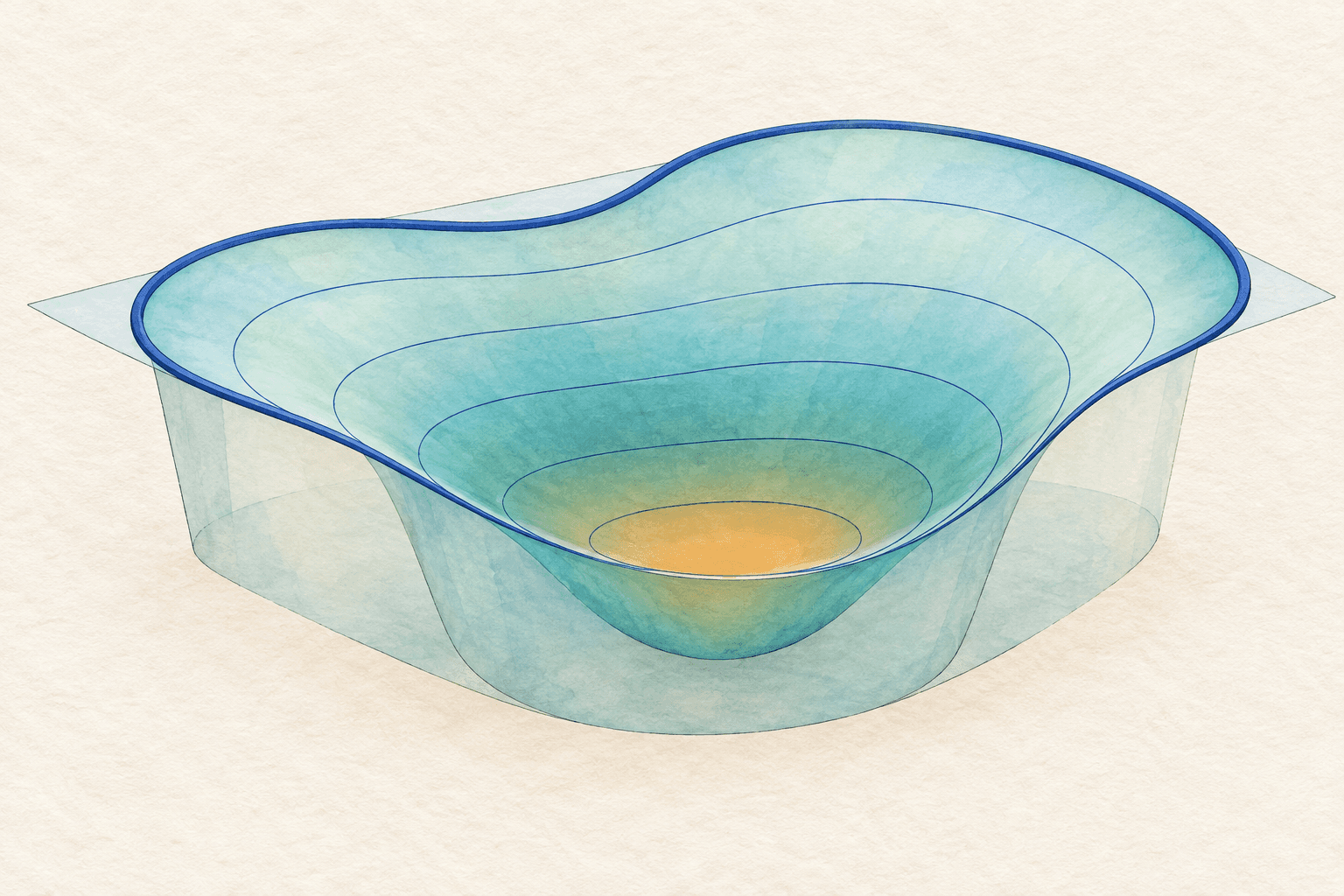
A vibrating drumhead with fixed edges produces resonance frequencies that depend entirely on the geometry of its boundary. In the late nineteenth century, the British physicist Lord Rayleigh observed that among all planar membranes enclosing identical surface area, a perfectly round drumhead produces the lowest possible fundamental tone. When a boundary curves inward, stretches into an oval, or develops jagged corners, the primary acoustic pitch invariably rises. For more than a century, mathematicians wondered how quickly that acoustic tone increases when an arbitrary geometric shape deviates from a perfect circle, asking whether an observer who hears a frequency only slightly above the theoretical minimum can determine how close the physical boundary sits to circular symmetry.
The classic Faber-Krahn inequality established that any non-circular enclosure produces a higher fundamental Dirichlet eigenvalue, which represents the mathematical frequency of the primary tone, than a ball of equal volume.1 Yet knowing that an irregular shape produces a higher pitch does not reveal whether a tiny frequency excess guarantees that the shape is almost indistinguishable from a sphere. In physical and geometric problems, stability estimates quantify this relationship by bounding the geometric asymmetry of a domain using the frequency deficit, which measures the gap between the actual pitch and the optimal spherical value. When such stability bounds depend on non-constructive mathematical arguments, they confirm that a universal constant exists while leaving engineers and analysts unable to compute a single numerical value.
A mathematical preprint posted to the arXiv repository by André Guerra, João Miguel Machado, and João P. G. Ramos now establishes an effective sharp quantitative stability estimate for the Faber-Krahn inequality across every dimension higher than one.1 The authors report that the geometric deviation from a ball is bounded quadratically by the frequency deficit through an explicit constant that an algorithm can evaluate to any desired precision.1 By avoiding the non-constructive compactness methods that dominated previous proofs of quadratic stability, the result supplies computable geometric thresholds that link acoustic frequencies directly to physical geometry.
Why does acoustic frequency track geometric symmetry?
Vibrational pitch tracks geometric symmetry because spreading energy evenly across a physical space requires minimal perimeter and maximum interior volume. In a vibrating drumhead, energy concentrates where the spatial gradient of the membrane displacement changes most abruptly. If a boundary pinches inward or elongates, the internal vibrations must adapt to tighter boundary constraints, which forces the gradient of displacement to steepen and drives the overall energy of the vibration upward. The primary tone corresponds to the lowest energy state, known mathematically as the first Dirichlet eigenvalue, which represents the minimum ratio of gradient kinetic energy to total displaced volume under zero-boundary conditions.
When a domain deforms away from a perfect sphere, two geometric and physical properties degrade simultaneously. First, the boundary area grows relative to the enclosed volume, creating an isoperimetric deficit that measures excess surface area. Second, the internal gradient of the governing energy function ceases to distribute evenly along the boundary of the domain. In a symmetric ball, the gradient of the displacement profile maintains an identical magnitude along every spherical shell, whereas in an irregular geometry, the gradient fluctuates wildly from one side of the boundary to another. Because both distortions demand additional gradient energy, any departure from spherical symmetry produces a measurable increase in the fundamental vibration frequency.
Earlier mathematical investigations by Nicola Fusco, Francesco Maggi, and Aldo Pratelli showed that geometric asymmetry could be controlled by the frequency deficit, but their initial inequality bounded asymmetry only to the fourth power.1 Lorenzo Brasco and Guido De Philippis later strengthened this exponent from four to three using level-set techniques.13 While a subsequent paper by Lorenzo Brasco, Guido De Philippis, and Bozhidar Velichkov achieved the optimal quadratic exponent, their proof relied on contradiction and abstract compactness arguments, which proved that an upper bound exists without producing a computable numerical factor.1
How can mathematicians measure distance from a sphere?
Mathematicians quantify the geometric departure of an arbitrary shape from spherical symmetry through the Fraenkel asymmetry, which calculates the volume of the regions where a given shape and an optimally placed equal-volume ball fail to overlap.1 In scale-invariant form, the normalized asymmetry measures the fraction of volume that sits outside the best matching sphere. If an open region encloses identical volume to a reference ball, an asymmetry value of zero indicates that the region matches the sphere almost everywhere, whereas a positive value reflects physical distortion. The corresponding frequency deficit measures the fractional gap between the shape's fundamental eigenvalue and the benchmark eigenvalue of a sphere.
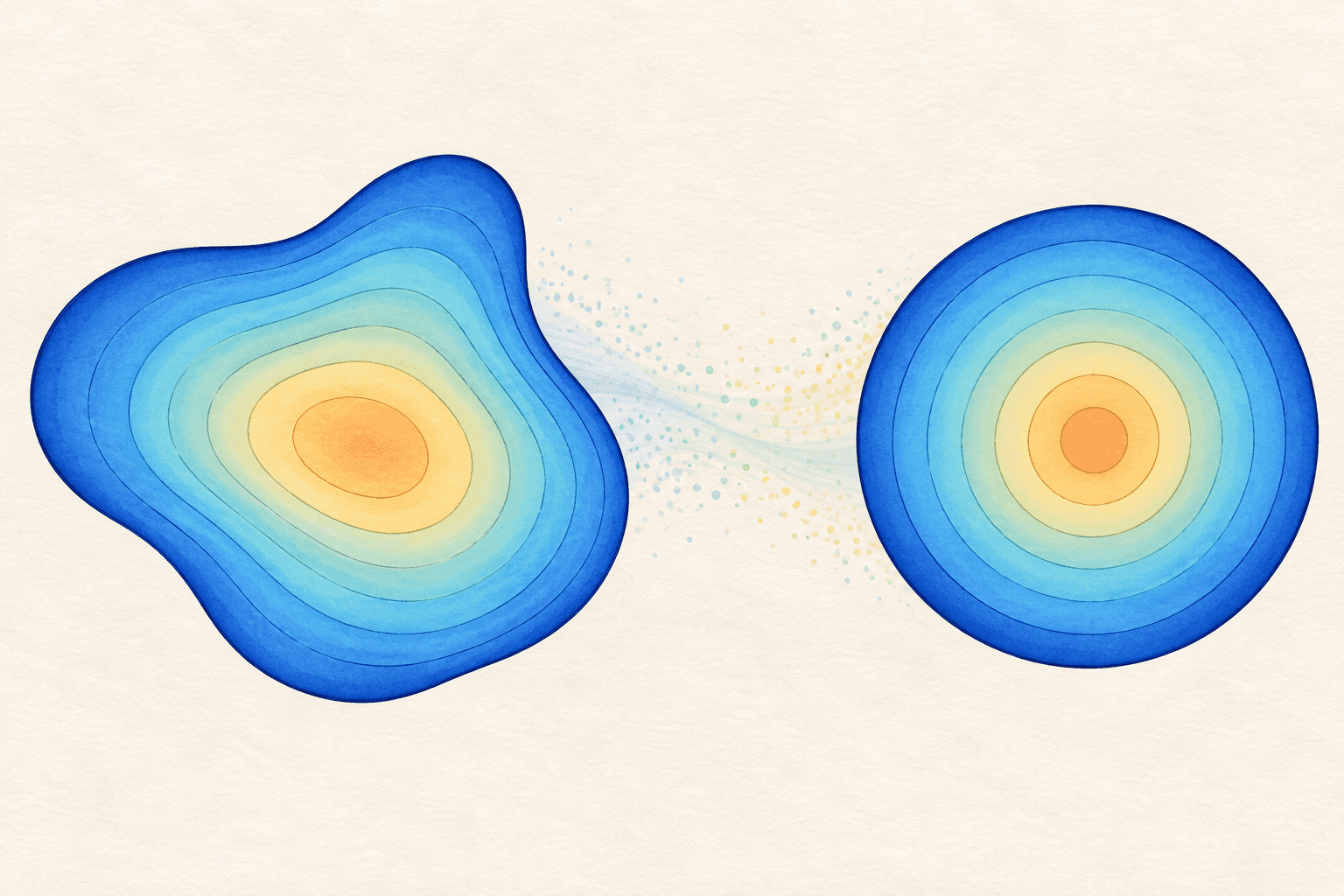
To obtain an explicit quadratic bound connecting asymmetry directly to frequency deficits, André Guerra, João Miguel Machado, and João P. G. Ramos analyzed the related physical problem of Saint-Venant torsional rigidity. Torsional rigidity describes the total resistance that an elastic cylinder exhibits against twisting forces under applied mechanical stress. In mathematical physics, this rigidity equals the integral of a torsion function that solves a Poisson equation with constant internal loading and vanishing boundary values. The classical Saint-Venant inequality dictates that among all cross-sections enclosing a fixed cross-sectional area, a circular cylinder maximizes torsional resistance.1
The researchers exploited a fundamental relationship established by the Kohler-Jobin inequality, which states that the product of the first Dirichlet eigenvalue and a fractional power of the torsional rigidity is minimized uniquely by a round ball.1 Because this inequality connects eigenvalue deficits to torsional rigidity deficits through explicit dimensional scaling coefficients, any quantitative bound proved for torsional rigidity translates directly into a quantitative bound for the fundamental vibration frequency. The research group demonstrated that bounding the geometric asymmetry against the torsional deficit with a computable factor automatically yields the sharp quadratic Faber-Krahn stability bound.1
The decision to route the calculation through torsional mechanics rather than attacking the Dirichlet eigenvalue directly was guided by analytical transparency. João, one of the authors, told Primary that the group sought an equivalent geometric formulation where the mathematical devices would remain transparent throughout each step.contributed As João explained, the authors could have attempted to extract an explicit factor through the classical Pólya-Szegö inequality, but they chose the torsion formulation because its level-set identity rendered every deficit mechanism clear.
What enables a constructive level-set proof?
The mathematical strategy developed by André Guerra, João Miguel Machado, and João P. G. Ramos decomposes the torsional deficit into an exact integral over individual level sets of the internal torsion function. By viewing the torsion function as an undulating landscape whose height drops to zero at the outer boundary, the researchers sliced the interior into super-level sets where the function exceeds a given elevation threshold. For each level set, the authors introduced two distinct deficit terms that isolate separate physical inefficiencies. The first deficit term measures the variation of the gradient magnitude along the boundary slice using the Cauchy-Schwarz inequality, while the second term captures the geometric isoperimetric deficit of that individual slice.
By expressing the global torsional deficit as an integral of these two non-negative terms across every internal slice, the authors avoided the lossy probabilistic estimates that forced earlier studies to accept suboptimal exponents. Previous investigations had relied on Chebyshev inequalities to select an isolated level set with bounded asymmetry, an approach that discarded valuable geometric information because intermediate level sets possess much better regularity on average.1 Instead of selecting a single slice, the authors tracked how the asymmetry of level sets evolves as the elevation parameter moves from the interior peak toward the outer boundary.
Tracing the continuous derivative of the asymmetry across elevation slices came as a technical turning point during the investigation. João said in response to questions from Primary that the researchers had initially tried diverse methods within elliptic partial differential equations to identify single well-behaved level sets.contributed Once the authors realized that the asymmetry function is Lipschitz continuous and that its derivative can be controlled directly by the two deficit components, they gained a framework that avoided all non-constructive selection principles.
To control this continuous geometric variation, the authors demonstrated that the derivative of the level-set asymmetry function satisfies a differential inequality governed by the two deficit components. The oscillation of the gradient magnitude bounds the internal variation of level-set normal vectors, while an effective quantitative isoperimetric estimate established by Sebastian Hensel and Tim Laux controls the deviation of the level-set boundary from a sphere.1 João noted to Primary that classical isoperimetric stability bounds volume differences, whereas the modern strong formulation controls the directional alignment of boundary normal vectors, providing the exact regularity needed to integrate level-set shapes back to the full domain.contributed
What are the limits of effective stability bounds?
The explicit constant derived by André Guerra, João Miguel Machado, and João P. G. Ramos provides a certified theoretical bound rather than a numerically optimized physical value. The authors explicitly note that while their constructive algorithm guarantees the existence of rational upper and lower approximations that converge to the constant, they made no attempt to minimize the numerical magnitude of the resulting dimensional factor.1 In practical computations, constants derived through multi-step geometric analysis often remain significantly larger than the empirical thresholds observed in numerical simulations of specific domain shapes.
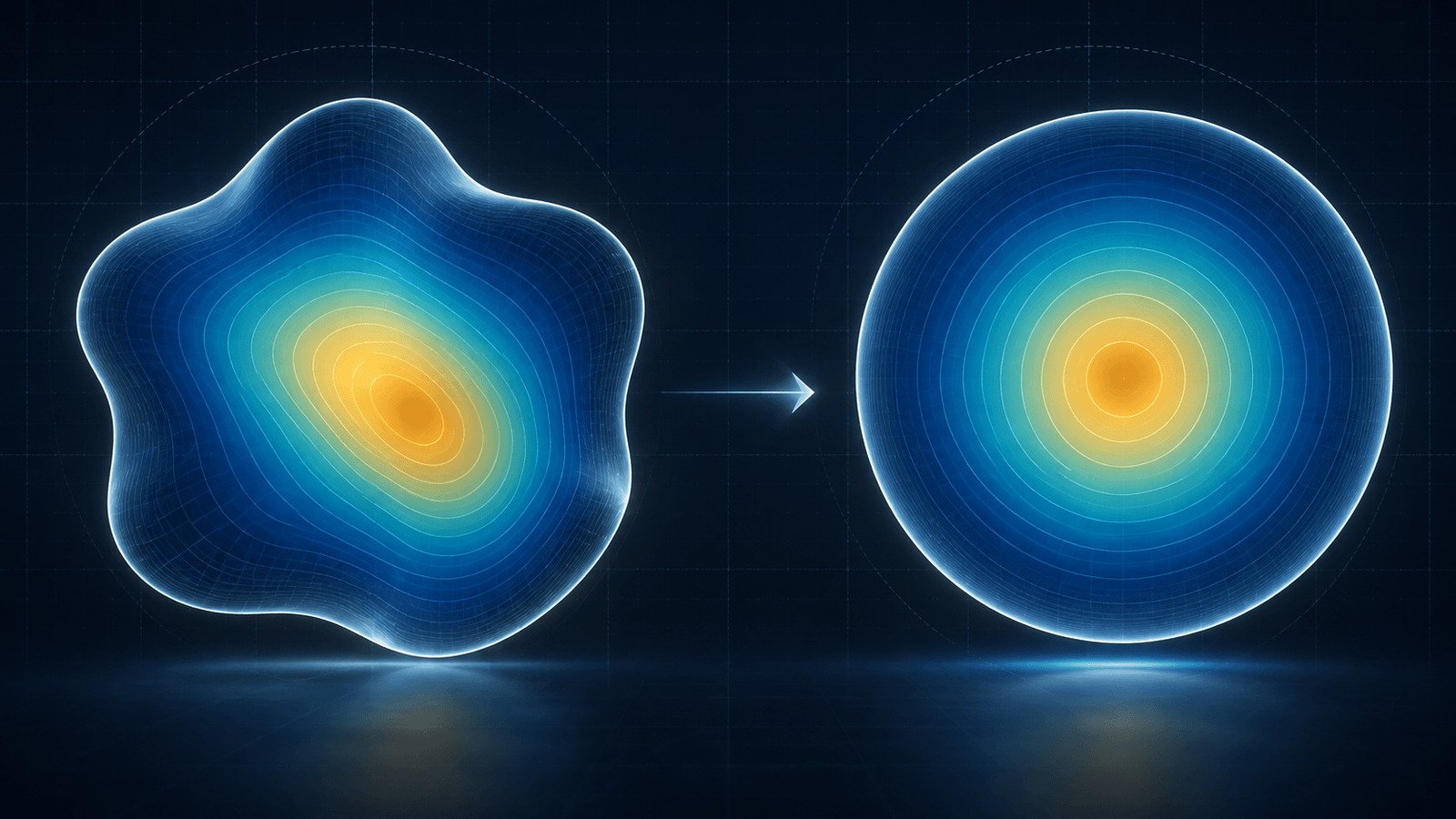
Evaluating the current analytical bounds directly would produce a constant that João described as too large for direct engineering applications.contributed João told Primary that refined arguments within the same proof architecture could bring the dimensional factor down toward 10 to the power of 30, and high-precision numerical implementations might potentially reach orders between 10,000 and 1,000,000. For geometries that lie in the near-ball regime without being strict smooth perturbations, the author indicated that the constant could improve still further.
The proof initially establishes the effective stability estimate under the geometric constraint that the domain remains confined within a bounded container ball.1 João explained that while fixing total volume is standard, unconfined shapes can sprout narrow tentacles whose perimeter grows far faster than enclosed volume, creating geometric configurations whose spectral impact is difficult to track without isoperimetric deficit controls.contributed Extending the result to arbitrary open sets of finite measure requires applying geometric truncation procedures alongside non-sharp global estimates, which weakens the numerical value of the final constant even though the sharp quadratic exponent survives.
The quadratic exponent itself has been confirmed primarily on regular geometries. João said that the research team verified the sharp quadratic scaling on standard shapes such as ellipses, leaving the question of whether identical quadratic stability holds for highly singular or irregular boundaries open for future work.contributed The bound applies specifically to the standard Dirichlet Laplacian on open sets and does not automatically transfer to alternative physical operators without dedicated technical estimates.
The findings appear in a preprint posted to the arXiv mathematics server and have not yet undergone formal peer review.1 While the mathematical logic relies entirely on deterministic analytical identities and verified partial differential equation estimates, the formal validation of the complete technical manuscript by independent journal referees remains pending.
What changes once stability constants become computable?
Establishing computable stability constants transforms the quantitative Faber-Krahn inequality from an abstract existence theorem into a practical analytical tool. In spectral geometry and partial differential equations, researchers frequently encounter optimization problems where a domain is known to possess a fundamental frequency very close to the optimal ground state. Without an explicit stability constant, analysts could assert that such domains resemble spheres but could never calculate a rigorous physical tolerance on boundary deviations.
The effective bound guarantees that if the normalized Fraenkel asymmetry of a domain exceeds an arbitrary positive threshold, the fundamental eigenvalue must exceed the spherical benchmark by a strictly computable positive margin.1 This mechanism supplies explicit rigidity thresholds in shape-optimization algorithms, where computational solvers need verifiable stopping criteria to guarantee that an evolving boundary sits within a prescribed distance of an optimal circular target. The result also provides a template for eliminating compactness arguments across related spectral problems, including the p-Laplacian, fractional diffusion operators, and Robin boundary problems.
Beyond its mathematical implications, the proof illustrates how artificial intelligence tools can participate in technical mathematical exploration. In the manuscript acknowledgments, the authors describe using large language models to explore intermediate proof directions, identify Lipschitz regularity properties for level-set asymmetry variations, and link their level-set derivative calculations to modern strong isoperimetric inequalities. The rigorous proofs, analytical verifications, and algorithmic definitions were constructed and checked entirely by the human authors, opening a productive pathway for combining machine reasoning with classical mathematical analysis.1
This piece was prepared from the arXiv preprint and public records together with answers from João to six questions from the Primary news team, completed September 2026.
What this rests on
23 sentences trace to 2 sources and 1 contributor.
-
1
AG
André Guerra, João Miguel Machado, João P. G. Ramos Paper · arxiv.org · 9 Sep 2026 On the effective sharp stability of the Faber-Krahn inequality Preprint · may not have been peer reviewed See the source
- 2 Contribution — João 12 statements added to this article
-
3
A
ar5iv.labs.arxiv.org Paper · ar5iv.labs.arxiv.org A quantitative stability estimatefor the fractional Faber-Krahn inequality Preprint · may not have been peer reviewed See the source
Article history
-
Published 22 Sep 2026, 12:51Assembled by the Primary desk from 2 sources · 1 contributor · 23 cited sentences
-
João, one of the authors
- Go to the sentence: The authors report that the geometric deviation from a ball is bounded quadratically by the frequency deficit through an explicit constant that an algorithm can evaluate to any desired precision.
- Go to the sentence: The research group demonstrated that bounding the geometric asymmetry against the torsional deficit with a computable factor automatically yields the sharp quadratic Faber-Krahn stability bound.
- Go to the sentence: João, one of the authors, told Primary that the group sought an equivalent geometric formulation where the mathematical devices would remain transparent throughout each step.
- Go to the sentence: Previous investigations had relied on Chebyshev inequalities to select an isolated level set with bounded asymmetry, an approach that discarded valuable geometric information because intermediate level sets possess much better regularity on average.
- Go to the sentence: João said in response to questions from Primary that the researchers had initially tried diverse methods within elliptic partial differential equations to identify single well-behaved level sets.
- Go to the sentence: The oscillation of the gradient magnitude bounds the internal variation of level-set normal vectors, while an effective quantitative isoperimetric estimate established by Sebastian Hensel and Tim Laux controls the deviation of the level-set boundary from a sphere.
- Go to the sentence: João noted to Primary that classical isoperimetric stability bounds volume differences, whereas the modern strong formulation controls the directional alignment of boundary normal vectors, providing the exact regularity needed to integrate level-set shapes back to the full domain.
- Go to the sentence: The authors explicitly note that while their constructive algorithm guarantees the existence of rational upper and lower approximations that converge to the constant, they made no attempt to minimize the numerical magnitude of the resulting dimensional factor.
- Go to the sentence: Evaluating the current analytical bounds directly would produce a constant that João described as too large for direct engineering applications.
- Go to the sentence: The proof initially establishes the effective stability estimate under the geometric constraint that the domain remains confined within a bounded container ball.
- Go to the sentence: João explained that while fixing total volume is standard, unconfined shapes can sprout narrow tentacles whose perimeter grows far faster than enclosed volume, creating geometric configurations whose spectral impact is difficult to track without isoperimetric deficit controls.
- Go to the sentence: João said that the research team verified the sharp quadratic scaling on standard shapes such as ellipses, leaving the question of whether identical quadratic stability holds for highly singular or irregular boundaries open for future work.