Bacteriophage DNA holds an enzyme system that could edit genes
New molecular machinery identified in viral genomes points to potential biotechnology tools, though laboratory tests have yet to confirm how the mechanism functions in living cells.

For decades, viruses that prey on bacteria have engaged in a perpetual molecular contest, evolving specialized biological machinery to manipulate and reorganize genetic instructions. These microscopic parasites, known as bacteriophages, survive by injecting their genetic material into host bacteria, often deploying biochemical tools that cut or modify bacterial genomes to secure their own replication. Many of the most versatile molecular technologies in modern medicine originated in these evolutionary struggles, where bacteria and viruses continually invent mechanisms to alter DNA.
To alter an organism's genome, a molecular system must carry out a precise sequence of chemical events. The system must first identify a specific sequence along a target strand of DNA, distinguishing that target from millions of surrounding genetic letters. It must then bind securely to the chosen site without detaching prematurely. Once attached, an associated enzyme must carry out a chemical reaction that cuts, copies, or splices the nucleic acids. In natural bacterial systems, long arrays of repeating genetic sequences often serve as structural guides, directing paired enzymes toward their targets. When an enzyme pairs with these repetitive patterns, the combination can perform targeted genetic alterations with high physical accuracy.
Anthropic, an artificial intelligence development company based in San Francisco, announced on September 23, 2026, that its computational model Claude identified an uncharacterised molecular machine nestled within bacteriophage DNA.1 Dario Amodei, the chief executive officer of Anthropic, stated in the public announcement that the company suspects the configuration could represent a previously unknown gene-editing mechanism.1
What did researchers find inside viral genomes?
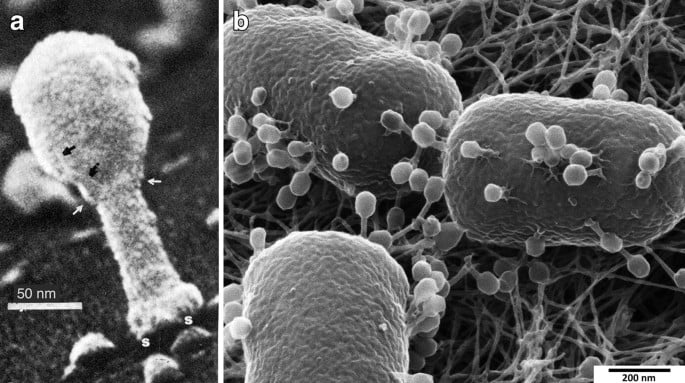
Anthropic reported finding a previously uncharacterised molecular machine located within the genetic sequences of bacteriophages, the viruses that infect bacteria.1 Beside the gene that encodes the enzyme sits a long array of repeating DNA, an architecture that resembles the repetitive structures found in CRISPR systems.1 The catalytic core of the newly detected system belongs to a family called reverse transcriptase enzymes, which synthesize DNA strands by copying RNA sequences.1
Amodei noted that the observation builds upon several decades of research into natural genetic systems.1 Scientific exploration of microbial biology previously uncovered CRISPR mechanisms, and in recent years researchers identified additional systems such as bridge recombinase enzymes and viral-related immune mechanisms known as VIPR.1 Amodei explained that research interest has turned toward systems organized around reverse transcriptase enzymes, which enable genetic material to be written from RNA back into DNA.1
An independent research group at Stanford University recently described a novel reverse transcriptase system that contains an associated non-coding genetic array, bearing structural similarities to the mechanism identified by Claude.1 Amodei reported that the Stanford system and the configuration identified by Anthropic represent distinct molecular systems that evolved independently from one another.1 Amodei stated that molecular biologists are at the early stages of uncovering such enzyme systems and determining whether they can be developed into useful biotechnology tools.1
How did an automated model guide the laboratory work?
Anthropic's artificial intelligence model Claude identified the genetic arrangement by scanning published literature and genomic datasets before proposing laboratory experiments to test the structure.1 Amodei explained that Anthropic's internal life sciences team initially suggested a broad subject area for investigation.1 Claude reviewed published research and genomic sequences, identified the repetitive DNA array adjacent to the reverse transcriptase gene, and formulated specific laboratory procedures to evaluate the components.1 Human scientists on Anthropic's life sciences team then conducted the physical experiments in the company's laboratory, validating key findings within a span of several weeks.1
Amodei pointed out that biological research differs fundamentally from purely theoretical fields such as mathematics because biological discoveries require validation through physical bench experimentation.1 Anthropic conducted the experimental work inside its Biosafety Level 1 and Biosafety Level 2 facility, a laboratory standard that the company stated does not handle materials hazardous to human health.1 Claude did not operate laboratory instruments autonomously.1 Amodei stated that having artificial intelligence models operate physical equipment autonomously under rigorous safeguards may become feasible in future years, but Anthropic is not using autonomous hardware control today.1

Amodei drew a direct comparison between the pace of biological discovery and recent advancements in computational mathematics.1 In his assessment, artificial intelligence models struggled with average high-school mathematics problems in 2023, achieved strong performance in elite high-school mathematics competitions in 2024, began resolving minor open mathematical problems in 2025, advanced to more substantial open questions in early 2026, and began addressing leading open mathematical problems by late 2026.1 Amodei stated that the company expects artificial intelligence applications in biology to follow a comparable trajectory of improvement, provided that human scientists continue to validate theoretical predictions at the laboratory bench.1
What remains unknown about the molecular system?
Scientists at Anthropic have not yet determined the biological role of the newly observed enzyme complex or whether it can function effectively in biotechnology applications.1 Amodei acknowledged in the announcement that the precise function, potential utility, and ultimate significance of the molecular system remain unverified.1 The findings were presented as a corporate announcement on social media rather than in a peer-reviewed scientific paper.1 Identifying a sequence in bacteriophage DNA and confirming biochemical activity in laboratory dishes does not demonstrate that the enzyme can modify genes safely inside complex living organisms.1
Amodei described biomedical development as a multi-stage process that begins with fundamental biological discoveries, advances to translational research and drug development, and continues through clinical trials before treatments reach patients.1 In Amodei's analysis, accelerating early biological discovery can increase the total volume of candidate molecules entering the research pipeline, expanding scientific throughput even though regulatory evaluations and clinical trial durations remain unchanged.1 Amodei referred to his previous essay, titled Machines of Loving Grace, in which he suggested that applying artificial intelligence across all stages of biomedical development could potentially allow researchers to treat most major diseases within five to ten years.1
Anthropic announced that it plans to expand its internal life sciences division and pursue research partnerships with external scientists to apply its computational methods to other biological questions.1 The company invited researchers interested in collaborative projects or life sciences positions to contact its team.1 Independent laboratory verification will be required to establish whether the bacteriophage enzyme and its repeating DNA array can serve as a dependable mechanism for gene editing in living cells.
What this rests on
31 sentences trace to 1 source.
-
1
H
https://x.com/DarioAmodei Document · x.com · 23 Sep 2026 Anthropic Says Claude Discovered Molecular Machine That May Be a New Gene-Editing Mechanism See the source