A giant plant eating theropod with an extreme underbite walked Cretaceous China
A newly described fossil reveals how a heavily built therizinosaur swapped fleet footed agility for dense dental machinery and specialized plant shearing.
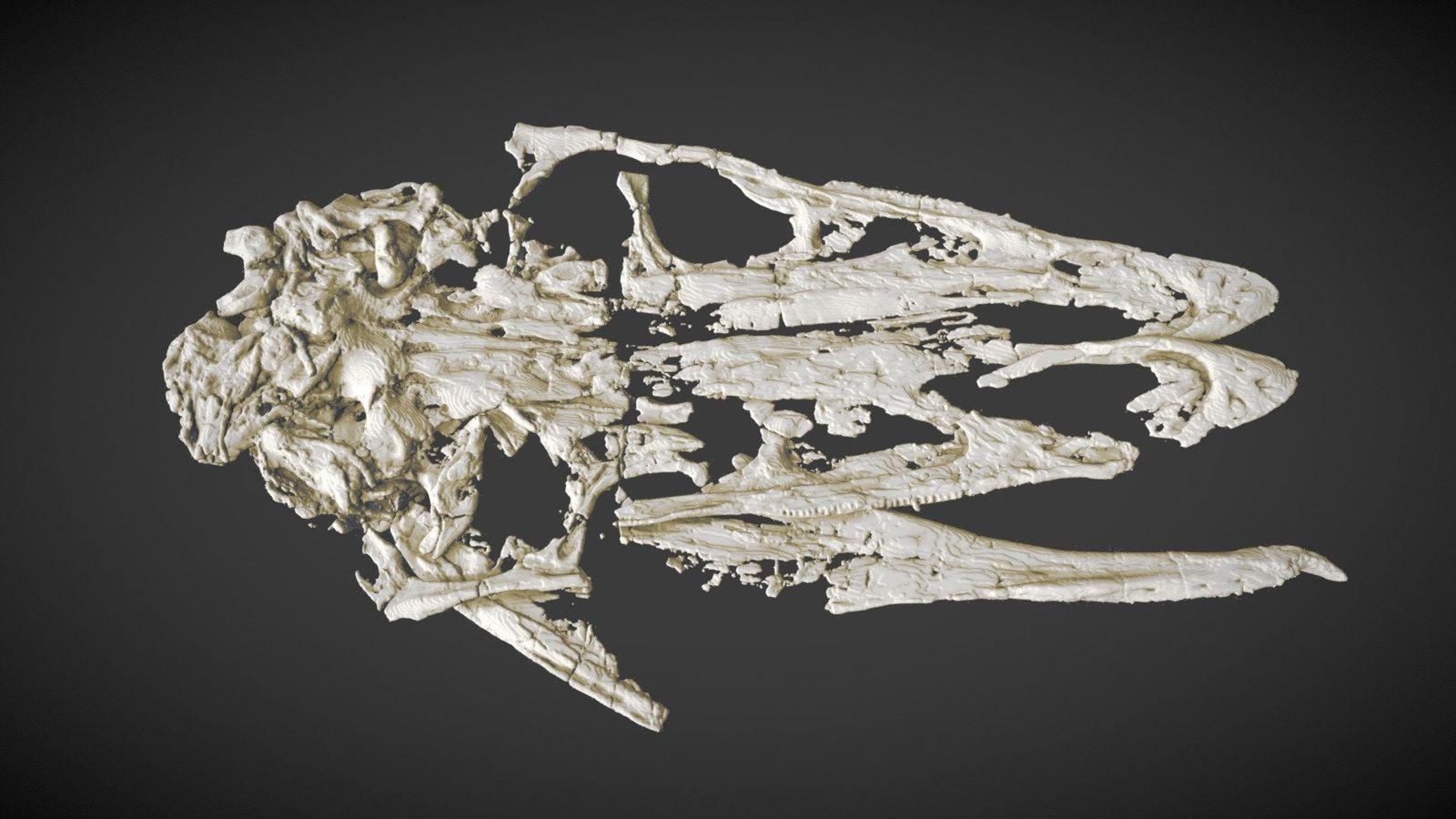
Predatory lineages rarely trade sharp meat-shearing teeth for the grinding mechanics of a dedicated vegetarian diet. In the fossil record of theropods, the group that produced meat eaters such as Tyrannosaurus rex, carnivorous bodies dominated almost every branch.1 Yet one peculiar family defied this predatory design by walking upright on two legs, sprouting coats of filamentous feathers, and developing massive hand claws alongside large, fermentation-friendly pot bellies.12 Therizinosaurs evolved an array of strange physical compromises as they transitioned from meat eating ancestors to browsing on leaves and woody Cretaceous vegetation.
A newly analyzed fossil found in northeastern China reveals how far that anatomical shift could go. Writing in the Journal of Systematic Palaeontology, Chun-Chi Liao, William J. Freimuth, Lindsay E. Zanno, and Xing Xu identified a new species of therizinosaur named Kayrasaurus changliensis.1 The creature carried an unusually dense battery of teeth set into a severe underbite, paired with a heavy frame that parted company with the lighter, running forms typical of early therizinosaur branches.
To understand why this creature looks so unusual, a reader must look at how plant-eating theropods processed tough prehistoric leaves. In plant eaters, digestion begins either by chewing fibrous material into digestible pulp or by swallowing vegetation whole to be fermented in a massive gut. For a two-legged animal with relatively short arms, harvesting tough foliage meant relying on long neck reach, specialized jaws capable of holding dozens of grinding teeth, and sharp claws to pull branches within range. As theropods adapted to this browsing lifestyle, selection favored larger abdominal cavities for digestion and sturdier jaws that could withstand repeated shearing pressure against tough vegetation.
How did Kayrasaurus changliensis differ from other therizinosaurs?
Kayrasaurus changliensis possessed an unprecedented number of tightly packed teeth arranged into a pronounced lower underbite. The paper reports that the lower jaw carried 45 teeth, whereas the upper jaw held only 32 teeth.1 Liao and colleagues recorded that no other large therizinosaur species possessed more than 40 teeth on either jaw.1 In addition to this dense dental battery, the researchers observed a distinct triangular side opening in the lower jaw and an expansive cranial opening situated near the snout in the upper jaw, though the exact biological function of these openings remains uncertain.1
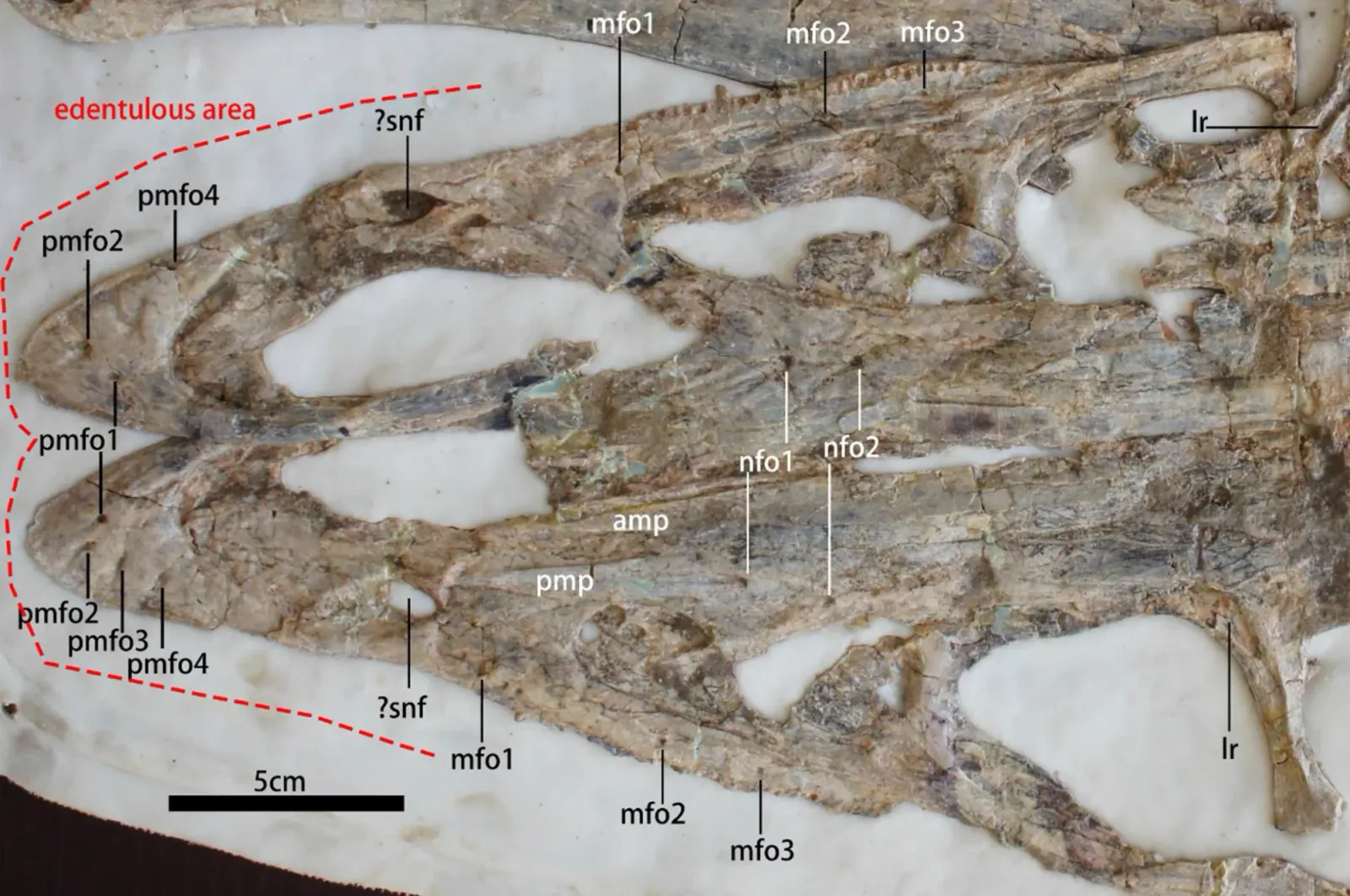
These dental and cranial features reflect a creature committed to intense mechanical processing of plant matter. According to the paper, the jaw and teeth of Kayrasaurus changliensis are "more reminiscent of herbivorous dinosaur clades" than the flesh-shearing tools of its distant meat-eating relatives.1 While smaller and earlier therizinosaurs possessed light skeletons suited for rapid cursorial locomotion, Kayrasaurus changliensis developed a stocky, bite-focused architecture that traded running speed for stationary feeding power.1
How large did this feathered herbivore grow?
Kayrasaurus changliensis grew to nearly 12 feet long, making it substantially larger than any other therizinosaur previously discovered in China.1 The authors calculated that the animal likely weighed between 250 and over 600 pounds, matching the mass range of an adult male grizzly bear.1 That body mass made the animal approximately 1.6 times larger in linear dimensions than the previous regional record holder, Beipiaosaurus inexpectus, whose skeletal anatomy from the same regional rock unit was described in detail by Liao, Zanno, Shiying Wang, and Xu in a 2021 study in PLOS One.12
The sheer scale of the discovery is heightened by the animal's developmental age. The authors determined that the nearly complete specimen recovered from the Lower Cretaceous Yixian Formation was a young, still-growing individual at the time of its death.1 Because the discovered bones belong to a juvenile that had not yet reached skeletal maturity, adult members of the species would have achieved even greater physical dimensions and total mass.1
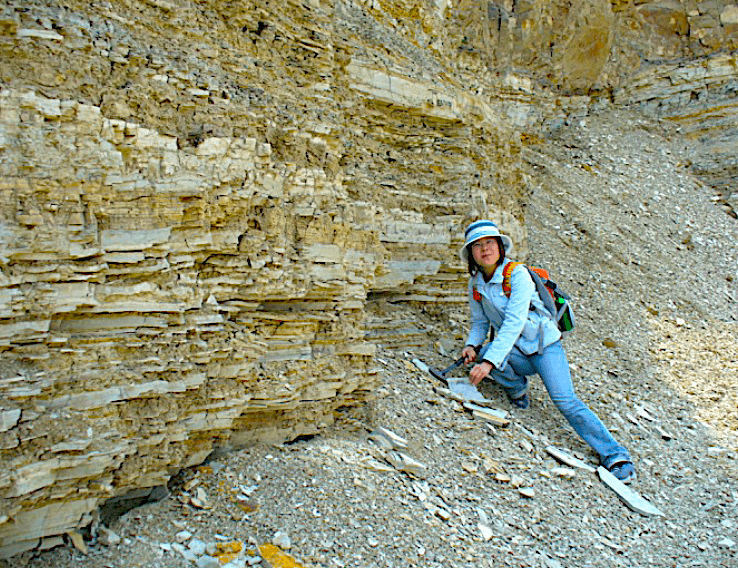
The discovery location also places the animal within one of paleontology's most productive fossil deposits. Paleontologists excavated the skeleton from the Lower Cretaceous Yixian Formation in northeastern China, an area positioned between Beijing and the border of North Korea renowned for producing exceptional preservation of early birds, feathered dinosaurs, and soft tissues.1 The rock beds capture an ancient temperate ecosystem where multiple feathered theropod lineages diversified side by side.
What can the fossilized skeleton tell scientists about therizinosaur evolution?
The postcranial remains demonstrate that massive size and herbivorous jaw specializations arose earlier in therizinosaur lineages than previously recognized. In their 2021 analysis of Beipiaosaurus inexpectus in PLOS One, Liao, Zanno, Wang, and Xu documented that earlier-branching therizinosaurs generally retained smaller body sizes and lacked many of the extreme hip, foot, and skull specializations seen in the clade's final Cretaceous representatives.2 By demonstrating that Kayrasaurus changliensis expanded in body mass while developing an extreme tooth count, the new material establishes that dietary divergence and gigantism were already underway within the Yixian fauna.
Therizinosaurs as a whole endured from roughly 100 million years ago until the end of the Cretaceous period around 65 million years ago, when the global asteroid impact eliminated all non-avian dinosaurs.1 Over their evolutionary history, late-branching members of the group developed enormous manual unguals, reaching over three feet long on their hand digits, while retaining pot-bellied profiles and coats of filamentous feathers.1 Kayrasaurus changliensis establishes that substantial body enlargement occurred in lockstep with specialized feeding mechanics rather than emerging only at the very end of the family tree.
What are the limits of the current evidence?
The conclusions drawn about the species rely on a single incomplete individual, which limits direct observation of population-wide physical variation. The skeleton represents an immature animal whose final adult proportions, fully fused bone sutures, and maximum body size can only be estimated through proportional modeling against related species. Furthermore, soft tissues such as gut contents were not preserved inside this individual, meaning paleobiologists must infer its exact botanical diet entirely from jaw geometry, tooth wear patterns, and comparative cranial anatomy rather than direct dietary evidence.
Future fieldwork across the Yixian Formation will seek fully mature adult specimens to clarify how the animal's underbite and unique cranial openings developed through ontogeny. Finding additional postcranial elements will also help researchers reconstruct its locomotion and establish exactly how its limb proportions compared with both slender runners and later, broad-footed giants.
The record
17 sentences trace to 2 sources.
-
1
SD
Sarah Durn Document · popsci.com · 27 Sep 2026 Giant, feathered dinosaur with massive claws and tons of teeth found in China See the source
-
2
J
journals.plos.org Third-party reporting · journals.plos.org Postcranial osteology of Beipiaosaurus inexpectus (Theropoda: Therizinosauria) See the source