Elon Musk projects off-world industrial output will outpace annual doubling
A response to David Holz maps industrial expansion across the solar system toward Kardashev energy benchmarks before the century ends.
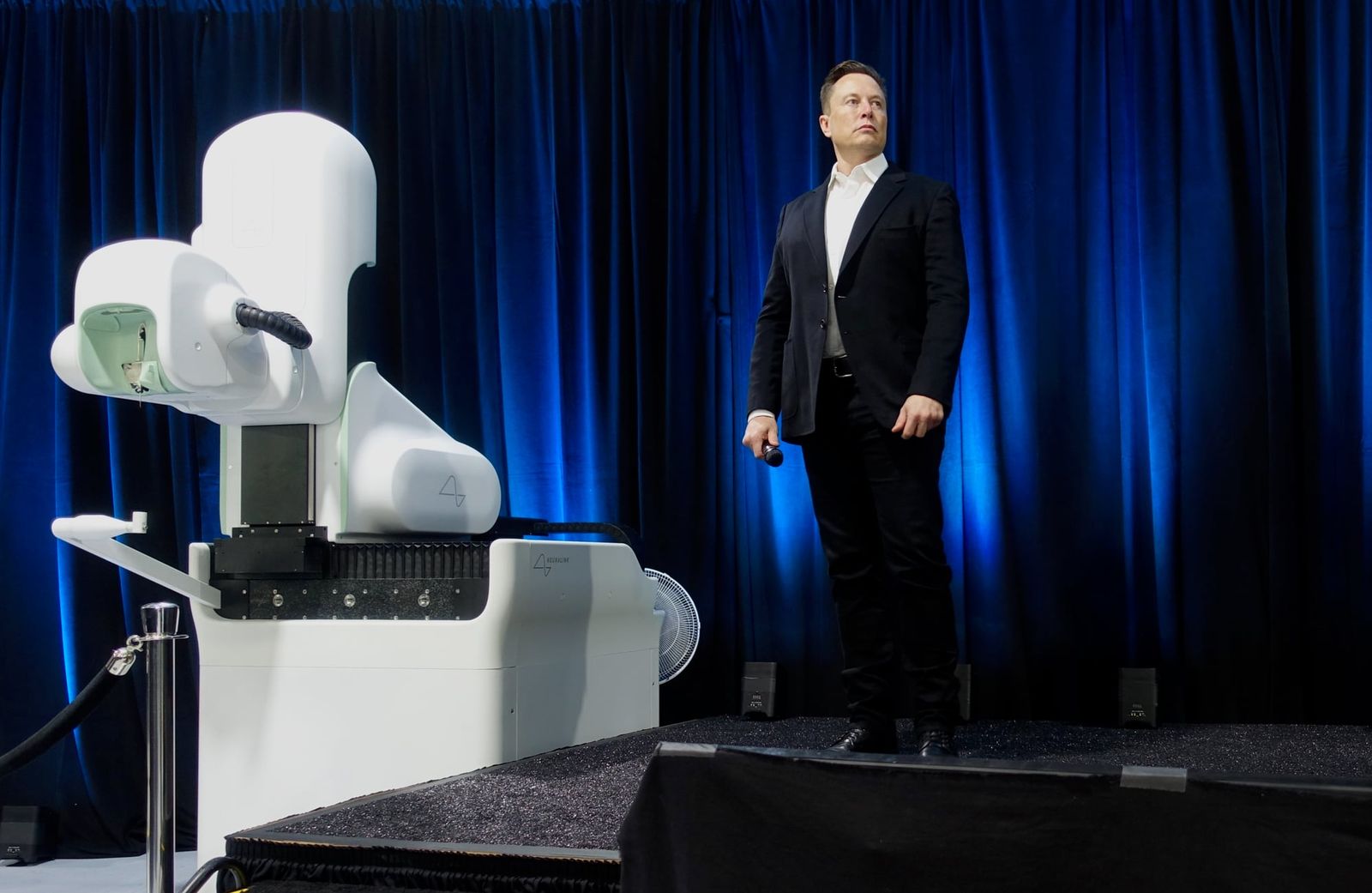
Industrial expansion across the solar system will accelerate faster than an annual doubling until it hits physical boundaries, according to Elon Musk.12 The projection, delivered on September 26, 2026, responded to a quantitative scenario outlining how rapid manufacturing growth in space could alter human civilizational capacity before the century ends.13
Musk addressed the timeline directly after technology founder David Holz published a compounding framework for extraterrestrial manufacturing.12 In that scenario, Holz calculated that doubling industrial production in outer space every 12 months from an initial seed in 2030 would place human civilization at Kardashev Type I status by 2064 and Kardashev Type II status by 2098.13 Extending the doubling period to 24 months pushed those respective milestones to 2096 and 2165.12
Musk argued that off-world scaling would initially exceed even that pace.13 "Production on the Moon & Mars will accelerate by far more than double every year, until natural limits are encountered," Musk said in response to the projection.12
The compounding timeline
The Kardashev scale, formulated by astrophysicist Nikolai Kardashev in 1964, classifies civilizations by their energy consumption. A Type I civilization harnesses the entire energetic output available on its home planet, roughly estimated near 10 to the 16th watts, while a Type II civilization captures the full energetic output of its host star, near 10 to the 26th watts. Moving between those thresholds requires sustained orders-of-magnitude gains in energy collection, fabrication, and thermal dissipation.
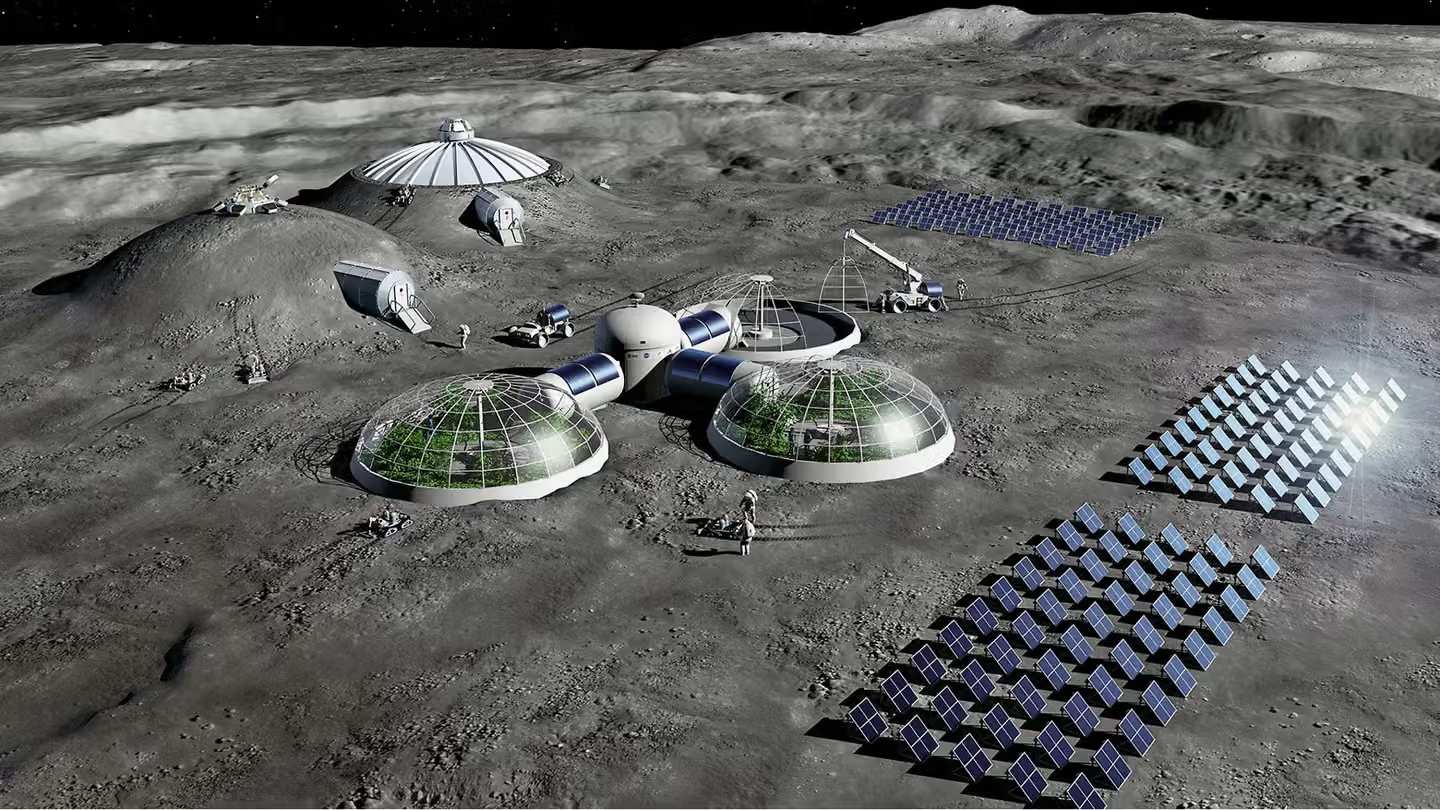
Under the mathematical model Holz proposed, sustained exponential growth transforms a modest initial payload into planetary-scale industry in several decades. An annual doubling represents an annual growth rate of 100 percent, multiplying base productive capacity by more than a thousandfold every decade. At that velocity, thirty-four doublings across thirty-four years expand an initial productive base by a factor of roughly 17 billion. Lengthening the cycle to a two-year doubling requires sixty-six years to achieve the same factor.
Musk asserted that early industrial growth on lunar and Martian surfaces will begin at an even steeper rate than 100 percent annually.14 In manufacturing systems starting from small absolute baselines, initial percentage growth often appears astronomical as secondary tools replicate primary machinery. However, sustaining hyper-exponential scaling across decades requires continuous access to raw feedstock, autonomous refinement facilities, and closed-loop manufacturing chains capable of reproducing their own components without supply interruptions from Earth.
Robotics and transport mechanics
The operational premise behind off-world fabrication relies on automated extraction and self-replicating capital. In discussions surrounding the manufacturing trajectory, Holz separately pointed to autonomous machinery operating across resource-rich orbital bodies, observing that industrial development will depend on robots mining asteroids.3 Musk endorsed that operational assessment with agreement.3
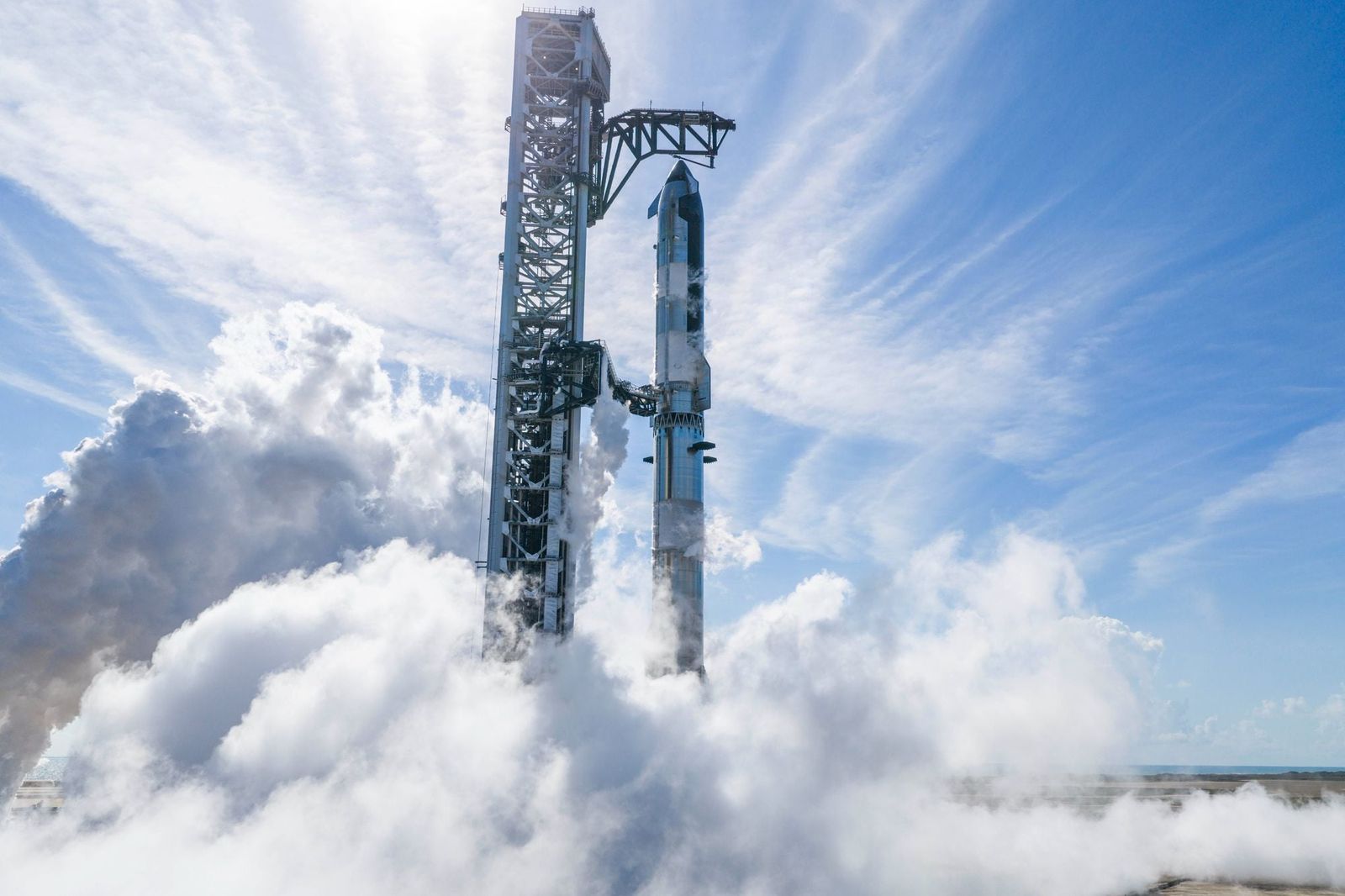
Terrestrial launch architecture serves as the initial bottleneck for establishing any industrial base on the Moon or Mars. SpaceX has prepared for operational expansion using its Starship heavy-lift launch system. Ahead of Starship flight 14, the vehicle received regulatory approval from the Federal Aviation Administration for its first revenue-generating flight, configured to deploy 26 V3 Starlink satellites into orbit.3 Initial operational cost estimates for the vehicle stood at approximately $9.8 million per terabit per second of satellite capacity, matching existing Falcon 9 performance before projected manufacturing learning rates and full reusability take effect.3
Transporting initial seed factories to the lunar south pole or Martian landing sites requires substantial heavy-lift capacity. Once landing occurs, local manufacturing must substitute for Earth imports to sustain the acceleration Musk described. On the Moon, regolith processing must yield metals and solar silicon, while Martian facilities must exploit atmospheric carbon dioxide and subsurface water ice to produce methane propellant, structural polymers, and shielding.
Reaching physical boundaries
Musk noted that the acceleration will continue until natural limits are encountered.12 In planetary and orbital industrialization, those boundaries are dictated by thermodynamics, material abundance, and communications latency rather than capital availability.
Thermal dissipation represents one of the steepest immediate constraints. While Earth sheds industrial heat through convective atmospheric cooling and oceanic heat sinks, vacuum and low-density environments depend almost entirely on radiative cooling. As productive capacity doubles repeatedly, radiating waste heat from massive computational arrays, foundries, and refining centers requires exponentially larger surface radiator arrays to prevent critical system overheating.
Supply chain synchronization presents an equally rigid physical barrier. Transport windows between Earth and Mars open only once every 26 months because of orbital mechanics, imposing fixed delays on specialized hardware upgrades that cannot yet be fabricated in situ. Even between the Moon and Mars, physical transit times and energy expenditure set upper bounds on how rapidly capital goods can circulate to support newly deployed production sites.
Whether early lunar and Martian outposts can achieve an annual doubling rate depends on the speed of closed-loop automation. If autonomous equipment can mine, refine, and fabricate duplicate equipment faster than terrestrial systems historically scaled, industrial growth will surge rapidly before leveling off against orbital heat and logistics limits.
What this rests on
13 sentences trace to 4 sources.
-
1
H
https://x.com/elonmusk Document · x.com · 26 Sep 2026 Elon Musk Predicts Rapidly Accelerating Production on the Moon and Mars See the source
-
2
X
-
3
E
elonmuskarchive.org Third-party reporting · elonmuskarchive.org Elon Musk Archive — The Reference Archive of Elon Musk See the source
-
4
A
ababnews.com Third-party reporting · ababnews.com Elon Musk: Production on the Moon and Mars will accelerate at a rate far exceeding doubling every year until natural limits are reached See the source