Cosmetic procedures can trigger compulsive addiction cycles in vulnerable women
Repeated aesthetic treatments may develop into behavioural dependencies when severe body dissatisfaction converges with heavy social media consumption, according to new psychological survey data.
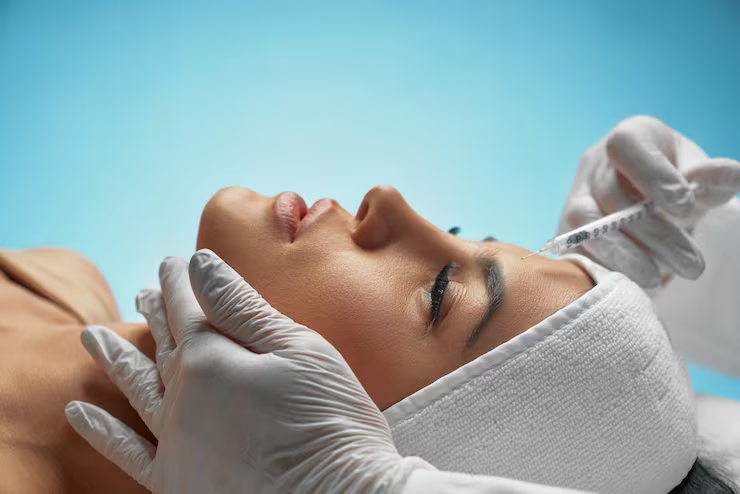
Aesthetic interventions once reserved for reconstructive surgery or rare personal milestones have grown into regular consumer habits across much of the globe. Injectable neurotoxins, dermal fillers, and surgical alterations are widely promoted as standard hygiene and personal grooming routines. For most patients, an appointment at an aesthetic clinic delivers an intended physical adjustment and a boost in subjective wellbeing. Yet for a noticeable share of people, modifying appearance does not conclude with a single desired outcome, shifting instead into an unyielding search for physical adjustments.
Understanding where personal grooming ends and compulsive behaviour begins has grown urgent as aesthetic interventions expand across demographics. Global surgical and non-surgical procedures increased by roughly 40 percent between 2019 and 2023, according to international clinical estimates cited in new research.1 When medical procedures become ubiquitous consumer products, the psychological motivations driving them warrant careful clinical scrutiny. If aesthetic interventions function as an emotional coping mechanism for distress, undergoing further treatments will fail to alleviate the underlying psychological suffering.
The sequence leading to compulsive treatment seeking follows a predictable behavioural progression. An individual experiences distress about a particular facial feature or physical contour, viewing it as a flaw that diminishes their self-worth. Encounters with digital platforms showcase heavily filtered, idealized portraits that intensify that dissatisfaction. The individual books an aesthetic intervention to correct the perceived imperfection, experiencing immediate psychological relief and validation once the procedure is complete. That relief, however, proves temporary because the intervention altered physical tissue without resolving the internal standard driving the distress. Within weeks or months, the perceived inadequacy attaches to another feature, prompting the individual to schedule another treatment to regain that short-lived sense of control.
A newly published investigation led by Vera Skvirsky, a psychologist at the Hebrew University of Jerusalem, examines how this cycle can transform into a measurable behavioural dependency.1 Working alongside Uri Lifshin, Dvora Shmulewitz, and Mario Mikulincer from the Hebrew University Department of Psychology and the Israel Center for Addiction and Mental Health, Skvirsky evaluated patterns of what the authors define as addictive cosmetic procedures use.1 Their findings, published in the Journal of Health Psychology on May 15, 2026, document that repeated treatments can mirror the psychological markers seen in recognized substance dependencies.1
What makes cosmetic treatments cross into addictive patterns?
Repeated aesthetic interventions develop characteristics of a behavioural dependency when an individual loses the capacity to control their treatment schedule and persists with treatments despite harmful consequences. To measure this pattern systematically, the authors adapted diagnostic assessment questions derived from the Diagnostic and Statistical Manual of Mental Disorders criteria for substance-related conditions.1 The research team asked participants whether they had attempted unsuccessfully to discontinue cosmetic procedures, whether they experienced intense cravings for further treatments, and whether they continued altering their appearance despite experiencing financial strain, emotional anguish, or physical complications.1
The research departed from earlier scholarship by sampling from the broader community rather than examining patients recruited inside aesthetic clinics. Previous clinic-based investigations tended to focus on body dysmorphic disorder, an established psychiatric condition where a patient obsesses over imagined or minor physical defects.1 By evaluating a broader community cohort, the Hebrew University team sought to capture how compulsive habits manifest across the general population.1
The survey analysed responses from 1,614 Jewish Israeli women between the ages of 25 and 71.1 Across the entire cohort of 1,614 participants, nearly 9 percent displayed moderate to severe signs of problematic cosmetic procedure use.1 The prevalence rose markedly when the authors examined only those women who had previously received aesthetic treatments. Within that subgroup, 20 percent met the threshold for moderate to severe lifetime risk of addictive cosmetic procedure use.1 Furthermore, more than 15 percent of the women who had undergone procedures reported active symptoms of this compulsive pattern within the preceding twelve months.1
Which psychological traits elevate the risk of compulsive use?
The convergence of low body esteem and problematic digital habits creates the most pronounced vulnerability for developing compulsive treatment patterns. In the analysis by Skvirsky and her colleagues, women who reported low regard for their physical appearance were significantly more likely to meet the diagnostic criteria for addictive cosmetic procedure use.1 That association grew especially acute among participants who concurrently displayed high levels of problematic social media use, characterized by compulsive scrolling, intrusive preoccupations with online feeds, and difficulty moderating time spent on digital platforms.1
The authors reported that continuous exposure to curated aesthetic imagery appears to interact directly with internal self-doubt. When an individual who already harbours severe dissatisfaction with their body spends hours consuming optimized digital profiles, the standard for acceptable physical appearance continually escalates. A cosmetic intervention provides momentary reassurance, but ongoing digital engagement quickly undermines that confidence, driving renewed cravings for clinical adjustments.
The researchers also identified weaker, less consistent correlations between addictive procedure habits and several other psychological markers.1 Participants reporting lower feminist attitudes, lower attachment security in personal relationships, and more negative attitudes toward aging showed higher tendencies toward addictive treatment use.1 These secondary correlations diminished in consistency once the investigators adjusted the statistical model to evaluate all psychological factors simultaneously.1

Skvirsky and her co-authors emphasized that their data should not be interpreted as an indictment of cosmetic medicine as a whole.1 “Cosmetic procedures have become deeply normalized in many societies, and for many people they may be a positive experience,” the researchers stated in the paper.1 “But our findings suggest that for a meaningful minority, the behavior may begin to resemble other compulsive patterns we see in addiction research, especially when low body esteem and problematic social media use are involved.”1
What can these survey findings tell clinicians and patients?
The survey establishes that compulsive cosmetic behaviour affects a meaningful proportion of patients, but its cross-sectional structure prevents researchers from determining clear cause and effect.1 Because all measurements were recorded at a single moment in time, the data cannot establish whether problematic social media consumption directly induces compulsive procedure seeking, or whether people with deep self-image insecurities naturally gravitate toward excessive screen time and repeated clinical enhancements.1 Unmeasured psychological distress could independently stimulate both digital consumption and aesthetic spending.
The sample composition also establishes clear boundaries for the conclusions. The study gathered self-reported survey answers from 1,614 Jewish Israeli women, reflecting specific regional, cultural, and aesthetic norms.1 The assessment relied on self-reported perceptions of distress and craving rather than formal clinical diagnoses conducted in person by psychiatric evaluators. Self-reporting can introduce recall errors or social desirability distortions when participants describe personal expenditures, emotional struggles, and private habits.
These diagnostic patterns carry direct implications for aesthetic practitioners, mental health specialists, and patients considering aesthetic alterations. Surgeons and dermatologists frequently evaluate whether a prospective patient holds realistic anatomical expectations, yet routine clinical consultations rarely assess digital consumption patterns or compulsive psychological cycles. Introducing screening protocols that evaluate a patient's emotional relationship with their appearance and their history of procedure seeking could help clinicians identify individuals whose needs require psychological support rather than surgical intervention.
Future investigations will need to track cohorts over multiple years to observe how compulsive cosmetic behaviours evolve over time. Longitudinal trials will help determine whether restricting digital media exposure reduces procedure cravings, and whether psychological treatments targeting low self-esteem can break the cycle of repeated clinical interventions before physical or financial harms accumulate.
What this rests on
23 sentences trace to 1 source.
-
1
S
scientificinquirer Document · scientificinquirer.com · 28 Sep 2026 Can cosmetic procedures become addictive? New study links addiction risk to social media and body image See the source