Violent gas winds ignite radio and infrared glow in dusty quasars
Galactic outflows colliding with interstellar gas explain why obscured supermassive black holes shine brightly at radio and infrared wavelengths, altering how astronomers view early galaxy evolution.
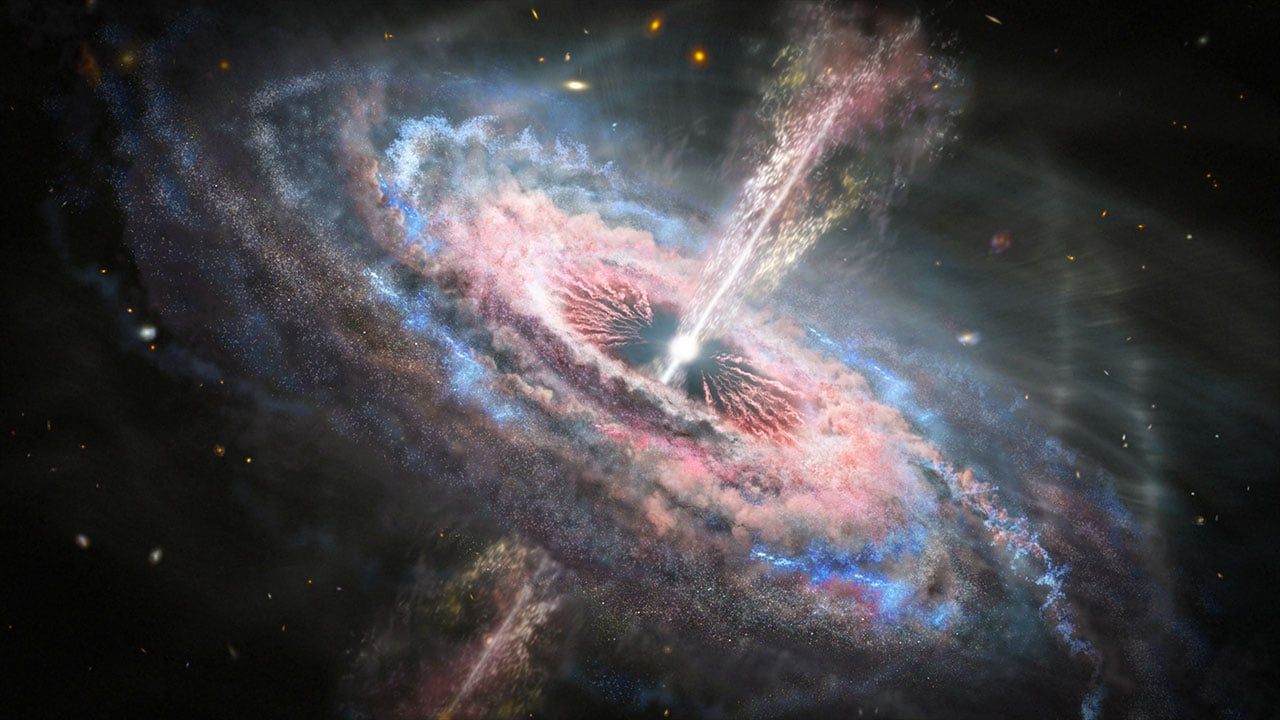
At the cores of massive galaxies across the universe, supermassive black holes pull in vast torrents of surrounding gas.1 These active galactic nuclei, the most luminous of which are known as quasars, radiate immense power as gravitational energy transforms into brilliant light.1 For decades, astronomers cataloguing these cosmic beacons noticed that certain quasars appear deeply reddened by obscuring screens of interstellar dust.1 Intriguingly, these dust-reddened quasars also tend to shine far more brightly in radio waves than typical, unreddened blue quasars.12
Astronomers have long suspected that this link between dust and radio emission captures a fleeting, violent stage of galactic evolution.1 Supermassive black holes, with masses spanning one million to ten billion times the mass of the Sun, appear intimately linked to their host galaxies through tight scaling relations.1 Theoretical models require active galactic nuclei to inject momentum and energy into their environments to curb runaway star formation in massive galaxy halos. According to these models, an obscured quasar clears out surrounding gas and dust through powerful outflows during a short-lived blow-out phase, eventually revealing an unobscured blue quasar before exhausting its fuel supply.1
A study accepted by the journal Astronomy and Astrophysics and posted to the arXiv preprint server demonstrates that high-velocity ionised gas outflows drive this connection between radio emission and dust obscuration, showing that dust extinction alone is not what powers the phenomenon. Victoria, an astronomer at the European Southern Observatory and previously at Newcastle University, led an analysis of spectra from the Dark Energy Spectroscopic Instrument.contributed Combining optical spectroscopy of thousands of quasars with radio data from the LOw-Frequency ARray, known as LOFAR, the authors found that energetic outflows are likely to shock surrounding interstellar dust and gas, simultaneously enhancing radio signals and infrared emission.1
To understand how these cosmic components interact, one must trace the physical chain governing the quasar environment. Gas accreting onto a central black hole releases gravitational energy that propels rapid winds of ionised plasma outward into the host galaxy.1 These fast winds slam directly into ambient gas and dust clouds that populate the interstellar medium.1 The resulting supersonic shocks compress and heat the dust grains, causing them to re-emit energy at mid-infrared wavelengths, while accelerating relativistic electrons that spiral through magnetic fields to emit radio waves.1 The enhanced radio and infrared emission therefore stems from dynamic, wind-driven shocks sweeping through the galaxy, superseding older assumptions about passive dust obscuration.1
Victoria told Primary that researchers prefer the term "outflow-driven shock", noting that "an outflow can arise from a wind or a jet that disperses gas and dust which then sweep up the surrounding material and propagate outwards."contributed Victoria explained that this outflow interacts directly with ambient gas: "This outflow will interact with the surrounding medium and shock it, heating up the dust. When dust is heated up it glows in the MIR. The shock will also accelerate electrons as you say which produce radio emission."contributed Victoria added that simulations predict this radio signal displays a steep spectral slope, matching what the observational data revealed.1
Why do dusty quasars shine so brightly in radio waves?
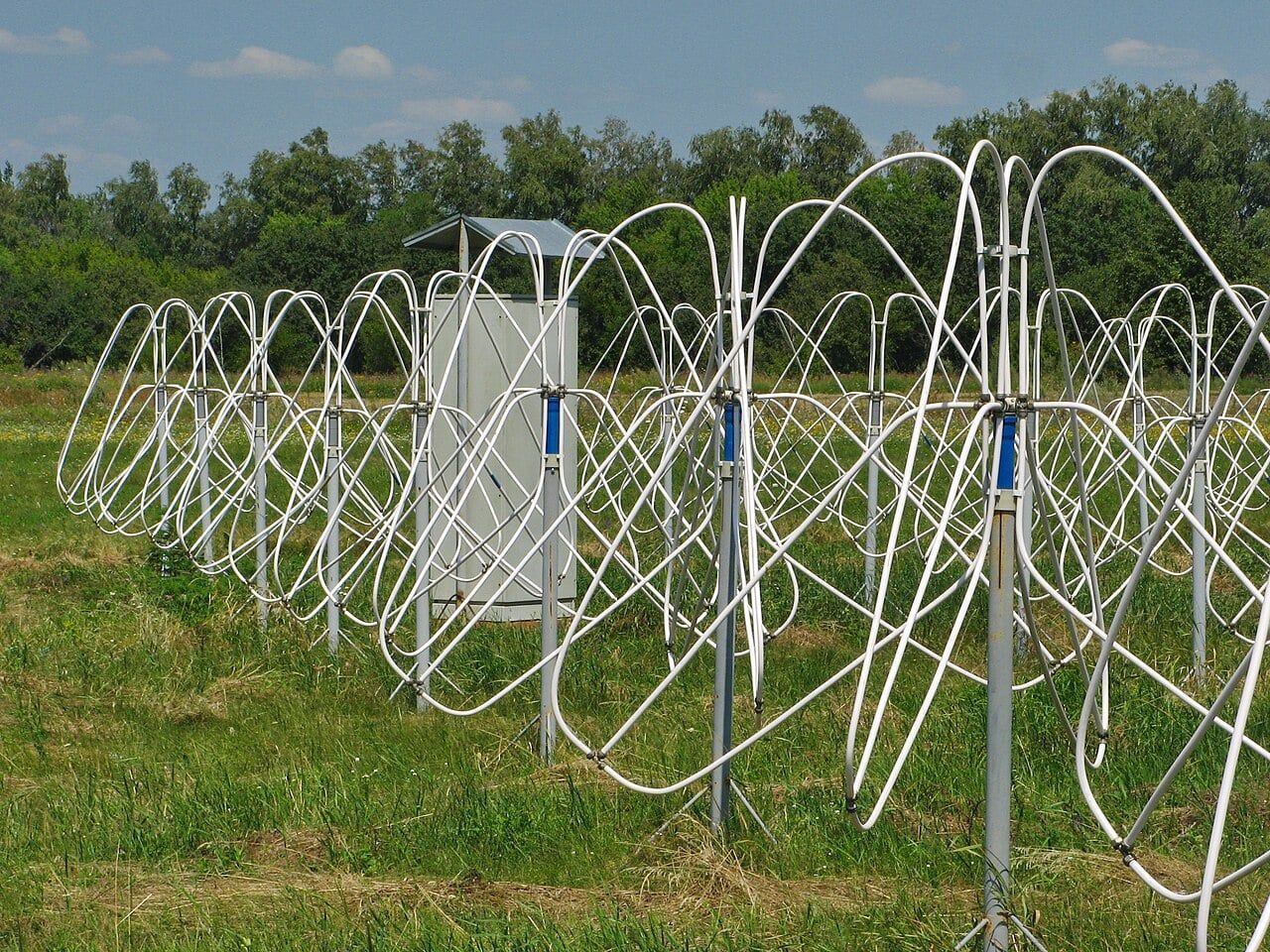
High-velocity ionised gas outflows generate shocks that heat surrounding dust and produce synchrotron radio emission.1 Fawcett and colleagues established that the statistical link between radio emission and dust obscuration across their sample is driven by quasars hosting high-velocity outflows of ionised gas.1 When an outflow strikes the interstellar medium, shocks accelerate charged particles that generate radio emission across radio frequencies. Victoria pointed out in response to questions from Primary that radio emission is produced across all radio frequencies rather than just low frequencies, but it appears particularly bright at 144 megahertz because flux rises toward lower frequencies along a steep spectral slope, making it easier for radio telescopes to detect.contributed The study noted that previous observations found radio emission in dust-reddened quasars to be enhanced on compact physical scales of less than 10 kiloparsecs, exhibiting steep spectral indices where radio flux declines sharply with increasing frequency.12 Those features align with theoretical models of shocks driven by winds or low-power jets.12
Line-of-sight dust extinction alone does not determine whether a quasar launches a high-velocity outflow.1 The researchers measured dust extinction along the line of sight, represented as E(B-V), for each quasar by comparing its spectrum to a dust-reddened composite template.1 The authors detected no statistically significant trend between line-of-sight dust extinction and outflow velocity.1 This result indicates that the quantity of obscuring dust lying between the quasar and Earth is not the primary factor dictating outflow power.1 A quasar can display substantial line-of-sight dust reddening without launching fast outflows, or launch extreme winds while presenting only modest reddening along the line of sight to Earth.1
Victoria said she was initially surprised to find no direct correlation with dust extinction, because researchers expected more powerful winds if dusty quasars were caught in an active clearing phase.contributed A pronounced relationship emerged when the authors examined the optical-to-mid-infrared colors of the quasars.1 The team found a clear positive trend between the g minus W2 color and the velocity of the ionised outflows, a pattern that persisted after controlling for quasar luminosity.1 The g band measures optical light vulnerable to dust absorption, whereas the W2 band captures mid-infrared light near 4.6 microns.contributed The authors suggested this trend reflects an excess of mid-infrared emission that boosts the W2 band.1
Victoria explained to Primary that an object can exhibit a red optical-to-infrared color either by dimming optical light through dust extinction or by brightening infrared emission through hot dust.contributed Because the data showed no correlation between outflow velocity and dust extinction alone, Victoria concluded that a boosted mid-infrared band drives the trend.contributed That interpretation was reinforced by a positive correlation between outflow velocity and the ratio of luminosity at 6 microns to optical luminosity at 5100 angstroms, confirming that shock-heated dust radiates strongly in the mid-infrared.1
How did the researchers detect the hidden winds?
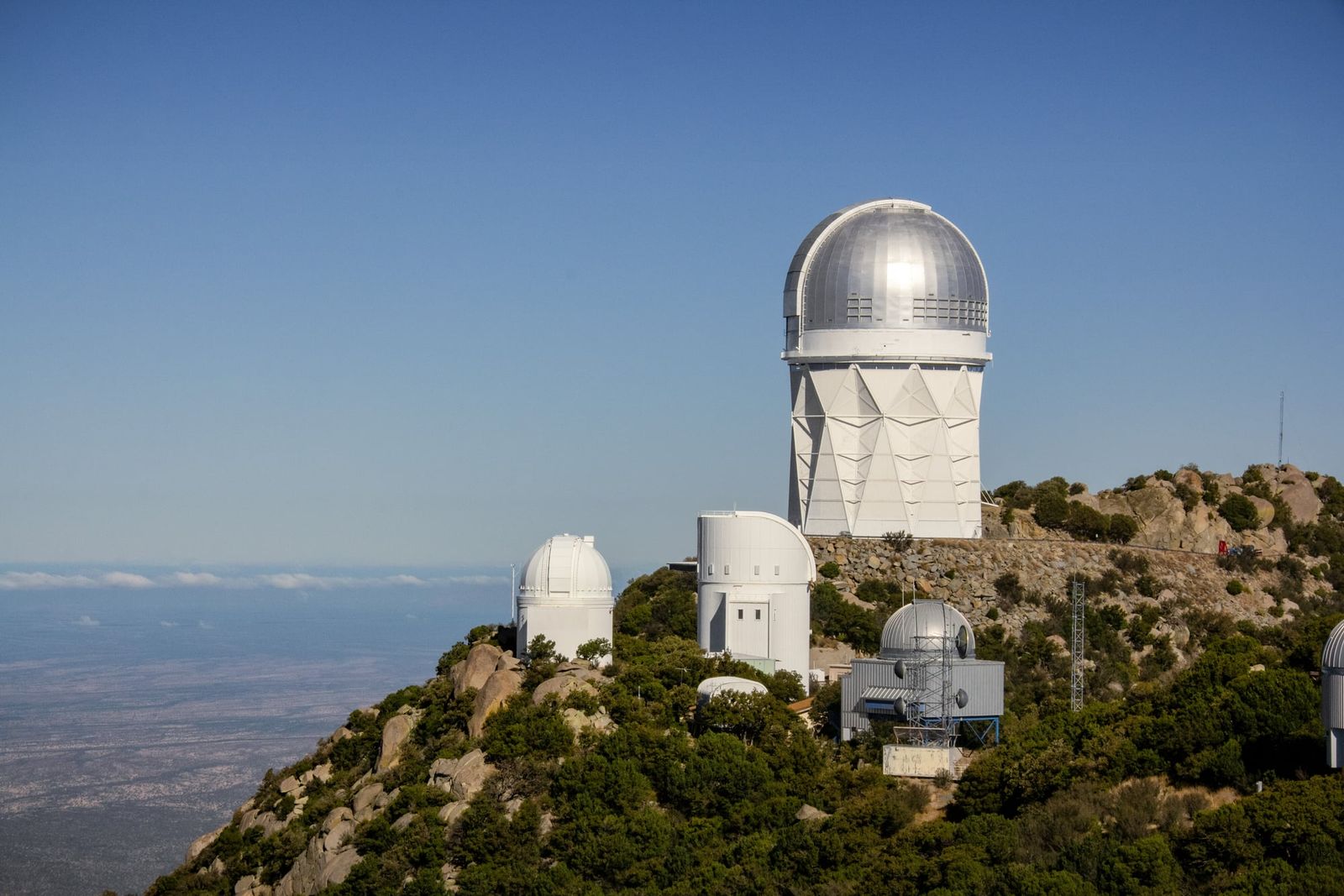
Researchers tracked the speeds of the energetic winds by analyzing Doppler shifts and asymmetries in the forbidden doubly ionised oxygen emission line.1 The investigation utilized optical spectra from the Dark Energy Spectroscopic Instrument, which operates on the Nicholas U. Mayall 4-metre Telescope at Kitt Peak National Observatory in Arizona. The team targeted the forbidden doubly ionised oxygen line, [O III] at a rest wavelength of 5007 angstroms, because it shines brightly and traces warm ionised gas at redshifts below 1.1 Gas moving toward the observer within an outflow shifts the emitted light toward bluer wavelengths and broadens the line profile, enabling the authors to quantify outflow velocities from the asymmetry, width, and velocity offset of the spectral feature.1
The researchers fit each spectrum with the PyQSOFit software to isolate the oxygen line from surrounding emission and continuum light.1 The authors trimmed the initial and final 100 pixels of the spectra to minimize noise, then rebinned the data using the SpectRes package to match the resolution of the Sloan Digital Sky Survey, which spans 110 to 190 kilometres per second.1 Victoria told Primary that the edges of a spectrum typically display severe noise spikes, and applying an automated signal-to-noise threshold instead of a uniform trim would have penalized dust-reddened quasars because their optical faintness makes them noisier.contributed Uniform trimming avoided introducing systematic observational biases into the census.contributed
The continuum model combined a power-law continuum referenced at 3000 angstroms, a third-order polynomial accounting for intrinsic dust extinction, and convolved iron emission templates covering ultraviolet and optical wavelengths with widths between 1,200 and 10,000 kilometres per second. The authors excluded a Balmer continuum component because their spectra lacked sufficient coverage blueward of 3646 angstroms to constrain that fit.1 Victoria said that including a Balmer continuum systematically degraded fit quality because of limited blue coverage at these redshifts, while noting that its omission should not alter oxygen kinematics given the large wavelength separation between 3646 and 5007 angstroms.contributed
The team matched these spectral fits with low-frequency radio measurements from the LOw-Frequency ARray Two-metre Sky Survey Data Release 2.1 That radio survey maps 5,740 square degrees of the northern sky at 144 megahertz with a spatial resolution of 6 arcseconds.1 From a broader parent sample of 34,293 quasars spanning redshifts from 0.5 to 2.5, the authors selected 3,854 objects situated between redshifts of 0.5 and 0.9, ensuring the oxygen line fell cleanly within the spectrograph's range. After removing sources with inadequate spectral fits, the final analyzed sample contained 3,418 quasars.1 Fawcett and colleagues found that 20% of these 3,418 quasars were detected at a 5-sigma significance threshold in the 144 megahertz radio data.1
What does the discovery leave unanswered?
The optical measurements trace only the warm, ionised component of the outflows, leaving the mass and energy of cooler molecular or hotter X-ray gas unmeasured.1 The study measured outflow kinematics exclusively through the [O III] line, which samples ionised gas at temperatures near 10,000 Kelvin. In addition, the radio survey detected only 20% of the quasar sample at the 5-sigma limit, requiring statistical averaging to evaluate fainter radio properties.1 The line-of-sight dust extinction measurement also evaluates obscuration along a single viewing angle, which may not represent the overall three-dimensional geometry of dust in the host galaxy.1
Victoria stressed in response to questions from Primary that observing only warm ionised gas means that colder molecular gas or hotter X-ray gas could behave differently in dusty systems, though current data cannot yet test those extreme temperature regimes.contributed Victoria added that three-dimensional outflow mapping will be critical to observe how gas moves spatially rather than integrating total light along a line of sight.contributed Furthermore, Victoria noted that color relationships like optical-to-infrared color depend on redshift, meaning identical wavelength filters will probe different emission mechanisms at earlier cosmic times, while stellar light from host galaxies could also contaminate infrared measurements if not properly decoupled.contributed
Astronomers still face unresolved questions regarding which physical engine launches these powerful galactic outflows.1 Outflows can theoretically be propelled by radiation pressure acting on dust, high-speed winds originating in the accretion disk, or mechanical driving from low-power radio jets interacting with the interstellar medium.contributed Victoria noted that high-resolution radio interferometry will help determine the launch engine: resolving emission into collimated structures and hot spots would confirm a jet origin, whereas diffuse radio emission that resolves out would favor wide-angle disk winds.contributed Prior studies in the literature reached conflicting results, with some observing distinct outflow traits in red quasars while others found that red and blue quasars possess similar kinematic properties when matched in luminosity.1
Future multi-wavelength investigations will need to test whether shock-driven outflows operate similarly in more distant and heavily obscured quasar populations. Classes of objects such as extremely red quasars and hot dust-obscured galaxies may represent earlier, more extreme stages of the blow-out phase where feedback clears dense surrounding gas. Testing whether the radio-dust connection persists at higher redshifts will require observations across the peak epoch of galaxy growth, roughly ten billion years ago, when both quasar activity and star formation reached their zenith. Confirming how supermassive black hole winds shock surrounding dust will help astronomers determine how massive galaxies terminate their growth across cosmic time.
What this rests on
59 sentences trace to 2 sources and 1 contributor.
-
1
VA
V. A. Fawcett, C. M. Harrison, T. Costa2, D. M. Alexander, C. Andonie, H. Haidar, R. D. Shepherd, C. L. Sargent, M. J. Temple, C. Circosta, D. J. Rosario Paper · arxiv.org · 1 Sep 2026 Radio-dust connection in quasars driven by powerful ionised outflows Preprint · may not have been peer reviewed See the source
-
2
A
- 3 Contribution — Victoria 31 statements added to this article
Article history
-
Published 2 Oct 2026, 17:51Assembled by the Primary desk from 2 sources · 1 contributor · 59 cited sentences
-
Victoria, an astronomer at the European Southern Observatory and previously at Newcastle University
- Go to the sentence: Victoria, an astronomer at the European Southern Observatory and previously at Newcastle University, led an analysis of spectra from the Dark Energy Spectroscopic Instrument.
- Go to the sentence: The resulting supersonic shocks compress and heat the dust grains, causing them to re-emit energy at mid-infrared wavelengths, while accelerating relativistic electrons that spiral through magnetic fields to emit radio waves.
- Go to the sentence: The enhanced radio and infrared emission therefore stems from dynamic, wind-driven shocks sweeping through the galaxy, superseding older assumptions about passive dust obscuration.
- Go to the sentence: Victoria told Primary that researchers prefer the term "outflow-driven shock", noting that "an outflow can arise from a wind or a jet that disperses gas and dust which then sweep up the surrounding material and propagate outwards."
- Go to the sentence: Victoria explained that this outflow interacts directly with ambient gas: "This outflow will interact with the surrounding medium and shock it, heating up the dust. When dust is heated up it glows in the MIR. The shock will also accelerate electrons as you say which produce radio emission."
- Go to the sentence: Victoria added that simulations predict this radio signal displays a steep spectral slope, matching what the observational data revealed.
- Go to the sentence: High-velocity ionised gas outflows generate shocks that heat surrounding dust and produce synchrotron radio emission.
- Go to the sentence: Victoria pointed out in response to questions from Primary that radio emission is produced across all radio frequencies rather than just low frequencies, but it appears particularly bright at 144 megahertz because flux rises toward lower frequencies along a steep spectral slope, making it easier for radio telescopes to detect.
- Go to the sentence: Line-of-sight dust extinction alone does not determine whether a quasar launches a high-velocity outflow.
- Go to the sentence: The authors detected no statistically significant trend between line-of-sight dust extinction and outflow velocity.
- Go to the sentence: A quasar can display substantial line-of-sight dust reddening without launching fast outflows, or launch extreme winds while presenting only modest reddening along the line of sight to Earth.
- Go to the sentence: Victoria said she was initially surprised to find no direct correlation with dust extinction, because researchers expected more powerful winds if dusty quasars were caught in an active clearing phase.
- Go to the sentence: The team found a clear positive trend between the g minus W2 color and the velocity of the ionised outflows, a pattern that persisted after controlling for quasar luminosity.
- Go to the sentence: The g band measures optical light vulnerable to dust absorption, whereas the W2 band captures mid-infrared light near 4.6 microns.
- Go to the sentence: The authors suggested this trend reflects an excess of mid-infrared emission that boosts the W2 band.
- Go to the sentence: Victoria explained to Primary that an object can exhibit a red optical-to-infrared color either by dimming optical light through dust extinction or by brightening infrared emission through hot dust.
- Go to the sentence: Because the data showed no correlation between outflow velocity and dust extinction alone, Victoria concluded that a boosted mid-infrared band drives the trend.
- Go to the sentence: That interpretation was reinforced by a positive correlation between outflow velocity and the ratio of luminosity at 6 microns to optical luminosity at 5100 angstroms, confirming that shock-heated dust radiates strongly in the mid-infrared.
- Go to the sentence: The team targeted the forbidden doubly ionised oxygen line, [O III] at a rest wavelength of 5007 angstroms, because it shines brightly and traces warm ionised gas at redshifts below 1.
- Go to the sentence: The authors trimmed the initial and final 100 pixels of the spectra to minimize noise, then rebinned the data using the SpectRes package to match the resolution of the Sloan Digital Sky Survey, which spans 110 to 190 kilometres per second.
- Go to the sentence: Victoria told Primary that the edges of a spectrum typically display severe noise spikes, and applying an automated signal-to-noise threshold instead of a uniform trim would have penalized dust-reddened quasars because their optical faintness makes them noisier.
- Go to the sentence: Uniform trimming avoided introducing systematic observational biases into the census.
- Go to the sentence: The authors excluded a Balmer continuum component because their spectra lacked sufficient coverage blueward of 3646 angstroms to constrain that fit.
- Go to the sentence: Victoria said that including a Balmer continuum systematically degraded fit quality because of limited blue coverage at these redshifts, while noting that its omission should not alter oxygen kinematics given the large wavelength separation between 3646 and 5007 angstroms.
- Go to the sentence: The optical measurements trace only the warm, ionised component of the outflows, leaving the mass and energy of cooler molecular or hotter X-ray gas unmeasured.
- Go to the sentence: The line-of-sight dust extinction measurement also evaluates obscuration along a single viewing angle, which may not represent the overall three-dimensional geometry of dust in the host galaxy.
- Go to the sentence: Victoria stressed in response to questions from Primary that observing only warm ionised gas means that colder molecular gas or hotter X-ray gas could behave differently in dusty systems, though current data cannot yet test those extreme temperature regimes.
- Go to the sentence: Victoria added that three-dimensional outflow mapping will be critical to observe how gas moves spatially rather than integrating total light along a line of sight.
- Go to the sentence: Furthermore, Victoria noted that color relationships like optical-to-infrared color depend on redshift, meaning identical wavelength filters will probe different emission mechanisms at earlier cosmic times, while stellar light from host galaxies could also contaminate infrared measurements if not properly decoupled.
- Go to the sentence: Outflows can theoretically be propelled by radiation pressure acting on dust, high-speed winds originating in the accretion disk, or mechanical driving from low-power radio jets interacting with the interstellar medium.
- Go to the sentence: Victoria noted that high-resolution radio interferometry will help determine the launch engine: resolving emission into collimated structures and hot spots would confirm a jet origin, whereas diffuse radio emission that resolves out would favor wide-angle disk winds.