A rocky habitable-zone super-Earth shows signs of an escaping atmosphere
Observations of escaping helium suggest LHS 1140 b has retained a layered envelope of gas, providing clues to how temperate worlds survive around cool stars.

For rocky worlds outside the solar system, keeping an atmosphere is a fragile prospect. Planets orbiting close to cool red dwarf stars face intense radiation that can strip away volatile gases, leaving behind airless rock.12 Yet an atmospheric envelope is essential if a planet is to preserve liquid water, maintain climate stability, and shield the surface from cosmic radiation.1 Confirming that a rocky world in a temperate orbit can hold onto its air has remained technically demanding.1
To determine whether such a world retains an atmosphere, astronomers watch the planet cross in front of its parent star.12 During this transit, starlight filters through the outer fringe of any surrounding gas before reaching telescopes on Earth.21 Chemical elements in that air absorb specific wavelengths of light, casting narrow absorption shadows in the stellar spectrum.21 When stellar heating drives lighter gases upward, elements like helium can expand outward into a trailing plume that bleeds into space, blocking an unusually large fraction of starlight at distinctive wavelengths.1
A research team led by Collin Cherubim of Harvard University and Shreyas Vissapragada of the Carnegie Institution for Science has detected direct evidence of such an atmosphere around a nearby rocky world.1 In a study published in July 2026 in the journal Science, the researchers reported seeing helium gas escaping from LHS 1140 b, a rocky exoplanet orbiting within the habitable zone of its red dwarf star.1
Why is LHS 1140 b considered a candidate for an atmosphere?
LHS 1140 b combines strong surface gravity with relatively mild stellar heating, conditions that help an exoplanet retain volatile gases.2

The planet was first discovered in 2017 by an astronomical team led by Jason A. Dittmann at the Harvard-Smithsonian Center for Astrophysics, who detected it orbiting a small red dwarf star 12 parsecs from Earth.21 According to the team's measurements reported in Science, LHS 1140 b has a mass approximately 5.6 times that of Earth and a radius around 1.7 times larger than Earth's radius, classifying it as a super-Earth, an exoplanet intermediate in size between Earth and Neptune.1 Orbiting its star every 24.7 days, LHS 1140 b receives 42 percent of the stellar radiation that Earth receives from the Sun, placing its orbit inside the liquid-water habitable zone.12 Red dwarf stars offer a distinct advantage for transit searches because their compact size means an orbiting planet blocks a larger share of starlight.1
What did astronomers observe escaping into space?
Astronomers detected a plume of helium gas leaking from the upper atmosphere of LHS 1140 b during observations in 2024.1
Using the WINERED spectrograph at Carnegie's Las Campanas Observatory in Chile, the researchers observed clear spectral absorption indicating that helium was escaping from the planet's outer envelope.1 When the team repeated the observation in 2025, however, the escaping helium was no longer detectable.1 That contrast points to variable atmospheric escape, where changing stellar activity or fluctuations in atmospheric heating cause the outflow to turn on and off over time.1 The researchers suggested that LHS 1140 b may possess a layered atmosphere, with lighter hydrogen and helium dominating the upper regions while heavier species such as water remain trapped closer to the planetary surface.1
What does this finding reveal about planetary survival?
The discovery provides observational evidence for the cosmic shoreline, the boundary dividing worlds that retain atmospheres from those stripped bare by stellar radiation.1
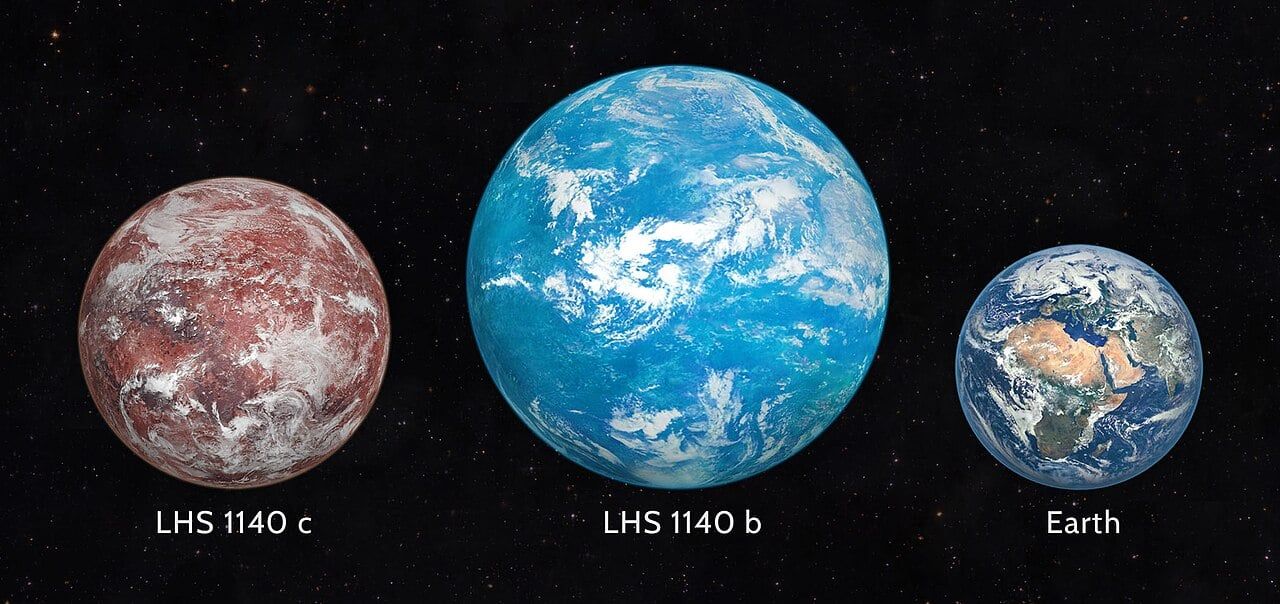
Alongside LHS 1140 b, the researchers examined LHS 1140 c, a smaller sibling planet in the same system that completes an orbit every 3.8 days.1 Discovered in 2018, LHS 1140 c orbits much closer to the host star and receives substantially higher radiation.31 The team detected no atmospheric signal around LHS 1140 c, suggesting that intense stellar irradiation stripped its volatile envelope away.1 The contrast indicates that the two worlds occupy opposite sides of the cosmic shoreline, demonstrating how orbital separation determines whether a rocky planet keeps its air.1
What does the helium measurement leave unresolved?
The detection of escaping helium indicates that gas surrounds the planet, though it leaves the composition and pressure of the air near the surface undetermined.1
Escaping helium reflects conditions only in the planet's uppermost atmospheric envelope, leaving the density and temperature of the lower atmosphere unmeasured.1 While the authors suggested that heavier molecules like water could remain trapped beneath the escaping helium, the spectrograph data do not confirm the presence of water vapor or surface oceans.1 The disappearance of the helium signal during the 2025 observations also highlights that atmospheric escape rates fluctuate, meaning single observations capture only temporary space weather.1 Furthermore, because red dwarf stars undergo magnetic flare events, variable stellar output can alter escape rates and complicate spectral interpretations.2
Determining whether LHS 1140 b can maintain its atmosphere over billions of years helps evaluate whether planets orbiting red dwarf stars can support habitable environments.12 Because red dwarfs make up roughly 75 percent of the stellar population in our galaxy, understanding how super-Earths hold onto volatile gases shapes where astronomers search for life beyond our solar system.21 The next step will involve monitoring future transits to track the variable helium escape, while deeper infrared observations probe for water vapor and heavier molecules trapped beneath the outer haze.12
What this rests on
32 sentences trace to 3 sources.
-
1
S
scientificinquirer Document · scientificinquirer.com · 1 Oct 2026 Detected: Rocky, habitable-zone exoplanet with an atmosphere See the source
-
2
N
nature.com Paper · nature.com A temperate rocky super-Earth transiting a nearby cool star - Nature Journal article See the source
-
3
E
exoplanetarchive.ipac.caltech.edu Third-party reporting · exoplanetarchive.ipac.caltech.edu LHS 1140 | NASA Exoplanet Archive See the source