Four giant exoplanets orbit a distant star across twelve years
Direct telescope images reveal multiple worlds larger than Jupiter tracing their paths around a sun 133 light-years away, offering a rare visual record of celestial mechanics in motion.
Most planets outside the solar system are known only as shadows or mathematical wobbles. For decades, astronomers have discovered distant worlds by watching for the slight dimming that occurs when a planet crosses the face of its star, or by measuring the subtle gravitational tug a planet exerts on stellar light. These indirect techniques have identified thousands of candidate worlds across the galaxy. Yet inferring the existence of an exoplanet from periodic dips in brightness is fundamentally different from watching an alien world travel across space. Observing an actual planet move along its orbit provides direct visual evidence of celestial motion unfolding in real time.
Directly imaging an exoplanet requires overcoming an immense optical contrast. A host star shines millions of times brighter than any planet circling it, creating an overwhelming glare that drowns out faint neighboring objects. To capture an orbiting world, astronomical instruments must suppress that central starlight without obscuring the narrow slice of sky immediately surrounding the star. Because planets located far from their suns move at measured paces, completing their circuits over decades, observers must record images across extended time spans to verify that the faint points of light are physically bound bodies traveling in coordinated paths.
How do telescopes capture planets orbiting distant stars?
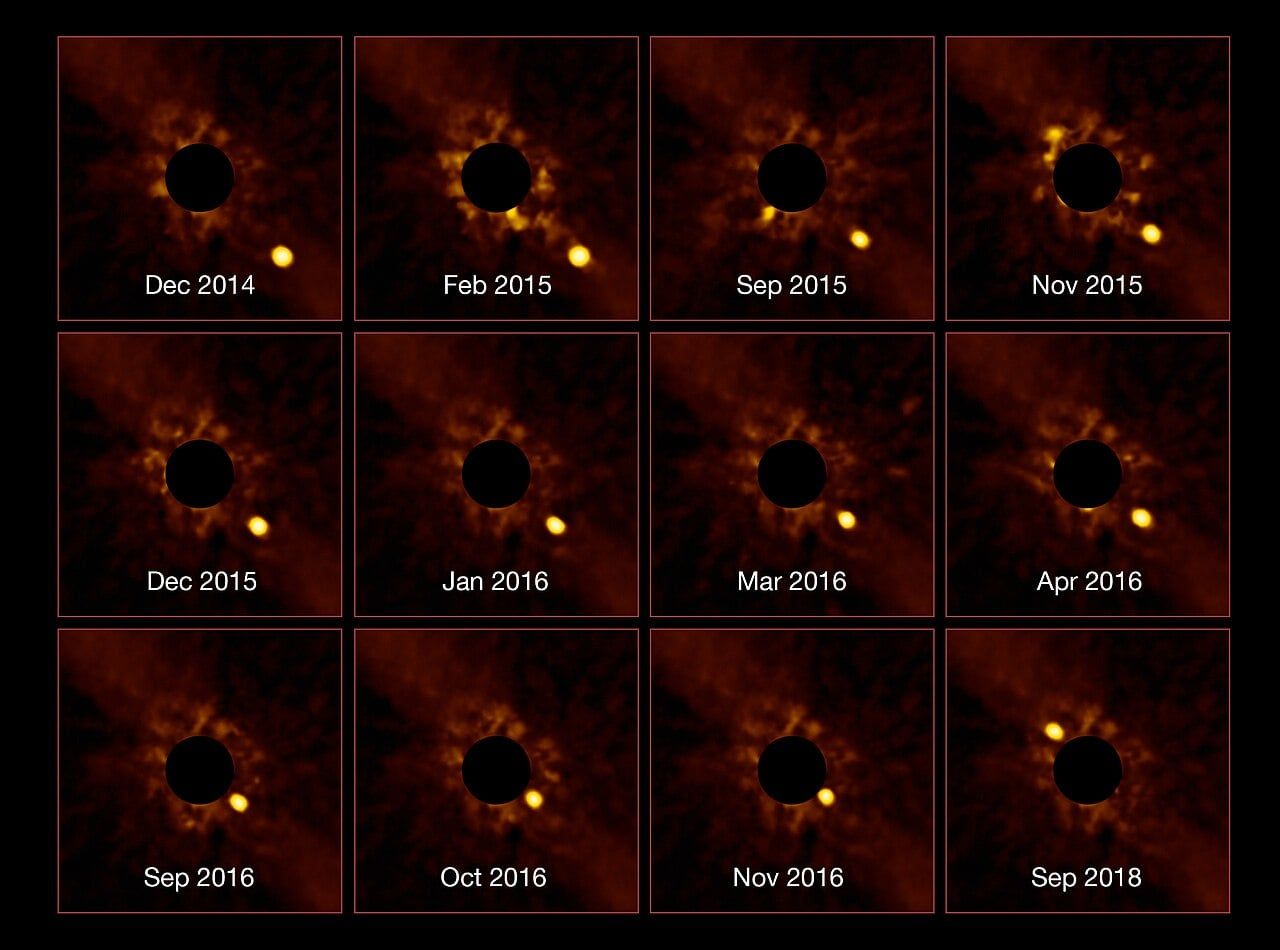
Direct astronomical imaging isolates the faint glow of exoplanets by dampening the intense glare of their central star. An announcement posted on October 2, 2026, on the social platform Bluesky by the account theplanetaryguy.com shared a vivid demonstration of this technique. The public release presented a 12-year sequence of telescope images showing a star located 133 light-years from Earth and its system of orbiting worlds.1 Across more than a decade of recorded observations, four exoplanets appear as distinct points of light slowly shifting their positions around the parent star.1
Tracking multiple worlds over such an extended duration relies on aligning telescope frames gathered years apart. In direct imaging, astronomical cameras record the position of each light source relative to the central star. By masking the stellar core and comparing snapshots captured across successive observing seasons, researchers can separate stationary background stars from genuine planetary companions. As the host star drifts through space, its gravitational family moves along with it, and the planets gradually advance along their respective orbital arcs.
What does the 12-year sequence reveal about the system?
The compiled observations show four giant exoplanets, each more massive than Jupiter, traveling along their orbital paths around a host star located 133 light-years from Earth.1 Having four massive gas giants in a single system offers a clear look at multi-planet architecture outside the solar system. In the solar system, Jupiter is the sole dominant gas giant of its scale, with Saturn, Uranus, and Neptune carrying considerably less mass. In this distant system, every detected world exceeds the mass of Jupiter, demonstrating that stars can host multiple super-massive gas giants in stable configurations.1
The visual sequence captures the slow cadence of outer planetary orbits. Because orbital speed decreases with distance from the central star, the inner planets in the sequence trace more noticeable portions of their paths than the outer worlds. Over the 12-year baseline of telescope observations, observers can watch the inner worlds noticeably alter their angles, while the outermost bodies shift more gradually.1 Seeing multiple worlds move simultaneously illustrates how their orbital motions follow the predictable rules of celestial mechanics, turning an abstract gravitational model into an observable physical phenomenon.
What can a decade of imagery leave unresolved?
A 12-year observational window captures only a fraction of a complete orbit for planets that circle far from their host stars.1 Because giant worlds located far from their sun can take decades or centuries to finish a single circuit, the sequence records orbital arcs rather than closed trajectories. The record functions as an observational compilation of direct images, leaving dynamic modeling of the system to dedicated numerical analyses. In addition, the brief public summary released on Bluesky does not specify the catalog name of the star, the telescope facilities used, or the precise orbital inclinations of the four planets.1 Fuller physical characterization will require formal published datasets that detail how the images were processed and calibrated across the 12-year baseline.1
Sustained direct imaging transforms how astronomers evaluate planetary formation and orbital dynamics. Long-term visual records show that multiple giant exoplanets can coexist around a single star without destabilizing one another through mutual gravitational perturbations. Moving forward, extended observations across additional decades will help astronomers map the complete orbits of all four worlds.1 Tracking their positions over longer baselines will allow researchers to refine the masses of the planets, measure their precise gravitational interactions, and explore whether other, smaller worlds remain hidden within the glare of the distant star.
The record
9 sentences trace to 1 source.
-
1
B
bsky.app Document · bsky.app · 2 Oct 2026 A 12-year sequence of telescope images of a star and four planets orbiting See the source