Drowned shoreline timbers reveal Stone Age construction beneath a German lake
Underwater excavations in northern Germany have recovered worked wooden posts and split boards dating to 8500 BCE, pointing to sophisticated carpentry thousands of years before the arrival of agriculture.
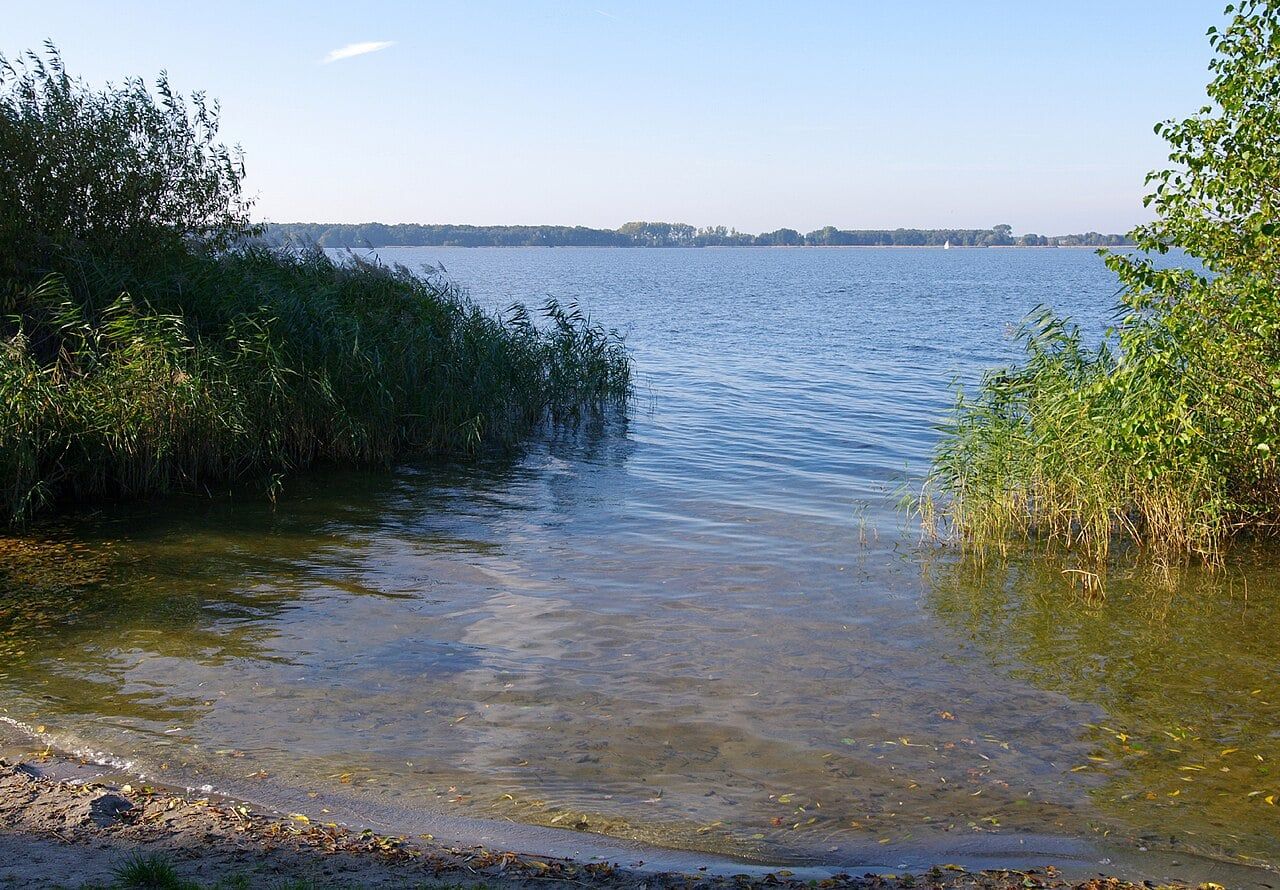
Organic matter from deep human prehistory rarely endures. When ancient hunter-gatherers felled trees, split trunks into planks, or raised shelters across northern Europe, the resulting wooden architecture almost invariably rotted away into topsoil within centuries. Fungi, bacteria, insects, and atmospheric oxygen collaborate to break down plant fibers, leaving modern researchers with an archaeological record dominated almost entirely by durable flint blades, stone axes, and calcified animal bones.
Yet 20 meters beneath the surface of Lake Arendsee in northern Germany, worked timber has remained remarkably intact for more than ten millennia.1 The submerged remnants show clear evidence of human craftsmanship, including cut marks from Stone Age tools and carefully separated boards.1 The find provides direct physical evidence of early woodworking in an era from which perishable materials are almost completely absent across Europe.
Underwater archaeologists from the State Office for Heritage Management and Archaeology Saxony-Anhalt, known as the LDA Saxony-Anhalt, identified the shaped timbers during multi-year diving operations across the lake basin.1 The discovery demonstrates that Mesolithic hunter-gatherers engaged in deliberate woodworking and structural engineering long before the advent of sedentary farming.1
The preservation of ancient timber requires an unbroken chain of environmental conditions that shield organic material from biological decay. Under normal circumstances, a tree cut down on dry land is consumed by wood-boring larvae and colonized by fungi that thrive in humid, aerated environments. For wood to survive across geological spans of time, the material must be submerged rapidly enough to escape terrestrial decomposition, buried under sediment to exclude light and mechanical disturbance, and sealed in anoxic conditions where microbial digestion slows to an absolute crawl.
How did ten-thousand-year-old wood survive beneath the water?
A collapsing salt deposit beneath Lake Arendsee gradually pulled the ancient shoreline downward into cold, oxygen-depleted sediment that halted natural decay.1 The lake basin formed through a geological phenomenon known as salt dome subsidence, where underground mineral layers dissolved over time and triggered the steady collapse of the overlying strata.1 This gradual subsidence dragged the prehistoric water margin into deep water, preserving the organic material from the destructive wave action and aerial exposure that typically obliterate shoreline encampments.

Buried beneath layers of dense lacustrine silt 20 meters underwater, the submerged timbers were deprived of free oxygen.1 Without adequate oxygen, the aerobic bacteria and fungi that feed on cellulose and lignin cannot sustain their metabolic activity. As a result, the shaped wood retained its cellular structure and the distinct tool scars left by its human makers, evading the natural breakdown that claimed virtually all contemporary wooden structures across the continent.1
What did the diving survey recover from the lake floor?
Divers working in Lake Arendsee recovered a 1.6-meter wooden post marked by felling tools alongside split boards measuring up to 1.3 meters in length.1 The longer post preserves obvious traces of human labor, showing where workers cut into the living tree and shaped the trunk for a specific structural purpose.1 The accompanying boards indicate that the occupants possessed the knowledge and technical skill required to split straight timber along the grain into flat planks, an advanced carpentry technique for the period.1
Harald Meller, the state archaeologist of Saxony-Anhalt, pointed to the exceptional rarity of such organic survival during archaeological investigations.1 "Besides the usual finds from this period, such as stone tools or animal bones, our divers were able to recover spectacular pieces of wood, which have very rarely survived from this era," Meller said.1 The recovered pieces establish that the occupants of the lake basin were crafting substantial, fitted wooden components, demonstrating deliberate structural design.1
The lake floor has long yielded a rich chronological sequence of maritime and shoreline artifacts spanning thousands of years of human habitation.1 Previous archaeological diving campaigns at Lake Arendsee located prehistoric fish traps, a medieval flat-bottomed cargo boat, and a later dugout canoe carved from a single trunk.1 The newly discovered structural timbers, however, represent a far deeper archaeological stratum than any of those earlier lake discoveries.1
What remains uncertain about the underwater construction?
Archaeologists cannot yet determine whether the submerged timbers formed a residential shelter, an elevated platform, a fishing installation, or an entirely unfamiliar type of wooden facility.1 The recovered pieces represent an initial sample of isolated elements brought up during exploratory diving operations, without exposing a complete ground plan.1 While researchers consider a domestic hut or seasonal shelter to be a serious possibility, the current material does not confirm how the components fitted together in three dimensions.1

The findings constitute a direct physical recovery of ancient building material, but they cannot show how frequently or continuously people occupied the shoreline. Isolated structural elements do not reveal whether the site served as an intensive settlement or as a temporary facility revisited during specific seasons. Furthermore, underwater excavation presents severe technical limits, as divers must contend with poor visibility, delicate sediments, and deep diving constraints while recording the spatial coordinates of every waterlogged timber.
Why does the site challenge assumptions about hunter-gatherer life?
The wooden artifacts date to around 8500 BCE during the Mesolithic period, roughly 3,000 years before farming communities introduced timber longhouses to central Europe.1 Mesolithic populations in northern Europe lived primarily by hunting wild game, fishing inland waters, and gathering edible plants across changing seasonal territories.1 Conventional anthropological models frequently characterize these societies as lightweight, highly mobile bands that maintained temporary camps and invested minimal effort in substantial, durable architecture.
The chronology of Lake Arendsee places the construction thousands of years prior to the arrival of the Linear Pottery culture, also designated as the LBK, which reached the region around 5500 BCE.1 The later Linear Pottery farmers transformed the countryside by clearing forests, planting cereal crops, managing domestic herds, and erecting massive timber longhouses that formed permanent village settlements.1 The presence of shaped, heavy timbers at Lake Arendsee shows that sophisticated construction techniques existed in northern Germany long before agricultural economies emerged.1
The discovery suggests that hunter-gatherer communities established substantial, repeated footholds along productive lakeshores and wetlands.1 Rather than wandering indiscriminately across northern Europe, these foraging groups returned systematically to favored aquatic environments where fish, waterfowl, and plant resources were abundant. In some instances, these repeated occupations motivated people to build sturdy, labor-intensive wooden structures on the water margins.1
Marcel Weiß, the project director for the LDA Saxony-Anhalt, explained that the implications of the site extend to fundamental questions about early human society.1 "Whether we are looking at the remains of huts or other, previously completely unknown wooden structures is the subject of ongoing and future research. If permanent buildings or intensively cultivated living spaces already existed 10,500 years ago, this would have far-reaching consequences not only for our understanding of hunter-gatherers, but also for the origins of modern cultural landscapes," Weiß said.1 He added that underwater archaeology at Lake Arendsee offers an exceptional opportunity to examine the roots of modern social structures.1
Upcoming phases of underwater research will attempt to trace the broader architectural footprint across the lake bed.1 If subsequent diving surveys discover additional posts still standing in coherent geometric patterns, along with preserved flooring materials or collapsed wall screens, archaeologists will be able to reconstruct the original layout of the installation.1 For the present, the project has established that complex timber construction formed part of the hunter-gatherer toolkit in northern Germany ten millennia ago, leaving the full purpose of the lakeside structure to be resolved by future fieldwork.1
What this rests on
34 sentences trace to 1 source.
-
1
MA
Mihai Andrei Document · zmescience.com · 2 Oct 2026 Divers Found a Stone Age Construction Under a German Lake. But What Was It Used For? See the source