Milt Windler, the Apollo 13 Flight Director Who Ran Crisis by Calculation, Dies at 94
The NASA engineer who led the room through three moon landings and brought an aborted lunar flight home treated command as a discipline of structured consensus.
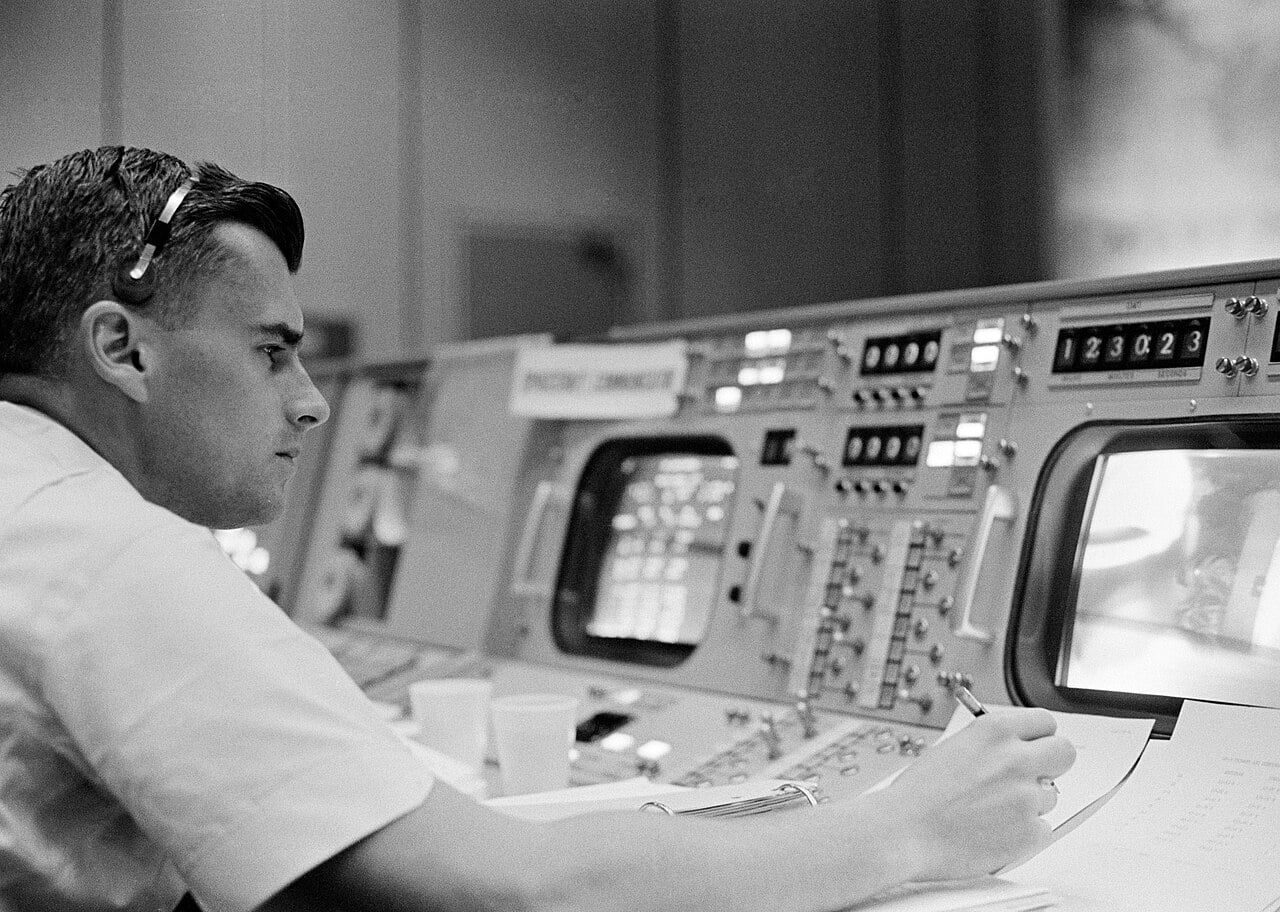
When the third shift at Mission Control took the console for Apollo 8 in December 1968, the room was preparing to send human beings beyond Earth orbit for the first time.12 Milt Windler, a thirty-six-year-old aeronautical engineer directing his first mission from the console, had spent weeks preparing for the trans-lunar injection burn that would place Frank Borman, Bill Anders, and Jim Lovell on a course toward the moon. Working quietly with his wife, Betty, and the spouses of several fellow controllers, Windler had assembled small red and blue flannel banners bearing a white numeral one at their center, intending to hand them out to his team when the burn succeeded.12 The gesture was planned as an uncharacteristically theatrical signal to Soviet observers watching the space race unfold.1 Before the burn executed, however, flight leadership concluded that displaying the flags was inappropriate while half of the journey remained ahead, and the banners stayed tucked out of sight until the crew splashed down safely under American colors.13
That suppressed celebration captured the strict operational ethic Windler spent three decades maintaining across the American space program. Appointed as NASA's seventh flight director in 1968, Windler died on October 1, 2026, at the age of 94, surrounded by his family.142 His career traced the entire arc of human spaceflight during the Cold War, from early splashdown logistics in the Mercury and Gemini programs to the technical development of the space shuttle's robotic arm and the operational architecture of the International Space Station. Yet his reputation within NASA rested on his command of the Maroon Flight shift, where he oversaw the second, third, and fourth lunar landings, and on his decisive role as lead flight director during the near-fatal mission of Apollo 13 in April 1970.3
The Anatomy of Maroon Flight
Born on January 10, 1932, in Hampton, Virginia, Milton Windler trained as an engineer at Virginia Tech, graduating in 1954 with a degree in aeronautical engineering.15 He completed the Air Force Reserve Officers' Training Corps program during his university studies and served as a military jet pilot before joining the National Advisory Committee for Aeronautics at the Langley Research Center in Virginia.14 When the civilian space agency superseded NACA in 1958, Windler transitioned directly into NASA, moving to Houston as the Manned Spacecraft Center began operations.13 Unlike several of his early peers, he came to the flight director role not from the flight operations room, but from the recovery division, where he coordinated tracking and recovery vessels for Mercury and Gemini capsules returning from orbit.4
That recovery background gave Windler an instinct for physical spacecraft limits and maritime-style operational discipline. In 1968, senior NASA official Chris Kraft selected Windler to expand the flight director corps, assigning him to support Eugene Kranz in the demanding operational restructuring that followed the fatal Apollo 1 launchpad fire.41 Flight directors chose color designations to identify their console teams, and Windler adopted the call sign Maroon Flight.1 His initial assignment placed him at the center of Apollo 8, followed by flight control shifts on Apollo 10, the full-scale dress rehearsal in lunar orbit.12 He went on to direct shifts during the Apollo 11 lunar landing, Apollo 12, Apollo 14, and Apollo 15.41
Windler described the tempo of those peak lunar landing years as an unbroken operational sprint that left little room to contemplate historical significance. "Apollo was such a rapid pace that I don't think people had the chance to think about it very much. It has only become more clear to me later on that we were making history," Windler recalled in a 2006 oral history interview for the University of North Texas.13 "You'd do a mission and then you'd immediately turn around and get ready for another mission. It was not [a] time for reflection."12
Rethinking Apollo 13 in Real Time
The operational philosophy of Mission Control faced its most severe trial in April 1970, when Windler served as lead flight director for Apollo 13.16 Under standard procedure, the lead director handled launch and lunar landing operations, leaving other shifts to manage the translunar cruise and return phases. Windler oversaw the launch from Florida and began directing preparations for the crew's descent toward Fra Mauro.13 Two days into the journey, an electrical short sparked an explosion inside an oxygen tank in the service module, blowing away an entire outer panel, causing the remaining oxygen supply to vent into space, and cutting off power to the command module Odyssey.1
The explosion instantly transformed the mission from an exploration expedition into an unprecedented emergency rescue. "What that meant was you did the ascent, the liftoff from Earth, I should say, the launch, and you did the lunar surface activity," Windler explained in his 2006 university interview.12 "But then, of course, after we lifted off from the Earth, when we got more toward the moon, why, the whole mission changed."12 Instead of managing surface traverses, Windler collaborated with Gerry Griffin, the flight director leading the Gold team, to reorganize operations around the limited consumables remaining inside the lunar module Aquarius.13
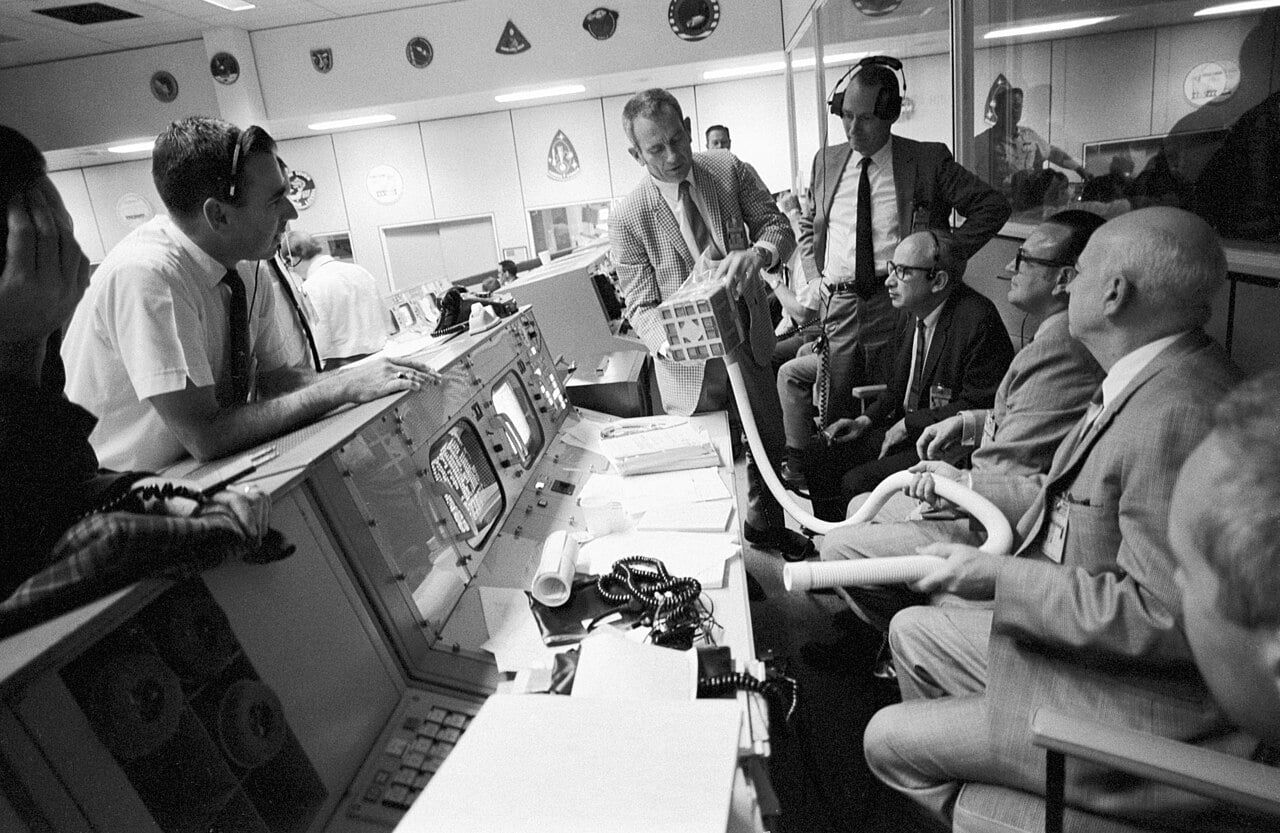
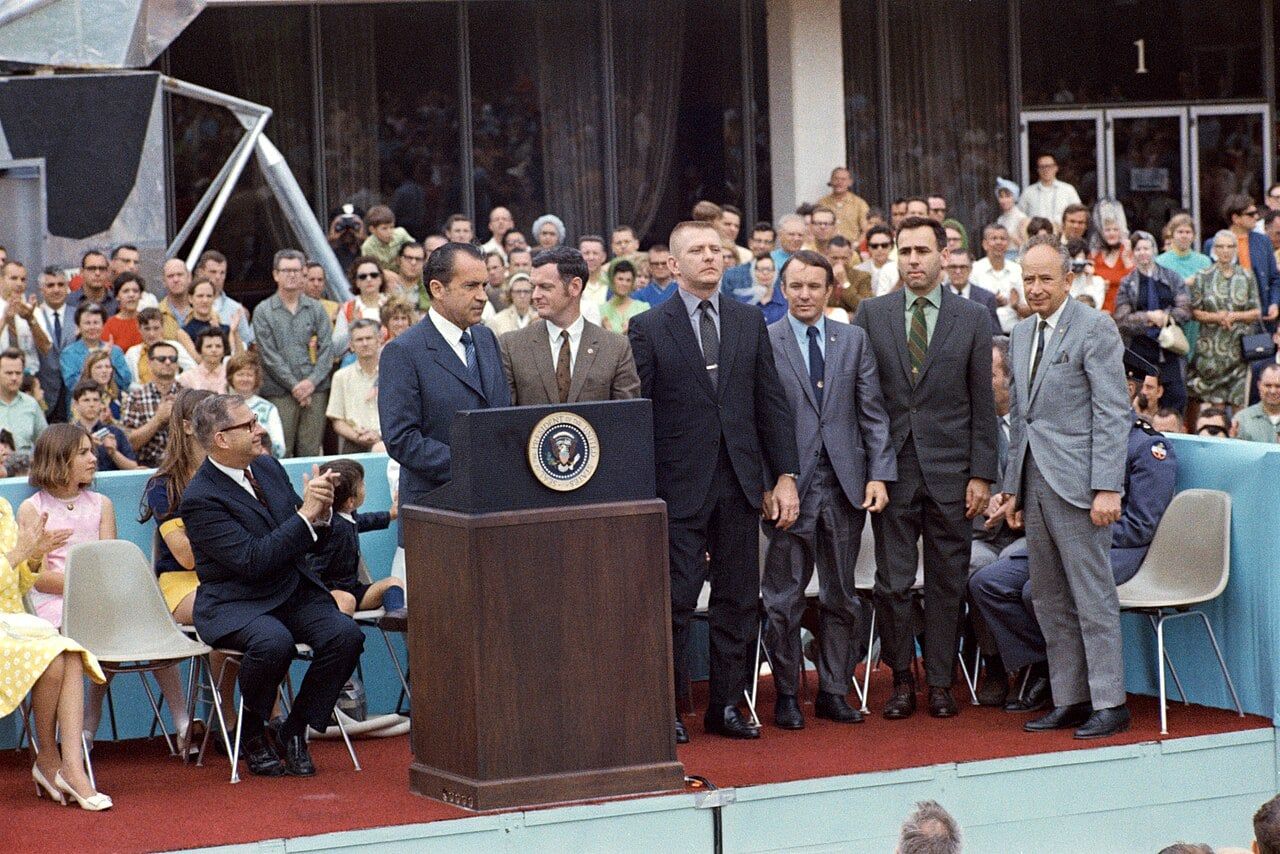
With the spacecraft drifting on an inaccurate trajectory that would miss Earth, Windler and Griffin polled each controller at the consoles to evaluate three distinct firing profiles for the lunar module descent engine.1 The decision required balancing consumable water, electrical battery margins, and structural stability against the duration of the burn. While Flight Crew Operations Director Deke Slayton demonstrated an improvised cardboard and plastic apparatus to adapt the command module's square carbon dioxide scrubbers to the lunar module's round receptacles, Windler and his controllers coordinated the calculations that established the abort trajectory around the moon.12 For their round-the-clock leadership during the four-day crisis, President Richard Nixon presented Windler, Kranz, Griffin, and Glynn Lunney with the Presidential Medal of Freedom on April 18, 1970.14
Inventing Adaptive Scheduling for Skylab
When the lunar landing program concluded, NASA directed its human spaceflight personnel toward long-duration orbital habitation. Windler served as flight director across all three crewed missions to Skylab, the orbital workshop launched in 1973.14 While Apollo missions followed rigid, pre-planned flight plans down to minute intervals, operating a scientific station required balancing unpredictable astronomical phenomena against fixed astronaut rest cycles and power budgets.
Solar physics research formed a primary component of Skylab through the Apollo Telescope Mount, an array of solar instruments mounted to the exterior of the station.15 When sudden solar flares or coronal mass ejections erupted on the sun, the existing flight plan became obsolete within minutes. Windler led the effort to construct a dynamic planning cycle that linked ground-based scientists directly with shift controllers.
"We had to come up with a system that would allow us to plan in real time and accommodate the science people," Windler said in 2006.13 "If something interesting happened on the sun, which it did several times, then we needed to be able to schedule the ATM work. We invented a way of flight planning in real time, or cycles, where one day the science people talked about what they wanted to do, and the 'Science Czar' got with them and said, 'All right, then, we need these particular objectives for tomorrow.'"
That iterative workflow became an operational blueprint for subsequent orbital programs. Following Skylab, Windler transitioned to the Space Shuttle Project Office, where he managed operations for the development of Canada's Remote Manipulator System, the robotic Canadarm that flew on orbital missions starting in 1981.14 After retiring from NASA, he worked in private industry, consulting on flight procedures and hardware verification as the initial modules of the International Space Station were manufactured.1
The Weight of the Console
In his later years in Friendswood, Texas, where he lived with his wife Betty, Windler reflected on the relentless speed of the space race with measured detachment.13 Reflecting on whether the early flight directors realized what they were building, he maintained that the work required total suppression of self-importance in favor of checklist rigor. "If I did it again, I'd probably try to do something more about trying to pay more attention," Windler said in 2006.12 "Apollo was, well, all of them were, bang-bang-bang. You couldn't enjoy, really, in a way you couldn't savor it, like maybe it would have been better to have done."1
Windler left behind three children and eight grandchildren.1 His career reflected an era when public engineering programs solved existential technological crises through collective institutional discipline rather than solo bravado. In the history of Mission Control, his legacy remains tied to that quiet operational balance: an engineer who understood that saving a crew required listening to the room, double-checking the numbers, and waiting until the capsule was floating securely in the water before allowing anyone to raise a flag.
The record
37 sentences trace to 6 sources.
-
1
RP
Robert Pearlman Document · arstechnica.com · 3 Oct 2026 Milt Windler, NASA flight director who helped save Apollo 13, dies at 94 See the source
-
2
C
collectspace.com Third-party reporting · collectspace.com Milt Windler, NASA flight director who helped save Apollo 13, dies at 94 See the source
-
3
E
evz.ro Third-party reporting · evz.ro · 4 Oct 2026 A murit directorul NASA caee s-a implicat în salvarea Apollo 13 See the source
-
4
WF
Wikimedia Foundation, Inc. Third-party reporting · en.wikipedia.org · 2 Sep 2017 Milton Windler - Wikipedia See the source
-
5
M
MY.UA Third-party reporting · my.ua · 4 Oct 2026 Помер диспетчер польотів NASA Мілт Віндлер, який допоміг урятувати Аполлон-13 See the source
-
6
I
it-boltwise.de Third-party reporting · it-boltwise.de · 3 Oct 2026 Milt Windler: Apollo-13-Flight-Director prägte auch Skylab-Planung See the source