Glowing ring around M87* reveals where black hole plasma traps light
Measurements across two radio wavelengths indicate that radiation shifts from trapped to transparent right at the ring boundary, showing how magnetized gas feeds the central void and powers giant jets.
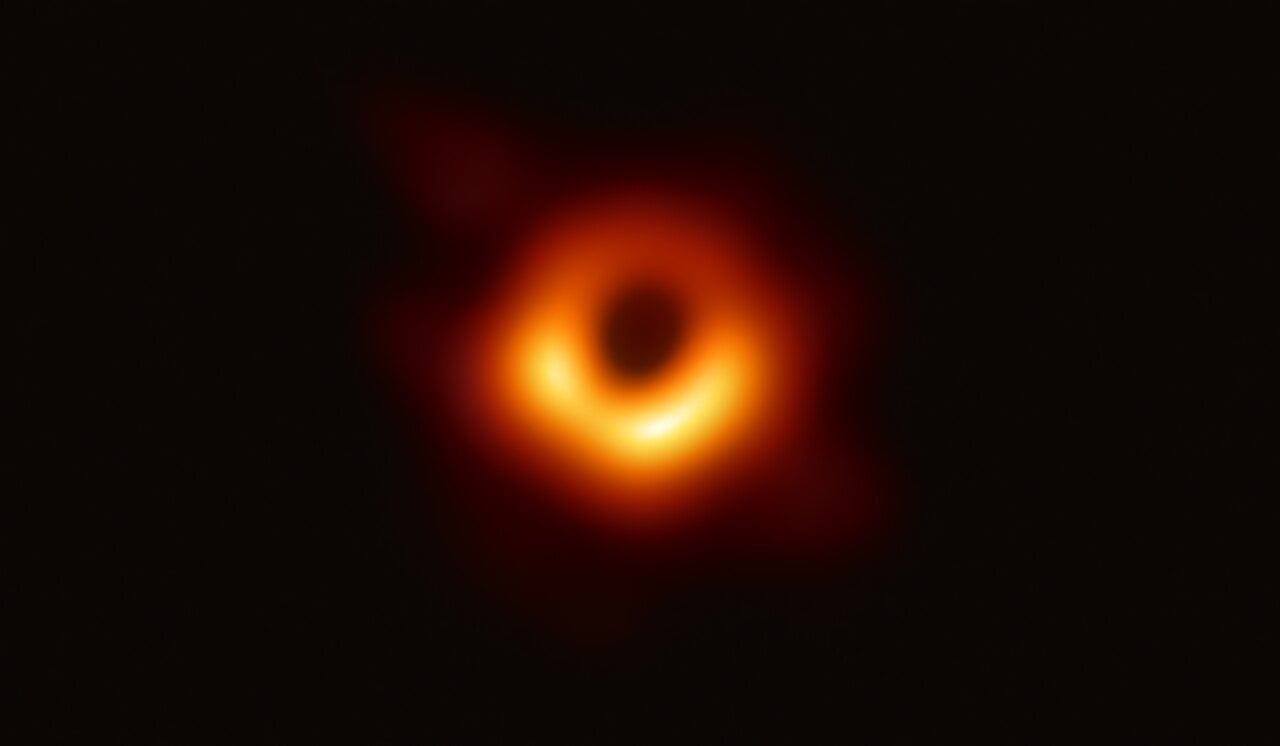
When telescopes peer at the supermassive black hole at the center of the galaxy Messier 87, they capture a bright ring of light enclosing an impenetrable shadow. Popular accounts often present this glowing circle as a purely gravitational effect, created when warped spacetime bends light paths into an orbit. That radiation, however, comes from real matter: a hot swirl of gas dragged inward at speeds approaching the speed of light. Knowing whether the ring marks the geometric path of bent light or the physical edge where the infalling gas changes state is essential for understanding how black holes feed and launch giant jets across galaxies.
The light follows a clear physical sequence. Infalling gas heats until its atoms lose their electrons, forming an electrified plasma. Magnetic fields force charged particles within the plasma to spiral along field lines, generating radio waves known as synchrotron radiation. Near the event horizon, the threshold beyond which nothing can escape, the plasma is so compact that it absorbs its own radio emission before the waves can break free. Further out, the gas thins, allowing radiation to stream unobstructed into space. Comparing emission across two radio wavelengths reveals whether the plasma is dense enough to trap its light or thin enough to let it shine.1
Now, an observational study published on July 20, 2026, in The Astrophysical Journal Letters provides the first spatially resolved spectral map of this plasma on event-horizon scales.1 Led by Zhao Shanshan and Lu Rusen at the Shanghai Astronomical Observatory, part of the Chinese Academy of Sciences, an international team combined millimeter-wavelength radio observations from global telescope networks to show that the observed ring marks the exact physical boundary where the trapped radiation breaks free.1
How does gas behave at the edge of a black hole?
Matter falling toward a supermassive black hole heats into an electrified plasma, swirling under intense magnetic forces before crossing the threshold of no return. To measure the conditions governing this gas, researchers compare how brightly the emission glows across different radio wavelengths to calculate a spectral index. A positive spectral index indicates that radiation is trapped within dense plasma through synchrotron self-absorption, while a negative spectral index shows that the gas is optically thin, allowing light to radiate freely into space.1
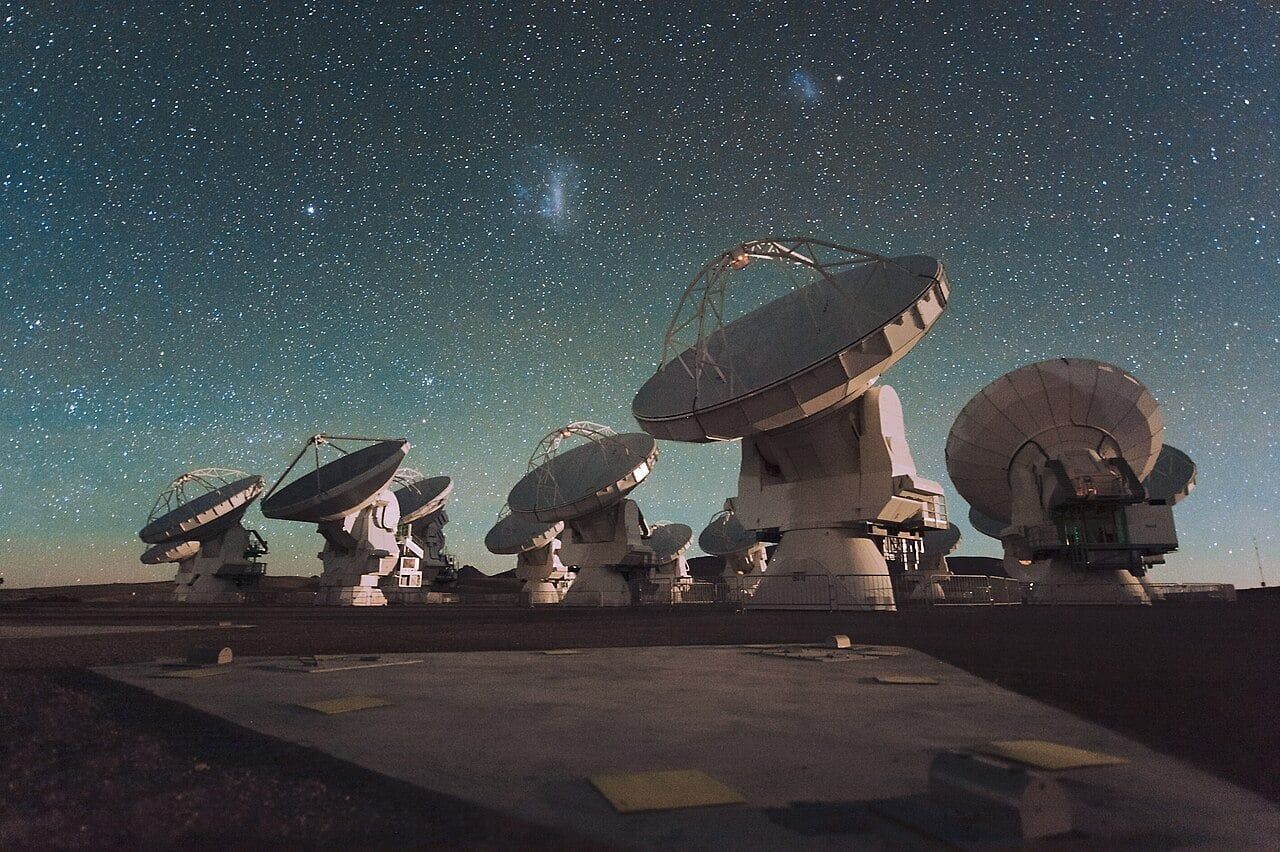
To construct this spectral distribution, the researchers combined two distinct observational datasets gathered in 2018.1 They paired 1.3-millimeter radio measurements from the Event Horizon Telescope with 3.5-millimeter data from the Global Millimeter VLBI Array.1 Aligning these two frequencies allowed the team to chart radiation properties across space around M87*, the black hole at the center of Messier 87, rather than averaging the signal into a single point.1
What does the glowing ring around M87* reveal about the plasma?
The glowing ring around the supermassive black hole M87* marks the boundary where the surrounding plasma stops trapping its own light and becomes transparent to radio waves.1 Close to the black hole, the spectral index remains positive, consistent with synchrotron self-absorption dominating the innermost emission.1 The spectral index then shifts to negative at roughly 30 microarcseconds from the center, where a microarcsecond measures an angle on the sky of one millionth of an arcsecond.1
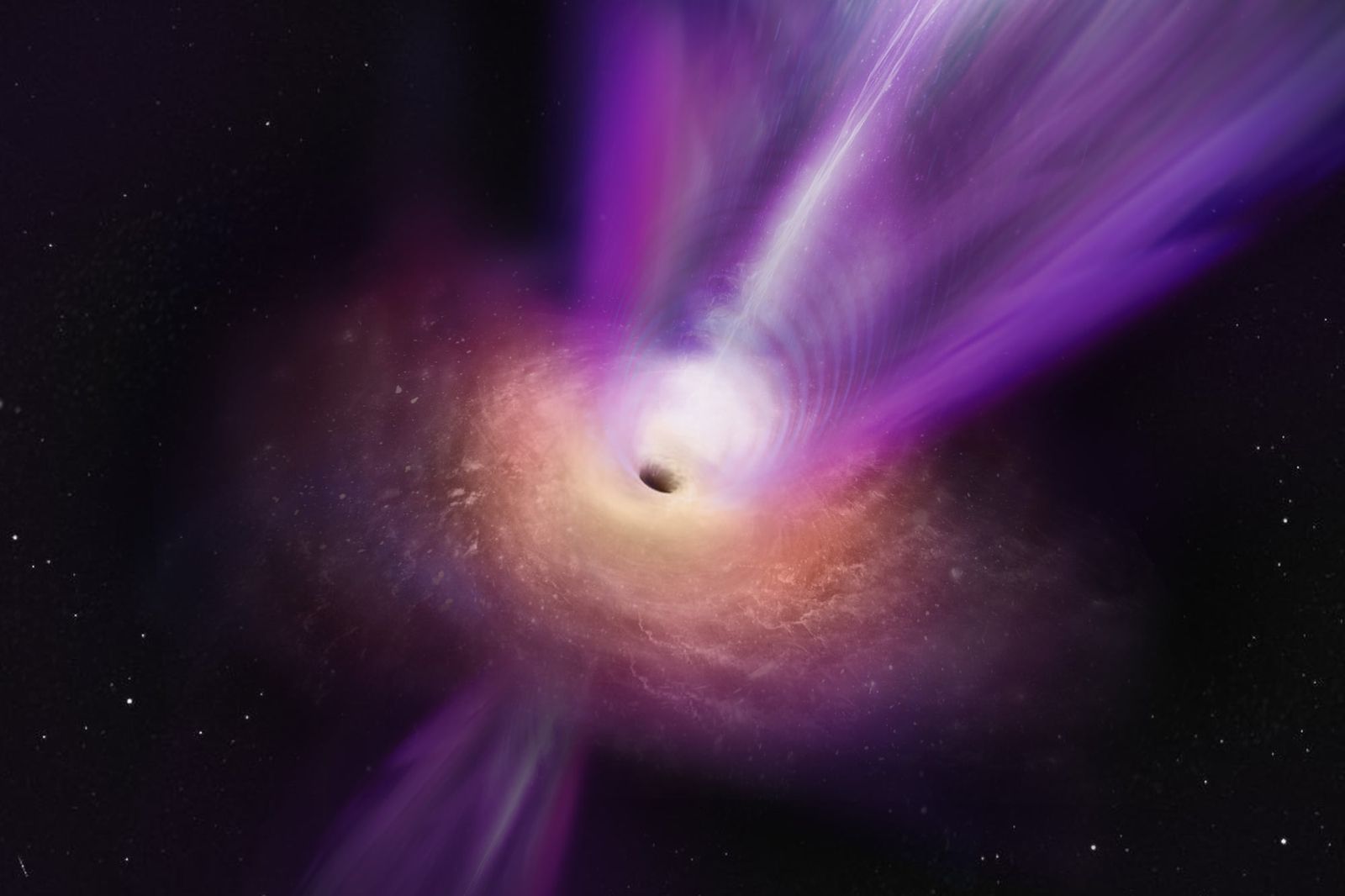
This transition at roughly 30 microarcseconds out matches the measured radius of the ring observed in the 3.5-millimeter images.1 According to the paper, that spatial match suggests the visible ring reflects the physical state of the surrounding plasma rather than the geometry of bent light alone.1 Zhao stated that mapping the spectral index across space makes it possible to quantitatively evaluate how radiation properties change around the black hole, providing direct clues about accretion flows and jet formation.1 Lu noted that multi-frequency imaging on horizon scales will enable more precise studies of black hole accretion, jet formation, and strong-field gravity.1
What questions remain unanswered about black hole accretion?
Snapshot observations from a single observing run cannot explain how black hole plasma moves, fluctuates, or powers outflows over long periods. The findings reflect conditions captured during 2018 observing sessions, leaving open how the boundary between opaque and transparent plasma changes as infalling gas churns.1 Because the analysis relies on two radio wavelengths at 1.3 millimeters and 3.5 millimeters, it cannot verify whether similar transitions occur across higher radio frequencies or in infrared bands.1 Reconstructing spatial details at scales of 30 microarcseconds also requires combining separate telescope arrays, where atmospheric turbulence and calibration differences introduce uncertainty into the exact location of the boundary.1
The research received funding from the National Natural Science Foundation of China, China’s National Major Science and Technology Projects, the Chinese Academy of Sciences, and the Shanghai Municipal Government.1 For astrophysicists studying accretion physics, linking the ring radius directly to the opacity transition provides an empirical benchmark for the density of infalling matter. Future multi-frequency campaigns will track how magnetic fields channel this plasma over time, clarifying how black holes convert falling matter into luminous jets that extend across space.
The record
18 sentences trace to 1 source.
-
1
S
scientificinquirer Document · scientificinquirer.com · 5 Oct 2026 Scientists Use Dual-Frequency Images to Explore Black Hole Plasma Physics See the source