Supernova gamma-ray echoes could reveal hidden neutrino behavior across the galaxy
A delayed flash of light from an exploding star could serve as a cosmic benchmark, allowing physicists to determine whether neutrinos decay or transform during their interstellar journey.
When a massive star runs out of nuclear fuel, its core collapses in a fraction of a second, unleashing an intense flood of energy carried almost entirely by neutrinos.12 These subatomic particles pass through ordinary matter with barely any resistance, escaping the collapsing interior long before light can break free.contributed For decades, physicists have viewed a future Milky Way core collapse as a once-in-a-generation laboratory to study how these elusive particles travel across interstellar space.1 Yet an obstinate challenge has hung over that prospect: once the particles arrive at terrestrial detectors, researchers have no way to know precisely how many started the journey.
If neutrinos transform into invisible states or scatter off unseen cosmic structures during their flight, the arriving stream simply appears weaker than expected.1 Because stellar computer models cannot predict the exact baseline output of an exploding star from first principles, an overall deficit in arriving particles looks identical to a star that simply emitted fewer of them at the start.1 Without a reliable measurement taken near the source, the signs of exotic physics along the journey remain hopelessly tangled with the natural variations of stellar engines.1
To overcome this impasse, physicists must trace a sequence of physical events that unfolds at the edge of the dying star itself. As the dense flood of antineutrinos surges outward from the collapsed core, it sweeps through the star's vast, hydrogen-rich outer envelope.2 Most pass straight through into the vacuum of space, but a tiny fraction collide with ambient protons in the stellar gas.2 These rare collisions produce positrons, the antimatter partners of electrons.4 The freshly created positrons slow down rapidly in the dense outer gas and annihilate against local electrons, producing pairs of high-energy gamma-ray photons with a characteristic energy of 511 kiloelectronvolts.2 Because these photons are generated in the translucent outer skin of the star, a portion of them escape directly into space, trailing behind the initial burst as a delayed flash across the visible stellar disk.2
How can a dying star act as its own monitoring station?
A gamma-ray echo produced in the outer stellar envelope provides a direct record of the antineutrino fluence emerging from the stellar surface before any long-distance travel effects can occur. In a preprint posted on the arXiv server, Garv Chauhan of Arizona State University and Yago Porto of the Technical University of Munich show that next-generation space telescopes could record this 511-kiloelectronvolt signal from a nearby stellar collapse. The authors report that comparing the brightness of this local flash to the neutrino count measured on Earth establishes an astrophysical near-far detector system across galactic distances.1
Terrestrial particle physics experiments have long used two separate detectors to study neutrino transformations.1 In those human-built facilities, a near detector placed close to a particle accelerator measures the initial beam before the particles have had time to oscillate or decay, while a far detector situated hundreds of kilometers away records what survives the trip. Chauhan and Porto realized that nature provides an analogous arrangement for a nearby dying star. The star's own outer envelope acts as the near detector, capturing a calibrated sample of the outgoing antineutrinos at the stellar surface, while massive underground detectors on Earth serve as the far station.
Earlier research by Cecilia Lunardini and colleagues established that an antineutrino burst crossing a stellar envelope triggers an electromagnetic cascade, producing a 511-kiloelectronvolt gamma-ray echo whose brightness reflects the size and composition of the envelope. In their 2024 paper in The Astrophysical Journal, Lunardini and her coauthors showed that this brief flare would be detectable for stars within one kiloparsec using gamma-ray instruments with effective areas of 1,000 square centimeters or larger.1 Building on that foundation, Chauhan and Porto demonstrated that the physical link between the antineutrino fluence and the escaping photon yield turns the flash into an absolute yardstick for interstellar propagation.contributed
The reliability of this natural detector rests on a separation of physical timescales within the collapsing star.contributed Yago, a researcher at the Technical University of Munich and coauthor of the study, told Primary that the rapid transit of particles preserves the unperturbed state of the stellar envelope.contributed
"The key is the enormous difference between the speed of the neutrinos and that of the supernova shock," Yago said in response to questions from Primary.contributed "The neutrino flash lasts only about ten seconds and crosses the star at nearly the speed of light. The shock moves far more slowly, so when the neutrinos reach the outer envelope, those layers have not yet received the news that the core has collapsed. They remain essentially in their pre-explosion state, and shock breakout occurs only hours later. This separation of timescales allows the gamma-ray echo to record the outgoing antineutrino flash before the explosion changes the stellar surface."contributed
What happens when neutrinos travel across galactic distances?
Neutrinos traveling across thousands of light-years can undergo subtle quantum transformations that suppress the flux observed by terrestrial instruments.1 In standard particle physics, neutrinos exist in three active flavors that oscillate among one another as they travel. However, several well-motivated theories beyond the Standard Model introduce additional behaviors, such as pseudo-Dirac states, particle decay, or scattering off galactic dark matter.1 Under the pseudo-Dirac hypothesis, each known active neutrino pairs with a hypothetical sterile partner, mixing maximally across astronomical baselines governed by minute mass-squared splittings.1
When pseudo-Dirac neutrinos travel across galactic baselines, their rapid flavor oscillations can wash out into a uniform, energy-independent reduction that cuts the arriving antineutrino flux exactly in half.1 In a single terrestrial detector, such a fifty percent reduction appears merely as an intrinsically dimmer supernova, indistinguishable from ordinary astrophysical variation.1 By contrast, because the gamma-ray echo is created within light-seconds of the core before the interstellar journey begins, its intensity remains completely immune to any propagation effects occurring between the star and Earth.
To quantify this comparison, Chauhan and Porto constructed a dimensionless estimator, designated by the Greek letter kappa, which combines the count of terrestrial neutrino events, the recorded gamma-ray echo photons, the telescope effective area, the envelope calibration factor, the target mass of the ground detector, and the detection efficiency. In the standard scenario without exotic propagation effects, kappa equals one.1 If pseudo-Dirac oscillations cut the surviving stream in half during flight, the estimator drops to one half.1 Because both the gamma-ray echo and the terrestrial neutrino detections scale inversely with the square of the distance to the progenitor star, the ratio between them becomes completely independent of the distance to the supernova.1
Addressing how the geometric factors balance, Yago explained that the distance scaling cancels cleanly in the combined formulation. "There was no unexpected factor," Yago told Primary.contributed "Both the terrestrial neutrino count and the gamma-ray echo count contain the same geometric dilution, \(1/(4\pi D^2)\). When these measurements are combined in \(\kappa\), that common distance dependence cancels exactly. The expected value of \(\kappa\) is therefore independent of distance, although a more distant supernova still produces fewer detected events and hence a less precise measurement."contributed
This strict distance independence allows the near-far comparison to probe fundamental properties that would otherwise remain hidden behind emission normalizations. If an observed supernova displays a deficit larger than the expected fifty percent, researchers would have to consider alternative physical mechanisms along the flight path. Yago noted that a sharper drop would rule out standard pseudo-Dirac mixing as the sole explanation. "If the neutrino spectrum shows no noticeable distortion and the measured ratio is below one half, then the pseudo-Dirac explanation considered in our study would be ruled out," Yago said.contributed "Once these oscillations wash out, they predict that exactly half of the detectable neutrinos remain. A larger deficit would mean that some additional process is removing neutrinos during their journey, such as neutrino decay or interactions with dark matter."contributed
How would future telescopes capture the dual signals?
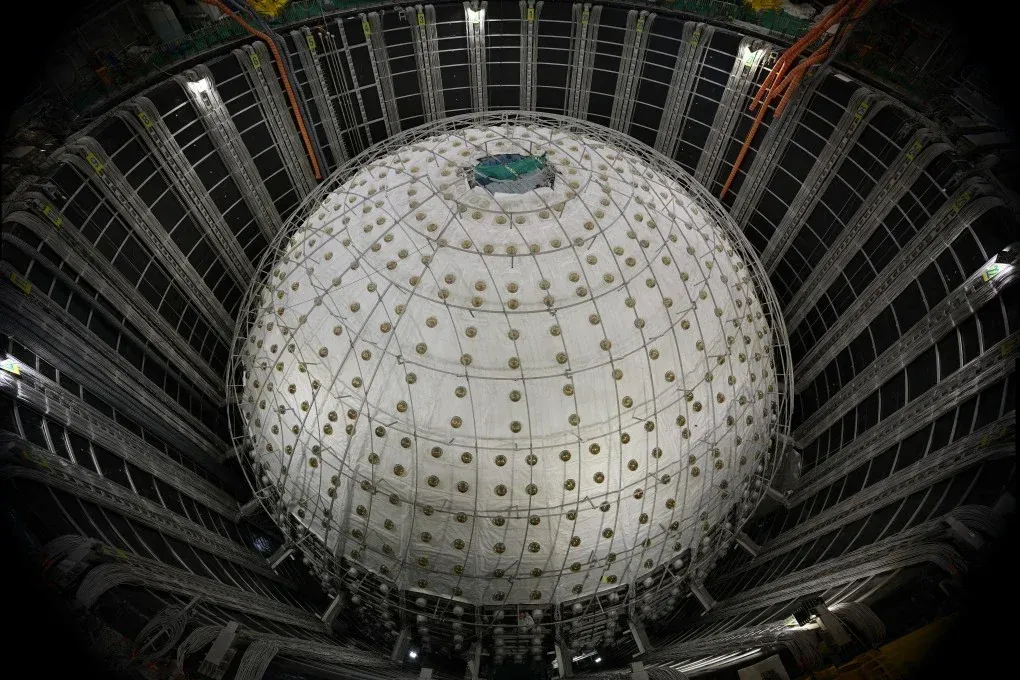
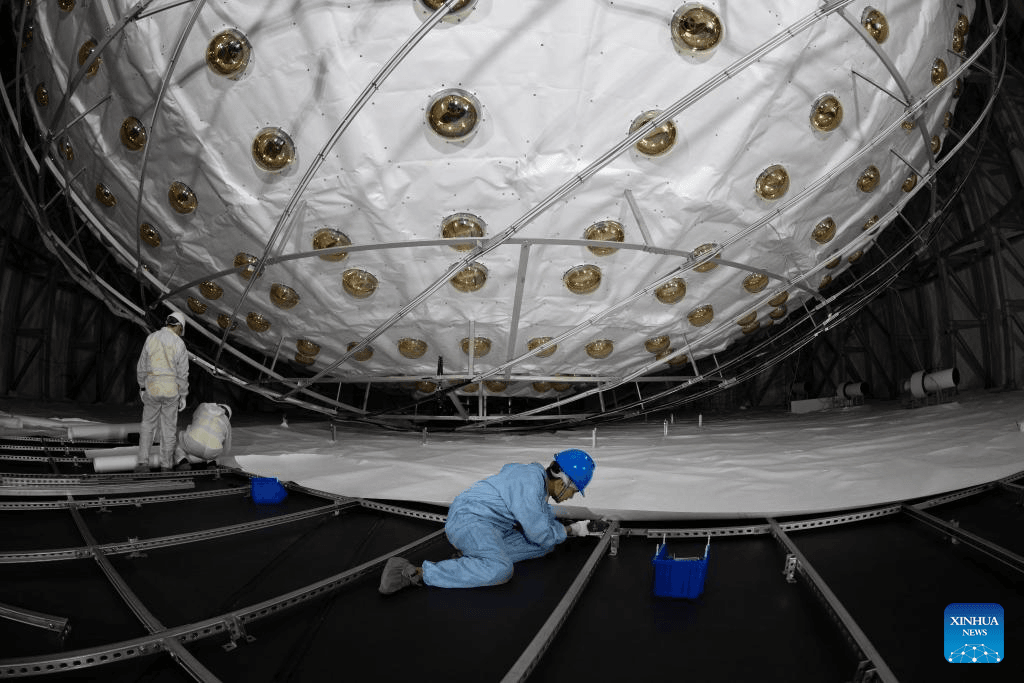
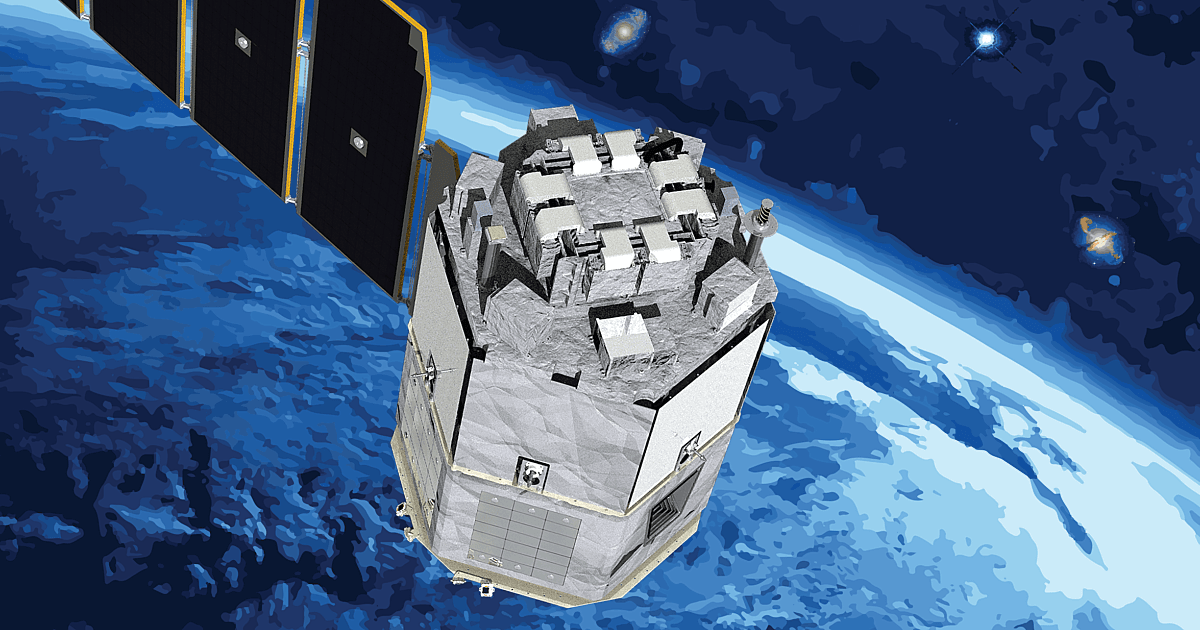
Observing both the gamma-ray echo and the surviving neutrino burst requires coordinating spaceborne gamma-ray observatories with underground liquid-scintillator facilities on Earth. In their study, Chauhan and Porto evaluated a hypothetical core collapse of Betelgeuse, a red supergiant located at an estimated distance of 0.222 kiloparsecs with an inferred initial mass between 18 and 21 solar masses. The authors paired a 20 solar mass stellar model with the planned Jiangmen Underground Neutrino Observatory in China, known as JUNO, and a prospective medium-energy gamma-ray telescope resembling the proposed All-sky Medium Energy Gamma-ray Observatory, or AMEGO.
The Jiangmen facility features an effective target containing 1.44 times 10 to the power of 33 free protons and operates with an inverse beta decay detection efficiency of 0.822.1 For a Betelgeuse collapse, Chauhan and Porto calculated that JUNO would detect approximately 13.7 million inverse beta decay events, providing an enormous statistical sample whose Poisson counting uncertainty becomes negligible.1 Meanwhile, a space telescope with an effective collecting area of 3,000 square centimeters would observe an estimated 70.7 gamma-ray echo photons above the diffuse galactic 511-kiloelectronvolt background within the star's field of view.
Separating those few dozen gamma rays from the diffuse cosmic glow requires careful timing and narrow spectral windows. Yago described the observational window used in their calculations, pointing out that existing instruments show the required sensitivity is attainable. "We integrated over the light-crossing time of the stellar radius, about 30 minutes for Betelgeuse," Yago told Primary.contributed "This was a proof-of-concept study using an AMEGO-like collecting area. Since AMEGO is a future telescope concept whose final detector properties are not yet defined, we did not impose a specific energy resolution. Nevertheless, COSI already demonstrates an energy resolution of roughly \(1\%\) at 511 kiloelectronvolts, showing that resolving this narrow line is technologically realistic. We included the diffuse Galactic 511-kiloelectronvolt background from the relevant sky region, which contributes about 1.3 photons during this interval. The exact energy response and instrumental backgrounds can be incorporated once the future observatory is built and calibrated."contributed
This combined measurement provides exceptional sensitivity to minuscule mass differences between neutrino states.1 For a progenitor at the distance of Betelgeuse, the preprint calculates that the near-far comparison can probe mass-squared splittings down to roughly 10 to the power of negative 18 electronvolts squared. Chauhan and Porto found that while energy spectrum distortions in JUNO could identify mass splittings near 5 times 10 to the power of negative 18 electronvolts squared, the oscillations wash out into a smooth suppression at splittings above 2 times 10 to the power of negative 15 electronvolts squared. In that fully averaged regime, the near-far comparison provides the only empirical method to identify the fifty percent deficit.1
What are the limits of the near-detector method?
The proposed near-far comparison is an idealized theoretical framework rather than an immediate observational certainty, and its power depends on how accurately researchers can model stellar physics.1 The projections rely on simplified treatments of how photons navigate the turbulent outer layers of an exploding giant star.1 In their preprint, Chauhan and Porto note that different published prescriptions for photon transport currently produce a factor-of-four discrepancy in the calculated escape fraction of gamma rays, a systematic spread large enough to mask a fifty percent neutrino deficit entirely.contributed Furthermore, the paper is an unrefereed preprint that has been posted to arXiv and has not yet undergone formal peer review.1
Bridging this factor-of-four spread will require more detailed numerical simulations alongside independent observational checks from other nuclear lines. Yago emphasized that the uncertainty can be resolved through joint modeling of multiple emission signatures:
The key step is a dedicated transport simulation using realistic models of the outer layers of stars such as Betelgeuse. It should predict both the 511-kiloelectronvolt positron-annihilation signal and the accompanying 2.22-megaelectronvolt line from neutron capture. Because both signals originate from the same antineutrino interactions but escape through different physical processes, reproducing them together would provide a powerful test of the model. This appears achievable with existing simulation techniques because the present factor-of-four spread comes mainly from different simplifying assumptions, not from an irreducible physical uncertainty.contributed
The method also assumes that the outgoing antineutrino blast radiates symmetrically in all directions from the collapsing core. If the neutrino emission is highly asymmetric, the antineutrino density passing through the Earth-facing envelope will differ from the average surface fluence, introducing geometric biases into the estimated baseline.1 In addition, researchers must understand the physical structure of the progenitor star before collapse. Yago noted that astronomical surveys can provide crucial constraints on candidate stars before they explode. "The main limitation is whether we understand the star’s outer layers well enough to translate the echo brightness into the original antineutrino output," Yago told Primary.contributed "Complementary astronomical observations can constrain the star’s radius, surface composition, asymmetry, and recent mass loss. These measurements would identify unsuitable targets and calibrate the echo for favorable hydrogen-rich stars such as Betelgeuse. Importantly, the pseudo-Dirac test requires the echo prediction to be accurate only to about thirty percent, so perfect knowledge of the star is not necessary."contributed
Finally, because the gamma-ray echo yields only dozens of photons in prospective instruments, the technique is strictly confined to very nearby stars within roughly one kiloparsec of Earth, such as Betelgeuse or Rigel, making it inapplicable to the vast majority of Milky Way supernovae.12 If astrophysicists can refine their three-dimensional simulations of radiative transfer in red supergiant envelopes, the systematic calibration uncertainty could drop below 30.7 percent, which the authors show is the threshold needed to distinguish pseudo-Dirac oscillations at a significance of three standard deviations. Achieving that precision would equip astronomers for the moment a nearby red giant collapses, turning an inevitable celestial catastrophe into an unprecedented laboratory for fundamental physics.
What this rests on
61 sentences trace to 3 sources and 1 contributor.
-
1
GC
Garv Chauhan, Yago Porto Paper · arxiv.org · 24 Sep 2026 Supernova Gamma-Ray Echo as an Astrophysical Near Detector for Galactic Neutrino Propagation Preprint · may not have been peer reviewed See the source
-
2
A
- 3 Contribution — Yago 19 statements added to this article
-
4
A
Article history
-
Published 6 Oct 2026, 18:32Assembled by the Primary desk from 3 sources · 1 contributor · 61 cited sentences
-
Yago, a researcher at the Technical University of Munich and coauthor of the study
- Go to the sentence: These subatomic particles pass through ordinary matter with barely any resistance, escaping the collapsing interior long before light can break free.
- Go to the sentence: Building on that foundation, Chauhan and Porto demonstrated that the physical link between the antineutrino fluence and the escaping photon yield turns the flash into an absolute yardstick for interstellar propagation.
- Go to the sentence: The reliability of this natural detector rests on a separation of physical timescales within the collapsing star.
- Go to the sentence: Yago, a researcher at the Technical University of Munich and coauthor of the study, told Primary that the rapid transit of particles preserves the unperturbed state of the stellar envelope.
- Go to the sentence: "The key is the enormous difference between the speed of the neutrinos and that of the supernova shock," Yago said in response to questions from Primary.
- Go to the sentence: "The neutrino flash lasts only about ten seconds and crosses the star at nearly the speed of light. The shock moves far more slowly, so when the neutrinos reach the outer envelope, those layers have not yet received the news that the core has collapsed. They remain essentially in their pre-explosion state, and shock breakout occurs only hours later. This separation of timescales allows the gamma-ray echo to record the outgoing antineutrino flash before the explosion changes the stellar surface."
- Go to the sentence: Because both the gamma-ray echo and the terrestrial neutrino detections scale inversely with the square of the distance to the progenitor star, the ratio between them becomes completely independent of the distance to the supernova.
- Go to the sentence: "There was no unexpected factor," Yago told Primary.
- Go to the sentence: "Both the terrestrial neutrino count and the gamma-ray echo count contain the same geometric dilution, \(1/(4\pi D^2)\). When these measurements are combined in \(\kappa\), that common distance dependence cancels exactly. The expected value of \(\kappa\) is therefore independent of distance, although a more distant supernova still produces fewer detected events and hence a less precise measurement."
- Go to the sentence: "If the neutrino spectrum shows no noticeable distortion and the measured ratio is below one half, then the pseudo-Dirac explanation considered in our study would be ruled out," Yago said.
- Go to the sentence: "Once these oscillations wash out, they predict that exactly half of the detectable neutrinos remain. A larger deficit would mean that some additional process is removing neutrinos during their journey, such as neutrino decay or interactions with dark matter."
- Go to the sentence: "We integrated over the light-crossing time of the stellar radius, about 30 minutes for Betelgeuse," Yago told Primary.
- Go to the sentence: "This was a proof-of-concept study using an AMEGO-like collecting area. Since AMEGO is a future telescope concept whose final detector properties are not yet defined, we did not impose a specific energy resolution. Nevertheless, COSI already demonstrates an energy resolution of roughly \(1\%\) at 511 kiloelectronvolts, showing that resolving this narrow line is technologically realistic. We included the diffuse Galactic 511-kiloelectronvolt background from the relevant sky region, which contributes about 1.3 photons during this interval. The exact energy response and instrumental backgrounds can be incorporated once the future observatory is built and calibrated."
- Go to the sentence: In that fully averaged regime, the near-far comparison provides the only empirical method to identify the fifty percent deficit.
- Go to the sentence: The proposed near-far comparison is an idealized theoretical framework rather than an immediate observational certainty, and its power depends on how accurately researchers can model stellar physics.
- Go to the sentence: In their preprint, Chauhan and Porto note that different published prescriptions for photon transport currently produce a factor-of-four discrepancy in the calculated escape fraction of gamma rays, a systematic spread large enough to mask a fifty percent neutrino deficit entirely.
- Go to the sentence: The key step is a dedicated transport simulation using realistic models of the outer layers of stars such as Betelgeuse. It should predict both the 511-kiloelectronvolt positron-annihilation signal and the accompanying 2.22-megaelectronvolt line from neutron capture. Because both signals originate from the same antineutrino interactions but escape through different physical processes, reproducing them together would provide a powerful test of the model. This appears achievable with existing simulation techniques because the present factor-of-four spread comes mainly from different simplifying assumptions, not from an irreducible physical uncertainty.
- Go to the sentence: "The main limitation is whether we understand the star’s outer layers well enough to translate the echo brightness into the original antineutrino output," Yago told Primary.
- Go to the sentence: "Complementary astronomical observations can constrain the star’s radius, surface composition, asymmetry, and recent mass loss. These measurements would identify unsuitable targets and calibrate the echo for favorable hydrogen-rich stars such as Betelgeuse. Importantly, the pseudo-Dirac test requires the echo prediction to be accurate only to about thirty percent, so perfect knowledge of the star is not necessary."