A miniature blazar candidate points its particle beam toward Earth
The binary system IRAS 18293-0941 could give astronomers a nearby natural laboratory to examine how stellar black holes accelerate matter into relativistic jets.
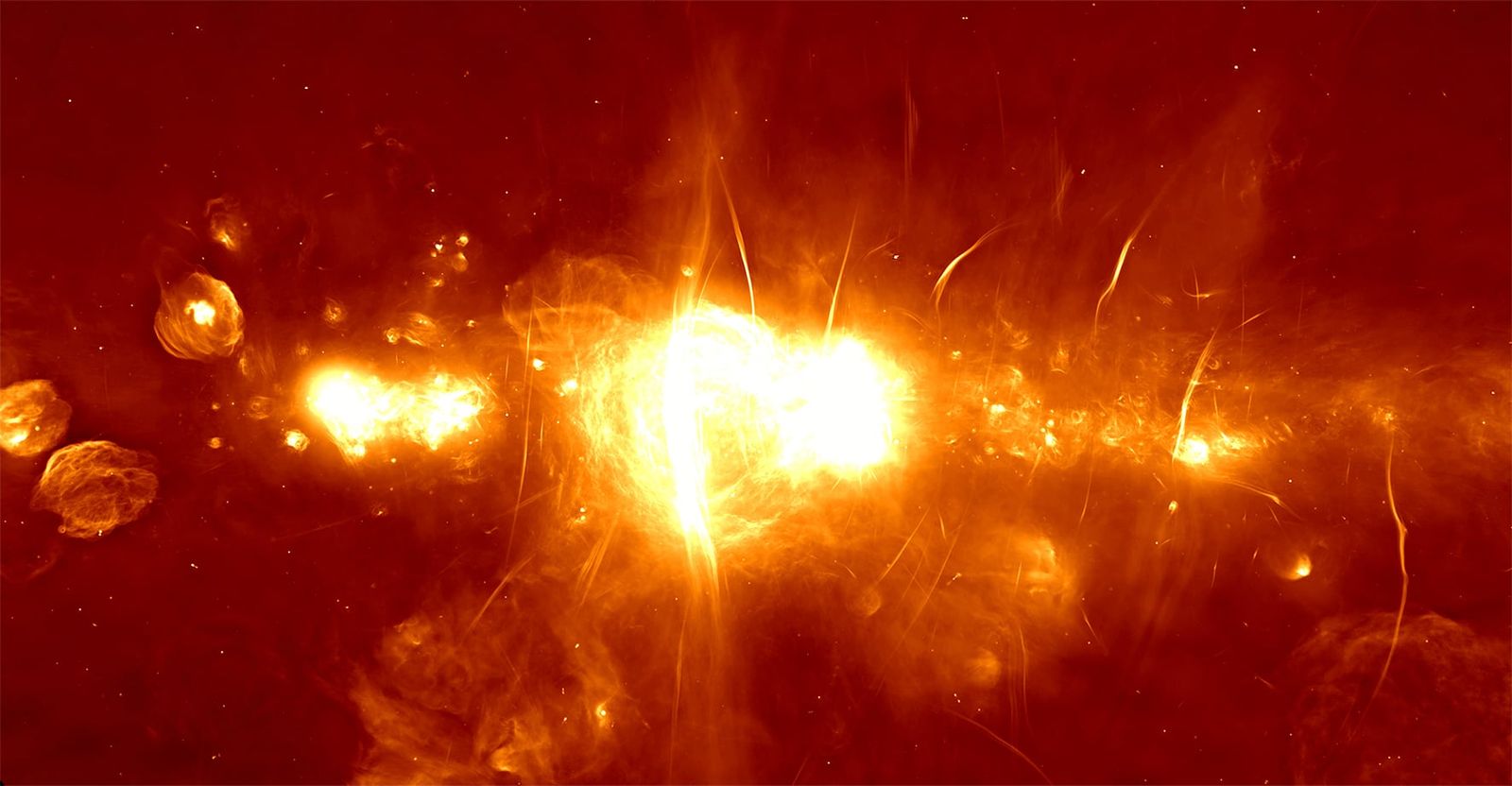
Throughout the cosmos, some of the most radiant spectacles appear when black holes consume surrounding matter and fling twin beams of high-speed radiation into deep space. When one of those energetic columns happens to aim directly along the line of sight to an observer, relativistic effects cause the beam to shine with extraordinary brilliance, producing what astronomers classify as a blazar.1 These colossal engines normally originate from supermassive black holes at the centers of distant galaxies, positioned millions or billions of light-years away from the Milky Way.1 Because of those vast cosmic distances, resolving the physical processes that launch such powerful outflows has remained an enduring challenge for observational astronomy. For decades, theorists proposed that smaller, stellar-mass counterparts should also exist within our own galaxy, yet astronomers lacked a confirmed specimen pointing its outflow toward Earth.1
Studying these scaled-down systems provides an accessible natural laboratory for understanding how compact objects pull in matter and propel high-speed particles into space.1 Supermassive blazars change over timescales spanning millions of years, which prevents observers from watching entire structural cycles or evolutionary shifts unfold. In contrast, smaller stellar systems operate on dynamic schedules that develop over days or weeks. For a binary system to function as a miniature blazar, a sequence of physical processes must align in a precise orientation. A compact black hole must share a tight orbit with a companion star, drawing stellar material into an accretion disk swirling toward the event horizon.1 Extreme gravitational forces and twisted magnetic fields then direct a fraction of the infalling matter away from the poles, accelerating particles to velocities approaching the speed of light in twin opposing jets.1 Finally, the orientation of the binary pair must align so that one of those jets points directly toward Earth, allowing relativistic beaming to amplify the oncoming radiation.1
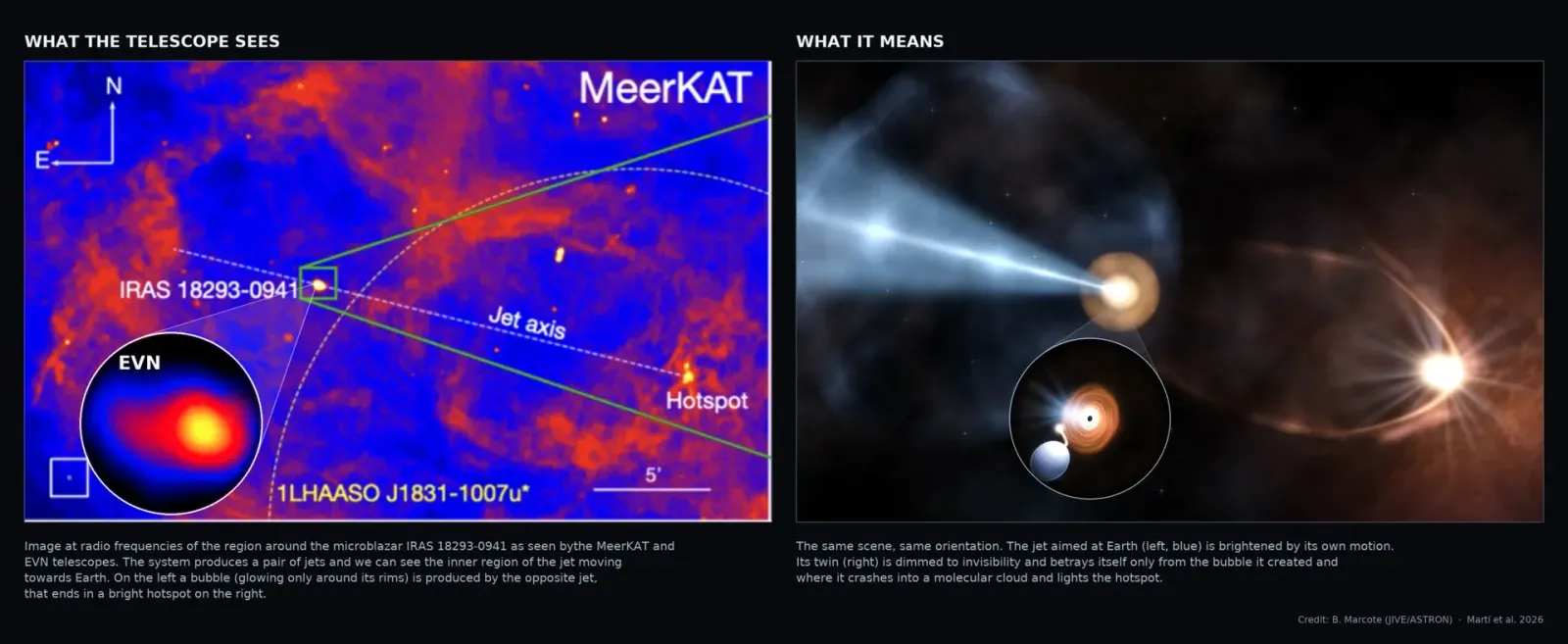
An international research collaboration led by astronomers in Spain, the Netherlands, and Argentina has now identified the strongest candidate yet for such an object within the Milky Way.1 The researchers analyzed a binary system designated IRAS 18293-0941, reporting their results in a study accepted for publication in the journal Astronomy and Astrophysics.1 According to the paper, the system sits roughly 12,000 light-years from Earth in our home galaxy, shielded from direct optical view by a thick veil of interstellar dust.1 In this binary arrangement, a stellar-mass black hole completes an orbit around a giant, hot star once every 11 days, drawing stellar gas across the orbital gap and ejecting two opposing columns of radiation into the surrounding environment, with one jet flaring toward Earth.1 The first author of the study, Josep Martí at the University of Jaén in Spain, identified the system as the strongest candidate yet found for a microblazar.1
What makes a microblazar so difficult to find?
Microblazars remain exceptionally rare because binary systems pass through this active jet-producing stage for only a brief window of their total stellar evolution. A companion star must swell to a size that allows its outer layers to spill across the gravitational boundary toward the black hole, an evolutionary state that lasts for a relatively short duration before stellar fuel depletes or the companion sheds its envelope. Josep Martí noted that the microquasar phase of evolution is very brief, making it difficult to catch a system at the exact moment when active accretion occurs.1 In addition to that narrow evolutionary timeframe, the geometric probability of an ejection beam aiming precisely along the line of sight to an observer is tiny. Most binary black holes launch their relativistic outflows at oblique angles across the galaxy, appearing as microquasars rather than microblazars.1
Finding a system in this configuration requires catching it during the brief span when accretion remains vigorous and pointing directly at terrestrial detectors. Theorists predicted that authentic microblazars would exhibit distinct physical traits that set them apart from standard binary stars.1 These expected signatures include powerful emissions spanning the electromagnetic spectrum, rapid variability in brightness, and a noticeable thermal hotspot where the rear jet collides with the interstellar medium on the far side of the system, opposite the direction of Earth.1
How did astronomers detect IRAS 18293-0941 through interstellar dust?
Astronomers detected IRAS 18293-0941 by combining observations from ground-based optical and radio observatories across multiple continents to pierce through cosmic dust.1 Because thick dust clouds in the galactic plane absorb visible light, optical instruments alone cannot reveal the underlying binary structure. The authors assembled observational data from the Calar Alto Astronomical Observatory in Spain, the European VLBI Network of radio dishes, and the MeerKAT radio telescope array located in South Africa, alongside archival records collected by the Very Large Array in New Mexico.1

By linking these instruments together through high-resolution radio interferometry, the researchers resolved fine spatial details around the black hole and mapped its energetic output across various frequencies. The observational data confirmed that IRAS 18293-0941 produces broad emissions across the electromagnetic spectrum, matching theoretical expectations for relativistic outflows.1 Furthermore, the radio images revealed an energized zone situated behind the binary pair, consistent with theoretical models where an opposing, backward-facing beam plows into interstellar gas and creates a localized shock region.1
Why does this candidate lack the rapid flicker of other blazars?
A dense surrounding shroud of interstellar gas may smooth out the brightness fluctuations that would otherwise produce a rapid flicker in IRAS 18293-0941.1 In standard blazar models, an oncoming jet produces fast variability, meaning its brightness changes substantially over brief intervals because relativistic beaming, also known as Doppler boosting, amplifies minute shifts in emitted energy.1 In the case of IRAS 18293-0941, the observations revealed broad spectral emission and evidence of an opposing interaction zone, but the signal did not display the rapid variability that theorists anticipated.1 Josep Martí suggested that the dense cloud of gas enveloping the binary system acts as a physical buffer, diffusing rapid energy pulses and flattening the light curve before the radiation escapes toward terrestrial telescopes.1
These observational findings establish IRAS 18293-0941 as a compelling candidate while leaving its ultimate classification provisional. The identification rests on circumstantial alignment and energy signatures while lacking the rapid brightness shifts considered a hallmark of beamed relativistic emission. Additionally, whether the observed patch behind the binary represents a genuine thermal hotspot from the opposing jet remains an open empirical question requiring further high-resolution analysis.1 Like many studies relying on multi-telescope radio datasets, the interpretation depends on assumptions about the density of the local interstellar medium and the geometry of relativistic particle beams.
If future observations confirm the identity of IRAS 18293-0941, the system will offer researchers an unprecedented view of extreme particle acceleration within our own galaxy. Theoretical astrophysicist Kinwah Wu at University College London noted that the observed signatures of interaction between the jets and ambient material indicate that particle interactions occur naturally within the surrounding medium.1 Astronomer Svetlana Jorstad at Boston University described the study as a comprehensive analysis of relativistic outflows.1 Astronomer Itumeleng Monageng at the University of Cape Town observed that such systems could represent an overlooked mechanism capable of generating some of the highest-energy emissions observed in the cosmos.1 Study co-author Pedro Luque-Escamilla at the University of Jaén and colleagues are currently conducting follow-up investigations to verify whether the rear feature is an authentic hotspot, testing how stellar-mass black holes energize the space around them.1
What this rests on
29 sentences trace to 1 source.
-
1
SW
Sarah Wild Document · livescience.com · 6 Oct 2026 Earth is in the firing line of a strange new type of cosmic object, astronomers say See the source