Tougher fat capsules keep genetic vaccines stable without deep freeze
A computational method finds additive recipes that preserve lipid envelopes at room temperature for a year, easing distribution to clinics that lack specialized freezers.

Messenger RNA vaccines transformed global immunization by instructing human cells to produce target antigens, but their reliance on extreme cold remains a persistent logistical hurdle.1 In regions without dependable electricity or dedicated freezing equipment, maintaining an unbroken chain of sub-zero transit is exceptionally difficult, causing vials to spoil if power flickers or transport is delayed.1
Inside a living cell, messenger RNA functions as a temporary template for assembling proteins. Because cells naturally break down these molecular messages within hours, the strand possesses a delicate chemical structure that degrades rapidly when exposed to warmth.1 To protect the sequence during transport and ferry it across cell membranes, scientists encase the genetic strand in microscopic bubbles of fat known as lipid nanoparticles.1 Even inside these oily shields, ambient warmth can cause the fatty capsules to clump together, rupture, or leak, permitting water to reach the genetic core and sever its molecular bonds. Freezing the liquid locks the fluid in place and arrests those destructive chemical reactions until the medicine is thawed for injection.
Chemical engineers at the Massachusetts Institute of Technology have now identified an additive formula that protects these oily spheres against heat, enabling messenger RNA vaccines to withstand warm environments for months.1 Published in Nature Biotechnology on September 28, 2026, the study describes a computational approach that selected combinations of stabilizing compounds capable of preserving the lipid particles without diminishing their ability to instruct cells.1
Standard messenger RNA vaccines must be maintained between minus 20 and minus 80 degrees Celsius to avoid degradation, creating severe distribution barriers in areas that lack specialized refrigeration units.1 The newly designed formulation permits the particles to remain intact at room temperature for up to one year, or at 37 degrees Celsius, equivalent to nearly 100 degrees Fahrenheit, for two months.1
Why do lipid envelopes fall apart outside the freezer?
Lipid nanoparticles break down in warmer environments because the tiny fat droplets lose their structural stability, allowing their oily membranes to fuse and expose the fragile genetic molecules nestled inside. When those fatty bubbles destabilize, the genetic cargo is quickly degraded by moisture and enzymes, rendering the vaccine ineffective before it ever enters a patient.
To prevent that structural breakdown, formulation scientists have experimented with adding excipients, which are inactive chemical ingredients such as sugars, salts, or polymers that cushion and stabilize active pharmaceutical ingredients.1 Senior authors Ana Jaklenec and Robert Langer, the David H. Koch Institute Professor at the Massachusetts Institute of Technology, had previously engineered polymer-stabilized lipid nanoparticles capable of enduring higher temperatures.1 However, those earlier nanoparticles differed in composition from the formulations approved by the Food and Drug Administration for commercial Covid-19 vaccines developed by Moderna and Pfizer.1
When the researchers attempted to transfer the stabilizing additives they had previously used into the approved commercial lipid formulations, the mixture failed to protect the particles.1 Jaklenec noted that the team repeatedly tried to screen excipients that had proven successful in their past work, but the conventional trial-and-error strategy stalled.1
How did a machine-learning algorithm find the right recipe?
A machine-learning algorithm pinpointed the optimal stabilizing recipe by evaluating small batches of experimental results and predicting effective ingredient ratios without requiring thousands of physical tests.1 To accelerate their search, the chemical engineers partnered with Mina Konakovic Lukovic and colleagues at the MIT Computer Science and Artificial Intelligence Laboratory, who developed a predictive model capable of learning from compact datasets.1 Konakovic Lukovic noted that while the laboratory had deployed its algorithms for automated engineering designs, it had not previously applied them to biological challenges such as vaccine preservation.1
The team began by screening nearly 50 excipients that had already received regulatory approval from the Food and Drug Administration.1 To assess how well each additive shielded the genetic core, the researchers packaged messenger RNA encoding firefly luciferase, an enzyme that produces bioluminescence inside living cells, and measured the intensity of light emitted after the particles entered cell cultures.1
From that initial screening, the researchers identified five promising excipients and instructed the algorithm to predict the precise proportions that would best stabilize lipid nanoparticles modeled on the formulation used by Moderna.1 Lead authors Jinbi Tian, a graduate student, and Khanh Tran, a postdoctoral researcher, tested two predicted formulations at a time in cell cultures, fed the resulting performance data back into the system, and allowed the algorithm to refine its subsequent recommendations.1 Tran noted that before adopting the computational method, the team had spent several months manually testing combinations and prescreening candidates without achieving complete stability.1 Guided by the predictive model, the selection process converged on a successful formulation in only a few weeks.1
What happened when the heat-tolerant vaccines were tested in animals?
Mice immunized with the heat-exposed formulations mounted an antibody response equivalent to the immune protection generated by fresh vaccines modeled on the commercial Moderna shot.1 To prepare the particles for thermal testing, the researchers packaged coronavirus antigens inside the optimized lipid envelopes and removed moisture through a vacuum drying process.1
The dehydrated particles were then stored in thermal chambers at 37 degrees Celsius for two months or at ambient room temperature for an entire year.1 Even after prolonged exposure to elevated temperatures, the vaccines retained their potency and elicited strong immune defenses when administered to mice.1
The researchers also applied the predictive algorithm to lipid nanoparticles matching the design used by Pfizer for its Covid-19 vaccine.1 The algorithm determined that the same five excipients could protect the Pfizer-style particles when blended in a different ratio, indicating that the computational strategy can adapt to distinct lipid chemistries.1 The team reported that once an optimal stabilizing mixture is established for a specific lipid carrier, that carrier can be adapted to deliver diverse messenger RNA payloads.1
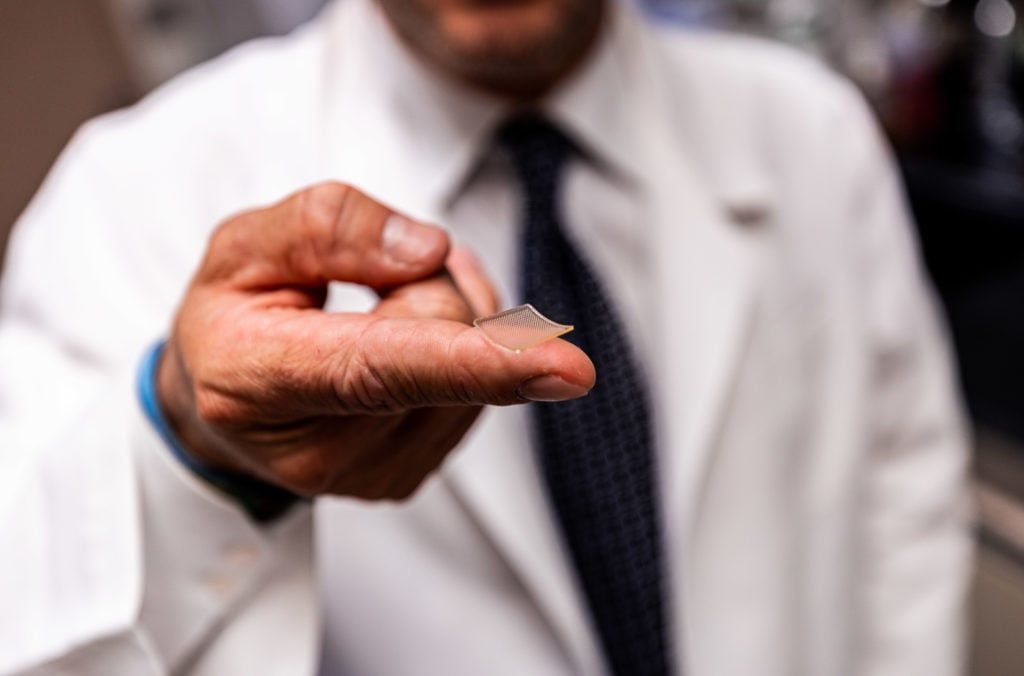
Beyond conventional injections, the team integrated the heat-resistant formulation into solid microneedle patches designed to deliver coronavirus antigens through the skin.1 These patches feature hundreds of microscopic needles that dissolve upon contact with the skin to deposit the vaccine, generating an immune response in mice that matched the protection observed from standard needle injections.1 Tian pointed out that the approach could expand the deployment of messenger RNA vaccines as well as controlled-release therapies and alternative drug-delivery devices.1
These results reflect preclinical measurements conducted in laboratory cell cultures and rodent models rather than completed human clinical trials. While mice developed high antibody levels after receiving the rehydrated particles, immune responses in small animals do not guarantee identical efficacy or safety in people. The stability assessments examined vacuum-dried vaccines held under steady laboratory temperatures, leaving unaddressed how the dry formulations withstand fluctuating humidity and physical vibration during real-world transit. Furthermore, the experiments focused on coronavirus targets and bioluminescent reporter genes, meaning additional validation is required to confirm whether larger therapeutic RNA sequences will retain equal stability within the modified lipid envelopes.
Removing the requirement for deep-freeze storage would simplify vaccine logistics across tropical and low-income areas, reducing shipping costs and preventing doses from spoiling during distribution.1 The researchers plan to test whether this formulation strategy can stabilize genetic vaccines targeting other infectious pathogens as well as personalized cancer treatments.1 Subsequent investigations will need to evaluate the safety of the excipient ratios in human trials and determine whether the vacuum drying technique can be scaled efficiently within commercial manufacturing facilities.
What this rests on
34 sentences trace to 1 source.
-
1
S
scientificinquirer Document · scientificinquirer.com · 6 Oct 2026 New Formulation Helps RNA Vaccines Withstand High Temperatures See the source