Ancient Polynesian voyages left a surprising genetic connection across thousands of miles
Centuries of open-ocean seafaring shaped modern genomes from Hawaii to Easter Island, revealing unexpected shared ancestry and altering inherited disease risks across the Pacific.
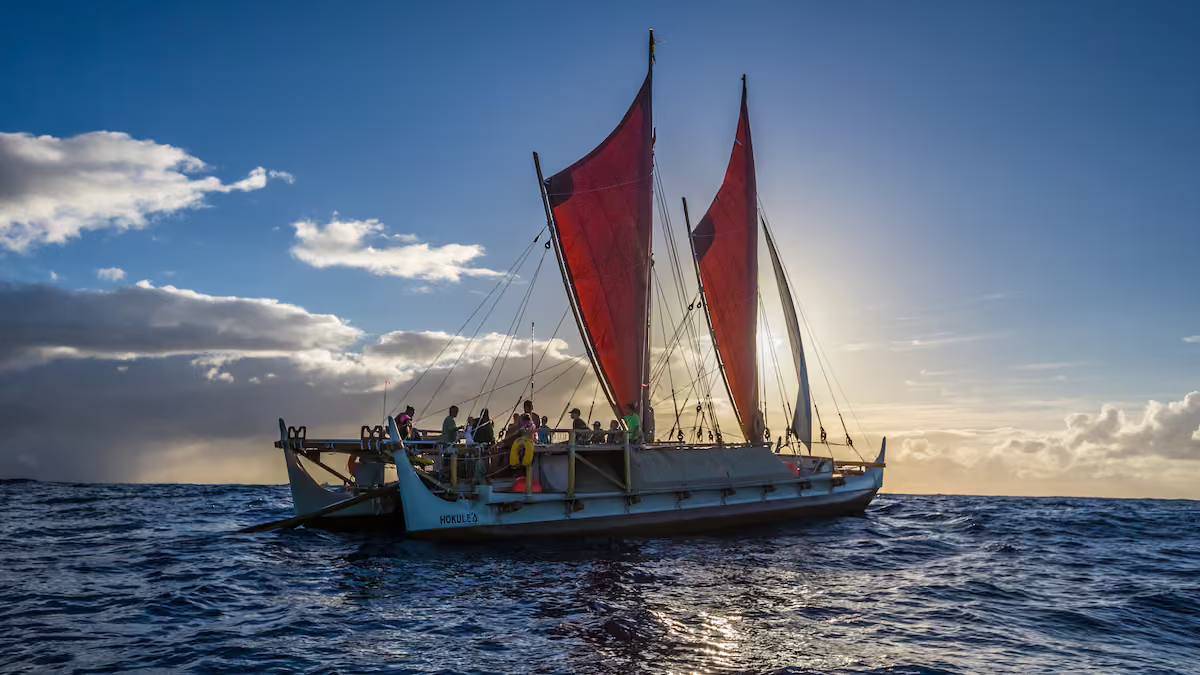
Across the vast expanse of the eastern Pacific Ocean, two tiny landmasses sit separated by roughly 7,000 kilometers of open water.12 Hawaii and Easter Island, known to its Indigenous inhabitants as Rapa Nui, represent two of the most isolated settled places on the planet.12 Each sits thousands of kilometers away from its nearest inhabited neighbor.2 For generations, traditional models of Pacific migration suggested that populations living at these extreme geographical corners would be among the most genetically distant communities in Polynesia.
Instead, a massive genomic study reveals that Indigenous people living on these opposite edges of the ocean share an unexpected ancestral bond. The finding alters historical models of how voyagers explored and populated the Pacific, showing that human travel patterns centuries ago continue to govern the biological inheritance of living communities. At the same time, the ancient voyages left behind a medical footprint that explains why certain severe inherited health conditions appear at unusually high rates on remote islands today.
Understanding how this shared heritage formed requires examining how island settlement actually worked. Voyagers set out across open water in double-hulled canoes, navigating by observing ocean swells, wind patterns, bird flight paths, and the stars.12 When a small group of navigators landed on an uninhabited island, they established a community that carried only a small slice of the genetic variation present in their homeland. If their descendants later launched new expeditions to settle even more distant lands, those new crews carried an even narrower selection of ancestral DNA. Over generations, this repeating sequence created a layered inheritance pattern where the most remote settlements preserved specific, highly concentrated branches of the broader Polynesian family tree.
A study published in the journal Science on October 8, 2026, demonstrates that Native Hawaiians and the Rapa Nui people are more closely related to each other than to any other remote Polynesian population examined.21 Led by researchers including Keolu Fox, an associate professor of anthropology at the University of California San Diego School of Social Sciences, the project analyzed whole-genome sequences from 1,050 individuals across the Pacific.21 The researchers compared genetic data from French Polynesia, including the Austral, Society, Marquesas, and Tuamotu archipelagos, as well as Mangareva, alongside genomic data from Native Hawaiians, Rapa Nui, Samoans, and Tongans.21
How did two distant islands end up sharing ancestors?
The genetic similarity between Hawaii and Rapa Nui stems from a shared ancestral departure point rather than direct shuttling across thousands of miles of ocean. When the research team tested relationships across 2,500 reconstructed genetic trees, Hawaii and Rapa Nui grouped together 61 percent of the time.1 By comparison, Hawaii grouped with Mangareva in roughly 10 percent of the reconstructed trees and with the Marquesas Islands in fewer than 3 percent.1 These statistical trees evaluate shared stretches of identical DNA that get progressively broken into smaller fragments with every passing generation.1
Archaeologists and linguists long viewed the Marquesas as the primary staging ground for the eastward settlement wave.1 The new genomic data indicates that the ancestral lineage that reached Hawaii also passed through Mangareva, linking its early founders directly to the group that ultimately populated Rapa Nui.12 The authors describe this shared seafaring tradition as Holomoana Nui, meaning great ocean voyaging.21 The finding also connects to prior research published in Nature in 2020, which documented prehistoric genetic contact between Polynesian voyagers and Indigenous South Americans around 1200 CE, centuries before European ships entered the Pacific.13
The settlement of the Pacific did not occur as a single one-way event. Rather, ancient navigation involved repeated travel among archipelagoes, carrying people, provisions, and cultural knowledge across vast distances.2 Yet because each outgoing crew represented only a fraction of the population that stayed behind, successive voyages steadily narrowed regional genetic diversity. The researchers compared this compounding dynamic to a set of Russian nesting dolls, where each newly established population held a smaller genetic subset inside the larger ancestral pool.2
Why does ancient navigation affect modern health?
The physical isolation of small founding groups repeatedly magnified rare genetic variations that might otherwise have remained almost undetectable in large continental populations. When a small crew establishes a colony, any rare mutation carried by an individual explorer becomes a much higher percentage of the local gene pool. When descendants experience a sharp population drop, known as a bottleneck, genetic variety shrinks even further.2 In remote eastern Polynesia, the researchers found that these combined founder effects became ten times more pronounced than those observed in other well-known founder populations, such as Finland.12
This concentration has direct consequences for contemporary medicine. In French Polynesia, the study identified three genetic variants linked to autosomal recessive disorders that occur at unusually elevated rates.21 One specific variant sits in a gene called FAN1, which is linked to karyomegalic interstitial nephritis, a progressive condition that often causes complete kidney failure when an individual inherits two copies of the harmful gene.21 The researchers identified this variant in the French Polynesian cohort, yet an evaluation of the international gnomAD database containing more than 800,000 global genomes found no sign of it.21
The absence of these variants from international reference databases highlights a persistent gap in modern clinical genetics. Because global genomic catalogs consist predominantly of individuals of European ancestry, clinicians frequently lack baseline information on which disease-causing variants exist in Pacific Islander populations. Broad administrative categories that group Native Hawaiians and Pacific Islanders into a single demographic bucket often obscure critical genetic distinctions between separate island communities.
What are the limits of the genetic evidence?
The study provides a map of shared ancestral inheritance, but it cannot reconstruct the physical travel paths taken by individual canoes. Showing that Native Hawaiians and the Rapa Nui people share an immediate common ancestral group does not prove that navigators sailed directly between Hawaii and Easter Island. The genomes record common origins and shared founding crews, not the specific geographic routes, intermediate landfalls, or navigational choices made during individual voyages.1
The investigation also does not establish new medical treatments or clinical screening guidelines.2 The findings identify genetic variations that point toward future clinical priorities, but converting those discoveries into targeted healthcare requires extensive subsequent laboratory work and local medical trials. The genetic data reflects the history of sampled communities, and the researchers note that their models depend on assumptions about ancient population sizes, demographic bottlenecks, and generational turnover across hundreds of years.
What comes next for Pacific genomics?
To conduct the research without repeating historical patterns of scientific exploitation, the study was paired with an explicit benefit-sharing structure designed to protect participating Indigenous communities. Fox, who serves as a senior advisor to Variant Bio, helped structure partnerships that treat Indigenous participants as stakeholders rather than mere research subjects.2 The biotechnology company established a benefit-sharing model designating 4 percent of revenue and 4 percent of equity-derived value for partner communities, funding local priorities such as healthcare services, educational programs, data infrastructure, and food sovereignty.2
The long-term goal of the project is to build clinical diagnostic tools that reflect the actual genetic diversity of Pacific populations. Local clinicians, community health workers, and nurses across French Polynesia participated directly in the research effort.2 By documenting how historical voyaging reshaped biology across generations, the research team aims to support more precise diagnostic screenings, particularly for complex conditions such as cancer and kidney disease, ensuring that the legacy of ancient navigation directly benefits living descendants.
What this rests on
26 sentences trace to 3 sources.
-
1
TT
Tudor Tarita Document · zmescience.com · 12 Oct 2026 Scientists Find a Surprising Genetic Link Between Hawaii and Easter Island See the source
-
2
T
today.ucsd.edu Third-party reporting · today.ucsd.edu Polynesian Wayfinding Is Written in the Genomes of Island Populations See the source
-
3
N
nature.com Paper · nature.com Native American gene flow into Polynesia predating Easter Island settlement - Nature Journal article See the source